Meaning & symbolism
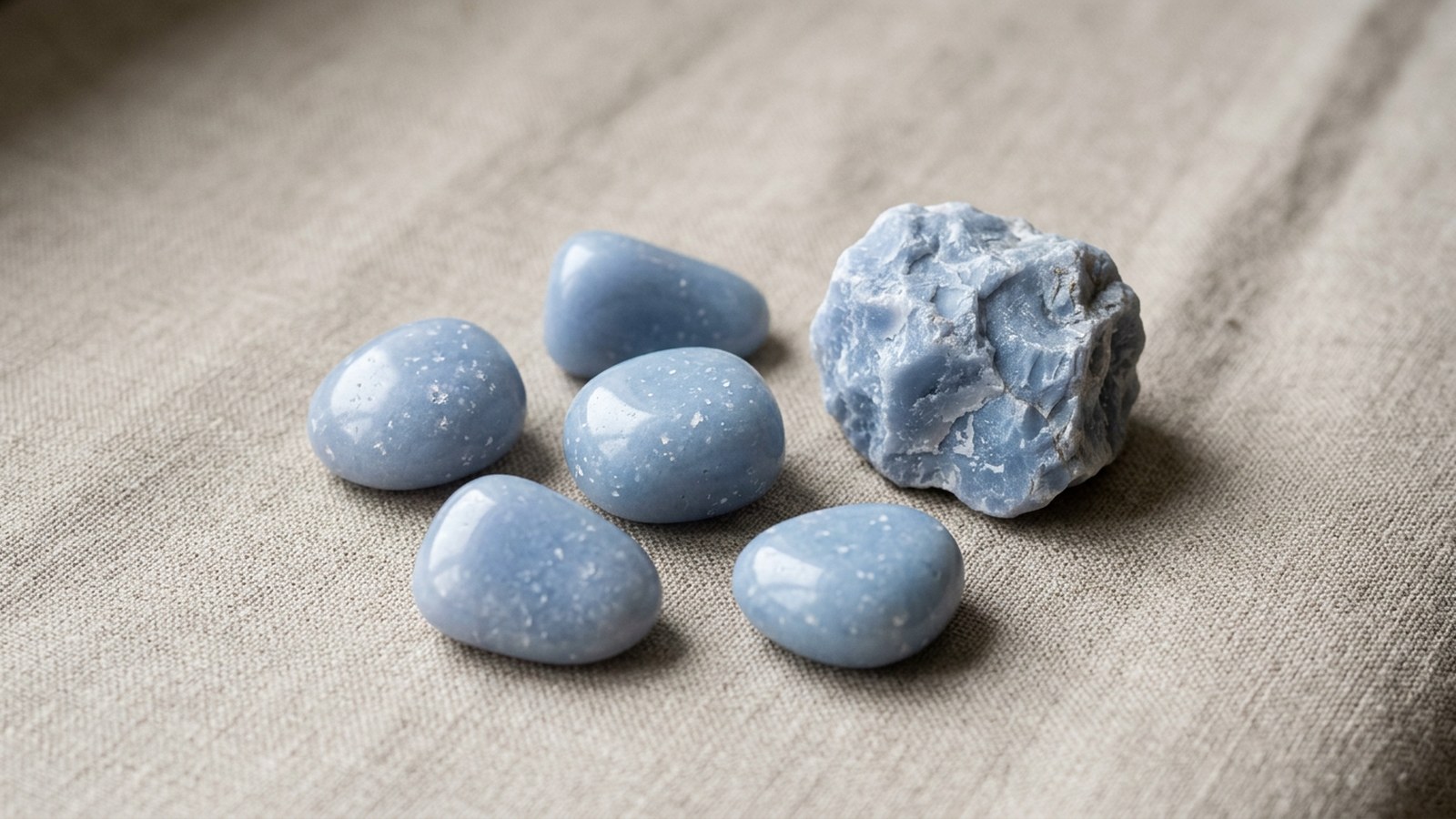
Angelite is the trade name for pale blue anhydrite, a calcium sulfate with no water in its structure. Most material comes from the Casapalca district of Peru, where it grew as nodules in altered limestone. The name appeared in the late 1980s and the stone was identified as anhydrite in Gems and Gemology in 1989. It is not compressed celestite, which is strontium sulfate.
Healing properties
Geology
- Blue anhydrite, orthorhombic
- CaSO4
- Main source: Casapalca, Peru
- About 3 to 3.5 on the Mohs scale, keep dry
Traditional associations
- Calm, kind speech
- Comfort in grief
- Angels and spirit guides
How to use it
Traditionally held before a difficult conversation, worn as a pendant at the throat, kept by the bed to wind down, or rested on the throat or forehead in meditation. These are traditional uses, not medical advice.
Cleansing & care
Soft (Mohs 3 to 3.5) and water sensitive: anhydrite slowly turns into gypsum when wet. No soaking, salt, steam or moon water; dry any splash at once. Cleanse with smoke, sound, moonlight or selenite and store apart from harder stones.
Questions & answers
No. Anhydrite slowly absorbs water and turns into gypsum, so keep angelite dry and dry any accidental splash straight away.