Meaning & symbolism
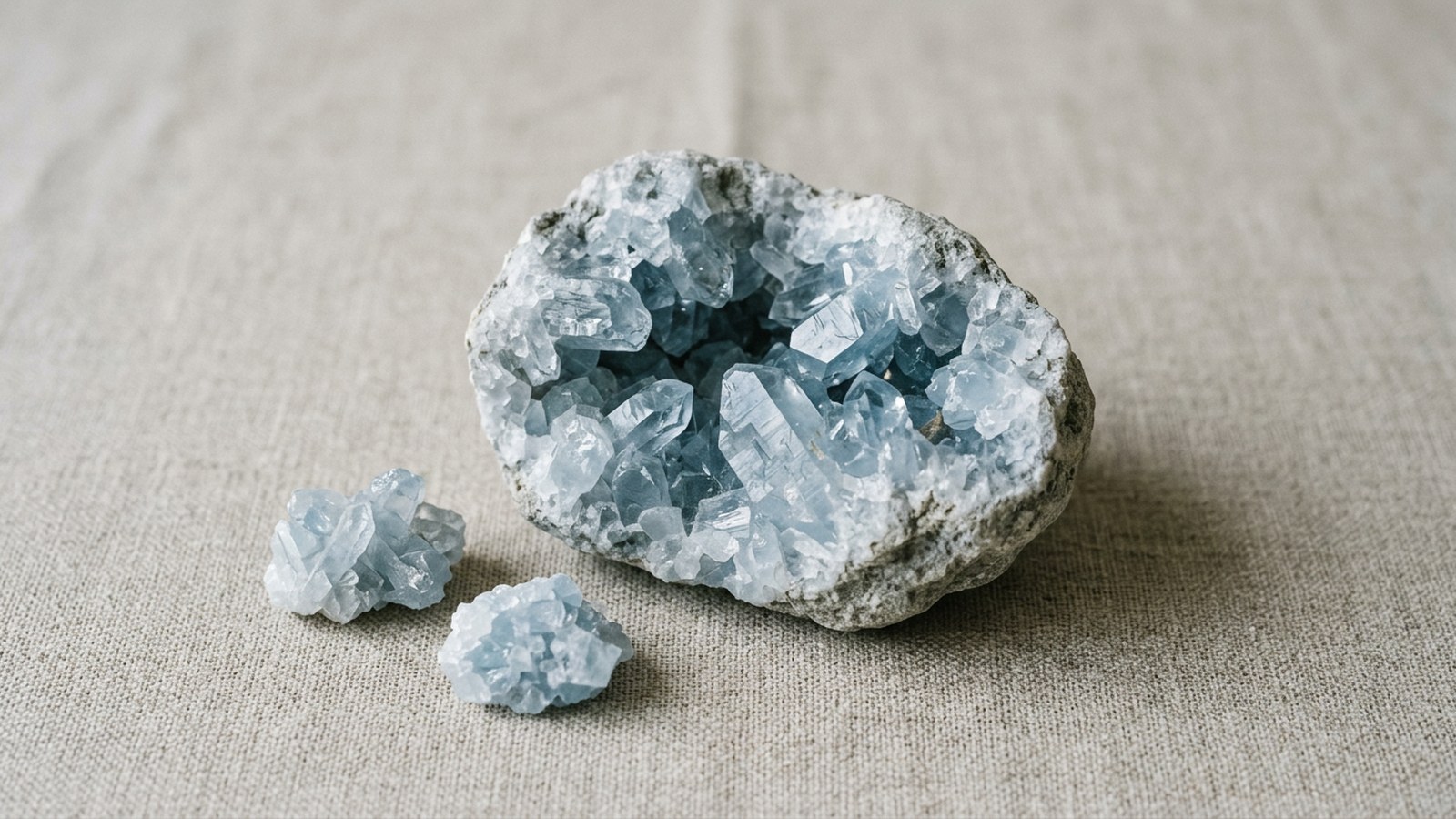
Celestite (IMA name celestine) is a strontium sulfate of the barite group, orthorhombic, usually tabular or bladed crystals lining geodes in limestone, dolomite and evaporite beds. Named by Abraham Gottlob Werner in 1798 from the Latin caelestis, heavenly. Main sources: Sakoany in Madagascar, Sicily (with native sulfur), Mexico, Poland, England, and Crystal Cave on South Bass Island, Ohio. It is the main commercial ore of strontium, used for the red in fireworks. Specific gravity about 3.96, noticeably heavy for its size.
Healing properties
Geology
- Strontium sulfate, SrSO4, orthorhombic
- Hardness 3 to 3.5, perfect cleavage
- Specific gravity about 3.96
- Blue from colour centres, fades in sunlight
- Barite group
How to use it
Traditionally kept on a nightstand for calmer evenings and dream recall, held during meditation, or placed on a desk before difficult conversations. Linked with the throat, third eye and crown chakras. These are traditional uses, not medical advice.
Cleansing & care
Soft (Mohs 3 to 3.5) with perfect cleavage, slightly soluble in water. Keep out of direct sunlight, which bleaches the blue permanently. Brief cool rinse only, never soak, never salt. Dust with a soft brush, store apart from harder stones. Natural strontium is stable, not radioactive; do not ingest or use for direct elixirs.