Meaning & symbolism
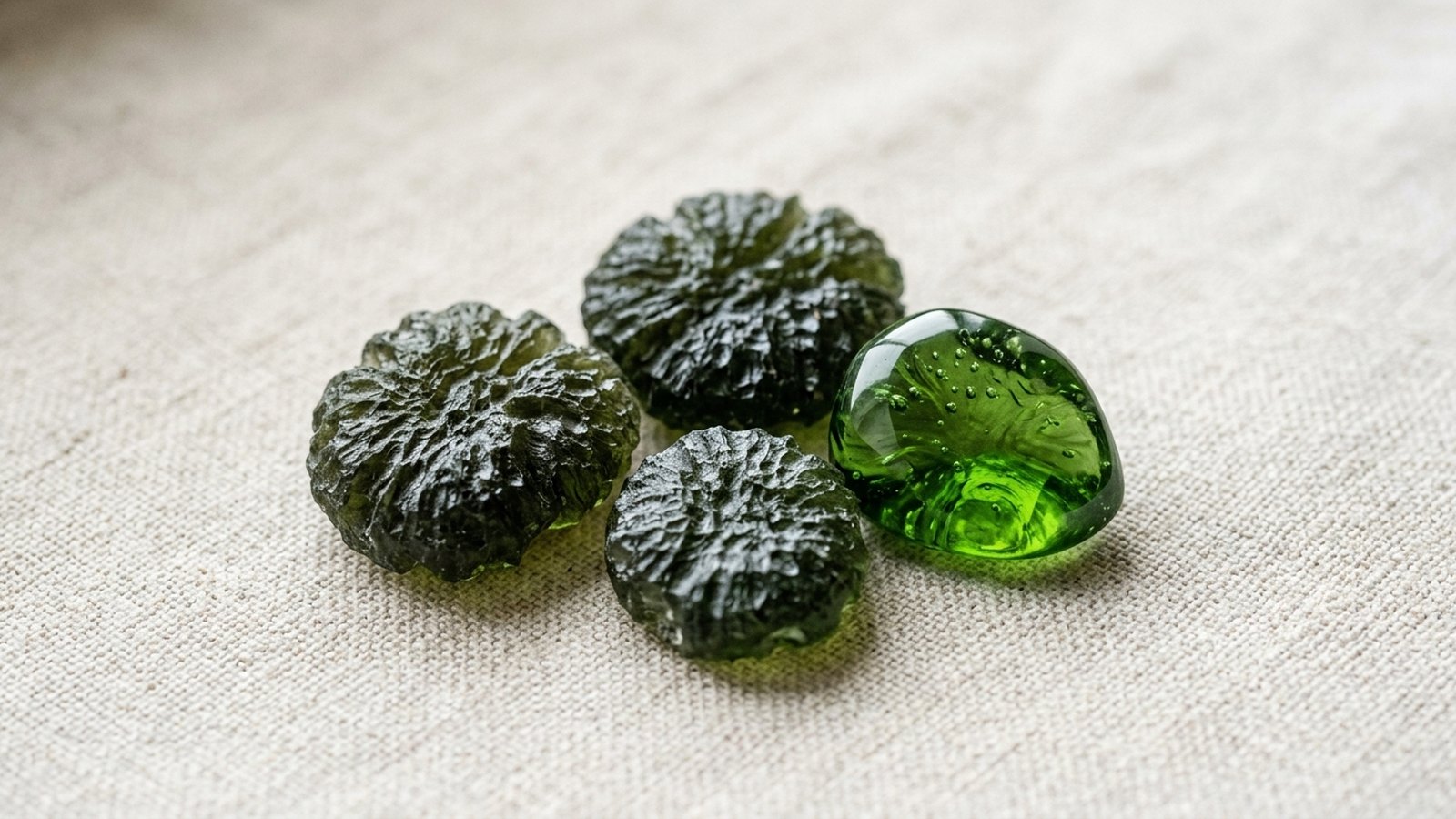
Moldavite is a tektite, a natural glass formed about 14.8 million years ago when an asteroid struck what is now Bavaria and flung molten surface sediment 250 to 450 kilometres east. It cooled in flight and landed as glass, almost entirely within the modern Czech Republic, along the river the Germans called the Moldau and the Czechs call the Vltava.
Because it is a glass it has no crystal lattice at all, which makes it the one piece on most shelves that is not, strictly speaking, a crystal. Its closest relative in the shop is obsidian, the difference being that obsidian was made by the Earth and moldavite by something arriving from outside.
In tradition it is the Stone of Transformation, and unusually for this field its reputation is unflattering: it is described as an accelerant rather than a support, associated with change that arrives faster and less comfortably than expected.
Healing properties
Transformation
- Traditionally called the Stone of Transformation
- Described as an accelerant rather than a support
- Associated with sudden change and breaking pattern
Heart and higher chakras
- Placed at the heart before the crown in tradition
- Extended upward through the third eye and crown
- Linked with Scorpio and Aquarius
Genuinely rare
- Found almost only in the Czech Republic
- All of it formed in a few minutes 14.8 million years ago
- The most counterfeited stone in the trade
How to use it
Start small. Hold it in meditation for a few minutes rather than an hour, sit down while you do, and avoid wearing it to sleep in the first weeks.
The one piece of advice everyone agrees on is to keep a grounding stone in the other hand or pocket, such as black tourmaline, smoky quartz or hematite. Worn as a pendant it sits near the heart, which is where tradition places it.
Cleansing & care
Moldavite is a glass at Mohs 5.5 to 6, softer than household dust, so it scratches and chips easily. Store it separately in a soft pouch, never loose in a bowl with quartz.
It is chemically durable and a brief rinse in cool water will not harm it, but never soak it in salt water and never scrub it: the wrinkled etched surface is the whole value of the piece. Cleanse with smoke, sound or moonlight rather than salt or sun.
Questions & answers
Not in the mineralogical sense. Moldavite is a natural glass, so its atoms have no repeating lattice at all. It is still widely used in crystal practice, but it is technically a tektite rather than a crystal.