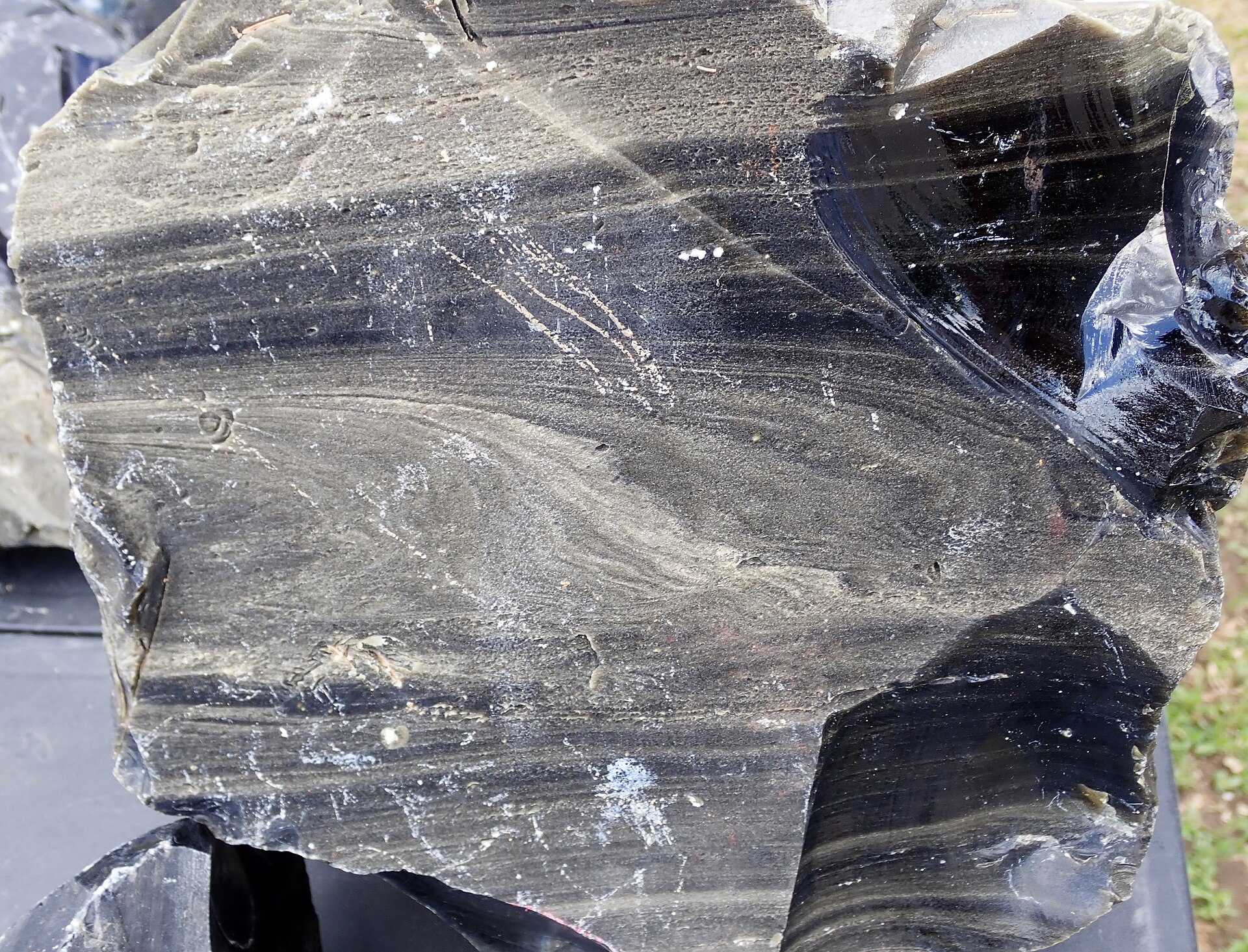
Few stones carry the weight of the earth quite like obsidian. Glossy, jet black and cool to the touch, it looks less like a gem and more like a piece of frozen night. If a shard has found its way into your hand and you want to understand the obsidian meaning behind that mirror black surface, here is a grounded, practical guide to what it is, what it has long symbolised, and how to live with it.
What obsidian is
Obsidian is not a crystal at all. It is a natural volcanic glass, born when silica rich lava cools so fast that its atoms never arrange into an ordered crystal structure. Because it lacks that internal lattice, mineralogists class it as a mineraloid rather than a true mineral. Its composition is dominated by silicon dioxide, usually more than seventy percent, the same SiO₂ that builds clear quartz, only here it is glass rather than crystal.
It sits around 5 to 5.5 on the Mohs hardness scale, softer than quartz and, more importantly, brittle. Obsidian breaks with a smooth, curved conchoidal fracture that can leave edges sharper than surgical steel. That quality is not folklore. For thousands of years people knapped obsidian into blades, arrowheads and scrapers, and its edges remain among the finest ever worked by human hands. Holding a polished piece, it is easy to feel why early cultures treated this glassy stone as something powerful.
The meaning of obsidian
The meaning of obsidian has always circled two ideas: protection and truth. As a dark, dense stone it is one of the classic grounding companions, valued for the sense of a steady floor beneath the feet. Traditionally it is reached for when life feels scattered or exposed, a symbolic shield placed between yourself and whatever feels draining.
The second theme is reflection, in every sense of the word. Because polished obsidian returns a dim, smoky image, cultures across the world saw it as a mirror for more than the face. The Aztecs named their god Tezcatlipoca the Smoking Mirror, and his obsidian mirror was used in ritual and divination, thought to reveal fate and the unseen. Centuries later an Aztec obsidian mirror even passed into the hands of John Dee, astrologer to Elizabeth I, who used it as a scrying glass. You do not need to share those beliefs to feel the pull of the symbol. The obsidian spiritual meaning tends to gather around a few honest themes:
- Protection. It is the traditional stone for feeling shielded and self contained, a quiet line drawn around your own space.
- Grounding. Its darkness and weight make it a natural anchor, often kept close during unsettled or overwhelming days.
- Shadow and truth. As a mirror stone, obsidian is linked to honest self reflection, to facing what is usually left in the dark rather than hiding from it.
None of this is medicine. Obsidian is a symbolic and contemplative companion, a prompt for intention rather than a treatment for anything. Held that way, it becomes a small, steady reminder to stand your ground and to look at things as they truly are.
Obsidian and the root chakra
In chakra practice, obsidian is one of the stones most often tied to the root chakra, the energy centre at the base of the spine linked with safety, stability and belonging. Its deep black colour makes the connection intuitive, sitting alongside other dark grounding stones as an anchor for the body. Many people rest a piece at the feet or hold it in the palm during meditation, letting its coolness and weight draw their attention down and steady a busy mind. If you are building a wider practice, you can read more in our guide to the seven chakras and their crystals.
Types of obsidian
Part of obsidian's appeal is how many faces it wears. The plain black form is the most familiar, but a few varieties carry their own character:
- Snowflake obsidian. Black glass dusted with soft grey rosettes of cristobalite, the snowflake obsidian meaning leans toward balance and gentle acceptance, the light patches read as small reminders that nothing stays wholly dark.
- Mahogany obsidian. Streaked with reddish brown from iron, it is often associated with grounded strength and steady, practical energy.
- Rainbow obsidian. Under angled light it flashes bands of colour from fine mineral layers, prized for a softer, more hopeful spin on the same protective stone.
Whichever form draws you, the core obsidian crystal meaning of protection and honest reflection runs through them all.
How to use obsidian
Obsidian is a straightforward stone to bring into daily life. A few simple ways to work with it:
- Carry it. Slip a tumbled piece into a pocket or bag as a grounding touchstone for busy or exposed days. Our guide to carrying and wearing stones has more on keeping one close.
- Place it at the threshold. Obsidian is a traditional favourite near a front door or windowsill, a symbolic guardian for the home. See where to place crystals in your home for more ideas.
- Hold it in meditation. Sit quietly, rest the stone in your palm or at your feet, and let its weight anchor a single intention, perhaps steadiness or courage.
- Use it for reflection. Because it is a mirror stone, obsidian suits quiet journalling or shadow work, sitting with an honest question rather than pushing it away.
Obsidian pairs naturally with other dark, steadying stones such as black tourmaline and hematite, and it appears often in routines for confidence and courage and for moving through grief. Because both are black, cool and sold for protection, obsidian and black tourmaline are mistaken for one another all the time: black tourmaline vs obsidian covers how to tell them apart and which of the two to choose.
Caring for obsidian
Obsidian asks for a little care in return. Because it is a brittle glass around 5 to 5.5 on the Mohs scale, it chips and scratches more easily than quartz, so keep it away from harder stones and hard knocks. A brief rinse under cool water is fine, but avoid long soaks and check our guide to crystals and water before making it a habit.
To reset a piece, gentle methods suit it best. Smoke, sound or a night under the moon are all kind choices, and you can read more in our guide to cleansing and charging crystals. Cared for simply, a single piece of obsidian can stay with you for years, a quiet black mirror reminding you to stay grounded and to see clearly.