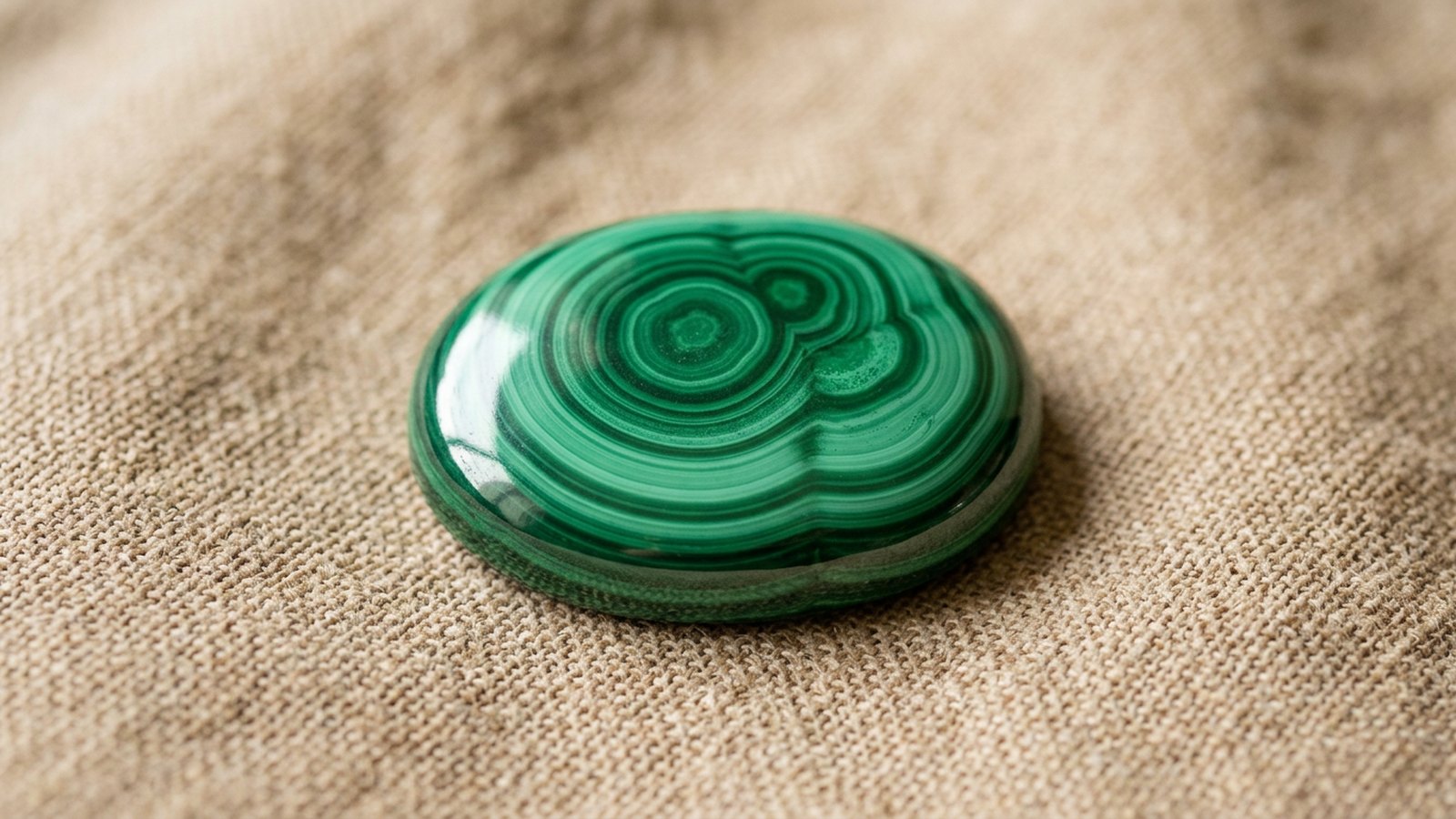
Few crystals wear their character as openly as malachite. Swirled in bands of deep forest and bright spring green, each polished piece looks like a cross section of something alive, rings within rings and eyes within eyes. If a stone like this has found its way into your hand and you want to understand the malachite meaning behind that vivid green, here is a grounded guide to what it is, what it has long symbolised, and how to live with it safely.
What malachite is
Malachite is a copper carbonate mineral, with the formula Cu2CO3(OH)2, and it is that copper content that gives the stone its unmistakable green. It forms slowly in the weathered upper zones of copper deposits, which is why it so often grows alongside its blue cousin azurite. As the mineral builds up in fine layers, it lays down the concentric bands, ripples and bullseye patterns that no two pieces ever quite repeat.
It is a soft stone, only 3.5 to 4 on the Mohs hardness scale, which means it scratches, chips and marks far more easily than quartz. Most malachite on the market today comes from the copper belt of the Democratic Republic of the Congo, though the great historic source was the Ural Mountains of Russia, where whole rooms and columns were once faced with it.
That green has always been useful as well as beautiful. Ground to a powder, malachite was one of the oldest green pigments in painting, and in ancient Egypt it was worn as green eye paint. The Egyptian word for green, wadj, was written with a sign linked to malachite and stood for fresh growth, new life and fertility. When you hold a piece, you are holding a colour that people have treated as a symbol of renewal for thousands of years.
The meaning of malachite
The meaning of malachite has always gathered around change, protection and the emotional heart. More than anything it is known as a stone of transformation, a companion reached for during the messy, in between times of life when something old is ending and something new has not quite arrived.
You do not need any particular belief to feel the pull of the symbol. The malachite spiritual meaning tends to settle on a few honest themes:
- Transformation. Malachite is the classic stone of change, associated with moving through transitions rather than bracing against them.
- Protection. Ancient cultures carried malachite as a guardian stone, a talisman against harm and a symbol of safe passage, especially for travellers.
- Emotional release. It is often described as a stone that helps you look at buried feelings honestly, a prompt for the clearing out that real change asks for.
- Abundance and growth. As a deep, fertile green it has long been tied to prosperity, luck and the natural world.
None of this is medicine. Malachite is a symbolic and contemplative companion, a prompt for intention rather than a treatment for anything. Held that way, it becomes a small green reminder that change, however uncomfortable, is the ground that new growth needs.
Malachite and the heart chakra
In chakra practice, green stones belong to the heart chakra, the energy centre at the middle of the chest linked with love, compassion and emotional balance. Malachite is one of its bolder stones, less about soft romance and more about clearing the heart of old weight so that it can open again.
Many people rest a piece over the chest during quiet reflection, or simply keep it close through a season of change. If you are building a wider practice, our guide to the seven chakras and their crystals shows where each stone belongs, and malachite pairs beautifully with gentler heart stones such as rose quartz and green aventurine when you want to balance its intensity with something softer.
How to recognise real malachite
Part of loving malachite is learning to read it. Genuine malachite shows those flowing, uneven bands of light and dark green, often with soft circular eyes, and every piece is different. It feels noticeably cool and heavy in the hand for its size, a clue to its dense copper content.
The most common thing sold as malachite is reconstituted stone, real malachite powder bound with resin, along with dyed and moulded polymer imitations. These tend to look too perfect, with bands that are suspiciously even or that repeat like a printed pattern, and they often feel warm and light rather than cool and dense. A very cheap piece with a flawless, regular swirl is always worth a second look. Blue-green pieces sold as malachite are often mixed with chrysocolla, and my guide to chrysocolla vs malachite explains how to tell the two apart by weight and pattern. If you enjoy telling stones apart, our guide on how to tell if a crystal is real or fake covers the simple checks.
How to use malachite
Malachite is a rewarding stone to bring into daily life, as long as you treat it with a little respect. A few simple ways to work with it:
- Wear it as polished jewellery. A sealed, polished malachite pendant or ring sits comfortably against the skin and keeps the stone near the heart. Our guide to carrying and wearing stones has more ideas.
- Hold it during reflection. Rest a tumbled piece in your palm or over your chest when you are sitting with a decision or a change. See meditating with crystals to build a simple practice.
- Keep it where change is happening. A piece on the desk during a new job, or by the door as a traveller's stone, turns the symbol into a daily reminder.
- Set a clear intention. As a stone of transformation, malachite suits journalling through a transition, sitting with what is ending and what wants to begin.
Malachite also very often grows alongside its blue cousin azurite, and when the two are intergrown solidly enough to polish you get azurite malachite, a single rock holding both minerals mid-transformation. A blue and green piece sold as lapis and malachite is usually this stone, since lapis never grows with malachite; the two are paired by hand, and I explain that combination in lapis lazuli and malachite. Because it is a copper mineral, avoid breathing in dust from raw or unpolished pieces, and wash your hands after handling rough stone. Well finished, sealed malachite is safe to wear and hold.
Caring for malachite safely
Malachite asks for real care in return, more than most stones. It is soft, so keep it away from harder crystals that can scratch it, and away from knocks that can chip the polish.
Most importantly, keep malachite out of water. Because it is a copper carbonate, contact with water, and especially acidic or salty water, can let copper leach from the stone, which both damages the surface and makes the water genuinely unsafe. Never soak it, never make a crystal elixir or gem water with it, and never drink water it has sat in. A quick wipe with a soft, barely damp cloth is all it needs, and our guide to which crystals can and cannot go in water explains why this matters.
To reset a piece, choose dry methods. Smoke, sound or a short spell under the moon are all kind and safe choices, and you can read more in our guide to cleansing and charging crystals. Cared for simply and kept dry, a single piece of malachite can stay with you for years, a banded green reminder that you are allowed to change.