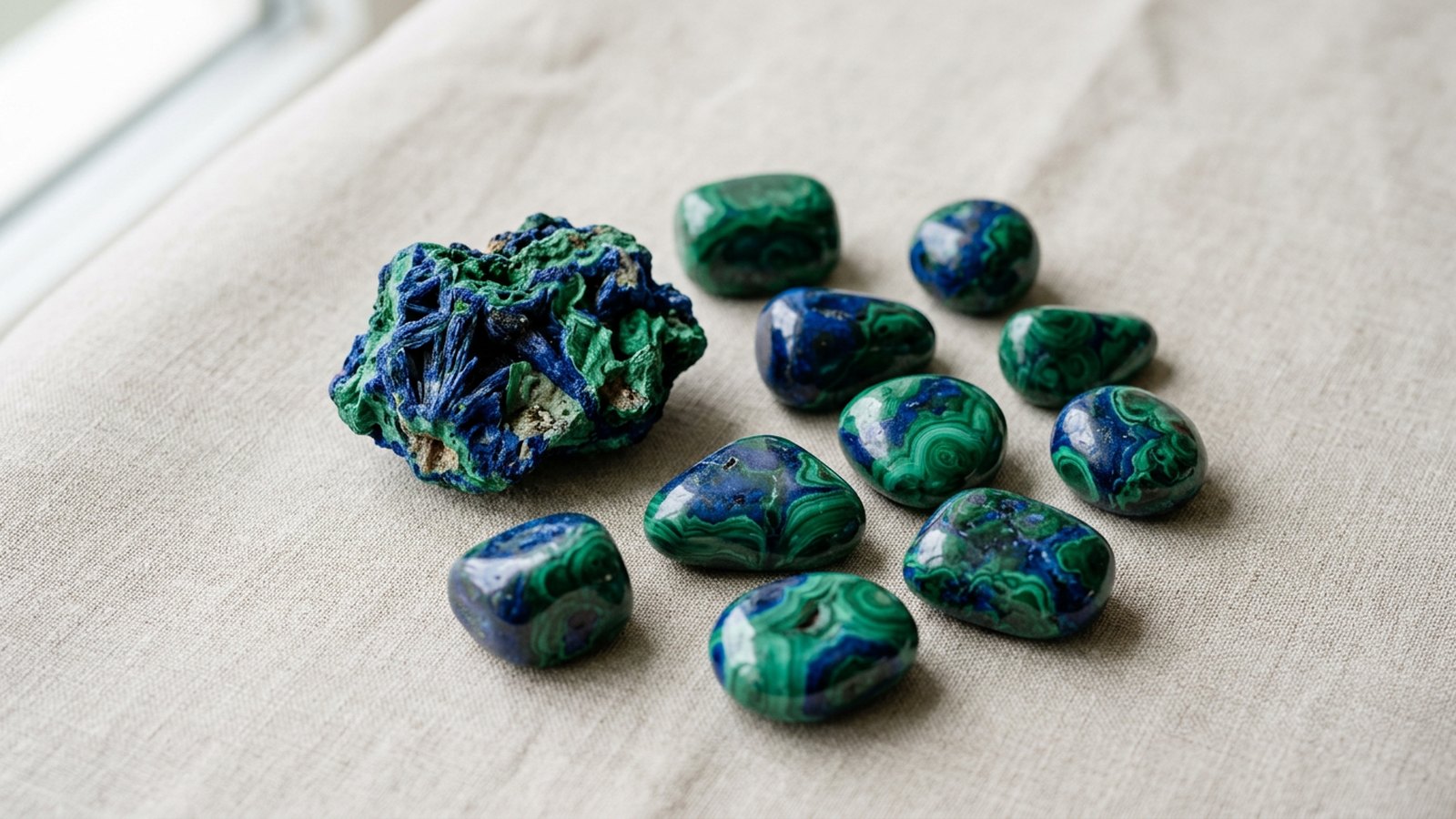
The first time someone handed me a polished slab of azurite malachite, I thought I was looking at a photograph of the Earth taken from very far away. Deep ocean blue pooling into forest green, the two colours swirling into each other with no clean border anywhere. I turned it over looking for the seam, the place where one stone had been glued to another. There is no seam. It is one piece of rock.
That is the whole strangeness of this stone, and the reason it is worth a guide of its own. Azurite malachite is not a pairing that somebody invented. It is two minerals caught in the middle of becoming one another, frozen at the moment a lapidary happened to cut them.
I have come to think of it as a stone for people who are partway through something. Not at the start, not finished, somewhere in the uncomfortable middle where the old shape is still visible and the new one has not settled. If that is where you are, this stone has something to say to you.
Is azurite malachite one stone or two?
Azurite malachite is a single rock containing two separate minerals, blue azurite and green malachite, grown together in the same specimen. They are not the same mineral, but they are close relatives: both are copper carbonate hydroxides formed in the weathered upper zone of copper ore deposits. Azurite is Cu3(CO3)2(OH)2, malachite is Cu2CO3(OH)2. The difference is essentially how much carbonate and hydroxide sit around the copper.
They occur together so reliably that prospectors have used the blue and green staining on rock faces as a field signal for copper for centuries. Where you find one, you very often find the other. What makes the combination stone possible is that some of these intergrowths are solid and dense enough to take a polish, rather than crumbling into powder.
You will also see the material sold as azurmalachite, and occasionally, wrongly, as a single mineral species. It is not a species. It is a rock, in the same way granite is a rock.
Reasons to work with azurite malachite
Azurite malachite is for the stretch of a change where you can see both versions of yourself at once. Most transformation stones are sold on the promise of the finished result. This one is honest about the middle. I reach for it when a person tells me they have already decided something important and still feel like a fraud for not having caught up with the decision yet.
Azurite malachite is for thinking and feeling at the same time, which is harder than it sounds. In tradition azurite belongs to the head, to insight and the third eye, while malachite belongs to the chest, to protection and emotional release. Held together in one piece, they make a quiet argument that a clear analysis and a difficult feeling are not in competition. If you tend to think your way around your emotions, or feel your way around a decision you need to reason through, this is your stone.
Azurite malachite is for the person who keeps almost telling the truth. Both minerals carry old associations with honest speech, azurite with saying the thing clearly and malachite with tolerating the discomfort afterwards. I find it useful before a conversation I have been postponing, less because it grants courage and more because handling something that took ten thousand years to change colour rearranges my sense of urgency.
Azurite malachite is also, plainly, for people who love rocks. Some stones ask for ceremony. This one is happy to sit on a desk being beautiful and reminding you what deep time looks like. There is no wrong way to appreciate it.
Azurite malachite meaning and healing energy
Emotional healing. Traditionally this stone is used for feelings that have gone stale: old resentment, a grief that has hardened into a habit, the sort of hurt you have told so many times it has stopped moving. Malachite's reputation is for drawing that material up rather than soothing it, so I would not call azurite malachite a comfortable stone. It is a stone for when comfort has stopped helping.
Spiritual healing. Azurite is one of the classic stones of inner vision, associated with dreams, intuition and the sense that you already know something you have not admitted. The green half keeps that from floating off. In practice people use the combination for the kind of spiritual work that has to survive contact with an ordinary Tuesday.
Mental healing. This is where I find the stone most immediately useful. Azurite has long been used as a study and focus stone, and the combination is often carried for decisions with too many variables. I would not claim it sharpens cognition. What it does, in my experience, is give the hands something to do while the mind stops circling.
Physical healing. Traditional lore links copper minerals to joints, circulation and the liver, and malachite in particular has a long folk association with childbirth and with easing physical tension. Please read that as tradition and nothing more. These are energetic and symbolic practices, not treatment, and they are not a substitute for a doctor. Anything persistent belongs with a qualified professional.
Chakras: third eye (azurite), heart and solar plexus (malachite) Zodiac signs: Sagittarius, Capricorn, Scorpio Element: Water and Earth Numerical vibration: 1 for azurite, 9 for malachite Affirmation: I can see clearly and still be kind to what I see.
The geology: why the blue turns green
Here is the part that most crystal guides skip, and it is the most interesting thing about the stone.
Azurite is unstable. Given water and time, it converts to malachite, and the reaction is simple enough to write down: two units of azurite plus water become three units of malachite plus carbon dioxide. This happens in the ground over geological timescales, and it is why pure, richly blue azurite specimens are rarer and generally more valuable than malachite. Every azurite malachite slab you have ever seen is a snapshot of that conversion in progress.
Mineralogists call the end result a pseudomorph when malachite replaces azurite while keeping the original crystal's outline: a green crystal wearing a blue crystal's shape. Once you know to look for it, you will notice it in museum cases everywhere.
One correction worth making, because it appears on more than one page currently ranking for this stone. The colour difference is not caused by copper being in two different oxidation states. Copper is Cu2+ in both minerals. What changes is the structure around it, the ratio of carbonate to hydroxide groups and the geometry of the oxygen atoms surrounding each copper ion. Same element, different neighbourhood, different colour. Blue and green really are that closely related here.
Both minerals are monoclinic and both sit at 3.5 to 4 on the Mohs scale, which is soft. A steel key will scratch them. Malachite is noticeably denser than azurite, which is one reason a genuine slab feels heavier in the hand than you expect. The names tell their own story: azurite comes through Latin and French from the Persian lazhward, meaning blue, while malachite comes from the Greek malache, the mallow plant, for its leaf green.
Where azurite malachite comes from
The great historical source is Bisbee, Arizona, where the Copper Queen mine produced azurite of a blue so saturated that collectors still name it as a standard. Tsumeb in Namibia is the other legendary locality, famous for crystallised specimens rather than cutting material.
Most azurite malachite in shops today comes from Morocco, which produces a large volume of attractive, well banded cutting rough. The Katanga region of the Democratic Republic of the Congo supplies much of the world's malachite, including the banded material used for boxes and inlay. There are also significant deposits in China, in Australia at Broken Hill, and at Chessy-les-Mines in France, where azurite was mined long enough to earn the old name chessylite.
Historically both minerals were ground for pigment. Azurite was the standard blue of European painting before lapis became affordable, and conservators regularly find medieval and Renaissance skies that have quietly turned green over the centuries. The paint did on a wall what the mineral does in the ground. I find that a lovely thing to know while holding a piece of it.
Caring for azurite malachite, and what will ruin it
This stone is genuinely fragile and genuinely reactive, so this section matters more than it does for quartz.
- Never put it in water. Copper carbonates are attacked by water over time, and soaking will dull the polish and can leach copper. That includes leaving it in a sink, a bath or a glass overnight. Our guide on which crystals can and cannot go in water puts it in the same category as selenite and pyrite, and for once the warning is not folklore.
- Never make a drinking elixir by immersion. Copper carbonate is not something to ingest. If you want the stone's presence in a drink, put it beside the glass, not in it.
- Keep it away from salt, acids and vinegar. Carbonates fizz and pit in acid. Salt cleansing will damage it.
- No ultrasonic or steam cleaners. At Mohs 3.5 to 4 with cleavage, it will not survive either.
- Wash your hands after handling rough or raw pieces, and never sand, grind or drill it dry. Lapidaries cut copper minerals wet for a good reason: the dust is the real hazard, not the polished stone sitting on your shelf.
- Store it out of direct sunlight and away from harder stones that will scratch it.
To cleanse it, use sound, smoke, moonlight or a bed of dry hematite. Our guide to cleansing crystals covers the dry methods, and charging works fine on a windowsill as long as the light is not harsh midday sun.
How to spot a fake or reconstituted piece
This is the question I get asked most often about malachite, and with reconstituted material as common as it now is, it deserves a real answer. Here is what I actually check.
Banding that is too regular. Natural malachite bands are irregular, with eyes, wobbles and interruptions. Reconstituted malachite, made from malachite powder bonded with polymer, tends to show even, repetitive stripes and sometimes a visible grain direction.
Weight and warmth. Real malachite is dense, around four times the weight of water, and feels cold and heavy. A polymer composite feels light and warms quickly in the palm.
The hot pin test, on an inconspicuous spot. Resin smells of burning plastic. Stone does not. Use it sparingly and only on a piece you are willing to mark.
Dyed substitutes. Dyed magnesite and howlite can imitate the blue, but the colour sits in the veins rather than the body, and the hardness is wrong. A genuinely suspicious "Bisbee blue" cabochon at a suspiciously good price is usually a chrysocolla or resin composite.
Price. Good Moroccan azurite malachite is affordable. Bisbee material is not. If the label says Bisbee and the price says Morocco, believe the price.
What to pair it with, and what to skip
Azurite malachite already does two jobs, so it does not need much help. When I do combine it, I reach for clear quartz to keep the signal simple, or for a grounding stone like hematite or smoky quartz when the insight side is running hot and sleep is suffering. For the courage to act on what the stone has shown you, crystals for confidence covers the usual suspects.
What I would skip is stacking it with other heavy emotional excavators. Malachite plus moldavite plus labradorite in one pocket is not a deeper practice, it is a crowded one, and most people who try it report feeling scattered rather than transformed. One difficult stone at a time is plenty.
Practically, keep it away from softer or water sensitive companions in the same pouch, and never store it loose with quartz points, which will scratch it within a week.
A last thought
I keep a small azurite malachite cabochon in a drawer rather than on display, and I take it out when I have stalled halfway through something. It is not a stone that makes the middle of a change comfortable. It is a stone that makes the middle feel legitimate, which is different and, on most days, more useful.
If the blue side is what drew you, look next at the stones of insight and inner vision. If it was the green, malachite on its own is a deeper and more demanding companion, and worth knowing properly. And if you are new to all of this, our guide to using crystals is a gentler place to begin than a stone that is still busy changing colour.