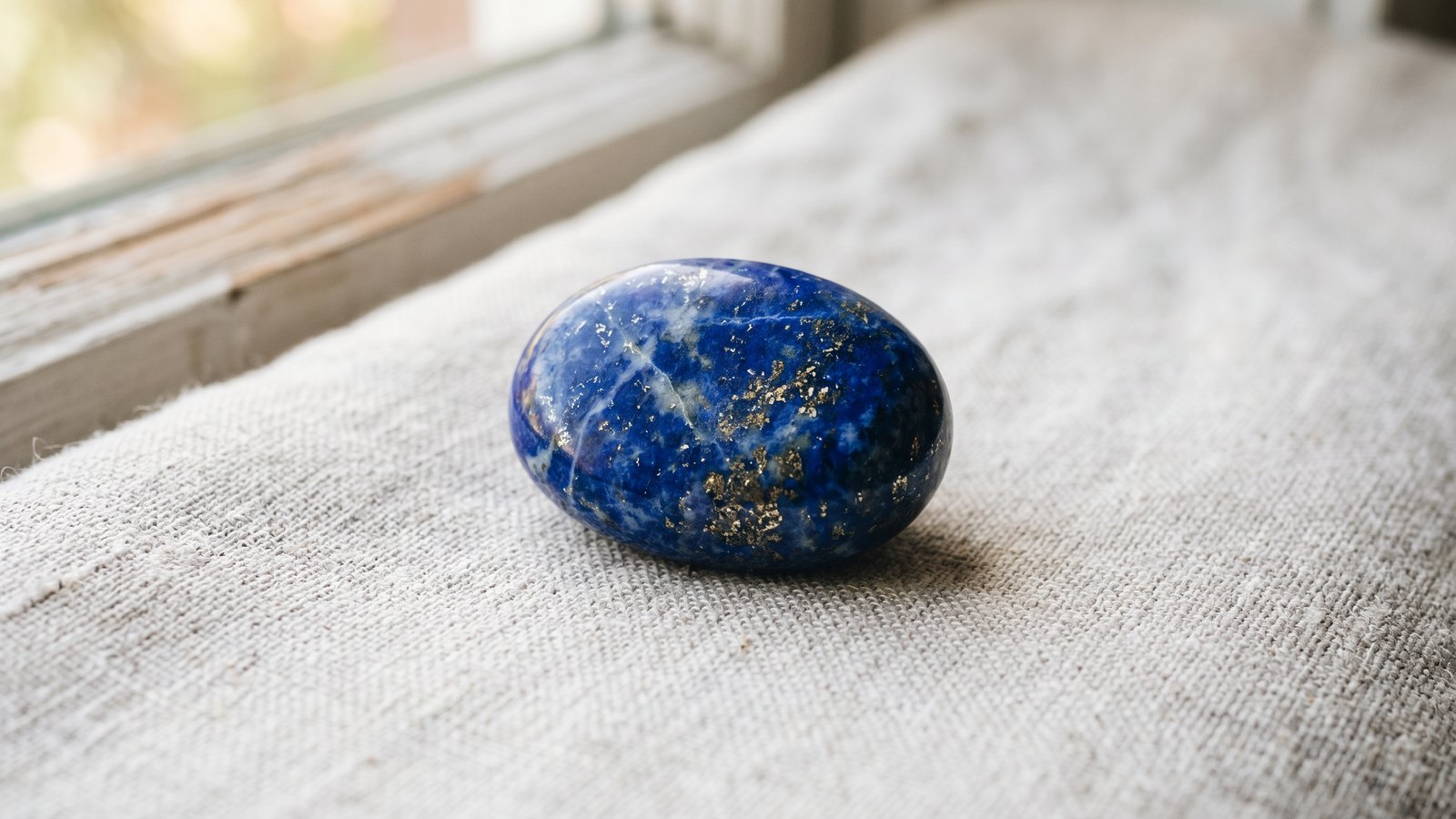
Few stones announce themselves quite like lapis lazuli. Deep celestial blue and scattered with flecks of gold, it looks less like a rock and more like a fragment of night sky pressed into stone. If a polished piece has found its way into your hand and you want to understand the lapis lazuli meaning behind that royal blue surface, here is a grounded, practical guide to what it is, what it has long symbolised, and how to live with it.
What lapis lazuli is
Lapis lazuli is not a single mineral but a rock, a natural blend of several minerals that together give it that unmistakable look. The deep blue comes from lazurite, which usually makes up thirty to forty percent of a good stone. The white veining and cloudy patches are calcite, and the small brassy sparkles running through the blue are pyrite, fool's gold, glinting like distant stars. The best stones are an even, saturated blue with just enough pyrite to catch the light.
It sits around 5 to 5.5 on the Mohs hardness scale, which makes it a relatively soft stone that scratches and marks more easily than quartz. Most lapis on the market today is traced to the Sar-e-Sang mines in the Badakhshan mountains of Afghanistan, a source worked by hand for more than six thousand years and among the oldest gem mines on earth.
That long history matters to the meaning. For much of it, lapis was ground into ultramarine, once the most precious pigment a painter could buy, costlier by weight than gold and saved for the robes of saints and kings. The same blue ringed the eyes of Tutankhamun's golden funerary mask. When you hold a piece, you are holding a stone that ancient Egypt, Sumer and Renaissance Europe all treated as a symbol of the sacred.
The meaning of lapis lazuli
The meaning of lapis lazuli has always gathered around truth, wisdom and the spoken word. As the blue of the heavens, it was tied to gods, royalty and the higher mind, a stone for those who guide and those who seek to understand. Traditionally it is reached for when you want to think clearly, speak honestly, and hold to what you know is right.
You do not need to share the beliefs of ancient priests to feel the pull of the symbol. The lapis lazuli spiritual meaning tends to settle on a few honest themes:
- Truth. It is the classic stone of honesty, associated with speaking and living in line with your inner sense of what is real.
- Wisdom. Its deep blue has long stood for insight, learning and the calm, clear-eyed part of the mind.
- Expression. Lapis is a favourite companion for finding your voice, whether that means a difficult conversation or simply saying what you mean.
- Inner royalty. As a stone of kings and queens, it carries a quiet sense of dignity and self worth.
None of this is medicine. Lapis lazuli is a symbolic and contemplative companion, a prompt for intention rather than a treatment for anything. Held that way, it becomes a small reminder to think before you speak and to trust what you already know.
Lapis lazuli and the throat chakra
In chakra practice, lapis lazuli is one of the stones most closely tied to the throat chakra, the energy centre at the base of the neck linked with communication, honesty and self expression. Its deep blue makes the connection intuitive, and many people rest a piece at the throat, or wear it as a pendant, when they want to speak with more clarity and less fear. If you want a lighter stone for the same work, kyanite is the other classic throat stone, bladed rather than blocky, and traditionally used to put words in order rather than to give them weight.
Because it is also associated with insight, lapis reaches up to the third eye chakra at the brow, the centre of intuition and inner vision. That pairing, voice and vision together, is a large part of why the stone has such a settled place in meditation. If you are building a wider practice, our guide to the seven chakras and their crystals shows where each stone belongs.
How to recognise real lapis lazuli
Part of loving lapis is learning to read it. A genuine stone shows an uneven, natural blue with soft white calcite clouds and those tiny gold pyrite flecks. Perfectly even colour with no markings at all is often a sign of dyed stone or an imitation.
Lapis is sometimes confused with sodalite, another blue stone, but sodalite tends toward a more royal-blue-and-white pattern without the golden pyrite sparkle. Dyed howlite and reconstituted "lab" lapis also appear on the market, so a very cheap, flawless blue is worth a second look. If you enjoy telling stones apart, our guide on how to tell if a crystal is real or fake covers the simple checks.
How to use lapis lazuli
Lapis is a rewarding stone to bring into daily life. A few simple ways to work with it:
- Wear it near the throat. A lapis pendant or beads sit naturally over the throat chakra, a quiet support before a talk, a class or anything that asks you to speak up. Our guide to carrying and wearing stones has more ideas.
- Hold it in meditation. Rest the stone in your palm or at your brow and let its blue settle a busy mind, perhaps around a single intention of clarity or truth. See meditating with crystals to build a simple practice.
- Keep it at your desk. Lapis has always been a scholar's stone, so many people keep a piece where they study, write or think.
- Set a clear intention. As a stone of honesty, lapis suits journalling and honest self reflection, sitting with a true question rather than avoiding it.
Lapis pairs naturally with grounding and clarity stones such as clear quartz and pyrite, and it appears often in routines for confidence and courage. Its oldest companion is turquoise, which has sat beside lapis in jewellery from ancient Egypt to the American Southwest, and I explain how the two work together in lapis lazuli and turquoise. Its other historic partner is green malachite, the two stones that frame the iconostasis of Saint Isaac's Cathedral, and I cover that heart and throat pair in lapis lazuli and malachite.
Caring for lapis lazuli
Lapis asks for a little care in return. Because it is a fairly soft rock around 5 to 5.5 on the Mohs scale, and porous where the calcite runs, it does not enjoy water. Avoid long soaks, salt water and harsh cleaners, all of which can dull the polish or loosen the surface. A quick wipe with a soft, slightly damp cloth is kinder, and our guide to which crystals can and cannot go in water explains why.
To reset a piece, gentle methods suit it best. Smoke, sound or a short spell under the moon are all kind choices, and you can read more in our guide to cleansing and charging crystals. Cared for simply, a single piece of lapis lazuli can stay with you for years, a small night-blue reminder to speak your truth and trust your own mind.
A note for students in particular: lapis is a memory and study stone rather than a concentration stone, and the two complaints are not the same. I explain the difference, and which stone suits which, in crystals for focus.