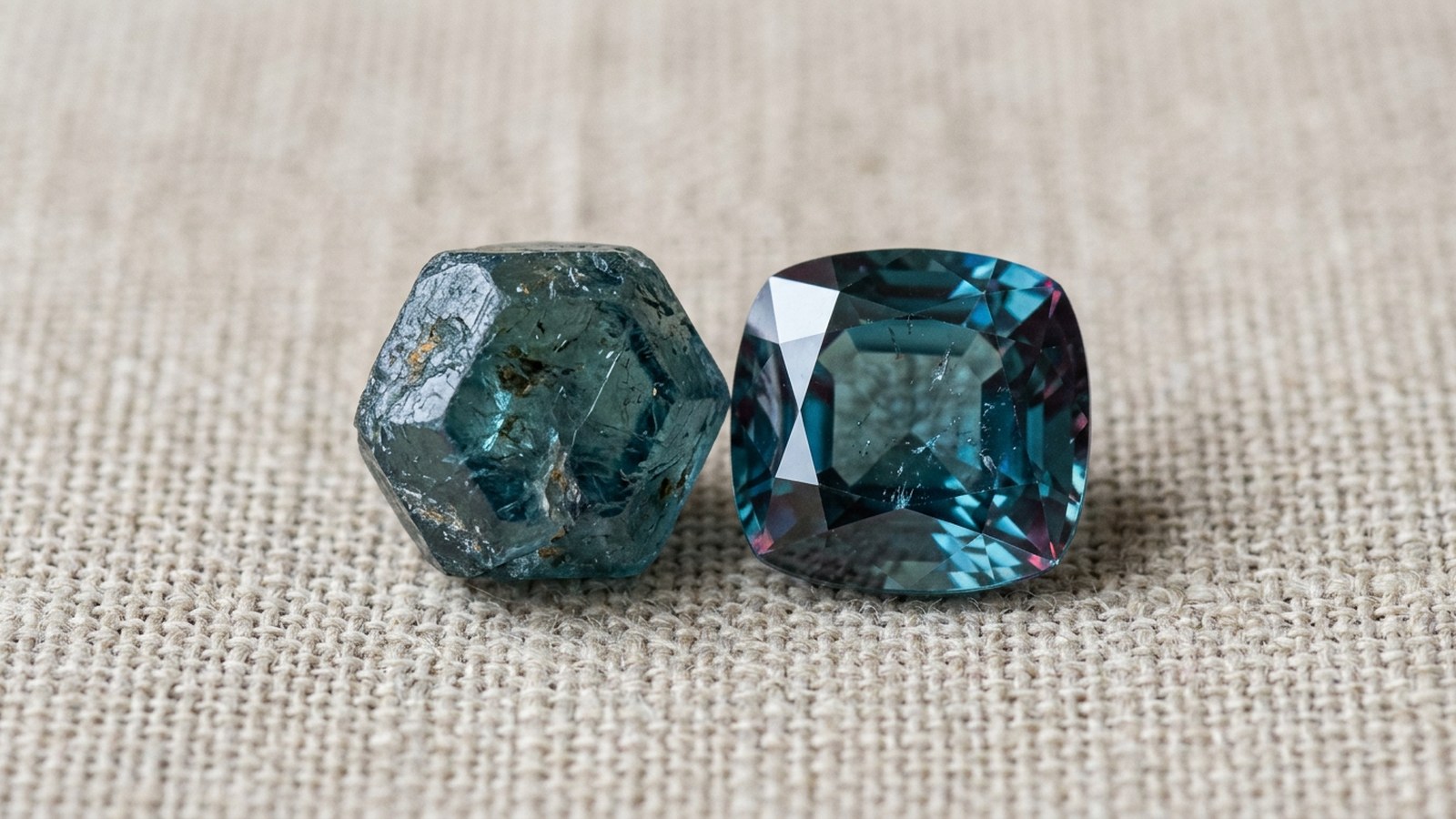
The first alexandrite I held was a small cushion of about half a carat, lent to me for an afternoon by a gem dealer who wanted me to see it "properly". By the window it was a deep, slightly blue green, the colour of a pine needle held up to the sky. When I carried it across the room and put it under an old filament desk lamp it turned a soft raspberry red, and when I walked back to the window it went green again. I must have done that walk a dozen times before I gave it back.
That shift is the whole story of alexandrite. It is a rare colour-change variety of the mineral chrysoberyl, and gem lovers describe it as "emerald by day, ruby by night". In crystal tradition, alexandrite means transformation, adaptability and the balance between opposite parts of yourself, and it is also linked with good fortune, the June birthday and the 55th wedding anniversary.
This guide gathers what the stone is said to carry, the real geology behind the colour change, the disputed story of its naming in Russia, and the practical questions most guides skip: how to tell whether the alexandrite in a family ring is natural, how to wear it, and how to look after it.
Reasons to Work With Alexandrite
Alexandrite is a companion for seasons of change. People reach for it when life asks them to become a slightly different person: a new job, a move to another city, a child leaving home, a diagnosis that reshapes the year. The stone itself does something that looks like change while remaining exactly the same crystal, and many wearers find that a comforting picture to carry. If you are at the edge of a new beginning, it is a gentle reminder that adapting does not mean losing yourself.
Alexandrite is a stone for people who feel split between two sides. Head and heart, duty and desire, the version of you at work and the one at home. Its two colours have long been read as a symbol of holding both without forcing a choice, which is why crystal writers call it a stone of balance.
Alexandrite is traditionally worn for luck. In nineteenth-century Russia it was considered a lucky stone, partly because its red and green echoed the colours of the imperial army. Today it sits comfortably beside the stones in my guide to crystals for good luck, especially for someone marking a milestone.
Alexandrite is a meaningful gift for June and for long love. As a modern June birthstone, alongside moonstone and pearl, and the traditional stone for a 55th anniversary, it is often chosen to honour a person who has changed and grown over many years while remaining recognisably themselves.
Alexandrite Meaning (Healing Energy)
Everything in this section belongs to crystal tradition and personal experience. I share it the way it has been shared with me, as a language for reflection.
Emotional Healing
Emotionally, alexandrite is associated with self-acceptance during transition. It is said to soften the grief that comes with leaving an old role behind and to help you welcome the parts of yourself that a new situation brings out. When I wear mine during unsettled weeks, I treat it as a cue to notice how I am adapting, at whatever pace that takes.
Spiritual Healing
Spiritually, the stone is linked with the crown chakra and, in more recent writing, the third eye. Practitioners describe it as a bridge between everyday awareness and intuition, and some keep it nearby during meditation or journaling to support intuition and inner listening.
Mental Healing
Astrologers often connect alexandrite with Mercury, the planet of thought and perspective. In that reading the stone supports mental flexibility: seeing a problem in two lights, as the stone itself does, before you decide.
Physical Healing
Older lore credits alexandrite with supporting the blood and circulation, probably because of its red evening colour, and some modern crystal books mention tension and inflammation. These are traditional beliefs, not medical advice, and no stone replaces care from a doctor or therapist.
Alexandrite Properties at a Glance
- Chakras: Heart, Crown, Third Eye (see my chakra crystals guide)
- Zodiac signs: Gemini and Cancer, the two June signs
- Element: Air and Water
- Planet: Mercury
- Numerical vibration: 5
- Birthstone: June
- Affirmation: "I can change and still be wholly myself."
Alexandrite Geology: Why the Colour Changes
Alexandrite is a variety of chrysoberyl, a beryllium aluminium oxide with the formula BeAl2O4. It crystallises in the orthorhombic system, often as twinned crystals that look like six-sided stars or "trillings", and it rates 8.5 on the Mohs scale. That makes it harder than every common gem except corundum (ruby and sapphire) and diamond, and its toughness is very good, so it suits rings worn every day.
The colour change comes from small amounts of chromium replacing aluminium in the crystal. Chromium absorbs light strongly in the yellow part of the spectrum and lets through two windows, one in the green and one in the red, of almost equal strength. Which window wins depends on the light source. Daylight and cool white light are rich in blue and green, so the stone looks green. Candlelight and old incandescent bulbs are rich in red, so it looks red or purplish red. Gemmologists call this the "alexandrite effect", and they now use the term for other gems that do something similar, including some garnets, sapphires and spinels.
Alexandrite is also strongly pleochroic, which means a single crystal can show green, orange and red when viewed from different directions. A skilled cutter orients the stone so that the face-up colour change is as clean as possible.
The reason it is so rare is geological. Beryllium is concentrated in granite pegmatites, while chromium comes from dark, iron and magnesium rich rocks such as serpentinite. The two elements rarely meet. Alexandrite forms where hot, beryllium-bearing fluids from a pegmatite reached chromium-rich rock, typically in mica schist, the same setting that produces emerald in the Ural Mountains. Some alexandrite also contains fine parallel needles that create a cat's-eye band, and cat's-eye alexandrite is among the most prized of all collector stones.
Alexandrite History and Lore
The story of alexandrite's discovery is told with great confidence in many places, and the details rarely agree. Here is what can be said honestly.
The first known alexandrite came from the emerald mines along the Tokovaya River, east of Yekaterinburg in the Russian Urals. The GIA dates the discovery to 1830; other accounts place it in 1833 or 1834. The stone was named after the young Alexander, heir to the throne, who would become Tsar Alexander II. The most repeated version says that the mineralogist Count Lev Perovskii presented it to him in April 1834, during the celebrations of his sixteenth birthday and coming of age.
Who actually identified the stone is disputed. One account credits the Finnish mineralogist Nils Gustaf Nordenskiöld, who received samples from Perovskii, took them for emerald, noticed they were too hard, and then saw them turn red by candlelight. He is said to have proposed the name "diaphanite". Another account, explored by the gem historian Richard Wise, points to Yakov Kokovin, director of the Yekaterinburg lapidary works, who may have recognised the stone first and was later accused of theft, imprisoned, and largely written out of the story. A German professor, Gustav Rose, had also described an unusual chrysoberyl in 1829. I like knowing all of this, because it reminds me that a stone associated with transformation began with a tangle of competing truths.
The red and green matched the military colours of imperial Russia, which made alexandrite a national stone almost at once, and Russian nobility wore it as a talisman. The Ural deposits were largely exhausted within a few decades, which is why fine old Russian stones remain the quality benchmark. In the United States, alexandrite was added to the June birthstone list in 1952, giving people born that month a choice between pearl, moonstone and alexandrite.
One modern footnote surprises people: synthetic alexandrite crystals are used in lasers, including the alexandrite lasers found in dermatology clinics. The same optical behaviour that makes the gem change colour makes it useful in technology.
Is Your Alexandrite Real?
This is the section I wish someone had written for me years ago, because it touches a great many family jewellery boxes.
From the early twentieth century, a synthetic colour-change sapphire coloured with vanadium was widely sold as "alexandrite", and a large share of the June birthstone rings made in the mid-1900s contain it. That material usually shifts from a greyish blue or blue violet in daylight to a purple or mauve under warm light. Natural alexandrite moves from green or blue green to red or purplish red. If your stone never looks truly green, it is very likely the synthetic sapphire.
Since the 1970s, laboratories have also grown true synthetic alexandrite, which has the same chemistry and colour change as the natural stone. It is a legitimate product when it is sold as lab-grown, and it can only be separated from natural alexandrite by a gemmologist looking at inclusions and growth features.
A few honest checks you can do at home:
- Look at the colours. Green to red points to alexandrite (natural or lab-grown). Blue to purple points to colour-change sapphire.
- Change the light. Compare a window at midday with a candle or a warm-white bulb. Many modern LED lamps are neither clearly warm nor clearly cool, so the change can look muted under them.
- Consider the price. Fine natural alexandrite above a carat with a strong change can cost several thousand to tens of thousands of dollars per carat. A large, vivid stone sold cheaply is almost certainly synthetic.
- Ask for a report. For any significant purchase, a report from a recognised gem laboratory is the only reliable answer.
My guide on how to tell if a crystal is real covers the general habits, and if red stones interest you, the confusions explored in garnet vs ruby and spinel vs ruby show how often names and colours have been mixed up in gem history.
Where Alexandrite Comes From and How to Care for It
Russian material is now mostly found in antique jewellery. Today most alexandrite comes from the gem gravels of Sri Lanka, from Brazil (notably the Hematita deposit in Minas Gerais, found in 1987), and from East Africa, including Tanzania and Madagascar, with smaller production in India. Stones from these sources vary widely, and many show a softer or browner change than the classic Ural colour.
Caring for alexandrite is simple. Clean it with lukewarm water, a little mild soap and a soft brush, then dry it with a lint-free cloth. Ultrasonic cleaners are usually tolerated by untreated stones, but I avoid them for anything with visible inclusions or a fragile setting. Store it apart from diamonds, sapphires and other alexandrites, which can scratch it, and keep softer stones away from it in turn.
For energetic care, alexandrite is comfortable with the gentle methods in my guide to cleansing crystals: a few minutes in smoke, sound from a bowl or bell, or an evening on a windowsill. Because it is hard and stable, a short rinse is fine too.
As for how to wear it, there is no fixed rule in Western practice. Some Vedic astrologers, who link the stone to Mercury, suggest the little finger of the working hand, while most people simply choose the hand where they will notice the colour change during the day. Wearers sometimes ask about side effects. Alexandrite has no known physical side effects as a gem. A few sensitive people say it feels stimulating at first and prefer to wear it for part of the day, which is a good approach with any stone you are getting to know.
Living With a Stone That Changes
Alexandrite is the stone I think of when someone tells me they are in between: no longer who they were, not yet sure who they are becoming. Its message, as I read it, is that both colours are real and both belong to the same crystal. If you are drawn to its quieter cousins, tanzanite carries a similar theme of shifting colour and transition at a gentler price, and moonstone shares its June birthday and its association with cycles. Whichever you choose, let the stone be a small daily reminder that you are allowed to change.