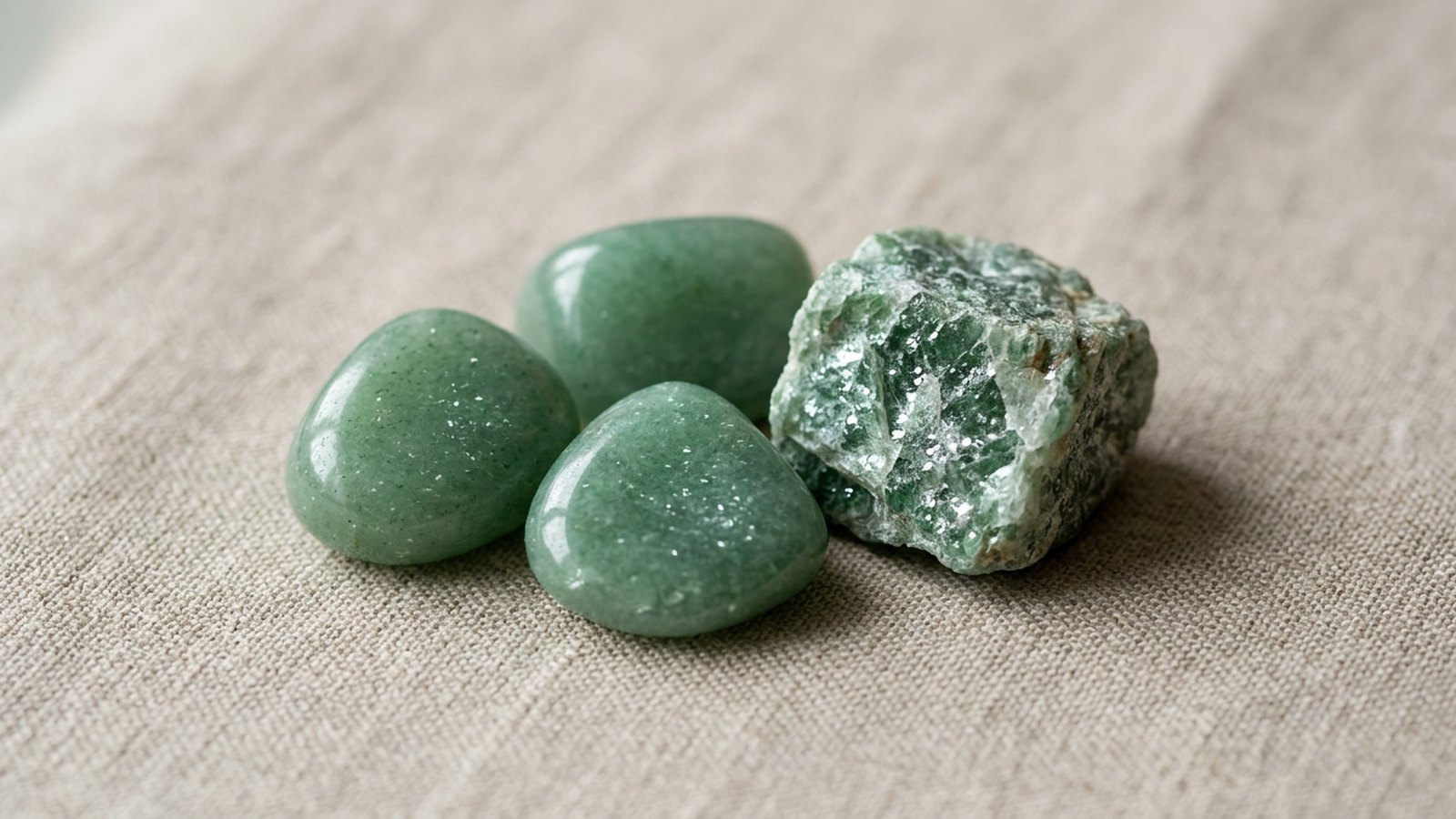
If you want the short answer first: the stones most often carried for good luck are green aventurine, citrine, tiger's eye, jade and pyrite. Green aventurine is the traditional choice for new opportunities, citrine for money and business, tiger's eye for the nerve to actually act, jade for slow and steady fortune, and pyrite for drive. You keep one in a pocket or a wallet, put one where you work, and hold it for a moment when you decide what you are asking for.
That is roughly what every article on this subject will tell you. What almost none of them do is say what luck is, or what a stone can honestly be expected to do about it. I want to do both, because the honest answer changes which stone you should pick, and it changes how you use it.
What luck actually is, and what a stone can honestly do
Two different things get called luck, and mixing them up is why so many people feel let down by a lucky charm.
The first is pure chance. The lottery number, the diagnosis, the driver who pulls out without looking. Nothing you own influences any of it. I am not going to pretend otherwise, and if a page tells you a green stone will change the odds on a roulette wheel, close the tab.
The second is opportunity, and that one is much more interesting, because it turns out to be partly a skill. In 2003 the psychologist Richard Wiseman published The Luck Factor after a decade of studying people who described themselves as consistently lucky or consistently unlucky. In one experiment he gave both groups a newspaper and asked them to count the photographs inside. He had planted a message on the second page, in letters half a page high: stop counting, there are 43 photographs in this newspaper. A second message, just as large, offered the reader 250 dollars for mentioning it to the experimenter. The self-described lucky people tended to see both. The unlucky people counted right past them, sometimes for two full minutes. They were not less capable. They were narrowly focused on the task they had been given, and the opportunity was outside the beam.
That is the kind of luck a stone can plausibly touch. Not the odds, but the width of your attention.
I want to be careful here, because the research on charms themselves is weaker than crystal writers usually suggest. A well-known 2010 study by Lysann Damisch and colleagues in Psychological Science reported that activating a superstition, including handing someone a "lucky" golf ball, measurably improved performance. It is cited everywhere. It also failed to replicate: in 2014 Calin-Jageman and Caldwell ran two direct, well-powered replications of the golf study and found the lucky-ball group performed almost identically to the control group. So the fair summary is that a charm may help by making you feel more capable, and that the evidence for it is thin and contested.
What I actually think a luck stone does is simpler and harder to argue with. It is a small, deliberate object that you touch several times a day, and each time it asks the same question: what are you here for, and are you looking around. Traditional lore gives each stone a different flavour of that question. That is the frame for everything below.
The stones, by the kind of luck you are asking for
Every other guide hands you a list of fifteen. That is not useful, because "lucky" is not one thing. Here is the same tradition sorted by what you are actually asking for.
To notice an opportunity: green aventurine
Green aventurine is the stone the tradition reaches for first, and it carries the nickname "stone of opportunity". It is a quartz threaded with tiny platy inclusions, usually fuchsite, a chromium mica, which give it that soft internal glitter and its green.
Here is the detail I love, and I have not seen a single competing page mention it. The name comes from the Italian a ventura, meaning by chance. It was not coined for the stone at all. It was coined for a copper-flecked glass made on Murano, reportedly the result of an accident at the furnace, and the glass became so popular that when the natural quartz was recognised as its own material it inherited the imitation's name. The stone of opportunity is named, quite literally, after a lucky accident. If you were choosing one stone off this page on the strength of its story, I would choose this one.
Carry it when you are starting something, applying for something, or when you suspect you have been counting photographs.
For money and business: citrine and pyrite
Citrine has been called the merchant's stone for a long time, and it is the one traditionally kept in a till, a cash box or the drawer where you do your invoicing. Its warmth sits with the solar plexus chakra, the seat of will and self-worth in that system, which is a fair description of what asking to be paid properly requires. One honest note: most citrine on the market is heat-treated amethyst, which is not a scandal, but it is worth knowing what you are buying.
Pyrite is the other half of that pair and it is the more demanding one. Fool's gold, iron disulfide, cubes so sharp they look machined. In the tradition it is not a stone of windfalls, it is a stone of ambition and follow-through, the one for luck that arrives because you did the work and were visible when it mattered. If money is your whole question, our guide to crystals for money and abundance goes further than I can here.
For the nerve to take the chance: tiger's eye
Opportunity is useless if you do not move. Tiger's eye is the stone for the gap between seeing the door and walking through it. Its golden bands shift as you turn it, an optical effect called chatoyancy caused by fibrous structure inside the quartz, and it is one of the most durable stones on this list at Mohs 7, which matters more than people expect when a stone lives in a pocket.
Roman soldiers are often said to have carried it into battle. I would treat that as attractive folklore rather than documented history, but the association with nerve is genuinely old. Pair it with our guide to crystals for confidence if that is really the block.
For the long game: jade
Jade is the oldest luck stone in continuous use anywhere, carried and carved in China for thousands of years, and it is a different promise from the others: not a break, but steadiness, longevity, fortune that accumulates.
It also comes with the biggest buyer-beware on this page. "Jade" is two different minerals, jadeite and nephrite, and a great deal of the cheap green "lucky jade" sold as a charm is neither. Dyed serpentine, dyed quartz and material traded as "new jade" all turn up in the same baskets, and green aventurine itself is sold as "Indian jade" often enough that our guide on aventurine vs jade walks through the tests that tell them apart. If a piece is suspiciously cheap, uniformly coloured and slightly waxy, be sceptical. Our guide on how to tell if a crystal is real covers the general tests, and none of this means a dyed stone cannot be meaningful to you. It means you should know what is in your hand.
For exams and interviews: fluorite and clear quartz
This one comes straight from what people actually search. Luck before an exam is mostly the ability to think clearly under pressure, so the tradition points at fluorite, long associated with mental order, and clear quartz, the one you programme with a specific intention. Fluorite is soft, Mohs 4 by definition, so keep it in a small pouch rather than loose with your keys.
After a run of bad luck: black tourmaline and smoky quartz
When people ask for a stone to break a bad streak, what they usually describe is a state: braced, superstitious, half expecting the next thing. The tradition answers with grounding stones rather than lucky ones, black tourmaline and smoky quartz, both of which we cover properly in crystals for protection. No stone removes bad luck, because a run of bad luck is usually a run of unrelated events plus the pattern your mind draws through them. What a grounding stone can do is give you something steady to hold while the streak runs out on its own.
| Stone | Mohs | The luck it is asked for | How it is usually carried |
|---|---|---|---|
| Green aventurine | 7 | Opportunity, new ventures | Pocket or wallet, daily |
| Citrine | 7 | Money, trade, being paid | Desk, till, cash box |
| Pyrite | 6 to 6.5 | Ambition, drive, visibility | Desk only, keep dry |
| Tiger's eye | 7 | Nerve, decisive action | Pocket, bracelet |
| Jade | 6 to 7 | Longevity, steady fortune | Worn, often as a pendant |
| Fluorite | 4 | Clear thinking under pressure | Pouch, study desk |
| Clear quartz | 7 | Whatever you programme it for | Pocket, grid |
| Black tourmaline | 7 to 7.5 | Steadiness in a bad run | Bag, bedside, doorway |
How to actually use one
Three habits, and they are the whole method.
Carry it. A luck stone works by being touched, so it belongs in a pocket, a wallet, a coat you actually wear, or as a bracelet. A tumbled stone the size of a thumbnail is ideal. If it lives in a drawer it is decoration, which is fine, but it is not doing the job. More on this in carrying and wearing stones.
Place one where the thing happens. Citrine near where money moves, fluorite where you study, aventurine where you make plans. Where to place crystals in your home has the fuller version.
Say what you are asking for, once, specifically. This is the step people skip, and it is the one with the clearest mechanism behind it. "Good luck" is too vague to notice anything by. "I am looking for a way into that industry" is a filter your attention can actually run. Hold the stone, name the thing, put it in your pocket. Our guide to programming an intention sets it out step by step, and cleansing your stone first is a reasonable way to mark the start.
The care problem nobody mentions
A luck stone is the most abused object in any collection, because by definition it lives in a pocket with keys and coins, gets warm, gets damp, and gets forgotten in a car. Not one of the four top-ranking pages I read for this article gives a single line of care advice. Here is what actually matters.
Pyrite must stay dry. This is the big one. Pyrite oxidises in humidity, breaking down into iron sulfates and sulfuric acid, and it cracks and crumbles from the inside. Museums keep specimens at around 45 percent relative humidity for exactly this reason. The damage is irreversible. Pyrite is a desk stone, never a pocket stone, and never a water stone. See crystals and water safety.
Malachite is softer than your keys. It appears on most lucky lists and it is a copper carbonate at Mohs 3.5 to 4. Sweat dulls it, anything acidic etches it, and it should not be soaked. Our malachite guide goes into why.
Household dust is quartz. Ordinary dust contains fine quartz at Mohs 7, which is harder than fluorite, malachite and jadeite. That is why a carried soft stone goes cloudy in a year. Wipe with a soft dry cloth rather than rubbing it clean.
Sunlight fades several of these. Citrine and amethyst lose colour permanently under strong UV, so a stone left on a car dashboard for a summer is a stone you have bleached. How to charge crystals covers gentler options.
What I will not promise you
No stone on this page changes probability. It will not shift the odds at a casino, a lottery counter or a betting app, and the "gambler's stone" nickname attached to aventurine is marketing, not evidence. If you are reading this while chasing a loss, the stone is not the tool you need, and there are gambling support lines that are.
Crystals are also not medical, legal or financial advice, and they are not a substitute for the help of someone qualified. What I do believe, having carried a green aventurine pebble for years, is that a small object you touch on purpose keeps a question alive in you, and people who keep the question alive tend to spot the door. Call that luck if you like. I think it is mostly attention, and I think that is a better deal, because attention is yours to widen.
Whichever one you choose, pick a single stone rather than five, and carry it somewhere your hand finds it without looking. The point was never the mineral. It is that you decided to pay attention, and gave yourself something to remember it by.