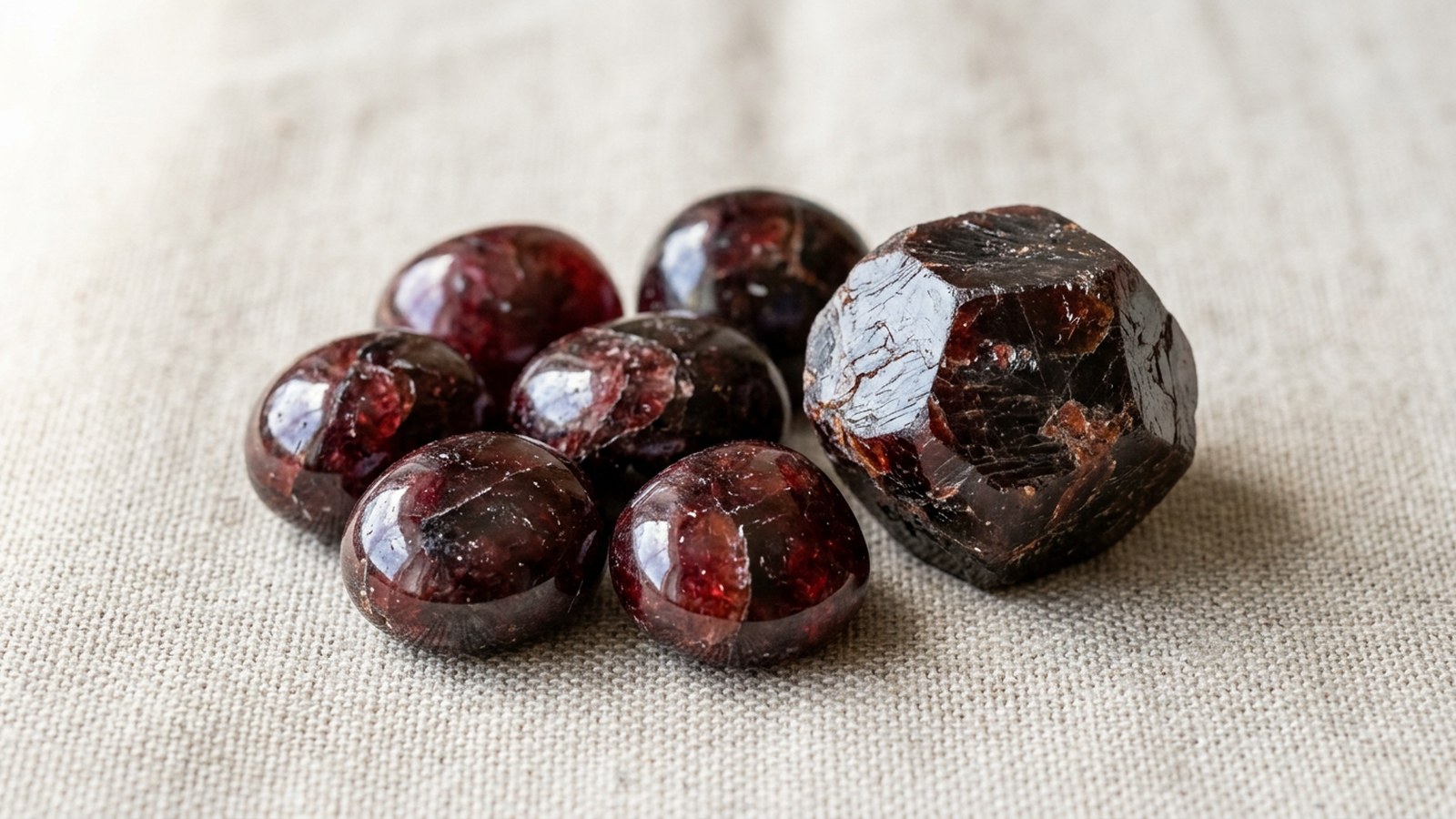
A friend once brought me a small red stone in a twist of tissue paper, set in a thin gold claw that had clearly been loved for decades. It had come down from her grandmother with the family word "ruby" attached to it, and she wanted to know before she had it reset. I held it under my desk lamp, then under a small ultraviolet torch I keep in a drawer, and the stone stayed a calm, dark wine colour without the faintest glow. It was a garnet, almost certainly a Bohemian pyrope from the late 1800s, and the story around it turned out to be more interesting than the label.
Garnet and ruby get confused all the time, in old jewellery boxes, in crystal shops and in online listings. This guide sets out what each stone really is, the tests you can do at home and the ones that will mislead you, why so many historical "rubies" were something else, what each stone is traditionally said to carry, and how to choose between them.
Garnet vs ruby: the short answer
Ruby is a single mineral, red corundum (aluminium oxide coloured by chromium), with a hardness of 9 and a price that can run from a few hundred to more than a million dollars per carat. Garnet is a family of silicate minerals, and the red ones (mostly pyrope and almandine) sit at 6.5 to 7.5 on the Mohs scale and usually sell for tens of dollars per carat. Ruby tends toward a bright, slightly pink or purplish red that often glows under UV light, while red garnet leans toward a deeper wine or brownish red and stays dark under UV. Ruby is the July birthstone and garnet the January one.
| Garnet (red) | Ruby | |
|---|---|---|
| Mineral | Garnet group silicates (pyrope, almandine) | Corundum, Al2O3 with chromium |
| Crystal system | Cubic, singly refractive | Trigonal, doubly refractive |
| Mohs hardness | 6.5 to 7.5 | 9 |
| Specific gravity | About 3.6 to 4.2 | About 4.0 |
| Typical colour | Wine, blood red, brownish red | Bright red with pink or purple notes |
| Under longwave UV | Inert | Usually red glow |
| Typical price per carat | Tens of dollars | Hundreds to six figures |
| Birthstone | January | July |
| Chakra in tradition | Root, heart | Root, heart |
What each stone actually is
Ruby is the red variety of corundum, the same mineral as sapphire. Pure corundum is colourless, and a small amount of chromium replacing aluminium in the crystal turns it red. When the colour is any other hue, the stone is called sapphire, which is why gemmologists sometimes say that ruby is simply a red sapphire with a better name. Rubies form where aluminium is plentiful and silica is scarce, because silica would combine with the aluminium to make other minerals. The classic setting is marble, limestone that has been transformed by heat and pressure, as in the Mogok valley of Myanmar. Other deposits sit in iron-rich rocks linked to ancient basalt, as in Thailand and Cambodia, or in the amphibolites of Montepuez in Mozambique, which now supplies a large share of the world's rubies. These conditions are rare, which explains most of the price.
Garnet is a group of related silicate minerals that share one cubic crystal structure. The red garnets you meet most often are pyrope (magnesium aluminium silicate) and almandine (iron aluminium silicate), with many stones sitting somewhere between the two. Garnet forms readily in metamorphic rocks such as schist and gneiss, so it is abundant enough that crushed garnet is sold as sandpaper grit and waterjet abrasive. The family also includes orange spessartine, green tsavorite and demantoid, and the cinnamon hessonite of Indian tradition. My garnet meaning guide walks through all six main species if you want to know exactly which one you hold.
Colour and light: the first clue, and a weak one
Good ruby has a bright, saturated red that often carries a pink or slightly purple note. Because chromium also makes ruby fluoresce, daylight adds a little glow of its own, which is the source of the famous "pigeon's blood" description for the finest Burmese stones. Red garnet is usually darker, with a wine, brown or orange undertone, and in a large cut it can look almost black until light comes through it.
The trouble is that the two ranges overlap. Rhodolite garnet is a raspberry red that can pass for a commercial ruby, and a dark, iron-rich Thai ruby can look a lot like almandine. Colour gives a first impression, and you will want at least one of the tests below to confirm it. Inclusions help a little more: ruby often contains fine needles of rutile called silk, which can produce a six-rayed star in a cabochon, while garnet is frequently very clean to the eye, and the star garnets of Idaho usually show four rays.
How to tell garnet from ruby: the tests ranked
These are the methods I would try, in order, with a stone you already own.
-
UV torch. In a dark room, shine a 365 nm longwave UV torch on the stone. Most rubies glow a clear red, because chromium fluoresces, and garnet stays inert because the iron in it quenches any glow. A red glow is strong evidence of ruby or red spinel. No glow is less conclusive, because iron-rich rubies from Thailand and Cambodia fluoresce weakly, so treat darkness as "probably garnet" and move to the next test.
-
Polarising filters. Garnet is singly refractive, and ruby is doubly refractive. You can see this with two polarising filters, and a phone screen plus a pair of polarised sunglasses will do. Rotate the sunglasses lens until the screen goes dark, place a transparent stone between them, then turn the stone slowly. Ruby will brighten and darken four times in a full turn. Garnet stays dark all the way round, or shows only a faint patchy strain pattern. This works on faceted and transparent stones; an opaque piece gives you nothing.
-
Rough crystal shape. If you have an uncut crystal, its shape settles the question quickly. Ruby grows as six-sided barrels or flat hexagonal plates. Garnet grows as a rounded, ball-like crystal with twelve diamond-shaped faces, sometimes twenty-four.
-
A dichroscope or a jeweller. Ruby shows two slightly different reds when viewed through a dichroscope from different directions, and garnet shows one. A refractometer reading (about 1.76 to 1.77 for ruby, roughly 1.72 to 1.81 across red garnets) is quick for any gemmologist and costs little.
There are two tests I would leave aside. The first is weight. With citrine and topaz, the heavier stone gives itself away, as I explained in my citrine vs topaz guide, but here almandine garnet can be just as dense as ruby, or denser, so a hydrostatic test proves nothing. The second is scratching. Ruby is harder, and a scratch test will tell you so by damaging one of the stones, which is a poor exchange for a family piece. For the general logic of checking a crystal without harming it, see how to tell if a crystal is real.
Why so many old rubies were garnets
For most of history, nobody separated red stones by mineral. Medieval inventories called any red cabochon a carbuncle, from the Latin for a small glowing coal, and that word covered ruby, garnet and red spinel alike. The most famous "ruby" in the British Crown Jewels, the Black Prince's Ruby set in the Imperial State Crown, is a red spinel, and the separation of spinel from ruby only became routine with modern mineralogy in the late eighteenth and nineteenth centuries.
Garnet also travelled under borrowed names. Pyrope from the diamond mines of South Africa was sold as "Cape ruby", pyrope gathered from ant hills on the Colorado Plateau as "Arizona ruby", and red garnets from the beach at Elie in Scotland as "Elie ruby". The Victorian fashion for clustered Bohemian pyrope jewellery filled countless family boxes, which is where my friend's stone came from. A family story of "grandmother's ruby" is worth checking for exactly this reason.
Fakes and treatments in both directions
Garnet has been used to imitate ruby, and ruby has its own modern shortcuts.
Garnet-topped doublets. From the late nineteenth century into the twentieth, jewellers fused a thin slice of almandine onto a base of coloured glass. The garnet top gave hardness and lustre, and the glass gave the colour, so the same trick imitated ruby, sapphire and emerald. Lay the stone face down on white paper: a doublet often shows a thin red ring around its outline. Seen from the side under a loupe, you may also spot the join and a change in lustre.
Glass-filled ruby. This is the trap I see most often in cheap "genuine ruby" jewellery today. Low-grade, heavily fractured corundum is filled with lead-rich glass to make it look transparent. Under a loupe you may notice blue or orange flashes along the fractures and round gas bubbles in the filled areas. These stones are sold legitimately as composite or glass-filled ruby, but they can be damaged by lemon juice, household cleaners and a jeweller's torch, and they are worth a small fraction of a heated ruby.
Synthetic ruby. Lab-grown ruby has been made by flame fusion since the early 1900s, so it turns up in antique pieces too. It often shows curved growth lines and glows very strongly under UV.
Crystal shop ruby. Many people meet ruby first as an opaque, purplish red tumble, or as ruby in zoisite from Tanzania, ruby in fuchsite or ruby in kyanite. These are genuine corundum of non-gem grade and perfectly good to work with, though the bright pinkish tumbles are sometimes dyed. Rub one with a cotton bud and a little acetone, and any colour on the cotton tells you the answer.
Price, hardness and daily wear
The price gap is wide. Most red garnet sells for tens of dollars per carat, while rare garnets such as fine demantoid or tsavorite can reach into the thousands. Commercial heated ruby usually costs a few hundred to a few thousand dollars per carat, and exceptional untreated Burmese stones go much further: the 25.59 carat Sunrise Ruby sold at auction in 2015 for about 30 million dollars, well over a million per carat. Heating is standard practice for ruby and is accepted by the trade when disclosed.
For a ring worn every day, ruby is the more durable choice. At hardness 9 it resists the scratches from household dust, which contains quartz at hardness 7. Garnet at 6.5 to 7.5 is fine in earrings, pendants and occasional rings, and its facet edges will soften slowly with constant knocks. Neither stone has a cleavage plane, which helps both of them survive a knock better than topaz or moonstone.
Garnet and ruby in crystal tradition
In crystal work, both stones belong to the root chakra, and both are often placed on the heart chakra as well. What follows is tradition and personal experience, and neither stone treats any medical condition.
Garnet is traditionally the steadier of the two. It is associated with grounding, commitment and devotion, and it was carried by travellers for protection on the road. When I reach for garnet, as in my list of grounding crystals, it is usually because I feel scattered or because I want to keep going with something slow, a long project or a relationship through a hard stretch. Its zodiac associations are Capricorn and Aquarius.
Ruby is traditionally the stone of vitality and courage. Medieval writers believed it warned its wearer of danger by darkening, and Sanskrit texts call it ratnaraj, the king of gems. People choose it when they want warmth, energy and confidence, often in love as much as in work. It is linked with Leo and Cancer. If you are drawn to the energy of ruby but not the price, carnelian and red jasper sit in a similar warm family, and my carnelian vs red jasper guide compares them.
People often ask who should not wear garnet. In Vedic astrology, ruby (manik) is the gem of the Sun, and hessonite garnet (gomed) is the gem of Rahu, and both are traditionally worn only after a reading of the birth chart. Some crystal practitioners also suggest that people who already run hot, restless or angry may find red stones too stimulating and prefer something cooler for a while. These are traditions to weigh, and I treat them as guidance on how a stone feels to wear rather than as rules.
Which one should you choose?
- For an engagement ring or a stone worn every day: ruby, for its hardness. Ask for a disclosure of treatment and avoid glass-filled stones in a ring.
- For a January birthday, or a red stone on a modest budget: garnet, with fine colour and much larger sizes available for the money.
- For a July birthday: ruby is the traditional stone, and an opaque ruby tumble or ruby in zoisite carries the same tradition at a gentle price.
- For grounding and steady effort: garnet. For warmth, courage and a lift in energy: ruby, or see my guide to crystals for strength.
- For a family piece of uncertain origin: keep the family name for it and have it tested by a gemmologist, since the history of the piece stays with it whatever the mineral turns out to be.
Caring for garnet and ruby
Warm water, a drop of mild soap and a soft brush clean both stones safely. Ultrasonic and steam cleaning are usually fine for an untreated or heated ruby, but never for a glass-filled one. Keep garnet away from ultrasonic baths and sudden temperature changes if it has visible inclusions. Store ruby apart from softer stones, since it will scratch nearly everything in a jewellery box. For energetic cleansing, both are comfortable with running water, smoke or sound, as described in my guide to cleansing crystals.
A last word
My friend kept her garnet in its old claw setting, and she now tells its story with the right name in it, Bohemian pyrope from a time when every red stone was a ruby to somebody. Whichever of the two you hold, I hope you can now look at it a little more closely and choose the one that fits you.