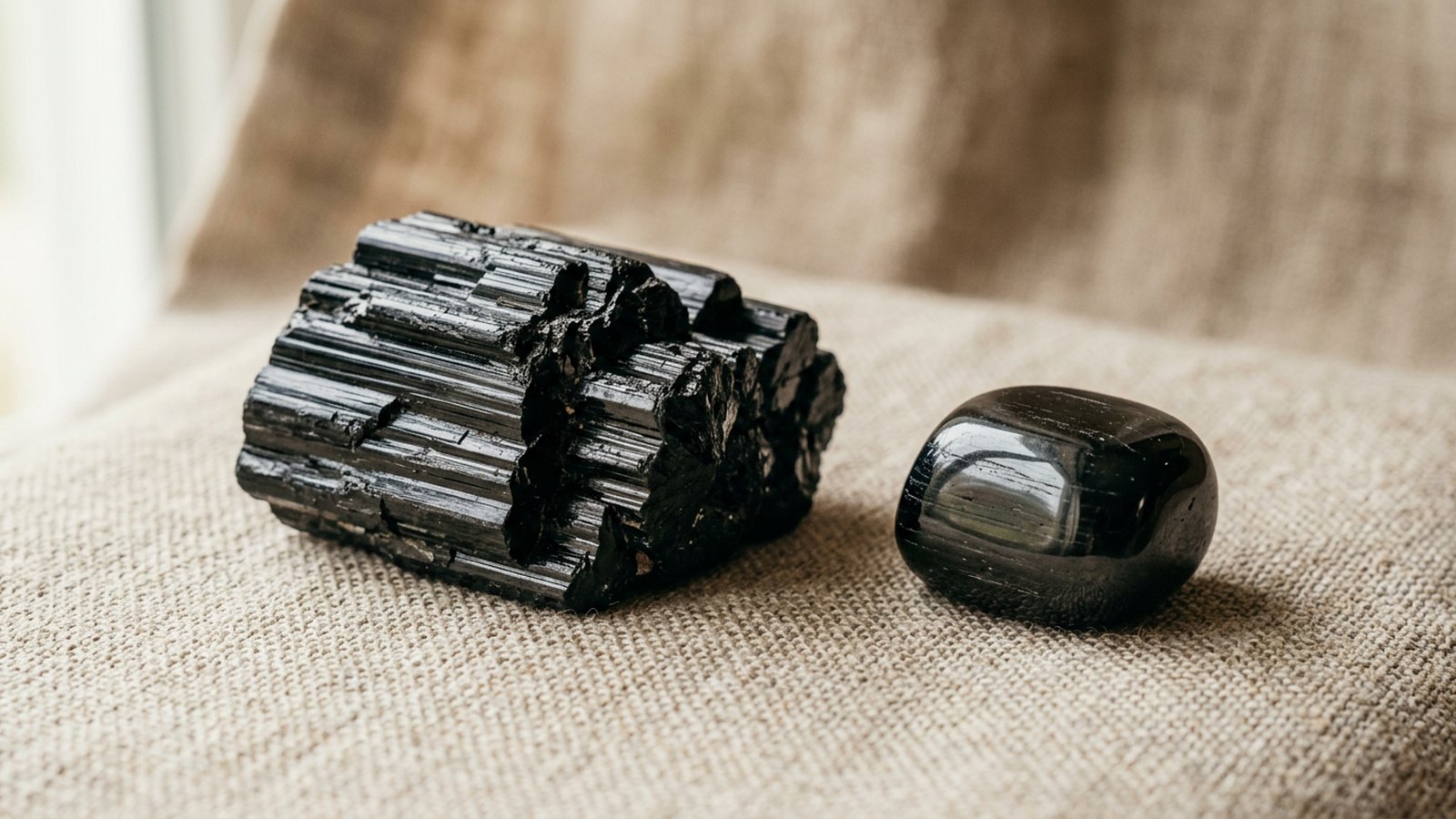
Black tourmaline is a deep, glossy black stone carried for one reason above all others: protection. For centuries it has been treated as a shield stone, a piece to keep close when the world feels heavy or the energy around you turns sharp. Its meaning centers on grounding and boundaries: the sense of being anchored, steady, and quietly guarded. If you are drawn to its inky, light-drinking surface, you are reaching for one of the most trusted protective stones in the crystal world.
This guide walks through what black tourmaline is, what it symbolizes, its link to the root chakra, and simple, practical ways to work with it at home and on the move.
What Is Black Tourmaline?
Black tourmaline is the common, opaque black variety of the tourmaline family, and mineralogists know it as schorl. It is a complex sodium iron aluminium borosilicate, and that iron content is what gives the stone its rich black color. Roughly 95 percent of all tourmaline found in nature is schorl, which is why it is both abundant and affordable compared with the rare pink and green gem tourmalines. If you are curious about those other colours, our tourmaline meaning guide walks through the whole family, from pink rubellite to Paraíba.
On the Mohs scale it sits around 7 to 7.5, hard enough for daily wear in rings, pendants, and pocket pieces. You will often see it as raw striated columns with lengthwise grooves running down the crystal, or tumbled into smooth protective palm stones.
The name schorl is older than you might expect. It comes from a village in Saxony, Germany, now called Zschorlau, which sat beside a medieval tin mine where black tourmaline turned up alongside the tin ore. The name was in use before 1400. The word tourmaline itself traces back to the Sinhalese term toramalli, used in Sri Lanka for mixed parcels of colored gemstones.
Black tourmaline also holds a genuinely unusual physical trait. It is pyroelectric and piezoelectric, meaning it builds a small electric charge when it is heated or put under pressure. When charged, one end becomes positive and the other negative, so the stone attracts light particles like dust and ash. In the early 1700s Dutch traders used warmed tourmaline to draw the ash out of their pipes and nicknamed it aschentrekker, the ash puller. That ancient reputation for pulling things toward itself sits neatly beside its modern symbolism as a stone that draws off unwanted energy.
Black Tourmaline Meaning and Symbolism
The meaning of black tourmaline is built around protection, grounding, and clearing. It is often called an energy bodyguard, a stone people keep near them to feel shielded from tension, negativity, and the general static of busy environments.
Where many crystals are described as absorbing heavy energy, black tourmaline is traditionally seen as transmuting it: taking the dense or anxious charge in a room and settling it into something calmer and more neutral. That is why it is a favorite for doorways, desks, and bedside tables.
Its second great theme is grounding. Black is the color of the earth at night, of roots and deep soil, and black tourmaline carries that steadying, feet-on-the-ground symbolism. People reach for it when they feel scattered, overwhelmed, or pulled in too many directions, using it as an anchor back to the present moment. In this it shares a family resemblance with obsidian, another dark stone of protection and honest self-reflection. The two are confused constantly in the shop and in the drawer, so if you are not certain which of them you own, our guide on black tourmaline vs obsidian ranks the tests that actually settle it. You can read more about how dark stones work in our guide to crystal colours and their meanings.
Black Tourmaline and the Root Chakra
Black tourmaline is strongly tied to the root chakra, or Muladhara, the energy center at the base of the spine associated with safety, stability, and belonging. When the root chakra feels settled, the traditional view is that you feel secure, capable, and calmly rooted in your own life.
Because of this link, black tourmaline is a natural stone to work with during grounding practice. Rest one at the base of the spine or hold one in each hand while sitting quietly, and let its weight and stillness draw your attention downward and inward. If you are new to this, our guide to the seven chakras and their crystals explains how to pair stones with each energy center.
How to Use Black Tourmaline
Black tourmaline is one of the easiest stones to fold into daily life. A few simple ways to work with it:
- Carry it as a pocket stone. A small tumbled piece in your pocket or bag acts as a quiet reminder of your boundaries through the day. See our notes on carrying and wearing stones for more.
- Place it at your entryway. Many people keep a raw piece near the front door so the first thing that greets the home is a grounding, protective presence. Our guide on where to place crystals in your home covers this in depth.
- Keep it on your desk or by a screen. It is a popular choice near computers and routers for people who want a calmer, more settled workspace.
- Hold it during moments of stress. When a day feels chaotic, wrapping your hand around a cool piece of tourmaline can be a small, steadying ritual. If restlessness is a regular visitor, you may also like our roundup of calming stones for anxiety.
For a broader primer on grids, layouts, and intention-setting, start with how to use crystals.
How to Cleanse and Charge Black Tourmaline
Because black tourmaline is thought to take on so much of the energy around it, many people like to cleanse it regularly. Smoke, sound, or a night beside a piece of selenite are all gentle options, and the selenite habit in particular has a guide of its own on black tourmaline and selenite, including what it costs the plate. All of it is covered in our guide to cleansing and charging crystals.
With a hardness of 7 to 7.5, black tourmaline is generally stable for brief contact with water, though a quick rinse and dry is all it ever needs and long soaking is unnecessary. Our guide to which crystals can go in water shows where it fits. To restore its charge, rest it on the earth, on a windowsill, or under the light of the moon, as described in how to charge your crystals.
Who Should Work With Black Tourmaline
Black tourmaline is welcoming and unfussy, which is part of why it is so widely loved. It is often recommended as a first protective stone and is traditionally linked with the earthy, steady signs, especially Capricorn, along with Virgo, Scorpio, and Pisces. That said, no tradition reserves it for one group. Anyone who wants a little more steadiness and a clearer sense of their own edges can keep black tourmaline close.
Whether you set it by your door, tuck it in your pocket, or simply hold it at the end of a long day, black tourmaline offers the same quiet promise it has carried for centuries: stay grounded, stay protected, stay yourself.