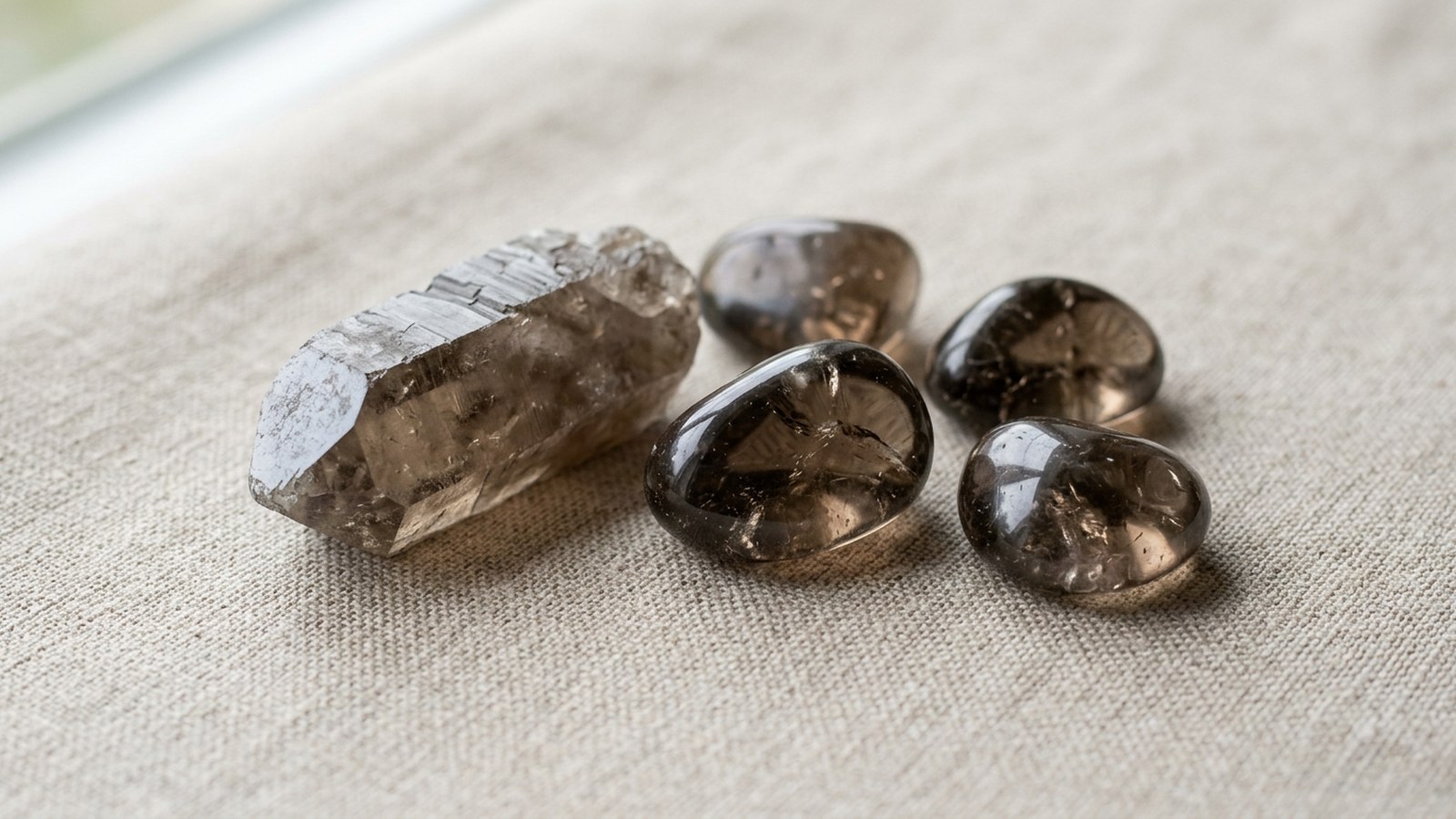
The first stone I ever carried for anxiety was a small piece of smoky quartz, worn smooth on one side by somebody before me. I bought it the week before a job interview, at a time when my heart would start racing in the shower before I had even thought about the day ahead. It did not make the interview easy. What it gave me was a place to put my thumb when the racing started, and a reason to breathe out slowly while I did. Years later I still keep a stone in my coat pocket, and I have learned a good deal about which stones help in which moments, and about the way a comforting habit can quietly turn into something you depend on.
This guide is organised around those moments. Anxiety rarely feels the same at 3 a.m. as it does in a crowded room or the morning of an exam, and the stone that suits one of them may be the wrong weight, size or texture for another.
The short answer: which crystals are used for anxiety?
The stones most often used for anxiety are amethyst for a constant background worry, lepidolite for thoughts that loop at night, blue lace agate for social nerves, smoky quartz and hematite for the physical rush of panic or anticipation, black tourmaline for feeling overwhelmed by your surroundings, and rose quartz for the harsh self-talk that often comes with worry. These pairings come from crystal tradition. In practice a stone works best as a physical cue to slow your breathing and bring your attention back to the present.
What a stone can and cannot do for anxiety
I want to be straight with you before we go further, because anxiety is a subject where honesty matters more than enthusiasm. There is no evidence that a crystal changes your nervous system by itself. The best-known test of the idea came from the psychologist Christopher French at Goldsmiths, University of London, who presented his results to the British Psychological Society in 2001. He gave eighty volunteers either real quartz crystals or glass imitations and asked them to meditate with them for five minutes. People in both groups reported the same tingling, warmth and calm in roughly equal measure, and those who already believed in crystal healing reported the strongest effects.
I find that study encouraging. It tells me that the calm people feel with a stone is real as an experience, and that it comes from attention, expectation and ritual, which are things you can deliberately strengthen. A stone has weight, coolness and texture. Holding it gives a restless mind one simple physical thing to notice, and when you pair it with a slow out-breath it becomes a portable signal to your body that you are safe enough to pause.
So when I talk about what a stone is "for" below, I am describing the tradition attached to it and the practical qualities that make it a good anchor in that moment. The energy readings belong to crystal lore and personal intuition. The breathing and attention are where most of the relief comes from.
Crystals for anxiety, chosen by the moment it arrives
Before something you dread: hematite and black tourmaline
Anticipatory anxiety is the kind that builds for days before an exam, a flight, a medical appointment or a difficult conversation. It lives in the body as much as the mind: a churning stomach, shallow breath, a feeling of being pulled upward and out of yourself.
For this I reach for hematite. It is an iron oxide and surprisingly heavy for its size, and that weight is the whole point. In crystal tradition it is a root chakra stone, associated with being pulled back down into your feet. Keep a tumbled piece in a trouser pocket and press it when the dread rises. If you prefer something you can wear, black tourmaline is the traditional protective stone and is hard enough (7 to 7.5 on the Mohs scale) for a pendant. People who feel anxious in busy places, or after too long on the news, often keep a piece by their screen as a reminder to step away. If what you need before the event is nerve more than calm, my guide to crystals for courage goes further.
In a room full of people: blue lace agate
Social anxiety tends to sit in the throat. You know what you want to say and it will not come out, or it comes out too fast. Blue lace agate, with its pale banded blue, is the stone tradition links to the throat chakra and to gentle, unhurried speech.
It suits this moment for a practical reason too. Agate is a tough form of chalcedony, around 6.5 to 7 in hardness, so a small bead bracelet or ring survives daily wear and gives your fingers something to turn under the table. Before you walk into the room, hold it, breathe out for longer than you breathe in, and let your first sentence be a slow one. For anxiety that is specifically about speaking up, my guide to crystals for communication covers more stones.
When panic spikes: smoky quartz
A panic surge is the hardest moment to use any tool, because thinking narrows to almost nothing. This is why I keep the choice simple and physical. Smoky quartz is my companion here: a tumbled piece large enough to fill your palm, cool and solid, with a brown-grey colour that many people find steadying to look at.
Use it with the 5-4-3-2-1 grounding exercise, which many therapists teach. Hold the stone and name five things you can see, four you can feel (start with the stone itself, its temperature and weight), three you can hear, two you can smell and one you can taste. By the time you reach the end, the wave has usually begun to pass. A practical note: much commercial smoky quartz is clear quartz that has been irradiated to darken it. It is still quartz and still works as an anchor, but a very even, almost black colour often signals treatment.
When worry loops at night: lepidolite and howlite
Night anxiety has its own texture. The house is quiet, the day is over and the mind replays every conversation. Lepidolite, a soft lilac mica, is the stone most people reach for here, traditionally linked to the crown chakra and to easing a mind that will not switch off. You may read that it calms you because it contains lithium. It does contain lithium, locked inside the mineral, and none of it reaches you through the skin. It is no substitute for any prescribed medication.
Lepidolite is very soft (around 2.5 to 3), so keep it on the nightstand rather than under a pillow where it can flake. Howlite, a white stone with grey veining, is the traditional alternative for people who find lilac too stimulating. My crystals for sleep and crystals for dreams guides cover the night in more detail.
For the everyday background hum: amethyst
Some anxiety has no single trigger. It is a low hum of worry that runs under the whole day. For this I suggest a stone you wear, so it is there without you having to remember it. Amethyst, purple quartz at hardness 7, has the longest tradition as a stone of a quiet mind: its Greek name, amethystos, means "not intoxicated", and it was once believed to keep the drinker sober and clear-headed.
A ring or pendant you can touch through the day works well. Each time you notice the hum, touch the stone and take one slow breath. Over weeks, that small repeated pause is what tends to make a difference. Keep amethyst out of strong sunlight, which can fade its colour.
When the worry is about your health: rose quartz, used carefully
Health anxiety deserves a careful word. It shows up as checking: searching symptoms, examining your body, asking others for reassurance. Each check brings a moment of relief, and then the worry returns stronger.
Rose quartz is the traditional heart chakra stone of self-compassion, and I suggest it here for a specific use. When you feel the urge to check, hold the stone, breathe slowly and wait ten minutes before acting. If the urge passes, you have learned something valuable. The stone is a pause button, and it should never become the thing you check instead.
How to use a crystal without leaning on it
I have not seen this covered in other guides to crystals for anxiety, and it matters. Psychologists who study anxiety, starting with Paul Salkovskis in the early 1990s, describe "safety behaviours": things we do to feel safe in an anxious moment, such as always sitting near the exit or carrying a particular object. They bring short-term relief, but they can keep anxiety going, because you never get to learn that you would have been fine without them.
A stone can drift into that role. If you find you cannot leave the house without it, or you panic when you forget it, it has become a safety behaviour. Three habits help keep it a helpful tool:
- Pair it with a skill. Always use the stone alongside slow breathing or grounding, so the skill does the work and travels with you even when the stone does not.
- Leave it at home sometimes. On calmer days, go out without it on purpose and notice that you managed.
- Take it toward what you fear. Hold it as you walk into the meeting or board the plane, so it travels with you into the situation.
Caring for anxiety stones
| Stone | Mohs hardness | Water | Sunlight | Watch for |
|---|---|---|---|---|
| Amethyst | 7 | Brief rinse fine | Fades | Colour loss on windowsills |
| Lepidolite | 2.5 to 3 | Avoid soaking | Fine | Flakes, keep off pillows |
| Blue lace agate | 6.5 to 7 | Brief rinse fine | Can pale | Dyed blue agate |
| Smoky quartz | 7 | Brief rinse fine | Can fade | Irradiated clear quartz |
| Hematite | 5.5 to 6.5 | Dry quickly | Fine | "Magnetic hematite" is a synthetic ceramic |
| Black tourmaline | 7 to 7.5 | Brief rinse fine | Fine | Brittle across the grain |
| Rose quartz | 7 | Brief rinse fine | Can fade | Dyed or glass imitations |
| Howlite | 3.5 | Avoid soaking | Fine | Often dyed to imitate turquoise |
For gentle cleansing methods that suit every stone above, see my guide to cleansing crystals, and check crystals and water safety before you soak anything. If you are unsure whether a piece is genuine, how to tell if a crystal is real walks through simple tests.
When anxiety needs more than a crystal
Stones are a comfort and a ritual. Anxiety that shapes your days deserves real care, and it is very treatable.
Is there a cure for anxiety? Anxiety disorders are among the most treatable mental health conditions. Cognitive behavioural therapy (CBT) has the strongest evidence, and many people improve a great deal within a few months. Medication helps others. Some anxiety is a normal part of life, so the aim is usually to stop it running the show.
What are the symptoms of chronic anxiety? Doctors look for worry that is hard to control and present on most days for six months or more, along with restlessness, tiredness, poor concentration, irritability, muscle tension or disturbed sleep. If that sounds familiar, talk to your doctor.
How can I help someone with social anxiety? Be patient, avoid speaking for them, and let them set the pace. Gently encourage them to seek therapy, since CBT works well for social anxiety too.
What treatments help health anxiety? CBT designed specifically for health anxiety is the best-studied treatment. It focuses on reducing checking and reassurance-seeking, which is why the ten-minute pause above can be a useful first step.
If you are in crisis or thinking about harming yourself, in the US you can call or text 988 at any hour. Elsewhere, contact your local emergency number or crisis line.
A closing word
If you are just starting, choose one stone for the moment that troubles you most and keep it simple. You can browse every stone linked to calm on its own page, and my guide to calming crystals sorts them by how restlessness feels in the body. Whatever you choose, let it remind you to breathe, and be kind to yourself while you learn what helps.