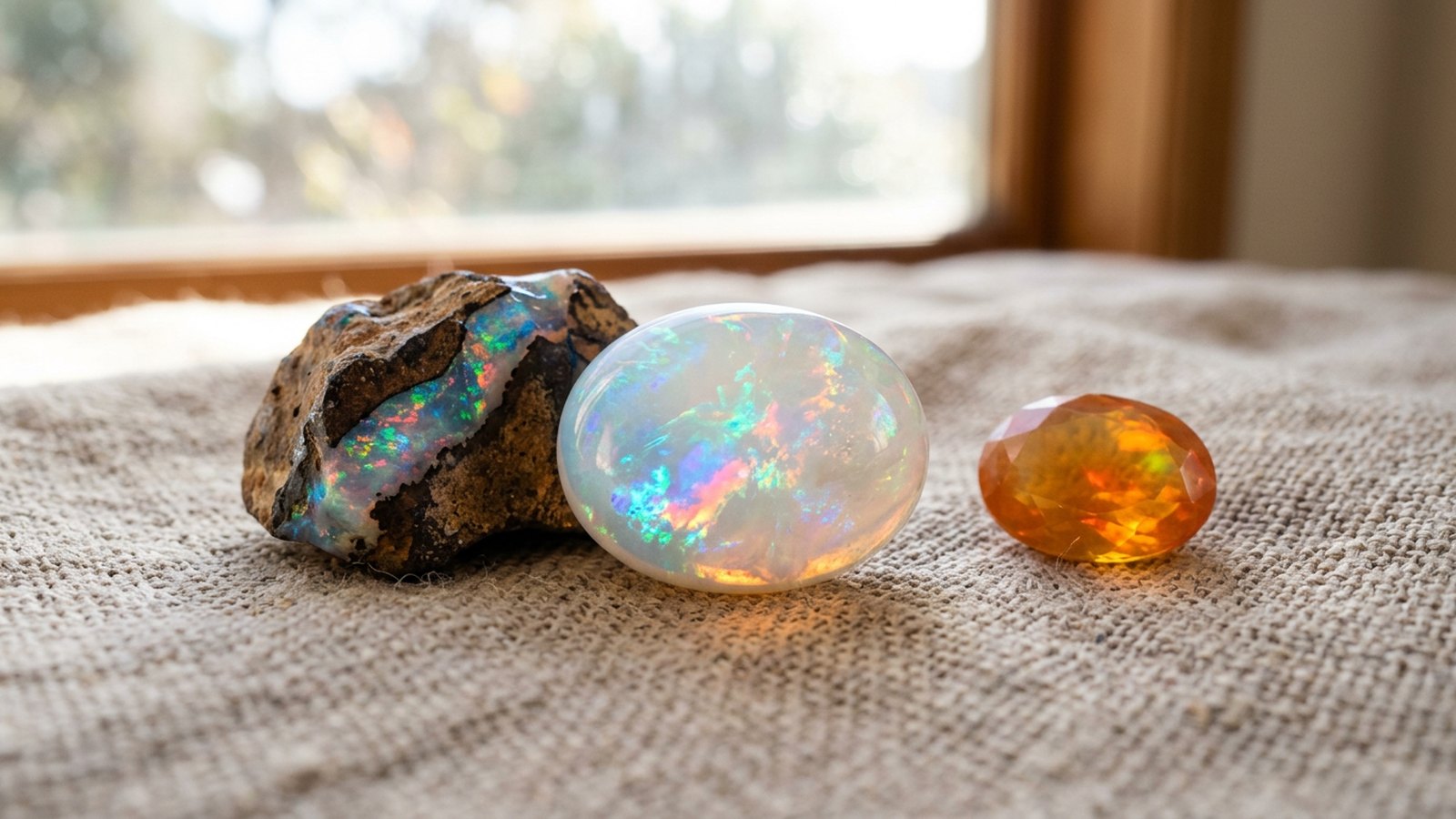
Hold an opal to a window and tip it slowly, and the whole stone seems to catch fire from the inside. Flecks of green, blue and rose flash and vanish as the light moves, as if a small storm of colour were trapped under the surface. No two are alike, and even a single stone never looks the same twice. That living, shifting glow is exactly why opal has been called the Queen of Gems, and why I think of it as the stone of imagination and feeling.
Opal's meaning centres on hope, creativity and emotional truth. Where a grounding stone asks you to settle and hold still, opal does something closer to the opposite: it invites you to feel, to dream and to let your inner light move. It is a soft, watery, quietly magical stone, and it has carried a reputation for both good fortune and bad luck across three thousand years of human history. Here is what opal actually means, where that meaning comes from, and how to work with a stone this delicate without harming it.
The meaning of opal
At its heart, opal is a stone of hope and imagination. The old lapidaries called it the Eye Stone and the Queen of Gems, and every culture that met it seemed to reach for the same idea: that this was a fragment of rainbow, lightning or light made solid. Because opal flashes with every colour at once, it has never been tied to a single, narrow message. It is the whole spectrum of feeling held in one stone.
Symbolically, opal stands for:
- Hope and optimism, a return of light after a dark stretch
- Imagination and creativity, the spark artists, writers and dreamers keep close
- Emotional depth and honesty, feeling your feelings rather than hiding them
- Amplification, said to magnify whatever you bring to it, for better or worse
- Love and passion, especially in the warm fire opals
That amplifying quality is worth naming early, because it shapes how the stone is used. Traditionally, opal is thought to turn up the volume on your inner state, strengthening hope when you feel open and bringing harder feelings to the surface to be looked at. That is why I treat opal as an honest companion rather than a purely soothing one.
Reasons to work with opal
Opal is the stone I reach for when life has gone grey and flat and I want to feel colour again. After a hard season or a long stretch of just getting through, its play-of-colour is a small, daily reminder that light is still moving inside things. People have carried it for centuries as a symbol of hope, and that is still its clearest gift.
Opal is a creativity stone, plain and simple. If you make things, write, paint, design or perform, it is a natural desk companion. I like it near me at the start of a project, when the blank page is loudest, because it seems to loosen the grip of self-editing and let ideas arrive before I judge them. If you keep a small collection for your work, opal pairs beautifully with the sunlit push of carnelian for confidence and follow-through.
Opal is an emotional stone for people who tend to armour up. Its watery, feeling-forward energy asks you to soften and let things move, which is uncomfortable if you are used to holding it in, and quietly freeing once you do. In that sense it sits close to the gentler heart work of crystals for self-love.
Opal is also a stone of love and desire, especially in its fiery orange and red forms. Fire opal has long been linked to passion, courage and the spark of new attraction, a warmer, bolder note than the dreamy pale opals. Where a white opal whispers, a fire opal glows.
Opal meaning and healing energy
Emotional healing
Opal's traditional territory is the emotional body. Because it is said to amplify feeling, it is used less to numb difficult emotions and more to bring them into the light where you can actually work with them. Old texts call it a stone of happy dreams and gentle change, reached for during transitions when your feelings are close to the surface and you want to move through them rather than around them.
Spiritual healing
Spiritually, opal is treated as a stone of light and intuition. Its rainbow flash is read as a symbol of the full spectrum of consciousness, and pale precious opals in particular are used in meditation to encourage inspiration, imagination and a sense of connection to something larger. If you like to work quietly with a stone in hand, our guide to meditating with crystals is a good place to begin.
Mental healing
On the mental side, opal is associated with creativity and spontaneity rather than sharp, cold focus. The tradition is that it frees up stuck thinking, loosens the inner critic and lets fresh ideas surface. For anyone whose creative work has gone rigid or fearful, that loosening is the whole appeal.
Physical healing
In folk tradition opal has been linked to the eyes (its old nickname was the Eye Stone) and to renewal more generally. I want to be honest here: these are cultural and intuitive associations, not medical facts. Opal is not a treatment and does not replace a doctor or any professional care. Enjoy it as a beautiful symbol, and see a qualified practitioner for anything to do with your health.
A compact properties block for opal:
- Chakras: colour dependent, most often the crown and third eye (pale opals), with fire opals working the sacral centre. See our chakra crystals guide.
- Zodiac signs: Libra and Scorpio (October), with a traditional affinity for Cancer
- Element: Water, with fire opal carrying the element of Fire
- Numerical vibration: 8
- Affirmation: "I let my imagination and my feelings move freely, and I trust the light I carry."
The many colours of opal, and what they mean
Opal comes in more variety than almost any other gem, and because its energy is read through its colour, each type carries a slightly different meaning. This is also where opal connects to the wider language of crystal colours and their meanings.
- White or light opal is the classic milky stone with pale flashes of colour. It is the most common precious opal and the one most tied to hope, purity and gentle spiritual light, often linked to the crown chakra.
- Black opal has a dark body tone that makes its play-of-colour blaze. The rarest and most valuable type, it is read as a protective, grounding opal, a rainbow held against the dark.
- Boulder opal forms in seams through ironstone rock and is often left on its host stone. That earthy backing gives it a steadier, more grounded feel than the floating pale opals.
- Crystal opal is transparent to translucent, its play-of-colour seeming to hang in clear space, and is prized for clarity of both sight and intention.
- Fire opal is the warm one, glowing orange to red, usually without the rainbow flash. It carries passion, courage and creative drive, and is the opal most linked to the sacral chakra.
- Common opal, or potch, shows no play-of-colour at all. Pink, green and blue common opals are gentle, everyday stones, used for soothing and heart work rather than fireworks.
The geology of opal
Here is where opal gets genuinely strange, and where a lot of guides get it wrong. Opal is not a crystal at all. It is a mineraloid, an amorphous form of hydrated silica with the formula SiO2 followed by nH2O, meaning it contains water, usually between three and twenty one percent by weight. Most gemstones are built from atoms locked in a repeating crystal lattice. Opal has no such internal order, which is part of why it behaves so unusually.
It is also soft, around 5.5 to 6.5 on the Mohs scale, and porous, both of which matter for how you care for it.
So where does the flashing rainbow come from, if not from a crystal structure? The answer was only settled in the 1960s, when Australian scientists John Sanders and Peter Darragh at the CSIRO put opal under an electron microscope. They found that precious opal is built from countless tiny spheres of silica, each only a couple of hundred nanometres across, stacked in a neat three dimensional grid. When light passes through those orderly rows, it diffracts and splits into spectral colours, exactly the way a fine diffraction grating works. The size of the spheres decides which colours you see. Common opal has the same spheres but jumbled and uneven, so the light scatters instead of splitting, and there is no flash. The whole difference between a plain stone and a Queen of Gems is a matter of how tidily nature stacked its microscopic marbles.
The name matches the mystery. Opal traces back through the Latin opalus and the Greek opallios to the Sanskrit upala, simply meaning precious stone or gem. Some read the Greek as hinting at a stone that changes, which suits it perfectly.
Opal history and lore
Few stones carry as much story as opal. The Roman writer Pliny the Elder adored it, describing an opal as combining the fire of the ruby, the purple of the amethyst and the sea green of the emerald all in one stone. Rome valued opal so highly that Pliny records the tale of the senator Nonius, who owned a famous opal the size of a hazelnut. Mark Antony wanted it as a gift for Cleopatra, who was said to love the stone, and when Nonius refused to sell, Antony had him banished. Nonius chose to flee Rome into exile with almost nothing rather than give up his opal, a fair measure of how precious this gem once was.
Many cultures met opal and reached for the sky to explain it. Arabian tradition held that opals fell from the heavens in flashes of lightning. Aboriginal Australians, who live above the world's great opal fields, tell of a Creator who came to earth on a rainbow, and where his foot touched the ground the stones lit up with every colour. In Mexico, the Aztecs treasured fire opal and linked it to the feathered serpent Quetzalcoatl. Across medieval Europe opal was thought to sharpen the eyes and even, wrapped in a bay leaf, to grant invisibility, which earned it the Latin nickname patronus furum, the patron of thieves.
For most of that long history, opal was considered deeply lucky, a stone of hope, prophecy and protection. Which makes its modern reputation all the more surprising.
Is opal really unlucky?
You will still hear that opals bring bad luck, or that you should never wear one unless it is your birthstone. It is worth knowing where that idea actually came from, because it is far more recent and far more flimsy than it sounds.
The superstition traces largely to a single novel. In 1829 Sir Walter Scott published Anne of Geierstein, in which the enchanted Lady Hermione wears an opal that flashes with her moods and, when touched by a drop of holy water, loses its fire; soon after, she dies and crumbles to ash. Readers took the fiction as folklore. The gemmologist George Frederick Kunz later blamed the book directly for opal's slump in popularity, and some accounts add that European opal dealers of the day suffered badly for it.
The tide turned thanks to a very practical monarch. Queen Victoria loved opals, championed the new Australian stones, and gave opal jewellery to her daughters as wedding gifts, publicly defying the whole superstition. So no, opal is not unlucky. For thousands of years before one novelist reached for a spooky prop, it was one of the most hopeful stones a person could carry. If a stone genuinely unsettles you, do not wear it, but there is no old tradition behind the fear, only a good ghost story.
Where opal comes from and how to care for it
Australia is the heart of the opal world, producing the great majority of the planet's precious opal. Lightning Ridge in New South Wales is famous for black opal, Coober Pedy in South Australia for white opal, and Queensland for boulder opal. Mexico gives us fire opal, Ethiopia has become a major source of bright hydrophane opal, and Brazil, the United States and elsewhere add to the supply.
Caring for opal matters more than for almost any stone in your collection, precisely because it holds water and is soft. Opal can craze, meaning it develops a fine network of surface cracks, if it dries out, overheats or meets a sudden change in temperature. So keep it away from radiators, hot cars, steam and direct blazing sun.
The water question surprises people. Because opal already contains water, it does not need soaking, and soaking can actually harm it. Porous opals, especially Ethiopian hydrophane, can drink up water, discolour and temporarily lose their play-of-colour, and any assembled opal (a doublet or triplet, which is a thin slice glued to a backing) can have its layers loosened by water. Never put opal in an ultrasonic or steam cleaner. A quick wipe with a soft, barely damp cloth is all it needs, and if you want the fuller picture, see our guide to which crystals can and cannot go in water.
For energetic cleansing, keep it gentle and dry. Sound from a bell or bowl, a smoke cleanse, or a night resting on a bed of dry hematite or amethyst all work well without any risk. To recharge it, soft moonlight is the traditional and safest choice, since strong sunlight can fade and dry the stone. Our guides to cleansing your crystals and charging your crystals cover the methods in more detail, and since opal is a delicate stone that is often imitated in glass and plastic, our notes on how to tell if a crystal is real are worth a read before you buy.
Working with opal is simple: wear it as a ring or pendant so it moves and catches the light through the day, keep a piece on your desk or altar where its colour can lift a dull moment, or hold it during quiet reflection when you want to feel more open and imaginative. If you are choosing where to keep your stones, our guide on where to place crystals in your home can help.
A last word on opal
Opal has always struck me as the most honest of the beautiful stones. It does not pretend to be calm and steady; it flickers, it feels, it changes with the light, and it asks you to do the same. As the October birthstone and the traditional gift for a fourteenth wedding anniversary it marks milestones for many people, but you do not need an occasion to love it. If you are drawn to its shifting fire, you might also enjoy the softer glow of moonstone, opal's cool, dreamy cousin in light. Keep your opal gently, let it catch the sun's edge rather than its full heat, and let it remind you that there is colour moving inside things, even on the grey days.