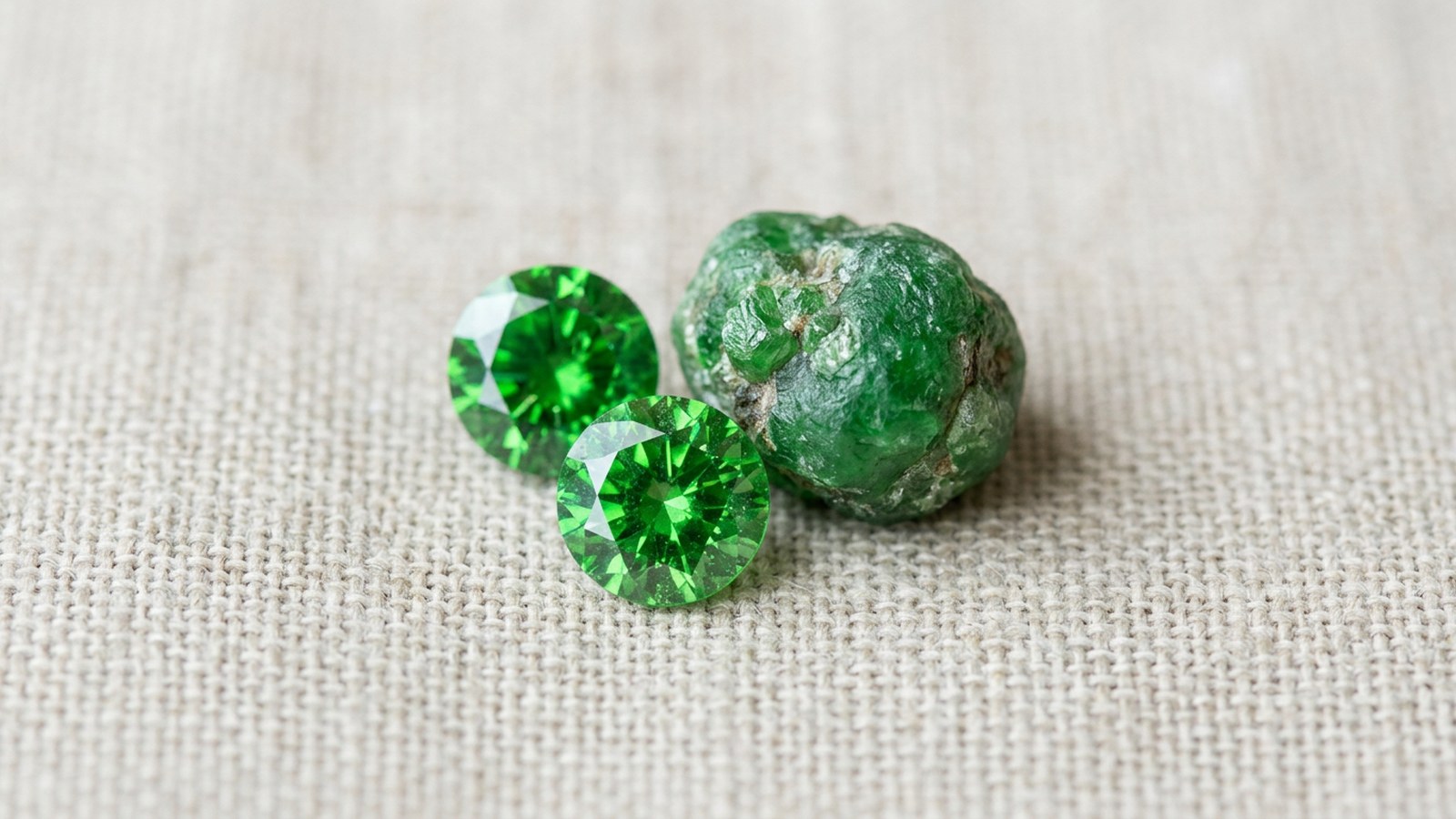
The first tsavorite I ever handled came out of a small paper parcel on a dealer's table, a round stone of barely half a carat that threw back so much light I took it for a piece of green glass. Beside it, on the same white tray, lay an emerald of about the same size, softer and deeper in colour, with a faint mist of inclusions you could see if you tilted it toward the window. The dealer asked me which one I would wear every day. I chose wrong, and he spent the next twenty minutes explaining why.
This guide is for anyone standing in that same spot: holding a green stone and wondering which of the two it is, or choosing between them for a ring, a pendant or a crystal practice. I will go through what each stone actually is, the checks that separate them at home (and the popular ones that do not), the fakes and treatments on both sides, durability, price, history, what each is said to carry in crystal tradition, and which one I would suggest for which kind of life.
Tsavorite vs emerald, in short
Emerald is the green variety of beryl, a beryllium aluminium silicate (Be3Al2Si6O18) with a Mohs hardness of 7.5 to 8, a hexagonal crystal structure and a refractive index around 1.57. Tsavorite is the green variety of grossular garnet, a calcium aluminium silicate (Ca3Al2(SiO4)3) with a hardness of 7 to 7.5, a cubic structure and a refractive index around 1.74. Both take their green from traces of chromium and vanadium. Emerald usually carries visible inclusions and is almost always oiled; tsavorite is usually eye-clean, brighter and sold untreated. Tsavorite is about a third heavier for its size, which is the most reliable home test on a loose stone.
Two different minerals coloured by the same elements
The chemistry of the colour is the one thing these stones share. Chromium and vanadium sit in place of a little aluminium inside each crystal, and they absorb red and blue light in a way that leaves green for the eye. Everything else about the two stones differs, starting with the crystal that carries the colour.
Emerald grows as six-sided prisms, often in turbulent hydrothermal veins (Colombia) or in mica schists where granite fluids met chromium-rich rocks (Zambia, Brazil, Zimbabwe). That violent birth is why almost every emerald has fractures and fluid inclusions, the "jardin" or garden that gemmologists treat as its fingerprint. Tsavorite forms in the metamorphic rocks of the Mozambique Belt in Kenya and Tanzania, usually as small rounded nodules inside graphite-bearing gneiss. The nodules are rarely large, which explains why fine tsavorite above a few carats is so scarce.
| Emerald | Tsavorite | |
|---|---|---|
| Mineral | Beryl | Grossular garnet |
| Formula | Be3Al2Si6O18 | Ca3Al2(SiO4)3 |
| Crystal system | Hexagonal | Cubic |
| Mohs hardness | 7.5 to 8 (brittle) | 7 to 7.5 (tough) |
| Refractive index | about 1.57 to 1.59 | about 1.74 |
| Specific gravity | about 2.72 | about 3.6 |
| Refraction | Double, two shades of green | Single, one green |
| Typical clarity | Inclusions expected | Often eye-clean |
| Usual treatment | Oil or resin | None |
The higher refractive index and roughly double the dispersion give tsavorite its lively, almost neon sparkle, even in dim restaurant light. Emerald returns less light and reads as a deeper, velvety glow. Most people know within a few seconds which of the two looks they prefer.
How to tell tsavorite and emerald apart at home
Colour alone will not settle it. Both range from yellowish to slightly bluish green, and I have seen Zambian emeralds and Tanzanian tsavorites that matched shade for shade. Here are the checks in the order I would use them, with honest notes on what each one can and cannot do.
- Look inside with a 10x loupe. A garden of wispy fractures, three-phase fluid inclusions or fine parallel tubes points to emerald. A clean interior points to tsavorite, though it also fits a synthetic emerald or glass, so this check narrows the field without closing it.
- Turn it under a dichroscope or a polarising filter. Emerald is doubly refractive and shows two slightly different greens, one more bluish and one more yellowish, as you rotate it. Tsavorite shows a single colour from every direction. This is the cleanest optical separation a hobbyist can make.
- Weigh it in water (loose stones only). Weigh the stone dry on a carat scale, then suspended in a cup of water, and divide the dry weight by the difference. Emerald lands near 2.72, tsavorite near 3.6. The gap is large enough that a cheap 0.01 ct pocket scale will show it on any stone over about one carat.
- Use a refractometer if you have one. Emerald reads around 1.57 to 1.59, tsavorite about 1.74. One forum reply that ranks for this query gives garnet as roughly 1.80, which is true for pyrope and almandine but too high for grossular, so a reading near 1.74 is exactly what a genuine tsavorite should give.
Two popular checks let people down here. The Chelsea filter is often sold as an emerald detector because chromium-rich emerald glows red through it, yet chromium-bearing tsavorite can glow pinkish red as well, so a red reaction proves neither stone. Looking for doubled facet edges with a loupe also fails, because emerald's birefringence is so small (about 0.006) that the doubling is almost impossible to see. A long-wave UV torch is useful only for one thing: many synthetic emeralds fluoresce a distinct red, while most natural emeralds stay inert or glow faintly. For a stone of real value, a lab report from GIA, SSEF, Gübelin or AGL is the only certainty, and for emerald it will also tell you how heavily the stone has been oiled.
Fakes and treatments on both sides
Emerald is one of the most treated gems on the market. Cutters fill surface-reaching fractures with cedarwood oil or a synthetic resin such as Opticon, which hides the cracks and lifts clarity. It is an accepted, disclosed practice, graded on reports as none, minor, moderate or significant. The risk is undisclosed coloured oil, which adds green that is not really there. Synthetic emerald has been grown since the 1930s by flux and hydrothermal methods, and it often looks cleaner than nature allows. A large, eye-clean, inexpensive "emerald" is the classic warning sign, and the same caution applies to green glass and to dyed quartz sold as "emerald quartz". To answer the question people ask most often: quartz and emerald are different minerals, and green quartz (prasiolite) or dyed quartz has none of emerald's value. I covered the same family of imitations in my guide to peridot vs emerald.
Tsavorite has an easier story. It is not heated, oiled or filled as a market norm, and there is no commercial synthetic. Its lookalikes are other green stones: chrome tourmaline, chrome diopside (much softer, about 5.5), green YAG and glass. Two labels also matter. Merelani mint garnet is the same grossular species in a pale, cool green, and a pale stone sold at tsavorite prices deserves a question about which word the lab report uses. Demantoid is a different garnet, andradite, with fire stronger than diamond, and it costs more again. You can read about the whole garnet family in my garnet meaning guide.
Durability and everyday care
On paper emerald looks tougher because it is harder. In practice hardness measures scratch resistance, and emerald's weakness is brittleness. Its internal fractures and a poor cleavage mean a sharp knock against a door frame can chip or crack it, and a ring stone worn daily needs a protective bezel or raised claws and a habit of taking it off for gardening, gym work and washing up. Tsavorite has no cleavage and no fissure network, so it takes daily knocks much better despite its slightly lower hardness.
Care follows from the treatments. Never put an oiled emerald in an ultrasonic cleaner or a steamer, avoid hot water and solvents, and expect a jeweller to suggest re-oiling every few years. Clean it with lukewarm water, a drop of mild soap and a soft brush. Tsavorite tolerates warm soapy water and, in most cases, ultrasonic cleaning, with the usual caution for any visibly included stone. For energetic cleansing, gentle methods such as smoke, sound or moonlight suit both stones, and you will find them in cleansing crystals.
If you want green in a ring you never need to think about, a question in the search results points the right way: green sapphire is indeed a strong stone. At 9 on the Mohs scale and with no cleavage, corundum outlasts both of these.
Price and value: is tsavorite more valuable than emerald?
For a comparable look below about two carats, tsavorite usually costs less. A fine, eye-clean one-carat tsavorite sits in the low four figures per carat at retail, while a fine emerald of similar colour with minor oil commonly costs more, and a no-oil emerald with a lab report costs much more again. Above three carats the picture shifts, because clean tsavorite becomes genuinely rare and per-carat prices climb toward those of good emerald. Emerald, by contrast, is available in large sizes, and many people feel it shows at its best above two carats, where the depth of colour and the garden become part of its beauty.
To answer whether tsavorite is more valuable: carat for carat at the top of the market, emerald still commands more, while tsavorite gives more brightness and clarity for the money in small and medium sizes. Name recognition carries a large share of emerald's price.
Two very different histories
Emerald has one of the longest records of any gem. The mines of the Egyptian Eastern Desert, at sites such as Wadi Sikait, were worked in the Roman period and later linked with Cleopatra. The Muzo and Chivor deposits of Colombia, worked long before the Spanish arrived in the sixteenth century, then flooded European and Mughal courts with stones; the Mogul Emerald, carved with prayers in 1695, weighs over 217 carats. Emerald is the May birthstone, and it sits beside aquamarine in the beryl family, a pairing I explored in emerald and aquamarine.
Tsavorite is a modern gem with a single protagonist. The Scottish geologist Campbell Bridges found bright green grossular in northeastern Tanzania in 1967, then followed the same rocks across the border and found it again in Kenya near Tsavo National Park. In 1974 Tiffany & Co. launched it and its president Henry Platt named it after the park. Bridges mined there for four decades and was killed in 2009 during a dispute over access to his mine. Tsavorite also comes from the Merelani Hills, the same ground that gives tanzanite. As a garnet it is often offered as an alternative January birthstone.
What each stone is said to carry
In crystal tradition both stones belong to the heart chakra, and green has long been read as the colour of growth and renewal. What follows is tradition and personal intuition, offered as that and never as a substitute for medical or psychological care.
Emerald is the older voice of love and loyalty. Practitioners link it with steady, committed affection, patience in relationships and clear speech from the heart, which is why it turns up so often in lists of crystals for love. It is traditionally associated with Taurus. When I hold a good emerald, the feeling I get is one of slowness and depth, which is why I reach for it when I want to stay with a feeling rather than move past it.
Tsavorite is read as livelier. Modern practitioners connect it with vitality, generosity and prosperity, and as a garnet it shares the family's grounding, energising reputation. It shows up in work around abundance and new beginnings, and through its garnet lineage it is linked with Capricorn. In my hand it feels quicker and brighter, and I tend to pick it up at the start of a project.
Wearing both together is fine; they sit on the same chakra and nothing in tradition sets them against each other.
Tsavorite or emerald: which should you choose?
- You want history, name and deep colour: choose emerald. Nothing else carries its story, and a larger stone with a visible garden has a presence tsavorite cannot copy. Accept the care that comes with it.
- You want a green ring for daily wear on a sensible budget: choose tsavorite under two carats. It is brighter, untreated and copes with ordinary life much better.
- You want a big green centre stone: emerald, because large clean tsavorite is rare and priced accordingly.
- You refuse any treatment: tsavorite, or a green sapphire if you also want maximum hardness.
- You want a heart chakra stone for meditation rather than jewellery: a rough or tumbled emerald costs little and suits slow, steady work; tsavorite rough is harder to find, so many people use it set in a pendant.
- You already own one and are unsure what it is: start with the dichroscope and, for a loose stone, the water weighing above, then get a lab report if the stone matters to you.
A last word
I still think about that paper parcel and the two green stones side by side: the same elements doing the colouring, two completely different crystals carrying it, and two very different ways of living with them. Whichever one you choose, choose it for how it behaves on you and how its colour makes you feel. You can read more on the emerald stone page and on the tsavorite stone page, and if your green stone turns out to be neither, my guides to peridot vs emerald and garnet vs ruby cover their closest cousins.