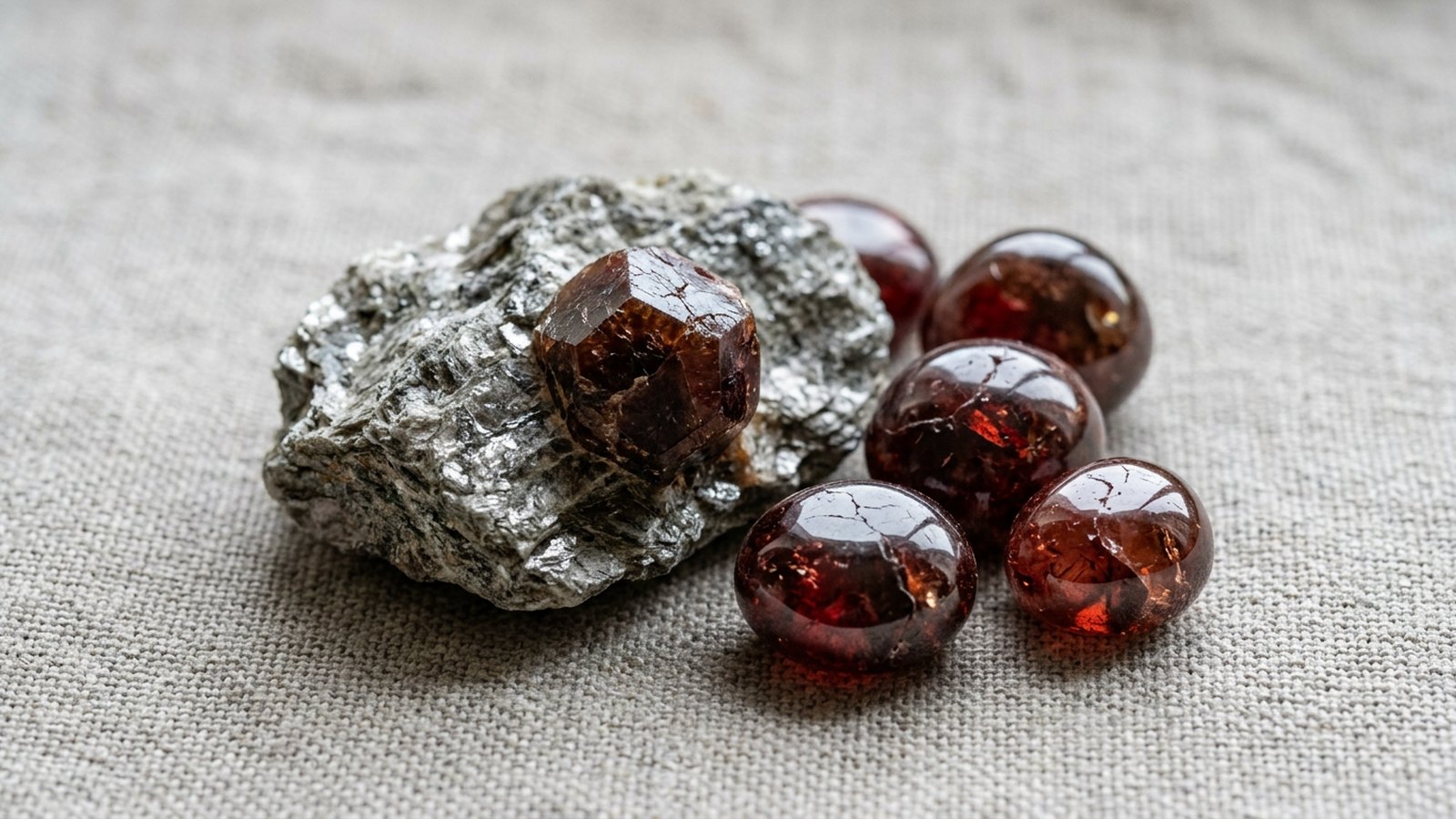
The first garnet I owned was a small tumbled pebble the colour of dark cherry syrup, and I spent about a year being quietly wrong about it. I thought garnet was a stone. It is not. Garnet is a family of at least six minerals that agree on a crystal shape and disagree on almost everything else, including colour, hardness, price, and what people say it does.
That sounds like trivia until you notice what it explains. It explains why one page tells you garnet is Mohs 7.5 and another says 6.5. Why one says it is always red and another sells you a green one. Why the zodiac attribution wanders between Capricorn, Aquarius, Aries and Leo depending on whose site you land on. They are all describing different minerals and calling them by the same word.
So this guide does two things. It gives you the meaning, the lore and the energy that garnet has carried for four thousand years, and it tells you which of the six you are probably holding, because that changes the practical answers.
What garnet means
Garnet means seed. The name comes from the Latin granatum, from malum granatum, the pomegranate, because a cluster of small red crystals in grey rock looks exactly like seeds in the pale flesh of that fruit. The Middle English gernet simply meant dark red. Symbolically, garnet has meant three things consistently across cultures: protection on a journey, loyalty and enduring love, and vitality or life force. It is the January birthstone, it is traditionally tied to the root chakra, and in modern crystal practice it is the stone people reach for when they need to want something again.
That last one is the meaning I trust most, because it is the one I have felt. Garnet is not a calm stone. It is a warm one.
Reasons to work with garnet
Garnet is for the point where you have rested enough. There is a stage after a hard season where the resting stops helping and starts becoming the new problem. You are not in crisis anymore, you are just not moving. Garnet is the stone I hand people there. It does not push. It warms, the way a room warms, and at some point you notice you have started doing things again. If that is precisely your situation, the guide on crystals for motivation sorts three different kinds of stuck and is worth reading beside this one.
Garnet is for commitment, not romance. Rose quartz is for opening the heart. Garnet is for staying. It has been given as a token of return since the Roman period, carried by travellers so they would come back, and that flavour has never left it. If you are trying to sustain something already begun, a relationship, a practice, a promise you made to yourself in January, garnet suits that better than the softer love stones.
Garnet is for people who go pale under pressure. Tradition ties it to blood and to circulation, and whatever you make of that, the felt sense is right: it is a stone for those who tend to get cold, withdraw and shrink when things get hard. It restores presence in the body. This is why it sits so naturally beside red jasper, which does the same work more slowly, and carnelian, which does it more brightly.
Garnet is for protection that keeps you moving. Black tourmaline protects by absorbing and by putting a wall up. Garnet protects the way armour does, close to the body and still letting you walk. Warriors carried it for exactly this reason, and the protection guide covers where each of those approaches belongs.
Garnet meaning: healing energy
Emotional healing. Garnet works on flatness rather than pain. Grief has its own stones, but the numbness that follows a long strain, where nothing is wrong and nothing is interesting either, is where I have found garnet useful. It brings back appetite in the broad sense: for food, work, company, plans.
Spiritual healing. In the old systems garnet anchors. It is a root stone, meaning it works on the sense of having a right to be here, take up space, and want things. If your practice has drifted upward into the abstract, garnet is a way back down into a body and a life.
Mental healing. Garnet is associated with commitment to a decision. Not clarity, which belongs to fluorite and clear quartz, but the willingness to close a question and act. Useful for the chronically deliberating, less useful if your problem is that you act too fast.
Physical healing. Traditional lore links garnet to blood, circulation, stamina and warmth, and old European texts recommended it for haemorrhage and inflammation. That is folk history, not medicine. A stone does not treat a circulatory condition or anything else, and if something in your body worries you, please see a doctor rather than a crystal.
Chakra: Root, with some traditions adding Heart for the green varieties Zodiac: Capricorn and Aquarius (the two signs January falls across), with Aries and Leo often added for the fire varieties Element: Fire, resting on Earth Numerical vibration: 2 Affirmation: I have the fire to begin, and the ground to stand on.
Which garnet do you actually own?
Here is the part almost no other page will give you plainly. Garnet is a group of nesosilicates sharing the general formula X₃Y₂(SiO₄)₃, where X and Y are different metals in each species. Six species matter, plus two famous blends.
| Species | Colour | Mohs | What it usually is |
|---|---|---|---|
| Almandine | Deep red to brownish red | 7 to 7.5 | Most tumbled and beaded garnet |
| Pyrope | Bright blood red | 7 to 7.5 | Bohemian antique jewellery |
| Rhodolite | Raspberry to purplish red | 7 to 7.5 | Pyrope and almandine blended |
| Spessartine | Orange to mandarin | 6.5 to 7.5 | The orange one, often called mandarin |
| Grossular | Green, honey, cinnamon, colourless | 6.5 to 7 | Includes tsavorite (green) and hessonite (cinnamon) |
| Andradite | Green, yellow, black | 6.5 to 7 | Includes demantoid, the rare brilliant green |
| Uvarovite | Emerald green only | 6.5 to 7 | Tiny crystals on matrix, rarely cut |
If you bought an affordable red garnet from a crystal shop, it is almost certainly almandine. If it is orange, spessartine. If it is green and cost a great deal, tsavorite or demantoid. If it is green and cost very little, check that it is garnet at all, because green glass and dyed quartz both travel under the name.
Does the species change the energy? Traditional practice says the colour does, which amounts to the same thing: red garnets for vitality and grounding, orange for creative drive, green for the heart and for prosperity. I hold that loosely. The through line of the whole family, the warm insistent forward push, is the same in every one I have handled.
Garnet geology
Garnets crystallise in the isometric system, which is why they form those satisfying near spherical shapes: the rhombic dodecahedron with twelve diamond faces, and the trapezohedron with twenty four. If you have ever seen a red bead sitting proud of a slab of grey mica schist, that is almandine, and that rock is the classic occurrence. Garnet grows under heat and pressure, which makes it a metamorphic mineral above all, and geologists read the species and composition of a garnet to work out the temperature and depth at which its host rock was cooked.
Pyrope has a different story. It comes up from the mantle in peridotite and kimberlite, riding the same pipes as diamond, which is why prospectors treat certain pyrope garnets as an indicator mineral: find these, and diamonds may be nearby.
Colour comes from what sits in the lattice. Iron gives the dark reds of almandine, magnesium the clear red of pyrope, manganese the orange of spessartine, chromium and vanadium the greens of tsavorite and uvarovite. Hardness runs 6.5 to 7.5 across the group, and no garnet is water soluble.
Garnet history and lore
Garnet is one of the oldest worked gems on record. Beads turn up in Egyptian burials from well before the Middle Kingdom, and jewellery from the tomb of Princess Sithathoryunet, around 1880 BCE, uses it. Greeks and Romans cut it for signet rings, so a garnet was often the thing that sealed a document and proved who you were.
Then comes the era that still amazes me. Between roughly the fourth and eighth centuries, Anglo-Saxon and Frankish goldsmiths made cloisonné work of astonishing precision, thousands of paper thin garnet plates set into gold cells. The Sutton Hoo treasure is the famous example, and analysis of similar pieces suggests much of that garnet travelled from India and Sri Lanka to northern Europe, which tells you how far this stone moved fifteen hundred years ago.
Medieval Europe called red gems carbunculus, little coal, and the carbuncle of the old texts is sometimes garnet, sometimes ruby, sometimes spinel. The thirteenth century Book of Wings advised engraving a lion on a garnet for safe travel. Jewish tradition holds that Noah lit the ark with a glowing stone, and later commentators guessed carbuncle.
Around 1500 large pyrope deposits were found in Bohemia, in what is now the Czech Republic, and Bohemian garnet jewellery, dozens of small stones clustered like pomegranate seeds, became a European standard through the Victorian period. Queen Victoria wore it, which was all it took.
Is your garnet real, and who should not wear it
Good news first: garnet is rarely faked, because it is not usually worth faking. It is far more often the substitute. Historically garnet stood in for ruby so routinely that "Cape ruby" and "Arizona ruby" are just red garnets under a flattering name. Being aware of that direction of deception is more useful than fearing a fake. If you need to settle whether a red stone in front of you is garnet or ruby, my garnet vs ruby guide sets out the home tests in the order I use them.
Still, three quick checks. Garnet is dense, noticeably heavier in the hand than glass of the same size. It has no bubbles: hold it to a light and look for the small round voids that betray moulded glass. And it is singly refractive, so unlike a ruby you will never see doubled edges through it. The broader method is in how to tell if a crystal is real.
As for who should avoid it, the honest answer is that this question comes from Vedic astrology and is about one specific garnet, not the family. Hessonite, the cinnamon grossular known as gomed, is assigned to the shadow planet Rahu, and Jyotish practice treats it as a stone to be prescribed rather than picked up casually. That caution has since been copied across the internet onto all garnets, which is not what the tradition says. In Western crystal practice there is no contraindication at all, though I would give any strongly stimulating stone a wide berth at bedtime if you sleep badly.
Where it comes from and how to care for it
Gem garnet comes mainly from India, Sri Lanka, Madagascar, Tanzania, Brazil, Mozambique and the United States. But most garnet mined on earth never becomes jewellery. Almandine is one of the world's principal industrial abrasives, and the garnet in sandpaper and in the waterjet cutters that slice steel is the same mineral you carry for courage. I find that a good corrective to preciousness.
Care is easy. At 6.5 to 7.5 garnet handles daily wear, warm soapy water and a soft brush. Skip ultrasonic cleaners, since many garnets carry inclusions and fractures that do not enjoy vibration. Store it apart from softer stones, as covered in how to store crystals. Brief water contact is fine, though the water safety guide is worth a read before you get in the habit. To reset it I use running water, a night on the windowsill, or smoke, all covered in cleansing crystals.
A last word
Garnet is not subtle and it is not gentle, and that is the whole point of it. It is the stone for the moment when you have understood your situation completely and still have not moved. Wear it close to the skin, as the wearing guide suggests, and give it a few weeks.
If you are starting something rather than restarting it, pair it with a stone of patience: moss agate for slow growth, or read the guide on crystals for new beginnings. And if what you actually need is to trust yourself out loud, confidence is the next door along. Garnet gets you moving. Where you go is your business.