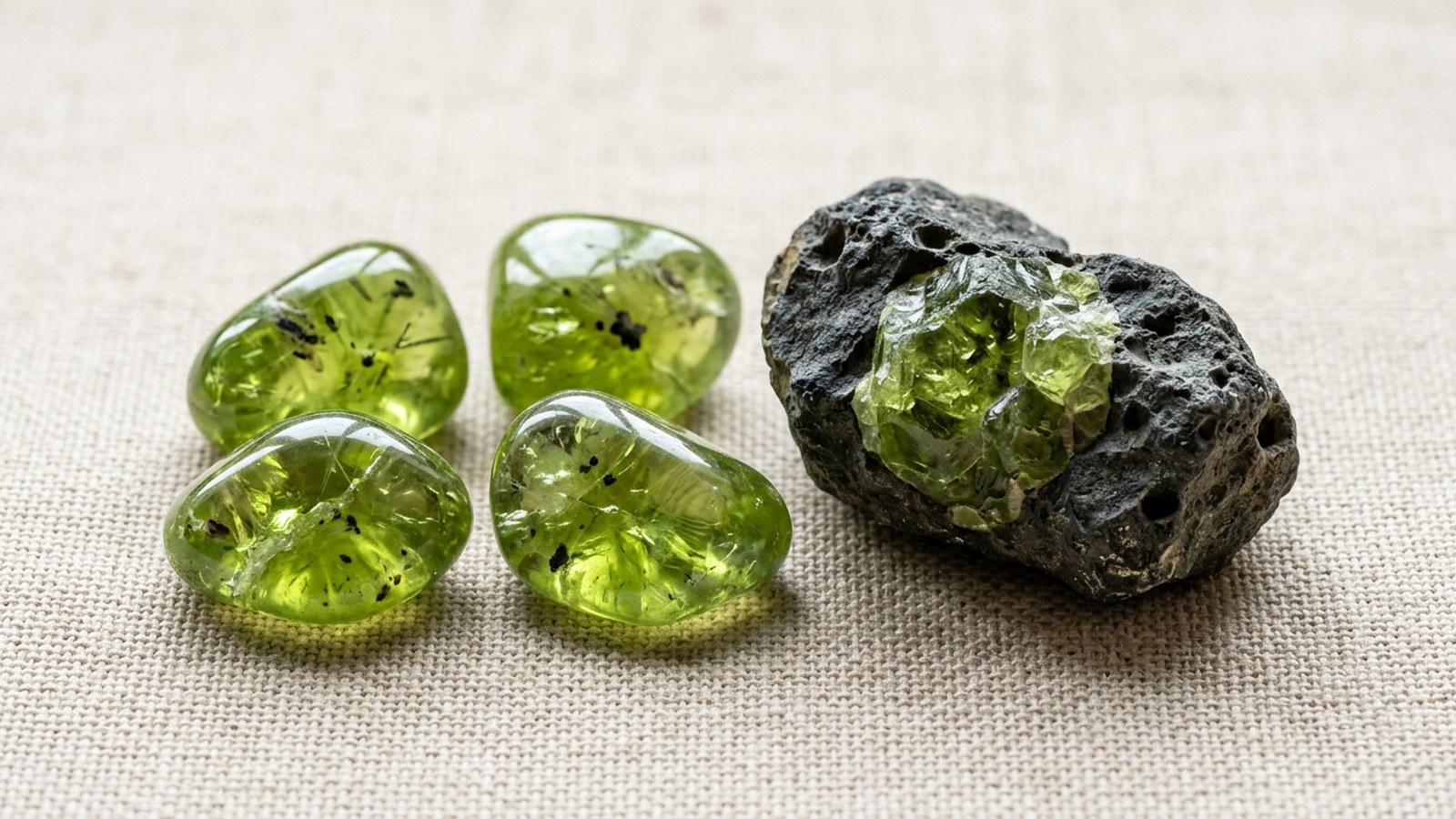
A few summers ago a woman at a mineral fair handed me a ring across the table and asked whether her "little emerald" was worth insuring. The stone was a bright, almost lime green, very clean, set in a slim silver band. I put my ten times loupe on it, looked down through the table facet and saw every back edge of the stone drawn twice, like a pencil line traced by an unsteady hand. That doubling was the whole answer. It was a lovely peridot, and she was more relieved than disappointed, because she had always felt it was a "happy" stone and now it had a name that matched.
Peridot and emerald have been mistaken for one another for at least two thousand years, in cathedral treasuries as much as in market trays. This guide explains what each stone really is, the checks you can make at home (and the ones that will mislead you), the fakes that circulate on both sides, how they wear and what they cost, where the confusion comes from in history and scripture, and what each is traditionally said to carry, so you can choose the green that suits you.
Peridot vs emerald: the short answer
Emerald is green beryl, coloured by chromium or vanadium, with a hardness of 7.5 to 8, a cool or slightly bluish green and almost always some visible inclusions. Peridot is gem olivine, coloured by iron, with a hardness of 6.5 to 7, a warmer yellow or olive green, strong double refraction and usually very clean clarity. Emerald is a precious stone and costs many times more per carat. Peridot is the August birthstone, emerald the May birthstone.
| Peridot | Emerald | |
|---|---|---|
| Mineral | Olivine (forsterite), (Mg,Fe)2SiO4 | Beryl, Be3Al2Si6O18 |
| Colour cause | Iron, part of the crystal itself | Traces of chromium and/or vanadium |
| Typical green | Lime, olive, golden green | Grass to bluish green, velvety |
| Clarity | Usually eye clean | Inclusions expected ("jardin") |
| Hardness (Mohs) | 6.5 to 7 | 7.5 to 8, but brittle |
| Specific gravity | About 3.34 | About 2.72 |
| Double refraction | Strong, visible with a loupe | Very weak |
| Usual treatment | None | Oil or resin in fractures |
| Birthstone | August | May |
| Traditional chakra | Heart and solar plexus | Heart |
Two different minerals that happen to share a colour
The two stones have almost nothing in common beyond their colour, and knowing where each comes from explains most of the differences you will see.
Peridot is the gem form of olivine, one of the most common minerals in the Earth's upper mantle. It crystallises at great depth and reaches the surface as nodules carried up in basalt, which is why so much of the world's commercial peridot comes from basalt flows on the San Carlos Apache Reservation in Arizona, with fine larger stones from Myanmar and from high in the mountains of Pakistan. Olivine also turns up in pallasite meteorites, and orbiters and rovers have detected it on Mars, which is why peridot is sometimes called a gem from space. If you love that story, my guide to moldavite tells a very different one about another green stone born of a cosmic event.
Emerald grows in a far stranger setting. Beryllium, the element that defines beryl, is rare in the crust and tends to stay in granitic fluids, while chromium and vanadium live in dark, iron-rich rocks. An emerald only forms where these two worlds meet, usually in hydrothermal veins or at the contact between a granite and a schist. Colombia's emeralds grew in veins cutting black shale at Muzo, Chivor and Coscuez, while Zambia, Brazil, Ethiopia and Afghanistan's Panjshir valley produce stones from schist contacts. That chemical unlikeliness is the root of emerald's rarity and its price.
What makes each one green
Peridot is idiochromatic, which means its colour comes from iron that is a built-in part of its formula, so it only ever appears in shades of green, from yellowish lime to deep olive. The less iron, the brighter and more golden the tone, and the finest stones sit in a pure green with only a hint of yellow.
Emerald is allochromatic. Pure beryl is colourless, and the green comes from traces of chromium or vanadium standing in for aluminium. Small amounts of iron can push the colour toward blue, which is common in Zambian stones. The result is a deeper, cooler green with a soft, velvety glow that peridot does not have. Under candlelight or warm bulbs peridot holds its brightness well, which earned it the nickname "evening emerald".
How to tell peridot and emerald apart at home
These checks are listed in the order I use them, from the quickest to the most conclusive. None of them will damage a stone.
- Look for doubled facet edges. Peridot has unusually strong double refraction, so light splits into two rays inside it. With a 10x loupe, look through the top facet of a faceted stone at an angle and the back facet junctions and any inclusions appear doubled. Emerald's double refraction is too weak to show this way. This is the single best home test for a faceted stone.
- Read the inclusions. Emerald nearly always contains fractures, crystals or fluid pockets, the "jardin" or garden that jewellers accept as part of the stone. Colombian emeralds often show jagged pockets holding liquid, a gas bubble and a tiny salt crystal together. Peridot is usually clean, and when it does have an inclusion it is often a "lily pad", a flat, round stress halo around a minute dark crystal of chromite.
- Try a Chelsea filter. This small colour filter, developed in London in the 1930s, lets through only deep red and yellow green light. Most chromium coloured emeralds appear pink or red through it, while peridot stays green. Read it with care: iron-rich emeralds from Zambia or Brazil may not turn red, and some synthetic emeralds glow a vivid red, so a red reaction is a clue and never a verdict on its own.
- Weigh it in water. This is where this pair differs from garnet and ruby, whose densities overlap. Peridot (about 3.34) is roughly 20 percent denser than emerald (about 2.72), which a jeweller's scale can show. Weigh a loose stone in air, then suspended in water, and divide the dry weight by the loss of weight. A result near 3.3 says peridot, near 2.7 says emerald. Stones under about one carat give unreliable readings on a kitchen grade scale.
- Refractive index. If you have access to a refractometer, emerald reads about 1.57 to 1.60 and peridot about 1.65 to 1.69, with a wide gap between its two readings.
Two "tests" to avoid: judging by colour alone, since a pale emerald and a rich peridot can look surprisingly close in a photo, and scratching, which damages whichever stone you hold and settles nothing. My general guide to checking whether a crystal is real covers more of these habits.
Fakes and treatments on both sides
Most of the deception in this pair runs toward emerald, because that is where the money is. Green glass is the oldest imitation and usually shows round gas bubbles and swirl marks under a loupe. Synthetic emeralds, grown since the twentieth century by flux and hydrothermal methods, have the same chemistry as natural stones and need a gem lab to identify with confidence. Doublets join a pale crown and pavilion with a green layer of cement; looking at the stone from the side often reveals the seam. "Emerald quartz" sold in crystal shops is generally dyed quartz.
Treatment is a separate matter from faking. Almost every emerald on the market has had oil or resin introduced into its surface reaching fractures to make them less visible, a practice that goes back centuries and is perfectly honest when disclosed. Peridot is rarely treated, and its imitations are mostly green glass or synthetic spinel in low cost jewellery. When a peridot is sold as emerald, as at that mineral fair, it is usually the survival of an old habit of naming every green stone after the most prestigious one.
Durability, and why emerald needs a gentler life
People often ask why you cannot wear emeralds every day. You can, with some care. Emerald is harder than peridot and resists scratching better, but its many internal fractures make it brittle, so a sharp knock against a door frame can chip or split it. Heat, steam and ultrasonic cleaners can also drive out the oil in its fractures and make it look suddenly dull or cracked. Clean an emerald with lukewarm water, a drop of mild soap and a soft brush, and keep it away from solvents.
Peridot scratches more easily, so a peridot worn daily in a ring will soften at the facet edges within a few years, while a pendant or earrings will keep their polish for much longer. It is also sensitive to acids and to sudden temperature changes. The same gentle cleaning suits both stones, and I store them apart from harder stones such as quartz and sapphire, as explained in my guide to storing crystals. For energetic cleansing, sound, smoke or moonlight are kinder than long soaks; my notes on crystals and water explain why.
Price and value
Peridot is one of the more affordable precious-looking green gems. Small faceted stones cost little, and only large, clean, rich green stones above about ten carats reach a few hundred dollars per carat. Emerald covers an enormous range. Heavily included commercial stones can be modest, but fine Colombian or Zambian emeralds with good colour and limited oiling commonly run into thousands of dollars per carat, and exceptional ones far beyond. If a green stone sold as "emerald" is large, clean, bright and cheap, the doubled edges of peridot or the bubbles of glass are the likeliest explanation.
How the two stones became tangled in history
For much of antiquity, any fine green stone could be called "smaragdus", and peridot sat in that pool. The oldest peridot source we know is Zabargad, a small volcanic island in the Red Sea also called St John's Island. Pliny the Elder described an island named Topazos where a green gem was gathered, and many scholars think that island was Zabargad and that the gem was peridot, which is also why the word topaz has such a tangled past (I unpick it in citrine vs topaz). Egypt also had real emerald mines, at Wadi Sikait in the Eastern Desert, worked in the Roman period and later associated with Cleopatra. So the emeralds of Cleopatra's legend may have included true emeralds and peridot side by side, which helps explain why the story keeps being retold both ways.
The best documented mix-up sits in Cologne Cathedral. The Shrine of the Three Kings, a gilded reliquary from around 1200, carries about 200 carats of green stones that were long admired as emeralds. They are peridot, as the GIA notes in its history of the gem.
Scripture adds another layer. The high priest's breastplate in Exodus 28 lists twelve stones, but the Hebrew names are notoriously hard to match with modern minerals, and translations disagree. One of them, "pitdah", is often rendered topaz, and because of the Topazos connection some scholars think it was peridot. Revelation 21 names emerald as the fourth foundation stone of the New Jerusalem and chrysolite, a word often linked to peridot, as the seventh. I would treat any confident one-to-one match with caution.
What each stone is said to carry
In crystal traditions both stones belong to the heart chakra, and both are reached for in matters of love and abundance, but they are described with very different temperaments. These are traditional and intuitive readings, offered as such.
Emerald is usually described as a slow, steady stone of devoted love, loyalty and patience, the kind of energy you keep for the long work of a relationship or a commitment. Some people find it intense, and I once read a question from someone who felt emerald was "too strong" for them and wondered whether peridot was gentler. In my experience it often is. Peridot is linked to the heart and the solar plexus, and is said to bring lightness, warmth and the release of old resentment or guilt, which makes it a natural companion for new beginnings. I go deeper into this in my full peridot meaning guide, and you can read the emerald stone profile for its correspondences.
In Vedic astrology emerald is "panna", the gem of Mercury (Budh), one of the nine classical navaratna. Peridot is a different stone; some astrologers suggest it as a lower cost substitute for panna, which is where the confusion comes from. Jyotish traditions also advise that gems tied to a planet should suit the wearer's birth chart, which is why you will see warnings about who should not wear peridot or emerald. Those warnings belong to that system, and a practitioner of it is the right person to ask. No stone replaces medical or psychological care.
Peridot or emerald: which should you choose?
- For a once-in-a-lifetime piece, an engagement ring or an heirloom: emerald, bought with a lab report that states its origin and level of treatment, set in a protective bezel.
- For a cheerful everyday pendant, earrings or a first green gem: peridot gives a bright, clean stone at a fraction of the price.
- For heart-centred crystal work focused on lasting love and commitment: emerald, or its gentler cousin chrysoprase if you want something to hold.
- For letting go, lightening up or starting afresh: peridot, perhaps alongside green aventurine.
- For a May or August birthday: follow the month, emerald for May, peridot for August.
A last word
The woman at the fair kept her ring and later told me she had had it engraved inside with the word "peridot", so the next person to inherit it would not have to guess. Whichever green you choose, take a minute with a loupe and a good light. Each of these stones looks better once you know what you are holding.