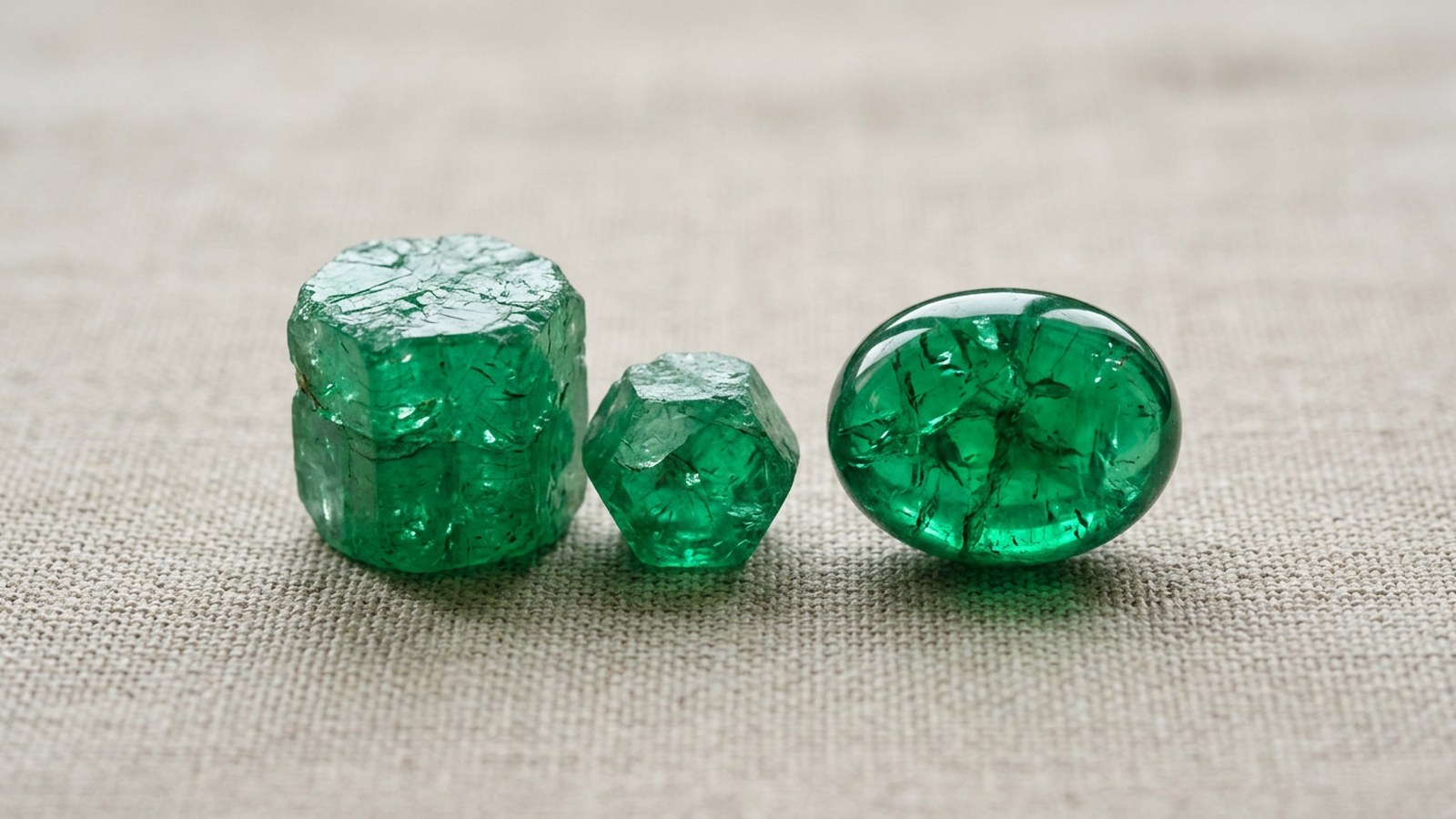
The first time I set an emerald and an aquamarine side by side on my desk, I did it by accident. Both had come back from the jeweller the same afternoon, a small included emerald pendant and a pale aquamarine I had worn for years, and I dropped them into the same dish. Looking at them together in the window light, I noticed something I had read many times and never really seen: the two crystals had the same six-sided habit, the same glassy shine and almost the same weight in the hand. They were clearly relatives. The emerald looked like a garden seen through deep water, and the aquamarine looked like the water itself.
That is the heart of this pairing. Emerald and aquamarine are two colours of one mineral, beryl, and a lot of what people say about wearing them together follows from that kinship. In this guide I will explain what makes them siblings and what makes them different, what the pair is said to do in crystal tradition (and what it is not for), the history that has tied them together since Pliny, practical ways to wear or place them, the one care routine that protects both, and how to avoid the imitations sold on each side.
Emerald and aquamarine, in short
Emerald and aquamarine are both varieties of beryl, a beryllium aluminium silicate with the formula Be3Al2Si6O18, a hexagonal crystal system and a Mohs hardness of 7.5 to 8. Emerald is green because of traces of chromium or vanadium; aquamarine is blue to blue-green because of iron. Emerald is the birthstone for May and is linked in crystal tradition to the heart chakra, love and renewal. Aquamarine is the birthstone for March and is linked to the throat chakra, calm and clear speech. Worn together, they are said to help you say what you feel. They can share a jewellery box safely, but emerald is almost always fractured and oil-treated, so the pair should be cleaned the gentle way the emerald needs.
One mineral, two colours
Pure beryl is colourless; collectors call that variety goshenite. Every coloured beryl owes its shade to a few atoms of another element sitting in the crystal lattice. In emerald, chromium (and sometimes vanadium) replaces a little of the aluminium and produces that saturated green. In aquamarine, iron does the work: ferrous iron gives the blue, ferric iron adds the green or yellow cast that many rough aquamarines show. The same family includes morganite, the pink beryl coloured by manganese, golden heliodor and the very rare red beryl from Utah.
So why does one sibling cost many times more than the other, and why do they look so different under a loupe? The answer lies in where they grow. Aquamarine forms mostly in granite pegmatites, cavities where beryllium-rich fluids cool slowly and leave room for large, clean crystals. Some gem aquamarines from Brazil and Pakistan weigh hundreds of carats with hardly an inclusion. Emerald needs beryllium and chromium to meet, and those two elements usually live in very different rocks. They come together only in unusual settings, such as the hydrothermal veins in the black shales of Colombia or the zones in Zambia and Brazil where pegmatite fluids invaded chromium-bearing schist. Those settings are violent, the crystals grow under stress, and almost every emerald carries fractures and inclusions that the trade calls the jardin, the garden.
There is also a grey zone between the two. A beryl that is green but too light to be called emerald is sold as green beryl, and gemologists openly disagree about where the line falls. A greenish aquamarine and a pale emerald can look closer to each other than either looks to the classic stones. When I hold a very light green beryl I think of it as the bridge between the pair, which is one reason I find this combination so coherent.
What the pairing is said to do
In crystal tradition, emerald is the stone of the heart: loyal love, compassion, recovery after a hard season, the feeling that something in you is growing again. Aquamarine is the stone of the sea, associated with calm, courage under pressure and the ability to speak clearly without raising your voice. Many practitioners also place aquamarine at the heart, which makes it the gentlest possible partner for emerald.
Put together, the pair is traditionally used for honest, kind communication. I reach for it before conversations where feelings matter and words tend to fail: telling someone you love them, apologising, setting a boundary with a family member, or speaking at a wedding or a funeral. The emerald is said to keep the conversation anchored in care, and the aquamarine to keep it calm and clear. If you already read my guide to crystals for communication or to crystals for love, this pair sits right where those two intentions overlap.
The second traditional use is renewal after loss or change. Emerald is the green of spring and aquamarine the colour of water, and their birth months, March and May, frame the season when things grow back. People sometimes give the two together to mark a new chapter: a recovery, a reconciliation, the first spring after a bereavement. That is a symbolic reading, and I offer it as such.
All of this is tradition and personal experience. No stone replaces a difficult conversation you have prepared for, a therapist when grief is heavy, or medical care. What the pair can do, in my experience, is give your hands and attention something steady to hold while you find the words.
A long shared history
Ancient writers did not always separate the two. In his Natural History, Pliny the Elder described emerald as smaragdus and the paler stones as beryllus, and he noted that some authorities already considered them the same kind of stone or very close. He also wrote that gem engravers rested their tired eyes by looking at an emerald, and that Nero watched the games through one. For centuries both stones were prescribed for eye complaints because green and sea-blue were thought to soothe the sight.
The eye connection survived in an unexpected place. Clear beryl was ground into reading lenses in medieval Europe, and the German word for spectacles, Brille, comes from the old word for beryl. Meanwhile aquamarine kept its reputation at sea: Roman and later sailors carried it as a charm against storms, and medieval lapidaries such as Albertus Magnus credited pale beryl with calming quarrels and making an opponent gentler. Emerald gathered a different kind of lore, from Cleopatra's mines on the Red Sea coast to the Muisca and Inca emeralds of South America and the inscribed Mughal stones of India. For an aquamarine-centred view of that history, see my full aquamarine meaning guide, and the emerald stone page for its properties.
How to wear or place them together
Here are the four ways I use the pair, from the simplest to the most deliberate.
- One piece of jewellery with both stones. An aquamarine ring with small emerald side stones, or a pendant with both, keeps the pair on the body all day. Because they have the same hardness, they do not grind each other down the way softer stones do when set side by side.
- Emerald at the heart, aquamarine at the throat. A pendant on a longer chain for the emerald and a shorter necklace or earrings for the aquamarine places each stone over the area it is traditionally linked to. This is my choice for an important conversation.
- A short lying-down practice. Lie on your back, place the emerald on your breastbone and the aquamarine in the hollow of your throat, and breathe slowly for five minutes. On each out-breath, imagine saying one sentence you have been holding back. When you sit up, write the sentence down.
- On a desk or bedside table. Two tumbled pieces or rough crystals in one small dish make a quiet reminder of an intention, such as speaking kindly or starting again. Keep them out of a sunny window (more on that below).
What the pair is not for
Both stones sit in the upper half of the chakra system and carry a light, cooling feel. If what you need is grounding, protection or help with restless energy, this pair will feel too airy on its own. Add a darker stone instead, as I describe in my guide to black tourmaline and smoky quartz. And if you want a single stone for calm speech before a presentation, aquamarine alone does the job: the emerald adds the emotional side, which a purely professional situation may not need.
One care routine for both, set by the emerald
The two stones have the same hardness, yet the emerald decides how you clean the pair, because it is full of tiny fractures that are almost always filled with oil (traditionally cedarwood oil) or resin to improve clarity. Heat, solvents and vibration can push that filling out and make the fractures suddenly visible.
- Clean both stones with lukewarm water, a drop of mild soap and a soft brush, then dry them at once. Never soak the emerald.
- Never use an ultrasonic cleaner, a steamer or hot water on the emerald. Aquamarine tolerates them better, but if both stones are in one piece, the emerald sets the rule.
- Keep them away from long, strong sun and heat. Heat can dry the oil in an emerald, and some deep blue beryls lose colour in light (see the buying section).
- Store each stone in its own soft pouch. Two stones of equal hardness scratch each other only lightly, but a knock against the aquamarine can chip the more fragile emerald.
- Energy cleansing: moonlight, sound or a few minutes on a selenite plate all suit the pair. Avoid salt and salt water for the emerald. My guide to cleansing crystals explains each method, and how to store crystals covers the jewellery box.
A jeweller can check the setting and re-oil an emerald if needed, ideally once a year for a piece worn daily.
Buying both without being fooled
Each stone has its own imitations, and a pair sold as a set doubles the risk.
- Blue topaz sold as aquamarine. Irradiated blue topaz is cheap, abundant and similar in colour. It is noticeably heavier for its size and usually a more electric blue. My guide to citrine vs topaz describes the weight check.
- Maxixe beryl. A very deep blue beryl, first found in Brazil in 1917 and also produced by irradiation, that fades towards colourless after days in daylight. A dark, inexpensive aquamarine deserves a question.
- Green beryl or dyed quartz sold as emerald. Light green beryl is a real gem with its own value, but it is not emerald. Dyed quartz sold as emerald quartz is cheaper still.
- Synthetic emerald. Lab-grown emerald has the same chemistry and is often cleaner than a natural stone. It is perfectly fine to wear if it is disclosed. A large, flawless and cheap emerald is the clearest warning sign.
- Glass. Both stones are imitated in glass, which feels warmer to the touch and often shows round bubbles under a loupe. For more home checks, see how to tell if a crystal is real.
Ask the seller which treatments the stones have had. Oil in emerald and heating in aquamarine are standard and acceptable when disclosed.
Who the pair suits
I would suggest emerald and aquamarine to anyone born in March or May who wants a piece that holds both months, to couples whose birthstones they are, and to people at a point where they need to speak from the heart without losing their composure. If you love green stones and are still choosing, my comparison of peridot vs emerald may help, and for travellers, aquamarine also appears among my crystals for travel.
When I put the two stones back in their dish at the end of the day, I still think about that first afternoon and the two crystals that came from the same mineral by very different routes, the emerald from crowded, fractured veins and the aquamarine from slow, open pegmatite pockets. Knowing that history is a large part of why I keep wearing them together.