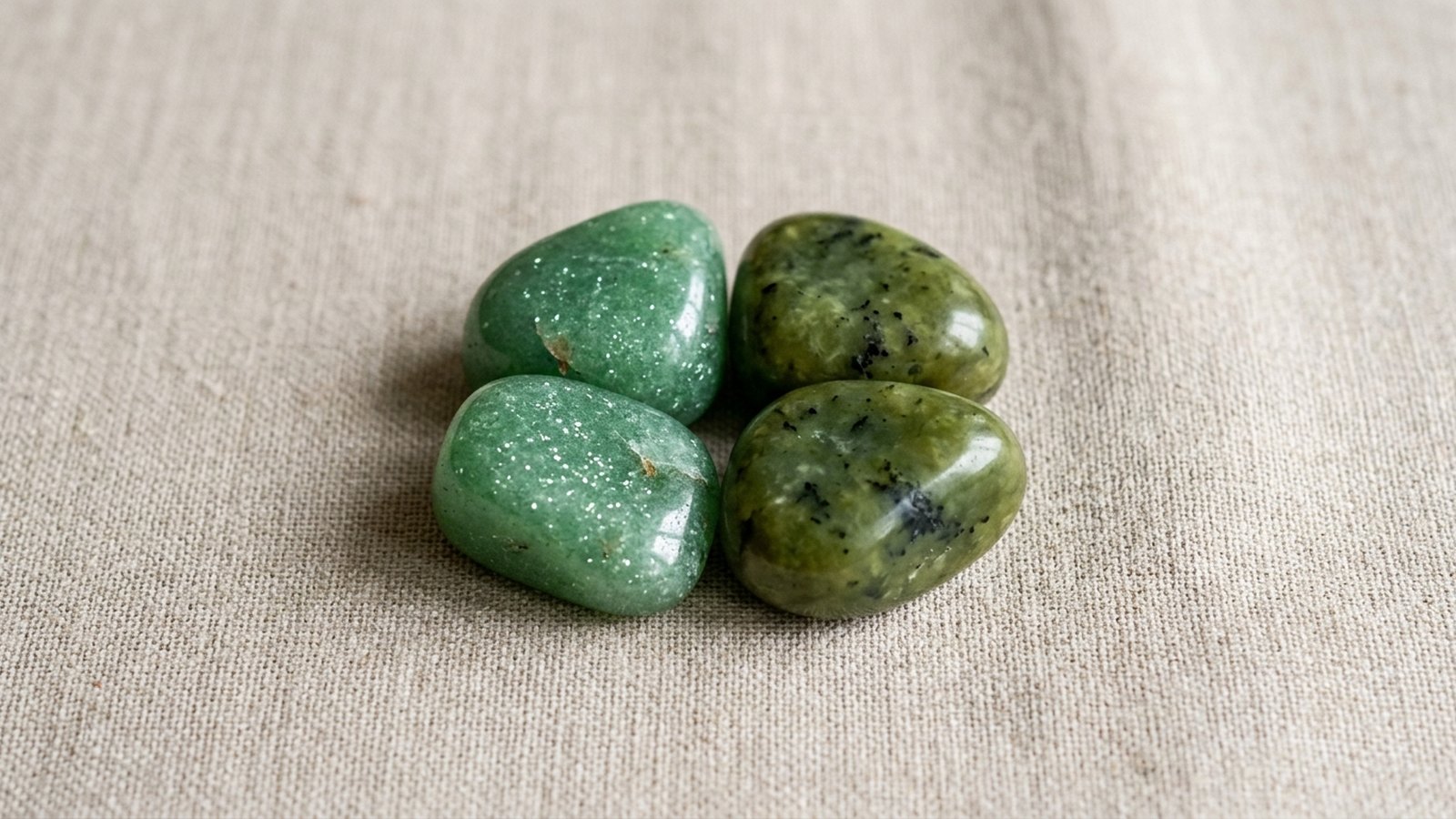
There is a particular green that sends people to the internet. It is somewhere between apple and moss, it takes a high polish, and it arrives in your hand with a label you are not sure you believe. Half the tumbled stones sold under the word jade are not jade, and a good number of them are green aventurine.
I have a small dish of both on my desk, bought years apart, and for a long time I could not have told you which was which from across the room. Up close, it takes about ten seconds. The tests that settle it are physical, repeatable and free, and they have nothing to do with how the stone makes you feel.
So this guide does the identification first, properly, and the meaning second. If you already know what you are holding and you are choosing between the two, skip to the section on which one to choose.
The short answer
Green aventurine is a quartz rock that glitters. Jade is a denser, waxier stone that never does. Tilt the piece under a lamp: if tiny flecks flash back at you, it is aventurine. Then weigh it in your palm against something the same size. Jade is noticeably heavier, because nephrite and jadeite are simply denser materials than quartz. Those two observations, sparkle and heft, resolve the great majority of cases.
They are not the same mineral, not the same family, and not remotely the same price. Aventurine is abundant and cheap. Fine jadeite is one of the most expensive materials on earth.
What each one actually is
Green aventurine
Aventurine is not a single crystal at all. It is a quartzite, a rock made mostly of interlocking quartz grains, and its green comes from flecks of fuchsite, a chromium rich mica scattered through it. Those flat mica plates catch the light and throw it back as a shimmer with a name of its own: aventurescence.
The name is borrowed, and backwards. Glassmakers on Murano stumbled on a sparkling copper flecked glass, supposedly by accident, and called it avventurina, from a ventura, by chance. The mineral that resembled it inherited the name afterwards. Most of what you will buy comes from Karnataka in southern India, with more from Brazil, Russia, Chile and Tanzania. It sits around 6.5 to 7 on the Mohs scale, and its specific gravity is that of quartz, roughly 2.65.
Green is the common colour, but aventurine also comes in blue, peach, orange, yellow and grey, coloured by other inclusions entirely. Our guide to green aventurine goes further into the stone on its own terms.
Jade
Jade is two minerals, not one, and this is the fact that unlocks everything else. Nephrite is an amphibole, a felted mass of tremolite and actinolite fibres. Jadeite is a pyroxene, sodium aluminium silicate, with a granular interlocking structure. They look similar, they were both called yu in Chinese for millennia, and they were only separated in 1863, when the French mineralogist Alexis Damour analysed the material arriving from Burma and found it was not the nephrite China had been carving for four thousand years.
Nephrite runs 6 to 6.5 on Mohs, with a specific gravity of 2.90 to 3.03. Jadeite is a little harder at 6.5 to 7, and considerably denser at 3.30 to 3.38. Nephrite comes from Hetian in Xinjiang, from the rivers of New Zealand's South Island, from British Columbia, Siberia and Wyoming. Almost all gem jadeite comes from one place, the Kachin State mines of northern Myanmar, with a second source in the Motagua valley of Guatemala that the Olmec and Maya were working long before anyone in Asia saw it.
Here is the part I find genuinely remarkable. Nephrite's tangle of fibres makes it the toughest natural stone in common use, not the hardest but the hardest to break. That is why it spent most of human history as axe heads, adzes and weapons rather than jewellery. A jade bangle survives a knock that would shatter an amethyst.
Five tests, in the order I would run them
-
Tilt it towards a light and look for sparkle. Green aventurine glitters, with distinct pinpoint flashes from the mica. Jade has no internal sparkle whatsoever. This one test settles most cases. Be careful under fluorescent light, where the effect can wash out; a window or a warm lamp shows it better.
-
Compare the weight of two similar pieces. Density is the most reliable difference between them and almost nobody uses it. A jadeite bead is about a quarter heavier than an aventurine bead of the same size, nephrite about a tenth. One piece alone tells you nothing; two in the same hand tell you a great deal.
-
Measure the density if you want a number. Weigh the dry stone on a kitchen scale that reads to 0.1 g. Then lower it on a thread into a measuring jug of water and read the volume it displaces in millilitres. Mass divided by volume gives you specific gravity. Around 2.6 to 2.7 is aventurine or another quartz. Around 3.3 is jadeite. Nephrite's 2.9 to 3.0 sits close enough to quartz that a kitchen measurement can blur the two, so treat that middle range as unproven rather than solved.
-
Read the surface, not the colour. Polished jade has a waxy, almost soapy lustre, and the light seems to sink a little before it comes back. Aventurine is glassy, in the ordinary way quartz is glassy. Look at the colour distribution too: aventurine is usually fairly even green with the glitter over the top, while nephrite tends to be cloudy and mottled, with darker veining or black specks of chromite and graphite.
-
Do not bother with hardness. Every comparison article lists both Mohs numbers side by side as though they helped. They do not. Aventurine at 6.5 to 7 and jadeite at 6.5 to 7 are the same number, and nephrite at 6 to 6.5 is not far enough below to separate with a scratch test. You risk marking a stone to learn nothing. Toughness is the real mechanical difference, and you can only observe it by breaking something, which is a poor way to spend an afternoon.
What none of this settles: nephrite against jadeite in an ambiguous piece, or a well made dyed quartzite. A refractometer separates them instantly, quartz reading about 1.54 and jadeite about 1.66, and a gemmological lab will do it for the price of a decent tumbled stone. If real money is involved, that is the answer. Our guide on how to tell if a crystal is real covers the wider set of home checks.
At a glance
| Green aventurine | Jade (nephrite) | Jade (jadeite) | |
|---|---|---|---|
| Family | Quartzite, with fuchsite mica | Amphibole | Pyroxene |
| Formula | SiO2 plus inclusions | Ca2(Mg,Fe)5Si8O22(OH)2 | NaAlSi2O6 |
| Mohs hardness | 6.5 to 7 | 6 to 6.5 | 6.5 to 7 |
| Specific gravity | 2.65 | 2.90 to 3.03 | 3.30 to 3.38 |
| Lustre | Glassy, glittering | Waxy, greasy | Waxy to slightly glassy |
| Sparkle | Yes, aventurescence | None | None |
| Typical colour | Even mid green | Mottled olive to spinach | Even, can reach vivid emerald |
| Main sources | India, Brazil, Russia | China, New Zealand, Canada | Myanmar, Guatemala |
| Price | Very affordable | Moderate | Modest to extraordinary |
| Traditional theme | Opportunity, luck | Harmony, endurance | Harmony, endurance |
The names that cause most of the trouble
The honest problem is not that aventurine and jade look alike. It is that the word jade has been bolted onto half a dozen unrelated green stones by people who wanted the association. Learn these four and most confusion evaporates:
- Indian jade is green aventurine. This is the single most common route by which the two get mixed up in the first place, and it is why so many listings sit in a grey zone between error and sales tactic.
- New jade, sometimes olive jade or Korean jade, is serpentine. Softer, often more translucent, and easy to scratch with a steel pin.
- African jade or Transvaal jade is massive green grossular garnet, sometimes jasper.
- Malaysia jade is quartzite that has been dyed green. It is a close cousin of the dyed howlite sold as turquoise, and the same rule applies: the dye pools in the porous parts.
There is one more layer worth knowing before you spend on jadeite. The trade grades it A, B and C. Type A is untreated, waxed at most. Type B has been bleached in acid to remove brown staining, then impregnated with polymer resin to hold it together; it looks superb on the day you buy it and can cloud or craze within years. Type C is dyed. B plus C is both. None of this is visible to the eye, which is precisely why a certificate exists. Nobody selling you a twelve pound tumbled stone is thinking about this. Anyone selling you a bangle should be.
What each stone carries, in tradition
Both belong to the heart chakra, and both are green, so the modern crystal world files them near each other. The traditions behind them are not similar at all.
Aventurine is the more restless of the two. It is called the stone of opportunity, and the folklore around it is all about chance falling your way: gamblers carried it, and it still turns up in every list of crystals for good luck and every drawer of money and abundance intentions. What I notice when I work with it is not luck arriving so much as a willingness to try the thing. It suits the moment when you know what you want and have been putting off asking for it.
Jade's story is older and much heavier. In China it carried the Confucian virtues and was buried with the dead. Maori pounamu became hei tiki and mere, passed down and named, and giving a piece meant something binding. In Mesoamerica jadeite outranked gold. What runs through all of that is endurance rather than opportunity: harmony, longevity, a fortune that builds slowly and stays. Jade is the stone you give at a wedding, not the one you take to a job interview.
None of that is a promise, and neither stone is a substitute for medical, psychological or financial help. I offer these as traditions people have kept for a long time, and as what I notice when I sit with each one, which is a different kind of claim.
Which one to choose
- If it is your first green stone, or you want several. Green aventurine. It costs very little, it is honestly sourced without much effort, and losing one is not a disaster.
- If you want something to wear every day for years. Jade, and preferably nephrite. Its toughness is not a metaphysical claim, it is a mechanical fact, and it is the reason jade bangles survive lifetimes of knocks.
- If you are giving a gift meant to be kept. Jade, on tradition alone. It has been the stone of lasting gifts across three continents.
- If your intention is a change you are trying to start. Aventurine. Its whole traditional character is forward motion and open doors.
- If your intention is holding steady through something long. Jade. It is a stone for the middle of a hard year, not the beginning of a bright one.
- If you are shopping online and cannot examine the piece. Aventurine, unless the seller offers a Type A certificate. Cheap listings of untested jadeite are the single easiest way to overpay in this corner of the trade.
Wearing them together
There is no conflict here, and I have worn both on the same wrist for weeks at a time. They pair well because their traditional characters divide the labour: aventurine leans towards trying something, jade towards staying with it. If you want a way to hold that, keep the aventurine somewhere active, a pocket or a desk, and the jade somewhere constant, a wrist or a neck. Our guide on pairing stones explains why very few combinations are genuinely worth avoiding.
Green aventurine is not the only stone that borrows the jade name. Serpentine does it far more often, and it takes a different set of tests: see how to tell jade and serpentine apart.
Care
Both take a brief rinse in cool water without harm, which puts them on the safe side of our crystals and water safety list. Neither wants salt.
For aventurine, the caution is light. Prolonged direct sun can pale some green quartzites over months, and any piece that has been colour enhanced will fade faster than a natural one. Keep it off a south facing windowsill.
For jade, the caution is heat. Skip hot water, steam and ultrasonic cleaners entirely, because if the piece is Type B the resin inside it will not survive them, and you may not know that it is. A soft cloth, cool water and a night of moonlight are all either stone needs.
Whichever one you are holding, the label mattered less than you thought and the stone itself matters more. Green aventurine will not make you lucky and jade will not make you patient. What they do, in my experience, is keep the intention in your hand where you can feel it, and that is worth a great deal more than the price difference between them.