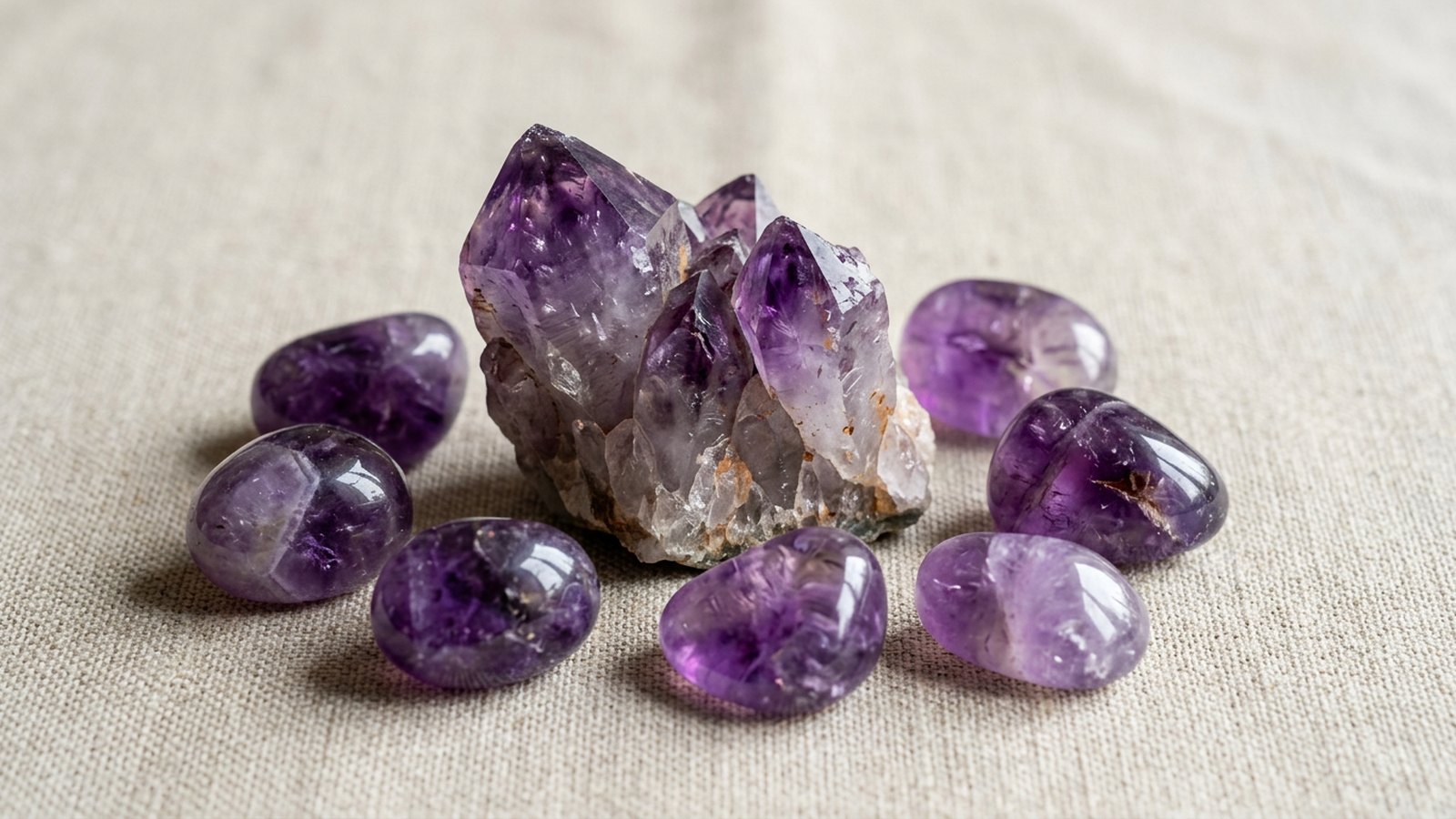
Somewhere between your third crystal and your tenth, you run into a list. It tells you that the two stones sitting together in your pocket are fighting each other, that one is cancelling the other out, that you have accidentally built a bad combination without knowing it.
It is an unsettling thing to read. A quiet, pleasant habit suddenly becomes something you can get wrong, and there is no obvious way to check whether you have.
So let me give you the reassuring part first, and then let me show you something I found while reading eight of the most visible articles on this exact question. They contradict each other almost completely. That contradiction is the most useful piece of information on the whole subject, and nobody seems willing to point at it.
The short answer
No crystal pairing is dangerous. Two stones in the same pouch will not harm one another energetically, will not sour a room, and will not undo any work you have done. Nothing in the tradition, and certainly nothing in mineralogy, supports the idea of a combination that backfires.
There are only two honest reasons to keep particular stones apart. The first is physical: hard stones scratch soft ones, and a handful of minerals genuinely suffer from water, salt or long hours of sunlight. The second is about your own attention: if you carry one stone to wind yourself up and another to wind yourself down, the muddle is in the intention, not in the minerals.
The pairs every list names
Read enough of these articles and the same handful of pairs keeps surfacing. Here is what they claim, stated fairly:
| Pair | The claim made against it |
|---|---|
| Carnelian + amethyst | Fiery, activating stone against a slow, calming one. Said to pull you in two directions. |
| Citrine + amethyst | Outward momentum against inward retreat. |
| Rose quartz + black tourmaline | Open-hearted receptivity against a defensive shield. Said to send a mixed signal. |
| Clear quartz + smoky quartz | An amplifier wired to an absorber, described as a feedback loop. |
| Clear quartz + malachite | Amplification of an already intense stone, said to overwhelm. |
| Selenite + hematite | A high, light stone neutralising a heavy, grounding one. |
| Tiger's eye + moonstone | Outward action against inward rest. |
| Red jasper + blue lace agate | Fire against water, described as a confused elemental signal. |
Notice the shape of every single entry. The argument is always the same argument: these two stones have opposite jobs, therefore they cancel. It is a tidy piece of reasoning, and it is worth taking seriously for about as long as it takes to check whether the people making it agree with each other.
Why no two lists agree
They do not. Not even loosely.
Take tiger's eye. Across the eight articles I read for this piece, it is named as incompatible with moonstone, with labradorite, with hematite, with blue lace agate, with smoky quartz, and with amazonite. Six different partners, six confident explanations, no overlap in the reasoning. A stone that clashes with everything is a stone that clashes with nothing in particular.
Clear quartz is treated even more strangely. Several of these articles warn you off pairing it with tourmaline, malachite, smoky quartz, green aventurine or moonstone, on the grounds that it amplifies whatever sits beside it. The same articles, often a few hundred words later, recommend clear quartz as the universal companion stone precisely because it amplifies whatever sits beside it. The property is identical. Only the verdict changes.
Rose quartz with black tourmaline is called a bad combination by four of the eight, and one of the four turns around and admits the pairing is genuinely contested. Meanwhile the most careful of the eight, a practitioner writing about crystal combinations rather than selling them, states plainly that with the right intention all crystals work together.
When independent sources measure the same thing, their answers cluster. When they invent it, the answers scatter. These answers scatter.
Three pairings that cannot possibly conflict
This is where the claims stop being merely unverified and start being checkable, because mineralogy has an opinion.
Citrine and amethyst. This is one of the most-cited forbidden pairs. It is also a single stone. Ametrine, mined mostly at the Anahí deposit in Bolivia, is one quartz crystal in which amethyst violet and citrine gold meet along a sharp boundary, the two colours produced by iron in slightly different oxidation states at slightly different temperatures. Nature grew the pairing that the lists say you must not make. If those two energies genuinely cancelled, ametrine would be inert, and it is one of the most sought-after quartzes there is.
Clear quartz and smoky quartz. These are the same mineral. Both are silicon dioxide. Smoky quartz is clear quartz that contains trace aluminium and has been coloured brown by natural background radiation, sometimes over millions of years. Telling someone that clear quartz and smoky quartz fight is telling them that a mineral fights itself.
Moonstone and labradorite. Both are feldspars, and both owe their shimmer to the same optical trick: light scattering off microscopic layers inside the stone. They are close cousins doing close work, which is a reason to pair them, not a reason to separate them.
I am not saying energy work has to answer to a chemical formula. I am saying that when a rule contradicts the rock it is a rule about, the rule was probably copied rather than observed.
The real reasons to keep two stones apart
Here is the part that six of the eight articles skip entirely, and it is the only part where "these two should not be together" is literally true.
Hardness. Stones scratch each other, permanently, and the Mohs scale tells you exactly who loses. Selenite sits at 2 and is softer than your fingernail, which is the whole difficulty behind black tourmaline and selenite. Calcite is 3. Malachite is around 3.5 to 4. Fluorite is 4. The entire quartz family, which is most of a beginner's collection, is 7. Put a quartz tumble in a pouch with a selenite wand and shake it around in a bag for a week, and the selenite comes out dulled and scored. That is not energetic incompatibility. That is one mineral being harder than another, and it is the single most useful pairing rule nobody prints.
In practice this costs you nothing to respect. Keep anything at 4 or below wrapped on its own, in cloth rather than loose in a tin: selenite, calcite, malachite, fluorite, and any polished piece whose finish you care about. Everything from 7 upwards can share a pouch and be none the worse for it. If you carry stones daily, the guidance in carrying and wearing stones is written around this constraint.
Water. Selenite is a form of gypsum and it will slowly dissolve. Malachite, a copper carbonate, degrades in water and in acids. Halite is salt and behaves accordingly. This matters most when people cleanse a whole collection at once in the same bowl, which is exactly the wrong move. There is a fuller treatment of which stones survive a rinse in the guide on crystals and water safety, and the cleansing guide covers the dry methods that suit the soft ones.
Light. Amethyst, citrine, rose quartz and fluorite all fade in sustained direct sunlight, some of them noticeably within a season on a bright windowsill. If you charge stones in the sun, do not leave the fade-prone ones out with the ones that do not care.
Dust and handling. Malachite contains copper and is best kept polished and sealed rather than raw against skin for long periods, and raw specimens should not be sanded or worked without care. Cinnabar contains mercury. These are not pairing rules, but they are the only genuine safety notes in this entire subject, and they deserve more space than they usually get.
The one rule I would actually keep
If you throw out the incompatibility charts, something still needs to replace them, because the underlying instinct is not silly. People sense that a handful of stones chosen at random says less than two chosen on purpose. That instinct is worth keeping. The chart it produced is not.
So here is the version I use. Pair by intention, and let everything else follow. Ask what you want from the pair in one sentence, then pick two stones that would both nod at that sentence. Rest and momentum in the same pocket is not dangerous, it is just vague, in the same way that a to-do list with two opposite first items is vague.
You will also see people pair strictly by chakra or by element, keeping fire stones away from water stones. As a way of organising a collection it is elegant, and the chakra guide lays out that system if it appeals to you. As a prohibition it does not hold up, because the traditions these categories come from disagree with each other about which stone belongs where. Amethyst alone gets assigned to the crown, the third eye, air, water and Saturn depending on whose table you read. A rule built on a category that unstable cannot tell you what is forbidden.
Use the categories to help you choose. Do not let them tell you that you have chosen wrongly.
What about the bedroom
The common advice is to keep stimulating stones out of the bedroom: clear quartz, citrine, tiger's eye, carnelian. I would put it less firmly. Nothing on a nightstand is going to keep you awake by itself.
What is true is that a bedside stone works partly as a cue, and a cue that says "get moving" is a strange thing to look at as you settle. If you want an object that points the other way, amethyst, lepidolite and blue lace agate are the traditional choices, and the crystals for sleep guide goes into how to actually use them.
How many at once
There is no ceiling. The lists that tell you to carry no more than three are inventing a number.
What I will say from experience is that a pocket holding seven stones is a pocket holding no particular intention. The limit is not energetic capacity, it is how much meaning you can hold at once before it becomes decoration. Two or three is usually where a set still says something.
How to test a pair on yourself
Since nobody agrees, you may as well find out directly. This takes about a fortnight and beats any chart.
- Pick the two stones you are unsure about. Decide what you want them to do together, in one sentence. The guide on programming an intention is useful here if the sentence is hard to find.
- Carry them together for a week, in a soft pouch, checking the hardness rule above so nothing gets scratched.
- Note, once a day and in a few words, how the day went. Do not overthink it.
- The following week, carry one of them alone.
- Compare the two weeks.
If the pair felt scattered and the single stone felt clear, you have learned something real about how you work. If you cannot tell the difference, that is also an answer, and a fairly common one.
Pairs that genuinely sit well together
For what it is worth, these are the combinations I keep returning to, offered as preferences rather than laws.
Amethyst with rose quartz is the gentlest pair I know for a hard emotional stretch, and it has its own guide here. Black tourmaline with hematite is a solid, unglamorous grounding pair for a chaotic environment, and both appear in the crystals for protection guide. Citrine with green aventurine suits the practical side of a new project. Lapis lazuli with amethyst is a good pairing for anyone who wants to think clearly and speak carefully, which is most of us. And clear quartz sits happily with anything, which is the honest version of the amplifier claim.
If you want to arrange several stones deliberately rather than pocket them, the crystal grids guide is a better route than a longer pouch.
In the end
The stones in your bag are not arguing. Some of them are softer than others and want their own pocket, which is really a storage question (how to store crystals works through it properly), a few object to water, and one or two fade in the sun. Beyond that, the only thing a pairing can really muddle is your own sense of what you are asking for.
Trust that more than the charts. The charts, as far as I can tell, are mostly copying each other.