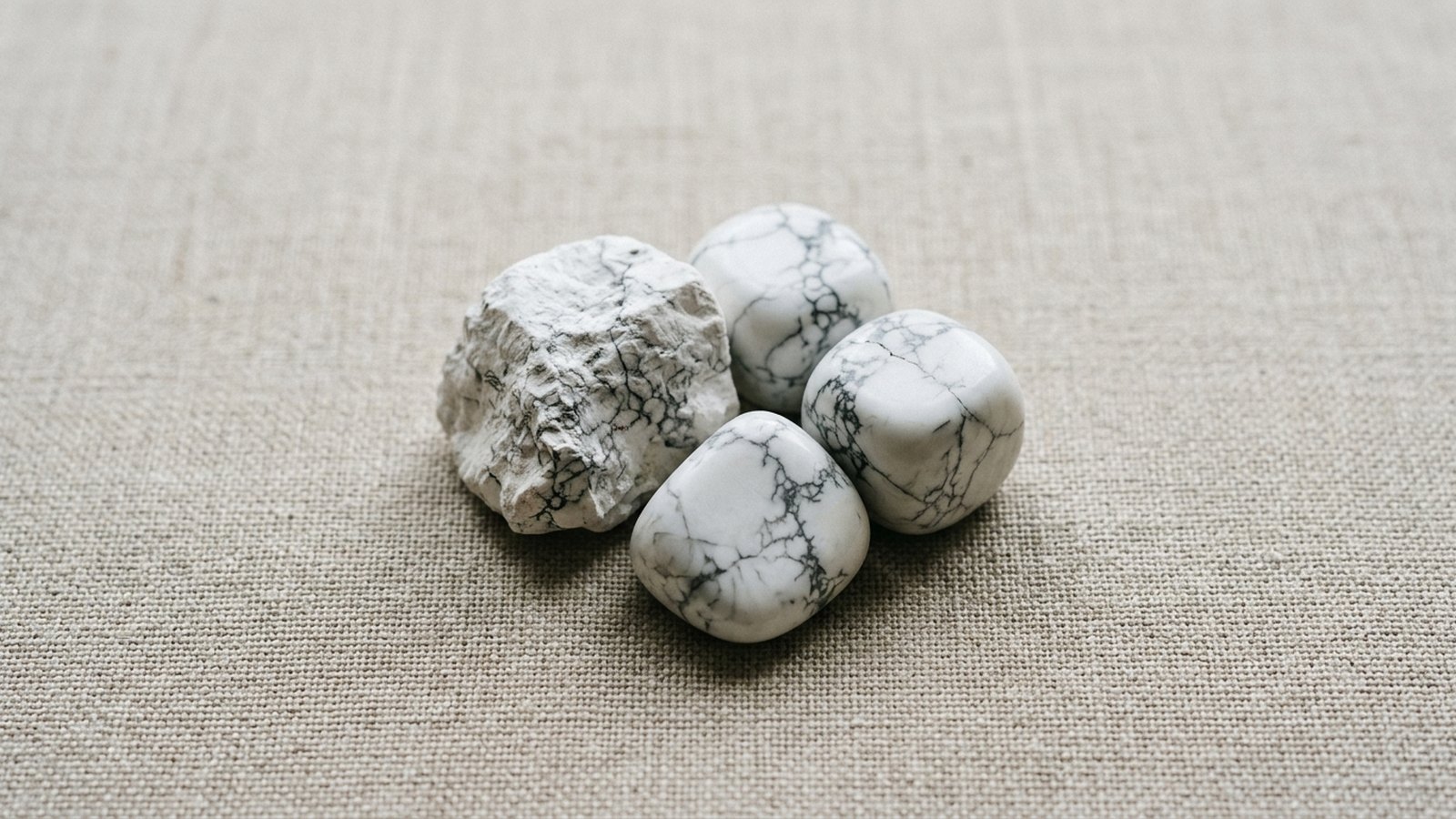
Howlite is the white stone with the black webbing, the one you have almost certainly held without knowing its name. It turns up in bracelet strands, in beginner sets, in the bowl by the till at every crystal shop I have ever walked into. Opaque, chalky white, threaded with grey and black veins that look like the cracks in an old teacup or a satellite photograph of dry riverbeds.
It is a hydrous calcium borosilicate, it sits at 3.5 on the Mohs scale, and it was first described in Nova Scotia in 1868. In the traditions I work in it is the stone of stillness: reached for when the mind will not stop talking, when anger arrives faster than thought, when the ceiling at two in the morning has become very familiar.
It is also the most impersonated and most impersonating stone in the whole trade. A great deal of the turquoise sold in the world is dyed howlite, and a great deal of what is sold as howlite is not howlite. I will untangle all of that properly further down, because it is the part almost nobody explains honestly.
Reasons to work with howlite
Howlite is for the mind that will not put itself down. Not anxiety exactly, though it borders on it. The specific state where you have finished the day and your head has not, and it keeps re-running a conversation you cannot change. I keep a piece on the nightstand for that. The tradition calls it a stone of awareness, meaning the awareness that lets you watch a thought go past instead of climbing on board it. If that state is a permanent fixture for you, our guide to crystals for anxiety is a better starting point than any single stone.
Howlite is for anger that arrives before you do. Every older source I have read describes howlite as absorbing anger, and it is the one traditional claim I find most useful to work with, because it comes with a practical shape. You hold the stone when the heat rises. What I notice is not that the anger vanishes, but that the pause between feeling it and speaking gets a little longer. That pause is where most of the damage does or does not happen.
Howlite is for patience you have run out of. The slow-moving house purchase, the parent who repeats the same story, the skill you are learning far too slowly. Howlite is a soft, unhurried, undramatic stone, and it asks very little of you. There is a reason it ends up in so many first crystal sets: it is undemanding company.
Howlite is for sleep, in the most modest sense. It is the classic under-the-pillow stone, and it appears on almost every list of crystals for sleep for that reason. I would frame the benefit honestly: a stone placed deliberately by the bed is a small ritual that tells your body the day is closed. Whether the help comes from the mineral or from the ritual is a question I cannot answer, and I would rather say so than pretend.
Howlite meaning and healing energy
Emotional healing. Howlite's traditional territory is the hot emotion cooled: anger, frustration, impatience, the flare of taking something personally. It is often given to people working through grief for the same reason, since grief so often arrives wearing anger's clothes. If that is where you are, our guide to crystals for grief sits alongside this one.
Spiritual healing. Older texts tie howlite to the crown chakra and to a quiet, unshowy kind of receptivity: not visions, but the settled state where you can actually hear yourself think. Some practitioners pair it with a grounding stone precisely to keep that openness anchored, which our chakra crystals guide explains in more detail.
Mental healing. This is where howlite earns its "stone of awareness" name. It is traditionally reached for to slow racing thoughts and to break a habit loop, on the reasoning that you cannot change a pattern you have not noticed yet.
Physical healing. Traditional lore associates howlite with restful sleep, with calming the physical signature of stress, and with bones and teeth, because it is a calcium mineral and old lore loved that kind of correspondence. Treat all of that as tradition, not medicine. Howlite does not replace a doctor, a therapist or a diagnosis, and I would not want anyone reading this to delay real help because a white stone is doing its best.
Chakra: crown, with secondary work at the root and third eye. Zodiac: Gemini and Virgo, with some traditions adding Scorpio. Element: wind, or spirit in some systems. Numerical vibration: 2. Affirmation: I do not have to answer every thought that arrives.
Howlite geology
Howlite is a borate mineral, a hydrous calcium borosilicate with the formula Ca2B5SiO9(OH)5. It is monoclinic, it has no cleavage, it breaks with a conchoidal to uneven fracture, and its lustre is dull to faintly glassy. It sits at 3.5 on the Mohs scale, which puts it below a copper coin and well below window glass. You can scratch it with a steel nail.
Two things about its structure explain almost everything else in this article. The first is that it forms as nodules rather than crystals, lumpy irregular masses that old field reports compared to cauliflowers. Well-formed howlite crystals do exist, but they are tiny and rare enough that most collectors will never handle one. The second is that those nodules are genuinely porous. Howlite is not a dense gem material; it is a soft, absorbent, slightly thirsty stone.
The black and grey webbing that everyone recognises is not veining inside the mineral in the way quartz is veined. It is the host material, the clay and rock the nodule grew inside, pressed into the seams and irregularities of its surface. That is why the pattern reads as a network of cracks rather than as bands: you are looking at the mould, not the casting.
Howlite forms in evaporite deposits, the salt-and-borate beds left behind where ancient lakes and shallow seas dried out. It keeps company with borax, colemanite and gypsum, which is exactly where the borax miners of California kept finding it.
The dye question: turquenite, white turquoise and white buffalo
Here is the sentence the trade would rather not print: howlite's porosity, the property that makes it worthless as a gem, makes it the finest turquoise substitute ever found. It drinks dye all the way through, its black webbing mimics turquoise matrix almost exactly, and it costs a fraction of the real thing. Dye it blue and you have what is sold, quite openly in some places, as turquenite.
I want to be fair about this. Dyed howlite is not a scam. It is an inexpensive, attractive, perfectly honest material when it is labelled as what it is, and I own a strand of it. It becomes a problem only at the point where the label lies, and that point is reached extremely often. If you paid a turquoise price, you have a right to know, and the turquoise you were promised is a copper aluminium phosphate at 5 to 6 on the Mohs scale, considerably harder than the 3.5 in your hand.
Three tests, in the order I actually use them:
- Look at the colour saturation against the veins. On dyed howlite the dye pools and darkens along the black seams, because those seams are the porous parts. Real turquoise usually shows the opposite relationship, with matrix distinct from body colour rather than deepened by it.
- Scratch it somewhere invisible. At 3.5 howlite gives up to a steel pin or a knife point. Turquoise at 5 to 6 does not. This is destructive on a small scale, so pick the back of a bead.
- Touch a hidden spot with acetone on a cotton bud. Dye often lifts. Nothing lifts off real turquoise. Resin-stabilised pieces can resist this one, so a negative result is not proof.
Our guide on how to tell if a crystal is real covers the same logic across other stones, and if this subject interests you, opalite versus moonstone is the companion case of a manufactured material wearing a natural name.
What the colours actually mean. Natural howlite is white. That is the whole range. If your howlite is blue, it was dyed to pass as turquoise; if it is red or pink, it was dyed to pass as coral; if it is deep blue with gold flecks, it was dyed and glittered to pass as lapis lazuli; if it is green, it was dyed to pass as jade or amazonite. So when you read about "blue howlite meaning" or "black howlite meaning", you are reading about a colour that came out of a vat, not out of the ground. I do not think that makes the piece meaningless. Colour carries its own associations, and our guide to crystal colours and their meanings works with exactly that. But the meaning belongs to the colour and to you, not to the mineral, and any source telling you blue howlite carries an ancient throat-chakra tradition is describing a bottle of dye invented in the twentieth century.
White buffalo is a separate confusion, and almost every crystal site gets it wrong. The white stone with black chert veining mined north of Tonopah, Nevada, and sold as "white buffalo turquoise" is not turquoise: it has no copper, which is what makes turquoise blue in the first place. X-ray work on it identifies magnesite with dolomite. So white buffalo is not turquoise, and it is not howlite either, though howlite is frequently sold under the white buffalo name because the two look alike from across a table. Three different white materials, one trade name, and a lot of confident labelling.
Howlite and magnesite
Magnesite is the stone most often sold to you as howlite, and it is an honest mistake at least as often as a dishonest one. They are both white, both veined, both soft, both dyed for the same purposes.
| Howlite | Magnesite | |
|---|---|---|
| Composition | Calcium borosilicate | Magnesium carbonate |
| Veining | Grey to black, web-like | Often brown or tan, coarser |
| White | Bright, slightly grey | Duller, creamier |
| Cleavage | None | Perfect, rhombohedral |
| Acid test | No reaction | Fizzes in dilute acid |
For everyday purposes the veins decide it: brown webbing on a creamy body is usually magnesite, black or grey webbing on a bright white body is usually howlite. Energetically the two are used almost interchangeably in modern practice, so if you have been working happily with a piece that turns out to be magnesite, nothing about your practice needs to change.
Where howlite comes from
The type locality is near Windsor, Nova Scotia, where the chemist and mineralogist Henry How, professor at King's College, encountered it in the gypsum quarries and described it in 1868 under the name silicoborocalcite. Quarrymen had already been finding the nodules and finding them a nuisance. James Dwight Dana renamed it howlite for him shortly afterwards, which is the rare case of a mineral named for someone who genuinely deserved it.
Almost all the howlite you will ever hold, though, came out of southern California. The Lang Mine in Tick Canyon, north of Los Angeles, was a borax operation, and the cauliflower nodules came up as a by-product of digging for something else entirely. Turkey, Mexico, Germany, Russia, Serbia and Namibia produce it too.
Caring for howlite
This is where I have to disagree, flatly, with advice sitting near the top of the search results. Do not soak howlite in salt water overnight, and do not bury it in damp earth for a day. At 3.5 on the Mohs scale and genuinely porous, howlite is close to the worst possible candidate for both. Salt is abrasive and it wicks into the pores, water dulls the surface over time, and on a dyed piece prolonged soaking can lift colour unevenly and leave you with something patchy. Our guide to crystals and water safety puts howlite firmly in the cautious column, and I would keep it there.
What works: a soft dry cloth, or barely damp with plain water and dried at once. For energetic cleansing, use the methods that touch nothing, which is most of them. Moonlight on a windowsill, smoke, sound, or a night on a selenite plate. Our guides to cleansing crystals and how to charge crystals cover the options. Keep it away from harder stones in a pouch, since anything with quartz in it will scratch howlite, and that includes ordinary household dust.
Living with it
Howlite pairs naturally with amethyst for sleep and with clear quartz when you want its quiet amplified. For anger specifically I like it with a grounding stone rather than another calming one, since the point is to have somewhere to put the heat, not simply to smother it. If you are thinking about combinations more broadly, what crystals should not be together is worth reading, mostly because it shows how little the popular lists agree.
Wear it, or keep it where your hand falls. Our guide to carrying and wearing stones has the practical side, with the caveat that a howlite bracelet will scuff faster than you expect.
I am fond of howlite in a way that has nothing to do with rarity or value, and it has neither. It is a common, soft, cheap, endlessly counterfeited stone that spends most of its working life pretending to be something more expensive. There is something quite restful about the real thing sitting there, plain and white and unbothered, being exactly what it is.
White magnesite is sold as howlite constantly, and the two are easy to confuse once they are tumbled. If you are not certain which one is in your hand, howlite vs magnesite walks through the veining, the weight and the acid test.