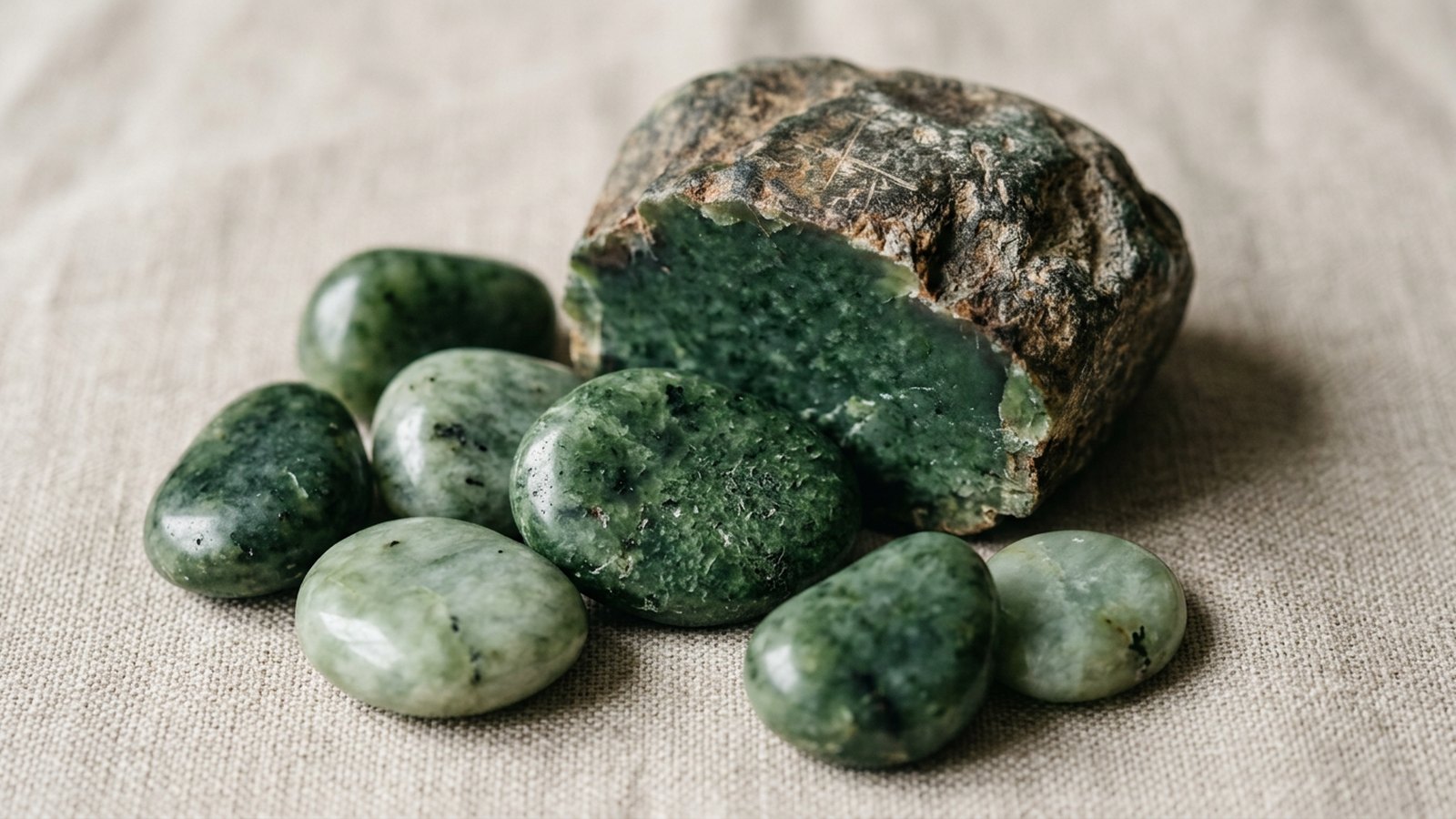
I have lost count of the green stones people have handed me across a table, saying "it was sold as jade" with a small question mark at the end of the sentence. Most of the time it is serpentine. Not always, and not always dishonestly, but most of the time.
That is not a sad story. Serpentine is a real stone with a real history, and it has been carved and worn for as long as jade has. The problem is only that it is sold under a borrowed name, at a price that assumes the name is true. So the useful question is not "which one is better". It is "which one am I actually holding", and that is a question you can answer yourself, in about ten minutes, with a lamp and a kitchen scale.
The short answer
Jade is either of two specific minerals, nephrite or jadeite, both hard (Mohs 6 to 7) and dense, with a fine granular or fibrous texture and an oily to glassy lustre. Serpentine is a whole group of softer magnesium silicates (Mohs 2.5 to 5.5), lighter in the hand, with a greasy or soapy lustre. The quickest reliable check is weight: for the same size, jadeite is roughly a third heavier than serpentine. The scratch test, which everyone recommends first, is the one that will fool you.
What jade actually is
Jade is not one mineral. It is two, and they are not related. Until 1863 nobody knew that, when the French mineralogist Alexis Damour analysed material from China and Myanmar and found he was looking at two different chemistries wearing the same name.
Nephrite is an amphibole, from the tremolite-actinolite series, and its structure is the whole story: microscopic fibres felted together like wet wool. That interlocking makes it the toughest natural stone in ordinary use. Not the hardest, toughest, meaning it resists breaking. Neolithic cultures worked it into axe heads for exactly that reason. It sits at Mohs 6 to 6.5, with a specific gravity around 2.90 to 3.03, and it comes from British Columbia, Siberia, Xinjiang, Wyoming and New Zealand, where Maori pounamu is nephrite.
Jadeite is a pyroxene, sodium aluminium silicate, and it forms under high pressure in subduction zones, which is why it is so much rarer. It is harder (6.5 to 7) and noticeably denser (3.30 to 3.38). Chromium gives the translucent "imperial" green that fetches serious money; iron gives the ordinary greens, manganese the lavenders. The great majority of gem jadeite comes from Kachin State in Myanmar, with smaller sources in Guatemala and Russia. Our jade stone page covers what the two share once you get past the chemistry.
What serpentine actually is
Serpentine is also not one mineral. It is a group, mainly antigorite, lizardite and chrysotile, all roughly Mg3Si2O5(OH)4. It forms when water works on the olivine-rich rock of the oceanic mantle, a process geologists call serpentinisation, and the rock it produces is serpentinite. There is a lot of it. Whole mountain belts are made of the stuff.
Its name comes from the Latin for snake, for the mottled, scaled look of a polished slab, and that resemblance carried a reputation with it: Roman and medieval sources recommend it against snakebite and poison. It is soft, usually Mohs 2.5 to 4, with a specific gravity near 2.55. It takes a beautiful polish and holds fine carved detail, which is precisely why it has been used for ornament for millennia, and why it is so easy to pass off.
One variety matters enormously here. Bowenite is a dense, tough, translucent antigorite that reaches Mohs 5.5 to 6. It is the reason the standard advice fails, and we will come back to it.
Five tests, in the order I would run them
Run them in this order. Each one is less reversible than the last, and you may well have your answer before you reach the end.
1. Look at the lustre. Turn the stone under a lamp and watch the highlight travel across it. Jade reflects with a slightly oily to glassy sheen sitting on a very fine, even texture. Serpentine looks greasier, softer, almost soapy, and the highlight spreads rather than sharpens. On polished jadeite you can often see a faint dimpling under reflected light, sometimes called orange peel, where harder and softer grains took the polish unevenly. Serpentine polishes too smoothly to show it.
2. Shine a torch through the edge. This is the flashlight test people ask about, and it is genuinely useful, though not for the reason usually given. Hold a small light against one edge in a dark room. Nephrite glows with a cloudy, fibrous interior, sometimes with visible fibre bundles like felted silk. Jadeite glows granular, a mosaic of tiny interlocking crystals. Serpentine glows more evenly and more waxily, often with dark dendritic veining or black magnetite specks floating in it. What the torch cannot do is prove authenticity on its own, so treat it as evidence, not a verdict.
3. Weigh it. This is the test I trust most, and it damages nothing. Density is the hardest property to fake. Put the stone on a kitchen scale and compare it against a similar-sized pebble of ordinary quartz, or simply against your memory of stones that size. Jadeite at 3.3 is about thirty percent heavier than serpentine at 2.55. Nephrite at around 2.95 is roughly fifteen percent heavier. It sounds subtle written down; in the hand it is obvious once you have felt the difference twice.
4. Tap it, if it is a bangle. Suspend a bangle on a thread and strike it gently with another bangle or a coin. Nephrite gives a bright, sustained, almost bell-like ring, a direct consequence of that felted structure. Serpentine gives a short dull knock. This only works on a bangle or a thin plate, never on a tumbled stone, and it will not distinguish nephrite from jadeite.
5. Scratch it, last, and on the base. A steel knife point sits near Mohs 5.5. It should not mark jade at all, and jade should faintly scratch glass. Most serpentine gives way to a steel point immediately. Do this on the underside or an inconspicuous edge, because the mark is permanent, and never on a carving you care about.
The test that lies
That fifth test is the one every article leads with, and it is the one that will hand you a wrong answer. Bowenite serpentine sits at Mohs 5.5 to 6. A steel knife will not mark it, and a firm edge will put a faint line on glass. Bowenite is also dense, translucent and convincingly green, which is exactly why it is the serpentine most often sold as jade, under names like new jade and Suzhou jade.
If the scratch test passes, go back to the scale. Bowenite still weighs around 2.6. It cannot fake density.
At a glance
| Jade (nephrite) | Jade (jadeite) | Serpentine | |
|---|---|---|---|
| Mineral | Amphibole | Pyroxene | Mg silicate group |
| Mohs | 6 to 6.5 | 6.5 to 7 | 2.5 to 5.5 (bowenite to 6) |
| Specific gravity | 2.90 to 3.03 | 3.30 to 3.38 | 2.5 to 2.65 |
| Lustre | Oily to glassy | Glassy, orange peel | Greasy, waxy, silky |
| Toughness | Exceptional | Very high | Chips and scratches |
| Typical price | Moderate to high | Low to extreme | Low |
The names that cause most of the trouble
Almost every dispute over a green stone starts with a label, not with the stone. Serpentine reaches the market as new jade, olive jade, Korean jade, Afghan jade, Suzhou jade, Teton jade, Styrian jade and serpentine jade. Not one of those is jade. The pattern is always the same: a qualifier in front of the word, which quietly does the opposite of what a qualifier normally does.
So the rule I use, and I would offer it to you, is this: a modifier before "jade" is a warning, not a description. Real jade is sold as jadeite or nephrite, and reputable sellers say which. If you see "serpentine (new jade)" written out in full, that is an honest seller using a trade term. If you see "new jade" alone at a jade price, that is not.
It is the same manoeuvre that puts howlite on the shelf as turquoise, and that sells opalite as a moonstone. Once you have seen the shape of it, you see it everywhere. The related confusion with sparkly green quartzite is covered in our guide to aventurine versus jade.
Green glass, dyed quartzite and dyed marble also travel under the jade name. Glass gives itself away with bubbles and a warm feel; dyed material usually shows colour pooling in cracks under magnification.
Is serpentine dangerous?
This question comes up constantly and deserves a straight answer. Chrysotile, one member of the serpentine group, is the fibrous mineral that was mined as commercial asbestos. That is a genuine hazard, and it is why the question exists.
Ornamental serpentine is normally antigorite or lizardite, which are not asbestiform, and a polished stone in your hand releases nothing. The real risk lies in cutting, grinding or sanding serpentine dry, which can put respirable dust in the air. If you are lapidary-inclined, work wet and wear a mask. If you are simply wearing a pendant, there is nothing here to worry about. This is general information rather than medical advice.
What each one carries, in tradition
I want to be careful here, because this is lore and intuition rather than anything measurable.
Jade has been, across Chinese, Mesoamerican and Maori traditions, a stone of harmony, longevity and slow good fortune. It is not a stone of momentum. It is the one people reach for when a decision needs to be made carefully rather than quickly, and it is associated with the heart chakra and with grounding. Traditions ask that it be worn on the body rather than kept on a shelf.
Serpentine, in the traditions that use it, is a stone of shedding. The snakeskin association runs all the way through: releasing what has been outgrown, and clearing the way for something new. It is often placed with kundalini practice and with earth connection. If you came looking for jade and found serpentine, you have not been left empty handed. You have a different stone, with its own quieter work, and it deserves to be met on its own terms rather than mourned as a failed jade.
Which one to choose
If it is going into a ring or a bangle you will wear daily, buy nephrite. Its toughness is not a marketing claim, it is a structural fact, and it is the reason jade bangles survive generations. Serpentine in a ring will be scuffed within a season.
If you want a carving, a bowl or a decorative piece, serpentine is genuinely the better buy. It holds fine detail, it comes in beautiful mottled greens, and it costs a fraction of jade. Bought as serpentine, it is excellent value.
If you want a green heart stone to carry and the budget is modest, buy serpentine honestly labelled rather than a doubtful "jade" at four times the price. And if you are buying jadeite at any serious sum, ask for a laboratory report stating grade A, meaning untreated. Grade B has been bleached and resin-filled, and it will cloud and craze with time. No home test will catch that.
Caring for either
Jade takes a brief rinse under cool water without complaint. Avoid heat, steam and ultrasonic cleaners, which will ruin resin-filled jadeite. Serpentine is softer and needs more care: wipe it rather than soak it, keep it away from salt, and store it apart from harder stones so it does not collect scratches. Our notes on which crystals can go in water and on storing crystals safely apply to both.
Whatever you find when you run the tests, you will know your stone better than the person who sold it to you did. That is worth more than the label was.