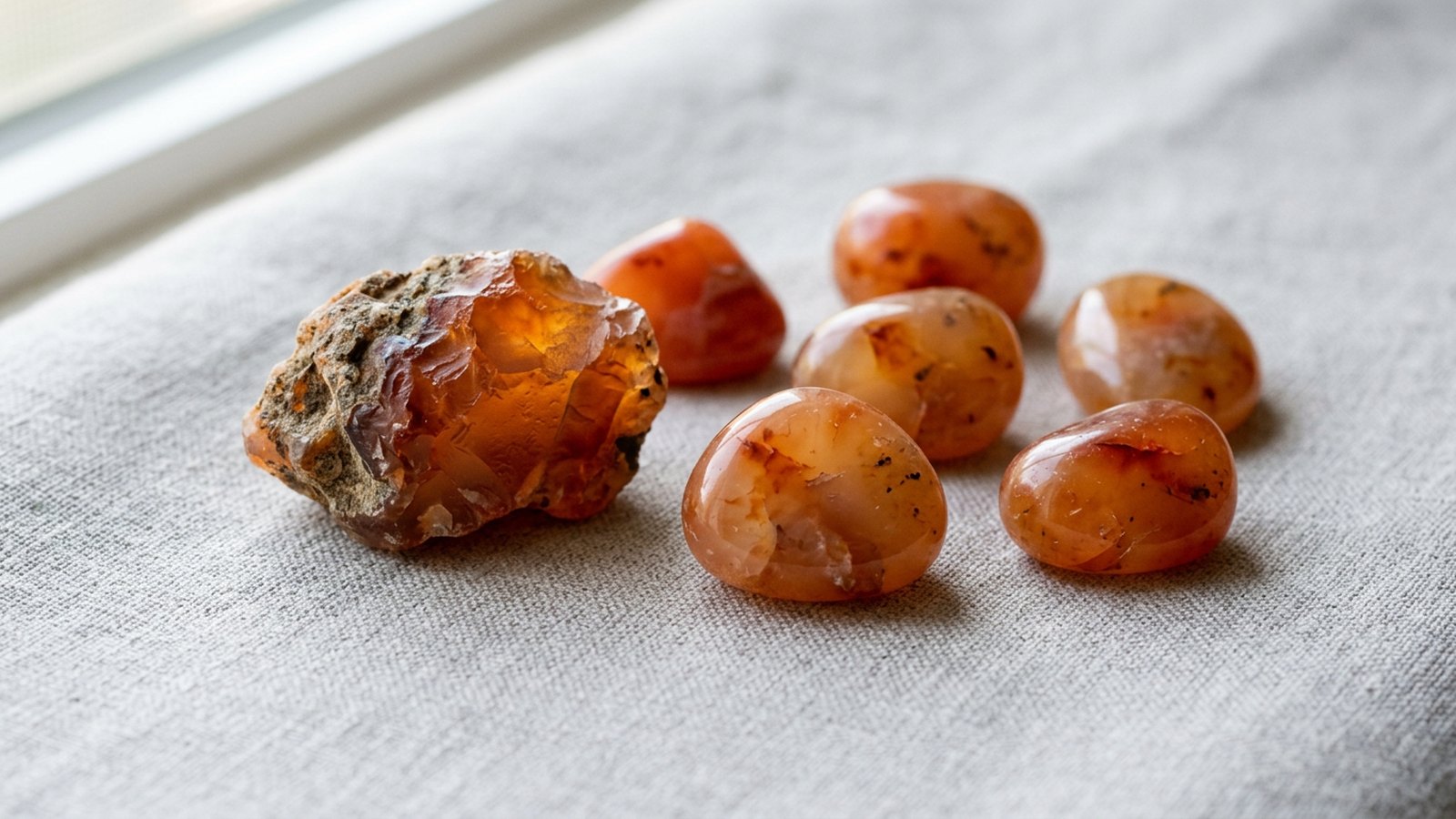
I have a small dish on my desk with about a dozen red and orange stones in it, and for the first two years I owned it I could not have told you, reliably, which ones were carnelian and which were red jasper. I could guess. I was right maybe seven times out of ten. What finally fixed it was not learning more lore, it was learning to do one thing with a light, and learning the two situations where that one thing lies to you.
So this is the guide I wanted then. What the difference actually is at the mineral level, how to tell them apart with a stone in your hand, why so much of the carnelian on the market has been helped along in a kiln, and which of the two to reach for depending on what you are actually carrying around this week.
Carnelian and red jasper are both cryptocrystalline quartz, but carnelian is translucent chalcedony in the orange to red range, while red jasper is fully opaque, brick to brownish red, and owes its colour to iron oxide mixed through a granular body. Hold a light to the edge: carnelian glows, red jasper stays dark. In traditional practice carnelian is worked with as a sacral chakra stone for creative momentum, and red jasper as a root chakra stone for steadiness.
Same family, different construction
Both stones are silicon dioxide. Both sit at 6.5 to 7 on the Mohs scale, which is hard enough that neither will scratch against ordinary handling. If you sent them to a lab, the chemistry would come back almost embarrassingly similar. The difference is architecture, not ingredients.
Carnelian is a chalcedony. Chalcedony is quartz that grew as microscopic fibres bundled together rather than as a single visible crystal, and that fibrous structure lets light travel a short way into the stone before it scatters. That is why a carnelian cabochon has depth to it, a sense that the colour is happening somewhere under the surface rather than on it. The orange comes from iron oxide, finely dispersed through the silica.
Jasper is built differently. It is granular rather than fibrous, and, more importantly, it is not pure. The working definition mineralogists use is that jasper contains up to around twenty percent foreign material, mostly clay minerals and iron oxides, mixed through the quartz. That load of extra material is exactly what makes it opaque. Red jasper is quartz with so much hematite through it that light simply stops at the surface.
This is worth holding on to, because it answers the question people keep asking in different words. Are jasper and carnelian the same thing? No, but they are siblings, and the family trait that separates them is not colour. It is how much non quartz material got trapped in there while the stone was forming. Everything you can see with your eyes follows from that one fact.
How to tell them apart, in about a minute
Here is the sequence I use, in order, with the failure mode of each step attached. The first step settles it perhaps eighty percent of the time. The rest are for the awkward pieces.
1. Light the edge, not the middle. Put a phone torch behind the thinnest part of the stone and look at the rim. Carnelian lights up, usually a warm glowing orange or red. Red jasper stays flatly dark. Here is the failure mode nobody mentions: thickness beats translucency. A chunky carnelian sphere or a thick tumbled nugget will read as opaque straight through the middle, because you are asking light to cross two centimetres of stone. Always test the edge, a corner, or the thinnest point you can find. If everything you own is thick, this test is inconclusive rather than negative.
2. Read the colour family. Carnelian lives in the warm range: bright orange, amber, apricot, a clear red with orange behind it. Red jasper lives in the earth range: terracotta, brick, oxblood, brownish red, often with a slightly dusty quality. If you are looking at something the colour of a clay flowerpot, jasper is the safer bet.
3. Look at the surface under raking light. Tilt the stone so light skims across it. Polished carnelian has a glassy or waxy shine with a slight greasiness to it. Red jasper polishes up well too, but the finish reads flatter and more matte, more like a glazed ceramic than like glass. The failure mode: a well polished jasper cabochon can look genuinely glossy, and gloss is a property of the polish, not of the stone. Lustre is a hint. Translucency is the evidence.
4. Hunt for structure. Red jasper very often carries inclusions you can see: dark specks, hairline black or grey veining, patches where the colour shifts. Carnelian is usually more uniform, or it clouds gradually from pale to deep. Sharp, straight, parallel banding is its own signal, and I will come back to that in a moment, because it usually means something other than carnelian.
5. If it is still ambiguous, accept it. A whole category of red chalcedony and red agate is neither textbook carnelian nor textbook jasper, and the trade names in that zone are inconsistent. Sard is the name for the darker brown red end of carnelian, and there has never been an agreed line between where carnelian stops and sard begins. Those labels were applied by merchants long before anyone was measuring anything. If your stone will not commit, that is not your failure.
The carnelian problem nobody warns you about
Now the part that changes how you shop. A large share of the carnelian sold today is heat treated agate or chalcedony, and a meaningful share of it is dyed.
The heat treatment is ancient and not a scandal. Iron bearing chalcedony often contains goethite, which is yellow or brown. Heat it, and the goethite converts to hematite, which is red. Stone cutters in Gujarat were doing this thousands of years ago, and most of the carnelian in a museum case has probably been through a fire. The material is real chalcedony, the iron was already in it, and the heat finished a job the earth had started.
Dyeing is a different matter. Plain grey Brazilian agate soaked in an iron nitrate solution and then baked comes out a confident, uniform orange that sells very well. It is still quartz, and it will not fall apart, but it is not what most people think they are buying.
The test is the same light you already used. Hold the piece up to a strong source and look at how the colour is distributed. Natural carnelian tends to show a hazy, cloudy, uneven spread, thicker in some zones and thinner in others, as though the colour were weather. Dyed agate tends to show colour in sharp straight bands, or as a suspiciously even wash that sits the same everywhere, sometimes concentrated in cracks and along the outer surface where the dye soaked in. Banding that looks like a cross section of tree rings is a strong sign you are holding treated agate.
Red jasper is much less often faked, simply because it is cheap and there is little incentive. Where it does get muddled is at the shop label, since jasper and agate are regularly mislabelled as each other.
I want to be plain about this: a dyed stone is not a cursed stone. If it pleases you and you know what it is, that is a complete answer. I just think you should be the one deciding.
Which one to choose
| Carnelian | Red jasper | |
|---|---|---|
| Light through the edge | Glows | Stays dark |
| Colour | Orange, amber, clear red | Brick, terracotta, brown red |
| Finish | Glassy, slightly waxy | Flatter, earthy |
| Structure | Even or gradually clouded | Specks, veining, patches |
| Traditional chakra | Sacral | Root |
| Traditional theme | Starting, creating, wanting | Staying, enduring, steadying |
| Commonly treated | Yes, frequently | Rarely |
| Mohs hardness | 6.5 to 7 | 6.5 to 7 |
The energetic difference, as I have come to understand it through my own practice and through the tradition rather than through anything anyone has measured, is the difference between ignition and ballast.
Choose carnelian when the problem is starting. When there is a project you keep circling, a conversation you have not opened, a body that has gone quiet and uninterested. Carnelian is the stone I hand to people whose difficulty is the first move, and it is the one I keep on the desk when I am writing. It belongs to the same family of work as crystals for creativity and crystals for motivation. Traditionally it is associated with Virgo and Leo, and it has a long history as a stone of confident speech.
Choose red jasper when the problem is lasting. When you are not short of desire, you are short of stamina. A long illness in the family, a job that grinds, a training block, a season where the task is simply to keep showing up without fraying. Red jasper is slower and heavier and it does not ask anything of you. It sits closer to crystals for strength than to anything about inspiration, and Aries and Scorpio are its usual traditional signs.
If you genuinely cannot tell which you need, ask yourself whether this week failed because you did not begin, or because you could not keep going. That question sorts it almost every time.
Wearing them together
They pair well, and unlike a lot of popular combinations this one has an internal logic rather than just matching colours. Sacral and root are adjacent, and the two stones cover the two halves of a single problem: the impulse to move and the stability to sustain it. Carnelian without ballast can read as restlessness. Red jasper without a spark can read as inertia. Together they cover for each other's weakness.
In practice I keep it simple. One of each in a pocket, a bracelet that alternates them, or the two sitting where you work. If you wear stones on the body, the usual thinking about which hand to wear a bracelet on applies here as much as anywhere. My one caution is about sleep: carnelian is stimulating in the traditional reading, and plenty of people find it unhelpful on the bedside table. Move it to the desk and see whether anything changes.
What these two stones have actually been used for
The histories are good, and they are more specific than most crystal writing admits.
Carnelian was the Roman world's seal stone. It was the material of choice for intaglio signet rings, and there is a practical reason for that which I find delightful: hot sealing wax does not stick to carnelian. You could press your ring into wax and lift it away clean, every time. The stone's slightly waxy lustre and its refusal to bond with wax are two faces of the same surface property. When you handle a piece and notice that faintly greasy feel, you are touching the exact quality that made it valuable to a Roman magistrate.
In Egypt, both stones were used for the tyet, the knot of Isis amulet described in the Book of the Dead, which was specified as red and was cut in carnelian, red jasper, or red glass. The two stones were treated as interchangeable for that purpose, which tells you the tradition was reading the colour rather than the mineral.
Both turn up in scripture too. The first stone of the High Priest's breastplate in Exodus is odem, rendered in older translations as sardius and usually understood as carnelian or sard. In Revelation, the one seated on the throne has the appearance of jasper and carnelian, and the wall of the new city is built of jasper. The word jasper there almost certainly did not mean what a modern mineralogist means by it, but the association has stuck for two millennia.
Care, water and what to pay
Both are quartz at 6.5 to 7, so both are more robust than most of the stones in your collection. Neither is water soluble, and a brief rinse will not harm either one, though I would still read the general notes on crystals and water before soaking anything. Two specific cautions: dyed carnelian can leach colour with prolonged soaking, and jasper with visible veining can have micro fractures along those lines that water and temperature changes will slowly worsen. Skip salt water for both. For routine care, the gentle methods in the cleansing guide are more than enough.
Price should not be a factor. Both are among the most affordable stones on the shelf, and a good tumbled piece of either costs less than a coffee. Which means the decision can be made on what you need rather than on what you can justify, and that you can buy both and find out which one your hand keeps reaching for.
None of the energetic properties described here are medical claims, and no stone is a substitute for care, treatment or a difficult conversation you need to have. They are traditions and personal practice, and they work best alongside the real thing rather than instead of it.