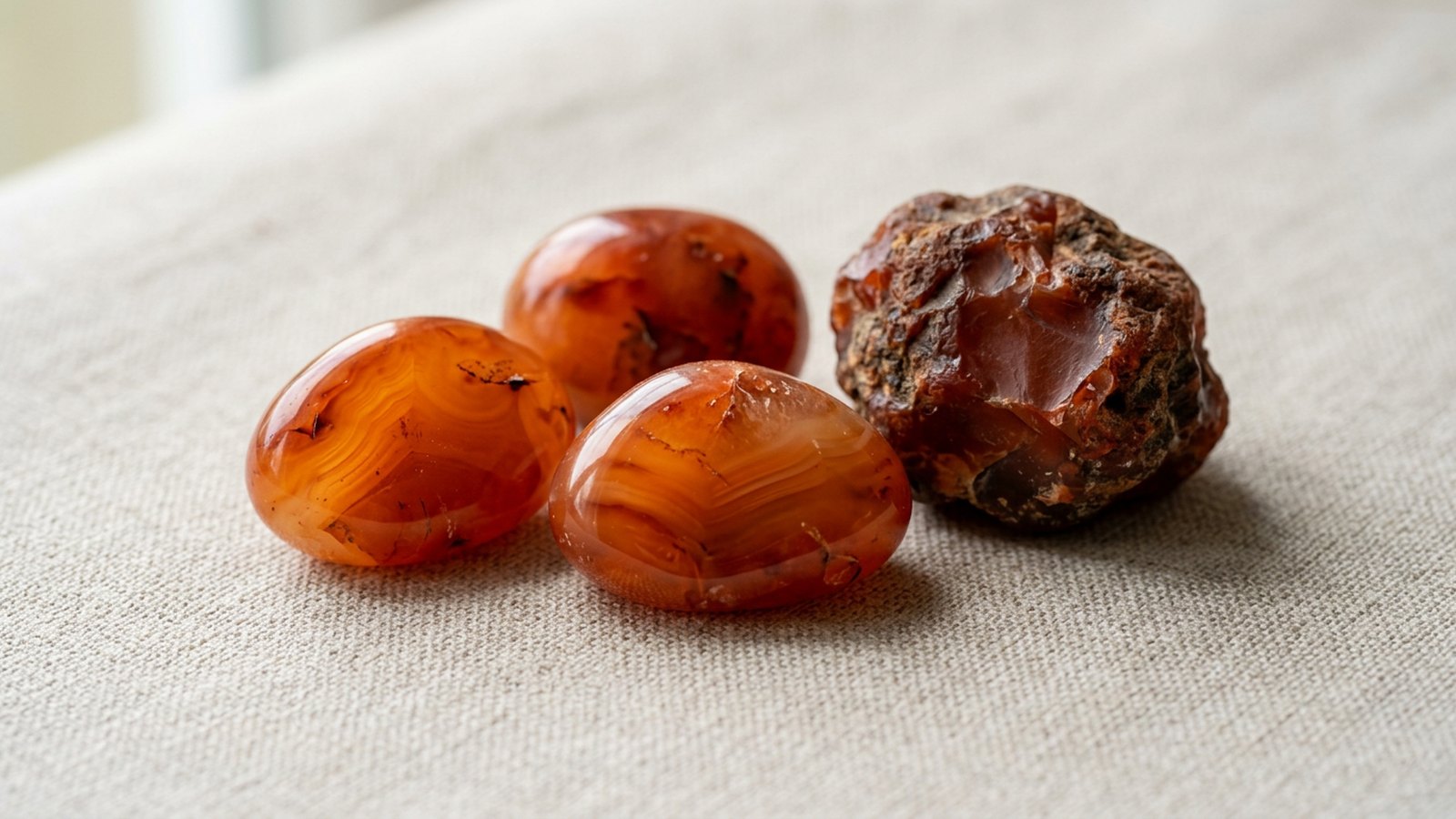
Most lists will tell you carnelian, and they are not wrong. Carnelian is the stone I reach for when I cannot make myself begin, and it has earned that place. But if you have already tried carnelian and nothing shifted, the problem is probably not the stone. It is that "I have no motivation" describes at least three different stalls, and they do not respond to the same thing.
I have been stuck in all three. There is the morning where the task is right there and I cannot make my hands start. There is the middle of a project where I began fine and then simply ran out of forward momentum. And there is the worst one, where something went badly and I cannot bring myself to try again. Same complaint, three different holes.
So before the stones, a question: which of those are you in? The rest of this guide follows from your answer.
Motivation is not focus, and what a stone can honestly do
Half the pages that rank for this keyword quietly swap in the word productivity, then hand you fluorite and clear quartz. Those are attention stones. Attention is a different problem: it is about staying on a task you have already started. If your trouble is that you sit down willingly and then drift to your phone eleven times, you want the focus guide, not this one.
Motivation is the ignition, not the steering. It is the willingness to begin, the fuel to continue, and the nerve to go again after it went wrong.
And I want to be straight about the mechanism, because I think honesty is the reason anyone comes back to a site like this. In the tradition these stones come from, carnelian carries a fire that stirs the sacral chakra and moves stalled energy. That is the lore, and I find it genuinely useful. What I can also tell you from years of keeping stones on a desk is more ordinary and, to me, just as valuable: a stone you have chosen deliberately and placed where you work becomes a physical cue. You pick it up, you have named what you are trying to do, and you are one small ritual closer to starting. That is not nothing. It is also not a battery. A crystal will not give you energy your body does not have, and it is not a treatment for depression, burnout or ADHD. If your drive has been gone for weeks and the floor keeps dropping, please talk to a doctor. A stone can sit beside that. It cannot stand in for it.
Stall one: you cannot start
This is inertia. The task is not hard, it is not even unpleasant, and yet beginning it feels like pushing a car uphill. Procrastination lives here, and so does the strange paralysis of having too many small things to do.
Carnelian is the stone for this, and the near-unanimity of every list is, for once, deserved. It is a warm orange to deep rust chalcedony, a microcrystalline form of quartz coloured by iron oxide, and it has been associated with vitality and courage for a very long time. Egyptian craftspeople set it in amulets, and it turns up in Roman signet rings because it took a carving well and, usefully, hot wax did not stick to it. Tradition puts it at the sacral chakra, the seat of appetite and drive, and gives it to Aries and Leo. I keep a tumbled piece within arm's reach and hold it for the length of three breaths before I start something I have been avoiding. Not as magic. As a starting gun. There is more on its history and how it forms in the carnelian guide.
Sunstone is my alternative when the inertia is heavier and greyer, the kind that comes with a bad week rather than a bad hour. Sunstone is a feldspar shot through with tiny platelets of copper or hematite that catch the light and flash as you turn it, an effect called aventurescence. It reads as warmth rather than push. Where carnelian says go, sunstone says it is worth going. If your reluctance has a low mood underneath it, start there instead. See the sunstone guide for its geology and the Oregon copper-bearing material.
If your stall is specifically at the start of something new, a job, a move, a chapter, the new beginnings guide covers that transition properly.
Stall two: you cannot keep going
You started. Good. Then somewhere around day four, or hour two, the thing went flat. This is the endurance failure, and it is the one people misdiagnose most often, because from the inside it feels identical to laziness.
Tiger's eye is what I use here. It is a fascinating stone geologically: golden brown quartz threaded with fibrous bands that produce chatoyancy, the shifting silk-like line that moves as you tilt it. It was long described as quartz replacing crocidolite fibre by fibre, though work published by Heaney and Fisher in 2003 argued for a crack-seal process where quartz and the fibres grew together in opening fractures. Either way, you are holding something that formed under sustained pressure over a long time, which is a fitting object for a task that requires the same. Tradition ties it to the solar plexus, the seat of will, and to Capricorn and Leo. Its practical virtue on a desk is that it rewards a glance: when my attention frays I let my eyes rest on the bands for a moment, then go back. The full story is in the tiger's eye guide.
Red jasper is the slower, more physical partner to it. Opaque, brick red, coloured by iron oxide through a dense chalcedony, it has none of tiger's eye's flash and that is the point. I associate it with stamina rather than will: the long unglamorous middle of a project, training, a thesis, a renovation. It is a root chakra stone in tradition, and it suits people whose energy dips are bodily rather than mental. More in the red jasper guide.
Neither of these will keep you working through genuine exhaustion, and neither should. See the depletion section below.
Stall three: you cannot get back up
This is the hardest one and it is almost absent from the pages ranking for this search. Something failed. The pitch was rejected, the relapse happened, the deadline was missed. You are not unmotivated in general. You are specifically unwilling to expose yourself to that again.
Pyrite is my stone for it, and it earns the job by what it is rather than only by what it means. Iron sulfide, brassy, and it grows in near-perfect cubes and interlocking clusters that look manufactured. Fool's gold, so named because generations of prospectors mistook it for the real thing, which makes it a fitting companion for a disappointment. Tradition gives it to the solar plexus and reads it as resolve and practical resilience. I keep a cube where I can see it after something has gone wrong, and I find its blunt, geometric solidity steadying in a way a pretty stone is not. The pyrite guide has its formation and its one real vulnerability, which I come back to at the end.
Citrine does the other half of this. Where pyrite is about standing back up, citrine is about believing there is a point. Warm yellow quartz, coloured by traces of iron, though it is worth knowing that the great majority of citrine on the market is heat-treated amethyst rather than natural material. That does not make it worthless, and I say so plainly in the citrine guide, but you should know what you are buying. Tradition puts it at the solar plexus with Leo and Sagittarius, and reads it as optimism and self-belief. Pair the two: pyrite in the hand, citrine in the light.
If what actually broke was your confidence in yourself rather than your drive, the confidence guide is the better door.
When it is not motivation, it is depletion
I would rather lose your click here than sell you a stone for the wrong problem. If you are sleeping badly, working past your limit, recovering from illness or grieving, what you have is not a motivation deficit. It is an empty tank, and the body is doing exactly what it should by refusing to move.
No stone fixes that, and the energising stones on this page can make it worse by encouraging you to push. What I do instead is switch the whole intention: smoky quartz by the bed, an early night, and permission to do the smallest possible version of the task tomorrow. Then, when there is something in the tank, carnelian.
The other stones you will see on these lists
Garnet and bloodstone appear on almost every motivation list, both traditionally read as stones of physical vigour and courage, and both worth having if the language of blood and heat speaks to you. Orange calcite is the softer, cheaper cousin of carnelian in the same sacral register, though at Mohs 3 it scratches if you carry it loose. Fluorite and clear quartz are on those lists because of the focus confusion above. Green aventurine shows up when the block is fear of a specific outcome rather than flatness. None of these are wrong. They are just answering a slightly different question than the one you came with.
How to actually use them
The method matters more than the mineral. This is what I do, and it takes under a minute.
- Name the stall out loud. "I cannot start" or "I cannot keep going" or "I cannot try again." One sentence. This step does most of the work.
- Pick the one stone that matches, not four. A bowl of stones is decor. One stone with a job is a cue.
- Cleanse it first if it is new to you, using a method the stone can survive. See cleansing your crystals, and check the water safety guide before anything goes near a tap.
- Give it its instruction. Hold it, breathe, and state what it is for in the present tense: "I begin before I feel ready." The intention guide goes deeper.
- Place it where the stall happens. Beside the keyboard, on the gym bag, in the pocket you reach into. Not on a shelf. See carrying and wearing stones.
- Touch it before you begin, every time. Three breaths, then start. Consistency is what turns an object into a trigger, usually within a week or two.
- Re-set it when it goes quiet. If you stop noticing it, move it, or swap it for the stone that matches the stall you are in now.
Keeping them intact
These are working stones that live on desks and in pockets, so durability is not a footnote.
Pyrite is the one that genuinely fails. Iron sulfide oxidises in humid air, and specimens can crack, powder and leave rusty stains, a process collectors call pyrite decay or pyrite disease. Keep it dry, never in water, never in salt, and away from a steamy bathroom. Carnelian and red jasper are quartz at roughly Mohs 7 and will take daily handling, but a great deal of orange chalcedony on the market has been heated or dyed, and dyed material can pale in a sunny window. Tiger's eye is similarly hard but its polish dulls against keys, so pocket it alone. Citrine is quartz and robust, though prolonged strong sunlight can lighten some heat-treated material. When in doubt, dry cloth, indirect light, moonlight or sound for recharging.
Whichever you choose, the stone is a prompt, not an engine. Name the stall, give one stone one job, and let it stand where you keep getting stuck. That much I can promise works, because the work is yours and the stone is only the reminder.