Someone asked me last winter which crystal to carry for strength, and I gave a bad answer. I said red jasper, because that is what you say. Two weeks later she told me it had not helped at all, and when I finally asked what she had actually needed strength for, it turned out she was trying to leave a job where everybody liked her. She did not need fuel. She needed to be able to say no to kind people.
That is the whole problem with this question. Strength is not one thing, and most lists treat it as if it were. If you want the short version: tiger's eye, bloodstone, carnelian and hematite are the four stones almost every tradition puts under strength, and they are genuinely the safest starting points. But which of them is right for you depends on whether you are trying to keep going, trying to begin, or trying to hold a line.
So let me split it three ways first, then name the stones, then tell you the honest part about physical strength that the shopping pages leave out.
The three things people mean by strength
When someone tells me they want a stone for strength, it is almost always one of these.
Endurance. Nothing dramatic is happening. It is just long. A caregiving stretch, a degree, a recovery, a year of one foot in front of the other. What is running out is not courage, it is fuel. These readers usually are not scared of anything, they are tired.
Courage. The opposite shape. One moment, and you have to move through it. The interview, the conversation, the first day, the phone call you have rescheduled four times. Nothing is long about it. It just has a threshold you are standing on the wrong side of.
Holding the line. The one people rarely name, and the one my friend needed. You know what you want. The difficulty is other people, and specifically people who are not villains. This is strength as refusal rather than effort.
They want different stones, and once you see the split it is hard to unsee. Notice that Google's own summary now opens by saying strength comes in physical, mental and emotional versions, then asks you which one you mean. That is because nobody answered it.
Stones for endurance, when you have to keep going
Bloodstone is the classic here, and the one I would hand to someone in a long stretch. It is a dark green chalcedony, a form of cryptocrystalline quartz, flecked with red where iron oxide sits in the green. Its old name is heliotrope. Roman and later medieval sources treat it as the soldier's stone, worn for stamina and for staunching bleeding, and Christian lore rewrote the red spots as drops of blood at the crucifixion. Traditionally it is worked with for staying power rather than for speed, which is exactly the distinction that matters here. We do not have a full guide for it yet.
Red jasper is the one I was reaching for badly in that conversation, and it is still excellent when the need really is fuel. It is an opaque microcrystalline quartz coloured brick red by iron oxide, and it is traditionally a root chakra stone, kept for steady physical energy and for people who start things at a sprint and burn out by week three.
Hematite is iron oxide itself, heavy in the hand in a way that surprises people the first time. The name comes from the Greek for blood, because it leaves a red streak when you scratch it, not because of its colour, which is silver grey. It is worked with for weight and for coming back into your body when a long effort has left you floating somewhere above it.
Garnet is the one I would add if the endurance in question involves other people. It is not one mineral but a family of silicates, and the deep red almandine most of us own is traditionally a stone of loyalty and of finishing what was promised. If your long stretch is one you undertook for someone else, this is the one.
Stones for courage, when you have to start
Carnelian is my first answer for a threshold, every time. It is chalcedony again, orange from iron oxide, and the Romans carved it into signet rings partly because hot wax does not stick to it. There is something apt in that. It is traditionally a sacral chakra stone for action and appetite, and in practice it is the one I put in a pocket on a morning that has one hard hour in it. Worth knowing before you buy: a large share of the carnelian on the market is heat-treated agate, which is an old and accepted practice rather than a scam.
Sunstone is for the particular fear of being seen. It is a feldspar shot through with tiny copper or hematite platelets, which is what produces that glittering flash when you turn it. Tradition keeps it for warmth and visibility, and I reach for it when the thing someone dreads is not the task but the attention.
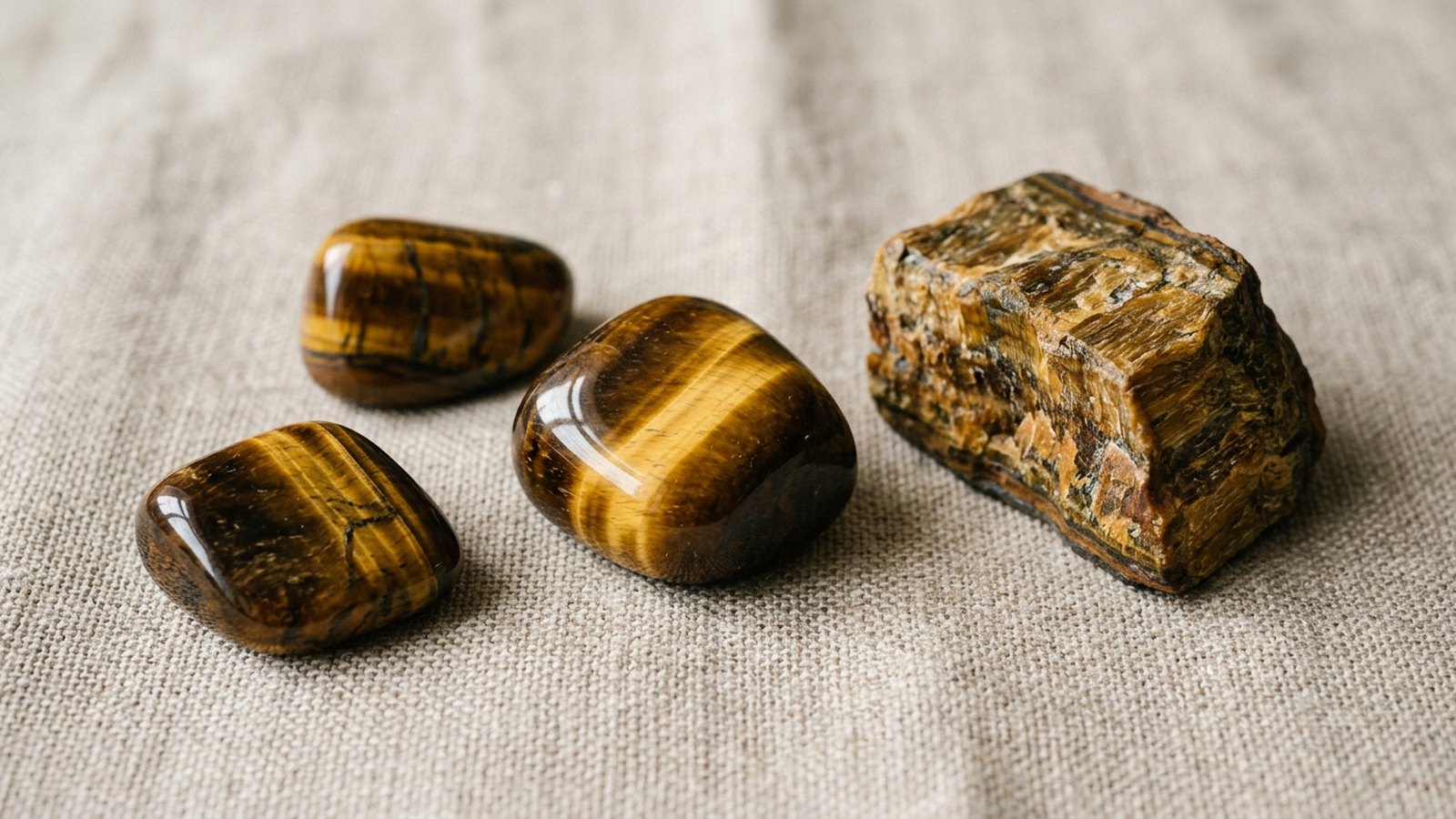
Tiger's eye is the one on every list, and it earns the place. It is quartz that has replaced a fibrous blue mineral, crocidolite, keeping the fibre structure, which is why the light runs across it in a band. Traditionally it is courage with the eyes open, the stone for the decision you have to make while frightened rather than after the fear passes. If you want the fuller version of this, the guide on crystals for confidence sits right next to this one.
Citrine I mention with a caveat. It is a fine solar plexus stone for self-trust, but most commercial citrine is heat-treated amethyst, which is why so much of it is that uniform burnt orange rather than pale lemon. That is worth knowing when you pay for it.
Stones for holding the line, when you have to say no
This is where lists that hand you rose quartz and moonstone under the heading of strength quietly fail, because those are stones of opening, and opening is not what is needed.
Black tourmaline is the standard, and deservedly. Mineralogically it is schorl, a complex borosilicate that grows in long striated prisms. It is traditionally worn as a boundary rather than a weapon, which is a distinction I like: not keeping people out, keeping yourself distinct from them. If you want it in full, we have a whole guide on crystals for protection.
Obsidian is the sharper choice, and I mean that literally. It is volcanic glass rather than a mineral, cooled too fast to crystallise, and it breaks along curved conchoidal fractures into edges that have been used as blades for tens of thousands of years. Tradition treats it as the stone that shows you the thing you have been avoiding, which is often the real obstacle to holding a line.
Onyx is the quieter one. It is a banded chalcedony, and the plain black onyx you see everywhere is almost always grey agate dyed, an industry practice going back to Roman Idar-Oberstein and not a modern deception. Traditionally it is the stone of the long refusal, the one for holding a position over months rather than in one conversation.
Who these suit less well: if you are someone who already finds it easy to shut people out, this family is not your medicine. I have watched black tourmaline become a very good excuse. The boundary stones work best for people whose instinct runs the other way, the ones who apologise for taking up room.
What a stone can and cannot do for physical strength
A lot of people arriving at this question mean it literally. They want to lift more, last longer, recover faster. I would rather be straight with you than sell you a set.
A crystal will not change what your muscles do. There is no mechanism for it, and anyone telling you otherwise is selling something. What a stone can genuinely do is act as a cue. If you put the same piece of hematite in your kit bag every session, it stops being a rock and becomes a marker attached to a routine, and that association is real and does real work, in the same ordinary way that a particular playlist does. That is not nothing. It is just not magic, and it is worth naming the difference.
And if what is draining you is not training but exhaustion that will not lift, low mood, or pain that keeps returning, please treat the stone as company and go and get that looked at properly. A pocket stone has never once been the right answer to a medical question, and the tradition itself has never claimed it was.
Which of these actually survive being carried
Nobody mentions this, and it matters more here than in any other category, because strength stones are the ones people carry loose in a pocket every single day.
| Stone | Mohs | Daily pocket carry | Water |
|---|---|---|---|
| Bloodstone | 6.5 to 7 | Excellent | Fine |
| Red jasper | 6.5 to 7 | Excellent | Fine |
| Carnelian | 6.5 to 7 | Excellent | Fine |
| Tiger's eye | 6.5 to 7 | Excellent | Brief only |
| Onyx | 6.5 to 7 | Very good | Brief only, dye can lift |
| Garnet | 6.5 to 7.5 | Good, brittle on edges | Fine |
| Black tourmaline | 7 to 7.5 | Hard but chips on its striations | Fine |
| Hematite | 5 to 6 | Scratches, and rusts | Keep dry |
| Obsidian | 5 to 5.5 | Chips to sharp edges | Fine |
Which also settles how to clean them, because the usual advice does not apply evenly. Everything at 6.5 and above on that list takes a rinse under cool running water and a dry cloth without complaint, which is the simplest cleansing there is. Hematite should never get that treatment, and obsidian is fine with water but should not be knocked against anything harder while wet hands are involved. Salt I would skip across the board here: it is abrasive, it gets into the striations on tourmaline and into the porous surface of dyed onyx, and it lifts colour. Moonlight, a few hours on a windowsill, or simply setting the stone down somewhere quiet does the same job without the risk. The full method is in our guide on cleansing crystals.
Two practical notes. Hematite is the one people ruin, because it is iron and it will develop rust spots if it lives in a damp pocket or gets washed and put away wet. And if your hematite is strongly magnetic, it is almost certainly synthetic barium ferrite sold under the name, not hematite at all. Our guide on telling whether a crystal is real covers that test and a few others. For the water side of all of this, see crystals and water safety.
How I would actually choose one
Pick the shape of the difficulty first, not the stone. Read the three headings again and notice which one made you tense slightly. That is your answer, and it is more reliable than a list.
Then take one stone, not four. A pocket with four stones in it is a pocket you stop noticing. Carry it where the difficulty happens, which for most people means a coat pocket or a wrist rather than a shelf at home. If you want the practicalities of that, carrying and wearing stones goes into it, and programming an intention covers giving it a specific job rather than a vague one.
Give it a real sentence. Not "strength", which is too big to mean anything on a Tuesday, but the actual thing: I can sit through this meeting without agreeing. Aries and Capricorn often gravitate here naturally, the first for the courage stones and the second for the endurance ones, though I would not let a birth chart overrule what you know about your own week.
And if what you are carrying is closer to dread than to difficulty, the stones on crystals for anxiety will serve you better than anything on this page. Strength and calm are not the same request either.
My friend, for what it is worth, ended up with black tourmaline. She left the job in March.