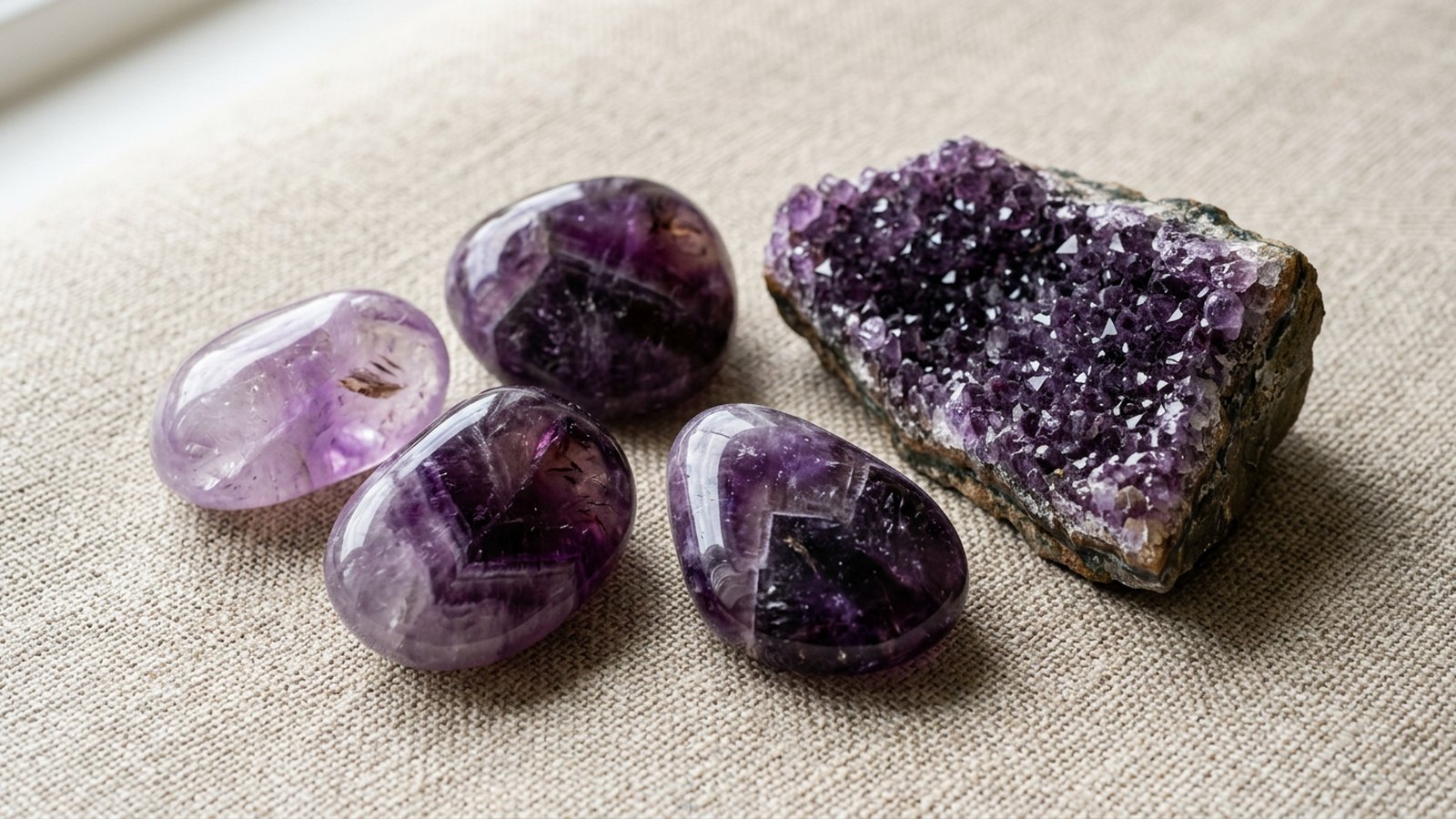
The first crystal bracelet I owned sat in its little organza bag for three days while I tried to find out which wrist it belonged on. Every page I opened told me the same thing in the same confident voice, and something about that unanimity made me trust it less, not more. If the answer were that settled, I thought, why does everyone need to say it so firmly?
It took me a long time to work out what was actually going on. There is not one rule about which hand to wear a crystal bracelet on. There are two, they come from different places, and for most people they happen to agree, which is exactly why nobody notices the difference. For the rest of us they point in opposite directions, and that is where all the confusion lives.
So here is the whole thing: the rule, the second rule hiding behind it, how to settle them when they disagree, and one physical consideration that in practice decides the question more often than either.
Which hand to wear a crystal bracelet on: the short answer
Wear a crystal bracelet on your left wrist when you want to draw a stone's quality inward, for calm, self-worth, sleep, grief, or receiving. Wear it on your right wrist when you want to send something outward, for boundaries, protection, confidence, or action. If you are left-handed, or if the bracelet is soft or fragile, reverse it. Neither wrist is wrong.
The rule everyone repeats, and where it comes from
The familiar version goes: the left hand receives, the right hand gives. Your left side is treated as the passive, yin, taking-in side of the body, and your right as the active, yang, putting-out side. Wear amethyst on the left to let its quiet in. Wear black tourmaline on the right to push something away.
That framing is not something modern crystal shops invented. It echoes much older habits of thought, the yin and yang halves of the body in Chinese practice, and the long-standing conventions in South Asian gemstone tradition about which hand a stone belongs on. Those older systems are more specific and more demanding than the tidy version we have inherited, and they do not agree with each other in every particular. What survives into a bracelet listing is the simplified shape of them.
I want to be plain about what that means. This is tradition and shared intuition, not a measured property of your left arm. A stone does not know which side of your body it is on. What the rule genuinely gives you is a way of holding an intention in your attention, which is the same thing you are doing when you set an intention into a stone in the first place.
The second rule, and why the advice online only looks unanimous
Read enough of these guides and a different sentence starts appearing: your non-dominant hand receives and your dominant hand gives.
That is a different rule. It is not a refinement of the first one, it is a separate idea about what makes a side receptive. The first rule says the sides are fixed, left is left for everyone. The second says the sides are defined by how you use your body, so the hand that writes, reaches and does is the one that projects.
For a right-handed person these two produce identical advice. Non-dominant is the left, dominant is the right, everything lines up, and the internet reads as though it agrees with itself. Roughly nine people in ten are right-handed, so nine guides in ten can quietly hold both rules at once and never discover they are holding two.
For a left-handed person they contradict each other outright. Rule one says put the rose quartz on your left. Rule two says your left is your giving hand, so put it on your right. Both instructions are given in the same reassuring tone, and neither page mentions the other exists.
When they disagree, this is how I settle it, in order.
- Ask which idea you actually find persuasive. If the fixed left and right of yin and yang is what resonates with you, follow rule one and stop reading. If it makes more sense to you that the hand you do things with is the hand that does things, follow rule two. Picking one on purpose is worth more than getting the "correct" one by accident.
- If neither pulls at you, use dominance. It is the rule that adapts to the person wearing it rather than assuming everyone is built the same way, and I find it holds up better under questioning.
- Then check the bracelet can survive that wrist. This is the step the next section is about, and it overrules both rules more often than people expect.
- Wear it for two weeks before revising anything. You are looking for whether you keep noticing it, not for a sensation on day one.
If you are left-handed
You are the person this whole question is actually difficult for, and almost no guide is written for you.
My honest advice: use the dominance rule. Your right wrist becomes your receiving side and your left becomes your giving side, the mirror image of the standard advice. That keeps the underlying logic intact instead of asking you to treat your writing hand as your passive one.
If you are ambidextrous, or genuinely mixed-handed, go by the wrist you would instinctively put a watch on. It tends to be the one you protect, and the one you protect is the receiving side.
Which wrist for which stone
Sort your stones by what you are asking of them rather than by the stone itself. The same clear quartz can go on either wrist depending on the job. This table assumes a right-handed wearer; if you are left-handed, swap the wrist column.
| Stone | Usual wrist | Why |
|---|---|---|
| Amethyst | Left | Taking in calm, easing an overactive mind |
| Rose quartz | Left | Receiving softness and self-kindness |
| Moonstone | Left | Intuition, cycles, listening inward |
| Lepidolite | Left | Settling anxiety, letting go of grip |
| Green aventurine | Left | Inviting opportunity in |
| Black tourmaline | Right | Holding a boundary outward |
| Obsidian | Right | Cutting through, saying the hard thing |
| Hematite | Right | Grounding into action, steadiness under pressure |
| Tiger's eye | Right | Courage you have to use, not just feel |
| Carnelian | Right | Drive, starting things, physical energy |
| Citrine | Either | Left to receive abundance, right to project confidence |
If a stone is not on the list, ask one question: am I trying to let something in, or send something out? That answers it. For a fuller sense of what each stone tends toward, the chakra guide is a useful cross-reference, since receiving stones cluster around the heart and crown and projecting stones around the solar plexus and root.
The criterion almost nobody mentions: which wrist will break it
Here is the practical fact that changed how I wear bracelets, and I have never seen it raised in an article about wrists.
Your dominant wrist takes a beating. It meets desk edges, keyboards, door handles, steering wheels, taps and shopping bags dozens of times a day. Your non-dominant wrist barely touches anything. So the choice of wrist is also a choice about how much abuse the beads absorb, and stones differ enormously in how much they can take.
Mohs hardness is the number that matters. Selenite sits at 2, soft enough to mark with a fingernail. Lepidolite is around 2.5 to 3 and flakes along its mica layers. Howlite and malachite are about 3.5. Turquoise and hematite run 5 to 6. Quartz-family beads, meaning amethyst, rose quartz, citrine and clear quartz, sit at 7, with tiger's eye just under and black tourmaline just above.
Anything below about 5 on your dominant wrist will be visibly dulled within months. A selenite bracelet on a right-handed person's right arm is a bracelet with a short life. If the stone you want is soft, wear it on the quiet wrist and let that settle the argument, or keep it somewhere else entirely; my selenite lives on a shelf now, not on my arm.
Moisture is the second half of this. The hand you wash more is the hand your bracelet gets wet on. Selenite is a gypsum and genuinely dissolves with repeated wetting. Pyrite oxidises and will rust against sweat. Howlite and turquoise are porous, so hand cream, sunscreen and perfume soak in and yellow them, and dyed howlite sold as turquoise can bleed. The rule I use is simple: jewellery goes on after lotion and perfume, and comes off before water. Our guide on which crystals can and cannot go in water covers the rest, and how to store crystals covers where they go when they come off.
Wearing bracelets on both wrists
You can, and for a lot of people it is the better answer. One receiving stone on the quiet wrist and one projecting stone on the working wrist gives you both halves of the idea at once, which is closer to how the yin and yang framing was meant to work anyway.
If you stack several on one wrist, keep them within a hardness band. A quartz bracelet worn beside a howlite one will sand the howlite down, and that is abrasion rather than any energetic quarrel. On the question of stones that supposedly should not touch, our guide on what crystals should not be together explains why no two lists of incompatible pairs agree, which is worth knowing before you rearrange everything.
Three or four bracelets on the same wrist is where I stop noticing any of them individually, and noticing is most of the point.
When to switch wrists
Switch when the intention changes, not on a schedule. If you bought black tourmaline for a difficult workplace and the difficult workplace is behind you, the reason for keeping it on your projecting wrist has gone with it.
Give any arrangement two to four weeks before deciding. If a bracelet has become invisible to you, that is useful information: move it, or take it off and cleanse it and come back to it later. A stone you have stopped seeing is not doing anything for you on either arm.
So does it actually matter?
Not in the way the confident pages imply. No measurable property of your body changes when a bracelet moves from one wrist to the other, and I am not going to tell you otherwise.
What matters is that choosing deliberately turns an ornament into a reminder. You put it on the left because you decided you were receiving something, and every time you catch sight of it, that decision repeats itself. That is a real effect, and it is an honest one. It also has nothing to lose from you knowing how it works.
So pick a wrist for a reason you can say out loud, check the stone is hard enough to live there, and then stop thinking about it. If you want the wider picture of wearing stones day to day, our guide on carrying and wearing stones picks up where this one leaves off.