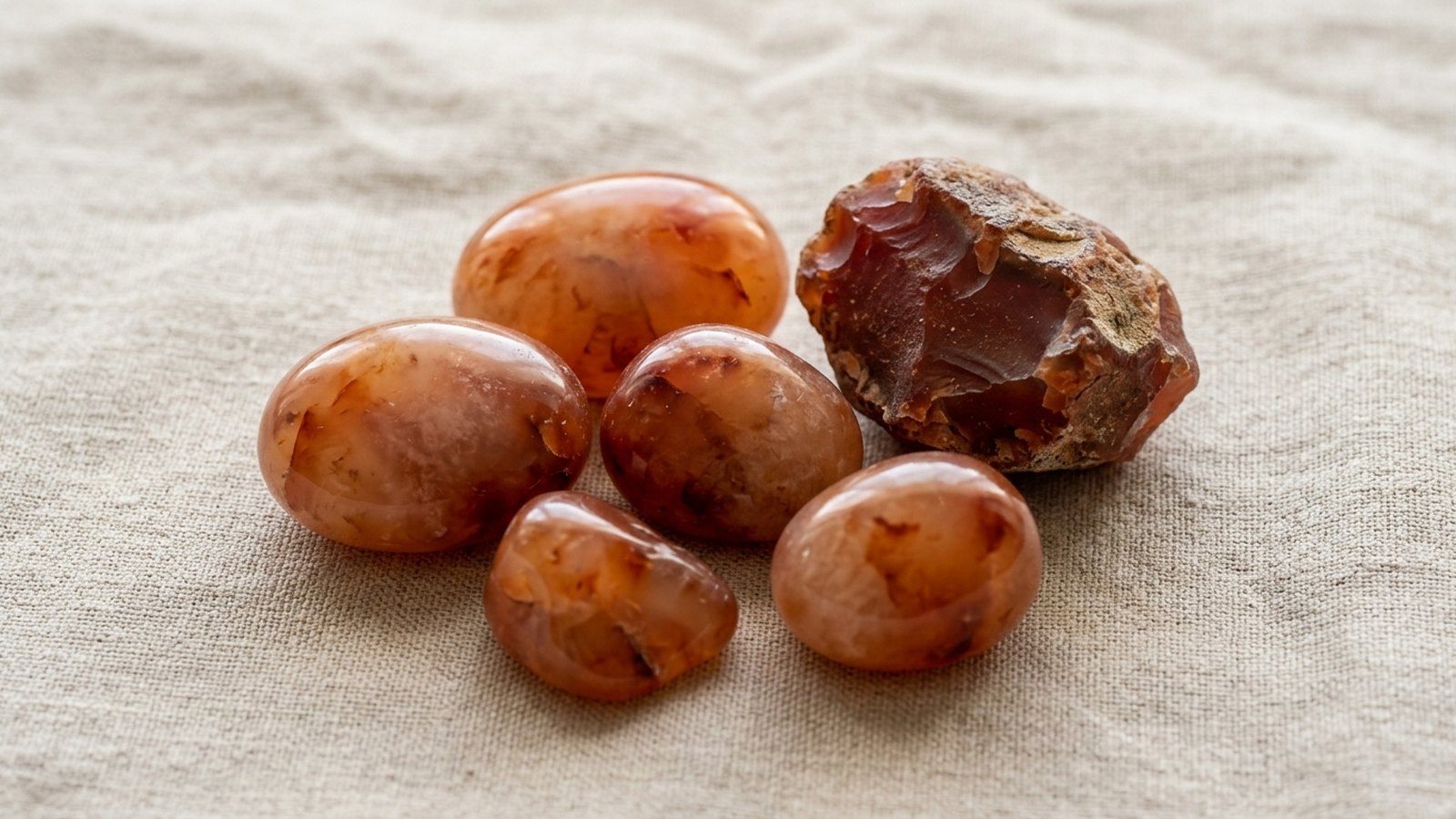
You are sitting in front of the thing you meant to make, and nothing is arriving. If you want one name to start with, take carnelian: a warm orange chalcedony that the tradition has tied to the sacral chakra, the body's old seat of creative fire, for thousands of years. But which stone actually suits you depends on which kind of block you have, and there are four of them.
That last part is where most crystal lists go quiet. They hand you eight stones and let you guess. I have watched people buy something stimulating when what they needed was something quieting, and then conclude that crystals do nothing, when really they had bought the opposite of their problem.
So this guide starts with the block, not the stone. Work out which one you are in, and the choice narrows from thirty-five options to two or three. That is the whole service I am trying to render here.
What the ranking lists actually agree on
I read the seven readable pages currently ranking for this search and counted every stone they named. Between them they recommended thirty-five different stones. Only two appeared on more than half the lists.
| Stone | On how many of 7 lists |
|---|---|
| Citrine | 7 |
| Carnelian | 5 |
| Fluorite | 4 |
| Lapis lazuli | 4 |
| Labradorite | 4 |
| Amethyst | 3 |
| Pyrite | 3 |
| Blue apatite | 3 |
| Twenty-seven others | 1 or 2 |
Here is the thing worth noticing. Citrine is on every single list, and that is not the endorsement it looks like. Citrine is on every list for abundance too, and for confidence, and for focus, and for joy. A stone that is recommended for everything is being recommended for nothing in particular. Carnelian is on fewer lists, but its reputation is narrow: drive, appetite, the courage to begin. When a stone's traditional reputation is that specific, it tells you more than unanimity does.
The other thing the tally shows is how little agreement there is underneath the top two. Twenty-seven stones were named by a single page. Two of the seven pages ran past three thousand words and simply widened the net, which is what a list does when it has no way of narrowing. A longer list is not a better answer to the question you actually asked, which was not "what could work" but "what should I get".
First, work out which block you have
Creative block is not one condition. It is at least four, and two of them are opposites.
The blank page. Nothing is coming. You sit down and the well is dry, and the longer you sit the drier it feels. This is a shortage of input and appetite.
The critic. Plenty is coming. You just reject all of it before it reaches the page. Ideas arrive, you look at them, they are embarrassing, you delete them. This is not a shortage of anything. It is a surplus of judgement arriving too early.
Notice that these two want opposite things. If you have the critic and you reach for a stimulating orange stone because a list told you to, you have added more material to a process that was already drowning in rejected material. That is the single most common mismatch I see, and it is why I put this section before the stones.
The stall. You have the idea. You know exactly what it is. You cannot get yourself to do the third hour of it. This is not creativity failing, it is follow-through failing, and it is closer to focus than to inspiration.
The showing. It is finished and you cannot let anyone see it. Different problem again, and it lives in the throat rather than the belly.
If you are not sure which one you are in, use this test: sit down for ten minutes and write down every idea that arrives, however bad, without judging any of them. If the page stays empty, it is the blank page. If it fills up and you feel worse, it is the critic.
If nothing is coming: carnelian, labradorite, orange calcite
Carnelian is the one I reach for first, and the one I would buy if I were only buying one. Its traditional territory is appetite: the willingness to start badly, which is the only way most things get started. Keep it where your hand lands before you begin, not where you look at it while you work.
Labradorite is for a subtler version of the same drought, when you are producing competent work and none of it surprises you. It is a feldspar whose blue and gold flash comes from light bouncing off microscopic layers inside the stone, so its whole character is that it looks like nothing until it is turned. The tradition reads it as the stone of the unexpected angle. I find it suits people whose problem is not output but sameness.
Orange calcite belongs here too, and it is the one the lists undersell. It is softer and sunnier than carnelian, less about courage and more about play, which is often the actual missing ingredient. It is also only Mohs 3, soft enough to be marked by a fingernail, so it lives on a shelf rather than in a pocket with keys. Sunstone belongs in the same family of warm, low-stakes stones if you find carnelian too insistent.
If everything is coming and you reject it all: amethyst, lepidolite, blue lace agate
Amethyst is the classic answer here, and its reputation for quieting mental noise is exactly the right shape for a loud internal editor. This is the pairing that crystals for manifestation touches on in a line: carnelian for blank-page fear, amethyst when the problem is self-criticism instead.
Lepidolite is the one I would add that no list I read mentioned. It is a lithium-bearing mica, genuinely soft and flaky, traditionally carried for a nervous system running too hot. If your block feels less like emptiness and more like a jittery, self-surveilling loop, this is the register you want.
Blue lace agate is the gentlest of the three. I suggest it for the specific case where the inner voice is not just critical but unkind, because its whole traditional association is with speaking softly, including to yourself.
A note on all three: they are quieting stones, and quieting is not the same as dulling. The point is not to stop caring about quality. It is to stop auditing quality at the exact moment the work is too young to survive an audit.
None of these will make the critic go away. What the tradition asks of them is that they push the judgement later in the process, which is all a first draft ever needed.
If you have the idea but cannot finish it: pyrite, fluorite, tiger's eye
Pyrite is a stone of stamina rather than inspiration. It has a blunt metallic weight in the hand that suits the hour when the interesting part is over and the work is just work.
Fluorite is the organiser: the tradition gives it the job of sorting a cluttered mind into an order you can act on. It is the stone I would pick for the moment when a project has become too many open threads to face. Be aware it is only Mohs 4 and it fades in sunlight, which I go into properly in the focus guide.
Tiger's eye sits between the two, traditionally read as steady nerve rather than raw drive. Good for the long middle of something, where the risk is not that you stop but that you drift.
For all three, the placement differs from the blank-page stones. Those you touch before you begin. These you leave in your line of sight while you work, because what they are marking is not the start but the decision to keep going. A stone at the edge of the keyboard, glanced at, is doing the job I am describing.
If it is finished and you cannot show it: lapis lazuli, sodalite, aquamarine
Lapis lazuli has carried an association with truthful speech since Egypt ground it into ultramarine pigment, and showing unfinished work is a form of truthful speech. It is the stone for the version of this where you are tempted to explain the piece into something safer than it is.
Sodalite is its calmer, cheaper cousin, and the two are confused constantly in shops. Where lapis is for saying the true thing, sodalite is for saying the clear thing: useful when you have to describe the work rather than defend it.
Aquamarine is what I would hand someone an hour before they present. Read traditionally as steadiness under a room's attention, it suits the physical end of this problem, the dry mouth and the racing start.
All three sit at the throat rather than the belly, which is the tell that this is a different problem from the blank page, and why an orange stone does nothing for it. If the fear is broader than the work itself, crystals for confidence is the better starting point.
Which chakra is creativity, and which is motivation
Two different ones, and people mix them up constantly.
Creativity belongs to the sacral chakra (svadhisthana), placed just below the navel, coloured orange, and traditionally associated with pleasure, emotional flow and the making of new things. That is why almost every creativity stone you will be shown is orange: carnelian, orange calcite, sunstone.
Motivation belongs one level up, at the solar plexus (manipura), yellow, associated with willpower and personal power rather than invention. Citrine and pyrite sit here. This is precisely why citrine gets recommended for creativity and does not quite deliver on it: it is a will stone doing a duty shift in the imagination department.
Our chakra crystals guide lays out all seven if you want the map. I will say plainly that I do not think there is a chakra "responsible for laziness", and I would be careful with any page that tells you one governs depression. That is a question for a doctor, not a stone.
How to actually use it, which is simpler than it sounds
Pick one stone. Not a bowl of them. Then anchor it to a repeatable physical action at the start of a session: pick it up, hold it for a slow count of ten, put it down, begin. That is the whole method.
What you are building is a cue. The stone is not supplying ideas; it is marking a boundary between not-working and working, and creative work responds well to a clear boundary. Over a few weeks the gesture starts doing the work of getting you into the chair, which is most of the battle.
If you want to add intention to it, our guide on programming an intention covers the traditional method, and cleansing your crystals covers what to do when a stone has been sitting through a rough month. Keep the stone somewhere your hand naturally falls, not somewhere decorative; our guide on where to place crystals goes further on that. And give the habit three or four weeks before you judge it. A cue that has only been used twice is not yet a cue.
The desk by the window, which is the trap nobody mentions
Every list tells you to put your creativity stone on your desk. Almost every desk is near a window. And the two stones every list recommends are the two most likely to be colour-treated, which means the two whose colour is most likely to leave.
Most carnelian on the market is heat-treated or dyed agate. There is a real test for this, and it takes five seconds: hold the stone up to a light. Natural carnelian shows a cloudy, hazy, uneven distribution of colour that drifts across the stone. Dyed agate shows either a suspiciously even colour throughout, or colour arranged in sharp regular bands, because the dye follows the banding that was already there. Neither is a scam exactly, treated chalcedony is sold openly across the trade, but you should know which one you own before you pay a natural price for it.
Most citrine is heat-treated amethyst, recognisable by a whitish base with the orange concentrated at the tip. I go into that properly in the citrine guide. What matters here is the consequence: heat-brought colour, in both stones, is the colour most vulnerable to a sunny windowsill over months.
So put the stone on the desk, but not in the sun. Blue apatite deserves a word too, since three of the seven lists recommend it and none mention that it is Mohs 5, soft enough to scuff against keys and coins in the same pocket. And if you rinse anything, check our note on crystals and water first.
What a stone will not do
It will not have the idea for you. Nothing on this page changes the fact that creative work is mostly the unglamorous business of showing up and making bad first versions.
What I do think a stone earns its place doing is smaller and more honest: it marks the start, it gives your hands something to do in the thirty seconds before you commit, and it keeps a chosen intention visible on a day when everything else is louder. These are traditional and intuitive associations rather than proven effects, and if a block has hardened into something that looks more like burnout or depression, please treat it as that and talk to someone qualified. A stone is good company for the work. It was never meant to be the worker.