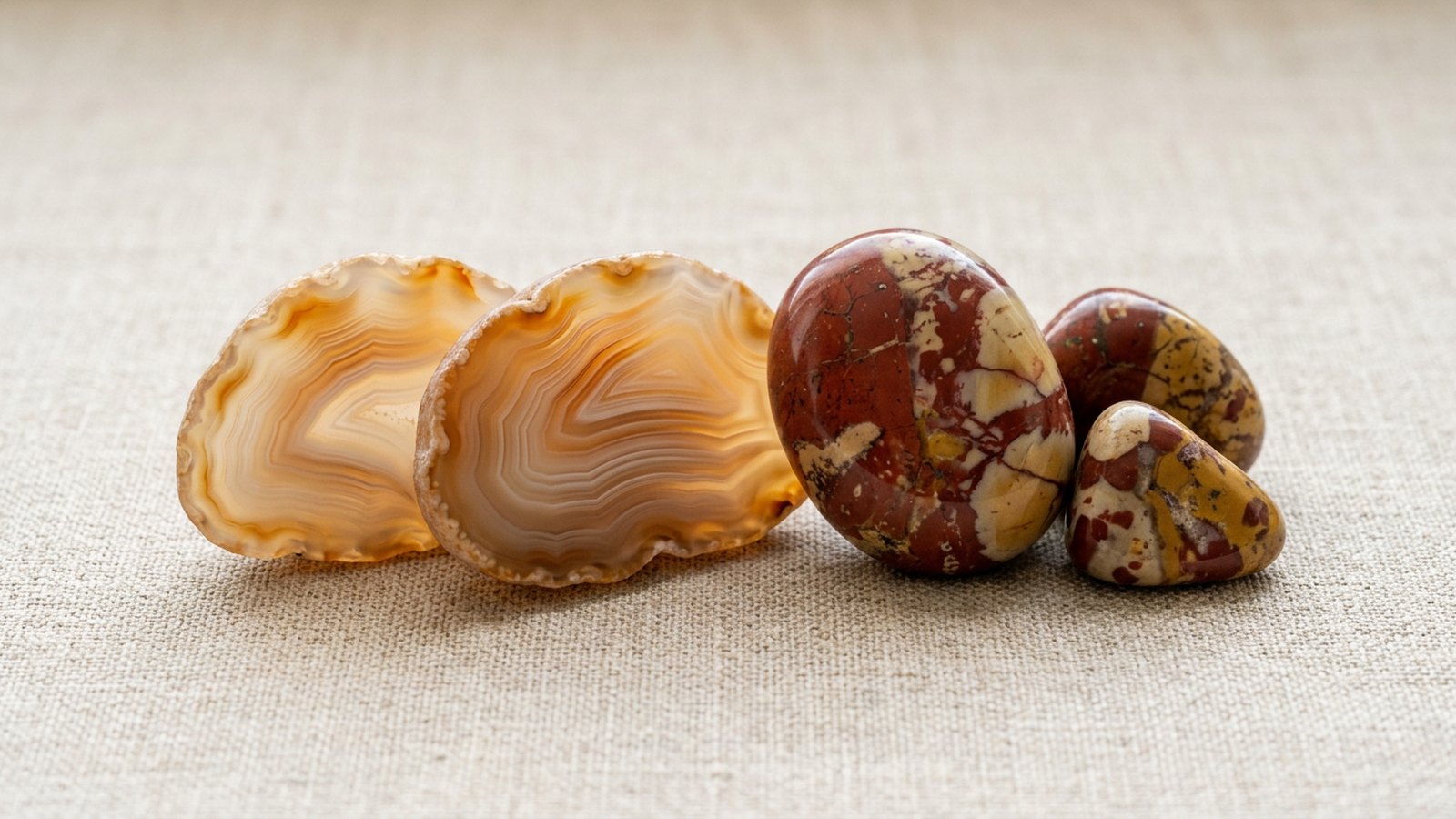
If you are holding a stone and wondering which one you have, there is one test that settles it. Hold a thin edge against a bright light. If light glows through the rim, it is agate. If the edge stays completely dark, it is jasper. Everything else, the colour, the pattern, the price, the weight in your palm, follows from that.
I have watched people spend an hour arguing about a pebble that a phone torch would have named in four seconds. So let me give you the test properly, and then the part nobody tells you: why the rule works, where it breaks down, and why two of the most respected pages on this subject do not actually agree with each other.
They are the same mineral, and neither is harder
This is the fact that reorganises everything else. Jasper and agate are not two minerals. They are two nicknames for one mineral, chalcedony, which is itself microcrystalline quartz. Same chemistry, SiO2. Same building block. The crystals are simply too small to see, packed in fibrous bundles, with a second silica phase called moganite laced through them (moganite was only described as a distinct mineral in 1994, named for the Mogán district of Gran Canaria).
So when the People Also Ask box asks whether jasper is harder than agate, the honest answer is no. Both sit at about 6.5 to 7 on the Mohs scale. Both scratch window glass. Both refuse a steel knife. Neither has cleavage, so both break in the same curved, shell-like fracture. If you own a jasper cabochon and an agate slice, you own two pieces of the same rock wearing different clothes.
What differs is how loaded that rock is with everything that is not quartz. Agate is relatively clean silica, so light travels through it. Jasper can carry up to about twenty percent foreign material, mostly iron oxides and clay minerals, and that cargo stops light dead. Opacity is not a different substance. It is the same substance, crowded.
The definitions on page one do not agree
Here is something worth knowing before you trust the first result you read.
Most of the big geology pages define it by light alone: translucent chalcedony is agate, opaque chalcedony is jasper, full stop. Under that rule, any stone you can see into is an agate whether or not it is striped.
Other sources, including some careful ones, use a three-way rule instead. Opaque means jasper. Translucent and banded means agate. Translucent and unbanded means plain chalcedony, and calling it agate is a courtesy rather than a classification.
I use the second rule, and so does the rest of this site, because banding is the thing agate is actually named for. It is why moss agate, whose stone page now sits with the other chalcedonies, is strictly speaking not an agate at all: it is translucent, but its green dendrites are not bands, so mineralogists tend to call it dendritic chalcedony. Blue lace agate, with its fine concentric ripples, is the real thing, and its stone profile sits alongside the other chalcedonies here.
Either way, the practical answer to "which do I have" is the same, because the first question in both rules is the light question. Start there.
Jasper vs agate at a glance
| Agate | Jasper | |
|---|---|---|
| Mineral | Chalcedony (microcrystalline quartz) | Chalcedony (microcrystalline quartz) |
| Formula | SiO2 | SiO2 |
| Hardness | 6.5 to 7 Mohs | 6.5 to 7 Mohs |
| Light through a thin edge | Yes, glows | No, stays dark |
| Impurity load | Low | Up to about 20% |
| Pattern | Curved, concentric bands | Spots, swirls, veins, landscapes |
| Formed | Layer by layer inside a cavity | Silica cementing a particle-filled deposit |
| Takes dye | Yes, and unevenly | Rarely, and poorly |
| Typical price driver | Pattern and locality | Locality and closed deposits |
| Traditional reading | Gradual, layered, communicative | Steady, grounded, enduring |
How to tell them apart in five minutes
- Find the thinnest part. A chip, a fractured corner, the tapered edge of a slice. Thickness lies: a two centimetre agate boulder looks as opaque as any jasper. Test where the stone is thin.
- Backlight it. Phone torch pressed against the back, room lights low, look at the rim. Agate glows amber or milky at the edge even when the face looks solid. Jasper gives you nothing, not a halo, not a glow.
- Wet it. Water sharpens the boundaries the same way polish does. Bands that were invisible dry often appear the moment the surface is wet, which is exactly the trick rockhounds use on a dusty riverbed.
- Read the pattern shape. Agate bands are concentric and curved, following the wall of the cavity they grew in. Jasper patterns are none of those things: mottled, spotted, veined, or arranged like a landscape, because they record a mess of sediment rather than an orderly deposit.
- Confirm it is chalcedony at all. Scratch a hidden spot on glass. If the stone marks the glass and takes no damage, you are in the quartz family. If the stone scratches easily, you have dyed howlite, magnesite, or something else pretending. Our guide on telling a real crystal from a fake covers the rest of those checks.
If steps two and four disagree, you probably have both in one stone. That is common enough to have a name: jaspagate. It is not a failure of your eye, it is the boundary showing itself for what it is.
Why they grew differently
The two patterns come from two completely different situations, and once you know them you can read almost any specimen.
Agate grows in a hole. Gas bubbles and cavities in cooling lava fill with silica-rich fluid, and the silica deposits on the cavity wall in successive layers, each one recording a slightly different chemistry as conditions change. That is why agate bands are curved and concentric: they are tracing the inside of the room they formed in. It is also why agate so often arrives as a rounded nodule that has to be sawn open.
Jasper grows in a mess. Silica-rich fluid soaks into a deposit that is already full of particles, volcanic ash, clay, fine sediment, iron oxides, and cements the whole thing into solid rock. The pattern you see is the arrangement of that original debris, frozen mid-swirl. Picture jasper's cliffs and skylines are real sedimentary structures, not a coincidence of colour.
Chert and flint sit next door: also microcrystalline quartz, also formed in sediment, but duller and typically grey to black. Flint is the dark chert that occurs in chalk, and it is the same family that gave the Stone Age its cutting edge, for the same reason obsidian did.
Why agate gets dyed and jasper does not
Look at a shop shelf and you will notice something. The screaming turquoise and magenta slices are always agate. Jasper is always its own earthy colour. That is not a stylistic choice, it is porosity.
Agate's bands are not equally dense. Some layers are slightly more porous than their neighbours, and dye soaks into those layers while the tighter ones resist. The result is a stone with colour pooled along its stripes, which is why dyed agate reads as too saturated, with candy colours that no iron oxide ever produced. Jasper, packed with impurities and lacking that alternating structure, simply does not take dye the same way.
This is old industry, not a modern trick. Idar-Oberstein in Germany was cutting agate from the sixteenth century, and when the local deposits ran out and Brazilian rough arrived in the nineteenth, the town developed dyeing recipes it kept secret for decades. Red came from bathing agate for weeks in nitric acid that had dissolved iron nails. Green came from potassium dichromate. Those methods built the world's supply of cheap coloured agate beads, and their descendants are still on sale today.
None of that makes a dyed agate a fake. It makes it treated, which is a thing you deserve to be told before you buy. If the colour is uniform and unnatural and the bands are sharply outlined in it, assume dye, and expect it to fade in a sunny window.
Which is worth more
Three of the nine questions Google surfaces for this search are about money, and almost every top result declines to answer. Here is the honest version.
Neither family is the expensive one. Common tumbled agate and common red jasper both sell for pocket change, and both are among the most abundant decorative stones on earth. Value in this corner of the mineral world does not attach to the species. It attaches to a specific deposit, its pattern, and whether you can still get material out of it.
That is why the highest prices here are jasper, not agate. Collectors speak of the five fine jaspers: Bruneau, Morrisonite, Willow Creek, Blue Mountain and Imperial. Morrisonite, from eastern Oregon near the Owyhee River, has changed hands at around 250 dollars a pound for rough. Bruneau jasper, from a canyon in Owyhee County, Idaho, has had no commercial production since 2009, and the price of what is already above ground reflects that. Meanwhile a fine Laguna agate from Mexico, with tight fortification banding, will beat almost any ordinary jasper.
So: is jasper a cheap stone? Usually yes, and occasionally it is the most expensive thing on the table. And the rarest jasper colours are blue and purple, because jasper's colours come mostly from iron, which gives reds, browns, yellows and greens generously and blues almost never. Treat vivid blue jasper with suspicion until you know its source.
The names that lie
Trade names in this family are marketing, not mineralogy, and several of the most popular ones are simply wrong.
- Dalmatian jasper is not jasper. It is a feldspar-rich igneous rock with dark mineral spots.
- Picasso jasper is not jasper. It is a metamorphosed dolomitic limestone, a marble.
- Tree agate is opaque white with green dendrites. Opaque means that under the standard rule it is a jasper, whatever the label says.
- Moss agate is translucent but unbanded, so it is dendritic chalcedony rather than a true agate.
- Bumblebee jasper from Mount Papandayan in Java is neither. It is a volcanic sediment, and its bright yellow comes from arsenic sulfides, which is a good reason to keep it out of your mouth, out of water you drink, and away from open cuts.
- Carnelian and sard are translucent, unbanded chalcedony coloured by iron oxide, which makes them cousins to agate rather than to jasper. Their story is in the carnelian guide and on its stone page.
- Onyx is chalcedony with straight parallel bands instead of curved ones, which is why it sits in a different discussion entirely, covered in the onyx guide, the onyx stone page and the comparison of onyx and obsidian.
None of this means your stone is not what you love. It means the label on the bin was written by a seller, the same problem that makes aventurine and jade so easy to mix up, and you now know more than the bin does.
What the difference means in practice
Now the part the geology pages leave out, and the part I want to be careful about.
Crystal tradition does not sort these stones the way mineralogy does. Tradition sorts by colour and pattern, which is why a red agate and a red jasper end up with almost identical descriptions in most crystal books, despite being distinguished by light in every geological sense. Once you see that, a lot of contradictory reading stops being contradictory. Two systems are being used at once.
Within the tradition, the readings that have held longest track what the stones look like. Agate, layered and translucent, is associated with gradual work: patience, steadiness through a slow change, and in the case of blue lace agate, gentler speech, which is why it is linked to the throat chakra and often carried by people who find conversation hard. Jasper, opaque and solid, is read as the endurance stone. Red jasper in particular is tied to the root chakra and to staying with something difficult rather than fixing it quickly, a theme it shares with the stones in our guide to crystals for protection and with the pair compared in black tourmaline vs obsidian.
As for who should wear jasper, the traditional answer is anyone who needs to last rather than to leap: it is associated with Aries and with the root chakra, and it is a common choice for people going through long, unglamorous stretches of effort. I offer that as tradition and personal observation, not as fact. Stones do not treat illness, replace medical or psychological care, or guarantee an outcome, and I would not trust anyone who tells you otherwise.
The Bible question that Google keeps surfacing deserves the same honesty. Jasper appears in Revelation 21 as the first foundation stone of the New Jerusalem, and the city wall is described as jasper, "clear as crystal". Modern jasper is never clear. Whatever the Greek iaspis meant to that writer, it was almost certainly something translucent, so the ancient name and the modern one do not point at the same rock. That is normal for gem names of that age.
Caring for both, and choosing between them
Care is simple, because at Mohs 7 with no cleavage these are among the most forgiving stones you can own. Both handle water, so brief rinsing is fine, as our water safety guide explains. Both survive being carried loose in a pocket. The two real cautions are treated material and sunlight: dyed agate fades, and if you own a slice in a colour nature does not make, keep it off the windowsill. Cleaning with mild soap and a soft cloth is all either needs, and the gentler methods in our cleansing guide suit both.
Choosing between them is easier than it looks, so I will not sit on the fence. Buy agate when you want to look into a stone: banded slices, backlit windows, anything where depth and light are the point, and anything where the pattern is meant to reward a long look. Buy jasper when you want to look at one and hold it: worry stones, palm stones, everyday carries, and any piece whose job is to be solid, warm and unbothered in a pocket.
And if you already own the stone and simply wanted its right name, take it to the nearest lamp. Four seconds, one thin edge, and the argument is over.