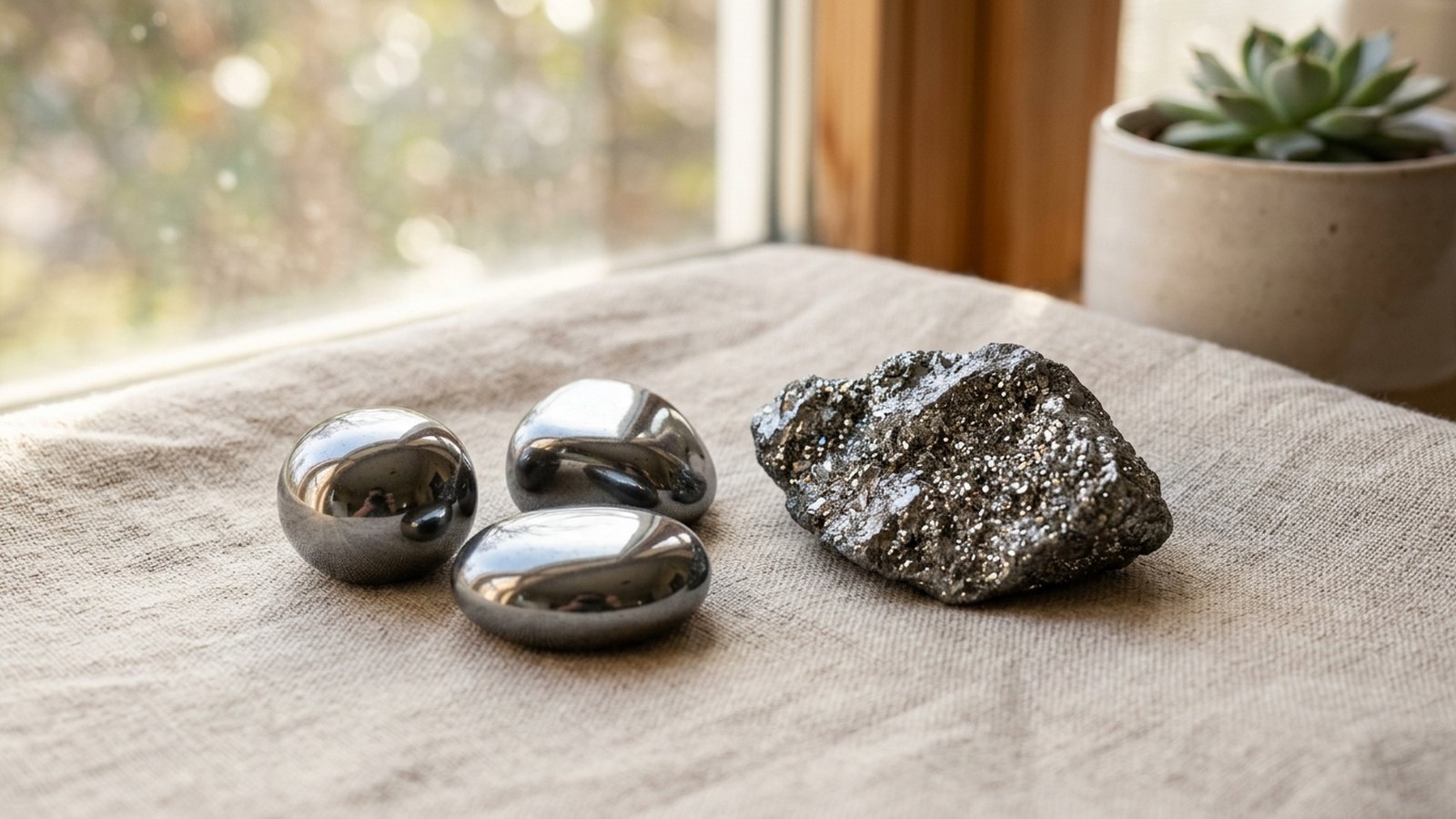
Hematite meaning comes down to a single word: grounded. This heavy, mirror-bright stone has been carried, crushed, and polished for tens of thousands of years as a symbol of strength, protection, and clear-headed focus. Its cool metallic shine looks almost futuristic, yet its story is ancient, and its name literally means "blood." If you are drawn to hematite's silvery weight, this guide explains what hematite means, what the stone actually is, its long history, and how people use it today.
What Hematite Means
At its core, the meaning of hematite is about being anchored and clear. Where a bright quartz point feels light and expansive, hematite feels dense, still, and close to the earth. It is traditionally seen as a grounding stone, a symbol of stability that draws scattered energy back down into the body and helps you feel steady on your feet.
Hematite is also known as a stone of the mind. People associate it with focus, memory, and practical thinking, the kind of quiet mental order that turns a busy day into a set of simple next steps. Alongside grounding, its second great theme is protection: many keep hematite close as a symbolic shield, a stone that deflects other people's moods and keeps your own energy your own. If that steadying quality appeals to you, you may also like our guide to crystals for anxiety.
Hematite Properties and What the Stone Actually Is
Beyond the symbolism, hematite is a genuinely remarkable mineral. It is iron oxide, chemically Fe2O3, one of the most abundant iron minerals on Earth and the main ore we smelt into iron and steel. On the Mohs scale it sits around 5.5 to 6.5, hard enough to take a bright polish but soft enough to scratch.
That polish is the source of its silver-grey to gunmetal shine. Yet hematite hides a surprise. Scratch it against an unglazed tile and it leaves a streak of deep rust red. That blood-red trace is why the ancient Greeks named it after "haima," their word for blood. A stone that looks like polished steel yet bleeds red when scratched is one of nature's small paradoxes, and that streak is also the single most reliable way to recognise the real thing.
Hematite forms in many shapes, from mirror-bright "specular" sheets that sparkle with tiny flakes to smooth kidney-shaped masses and rounded, bubbly botryoidal clusters. Whatever the form, its signature is weight. Pick up a tumbled hematite and it feels far heavier than a same-sized quartz, and that heaviness is part of why the stone reads as so grounding in the hand.
Hematite and the Root Chakra
Because hematite is so heavy and earthy, it is almost always linked to the root chakra, the energy centre at the base of the spine tied to safety, stability, and feeling at home in your body. In this tradition, hematite is a go-to stone for pulling your awareness out of a spinning head and back down to solid ground.
Many people reach for hematite when they feel scattered, overstimulated, or ungrounded after too much screen time. You might hold a piece during a slow breath at your desk, or place one at your feet during meditation to feel more settled. To see how this fits the wider system, read our guide to the seven chakras and their crystals, and for a quieter mind at night, our notes on crystals for sleep.
The History and Lore of Hematite
Hematite may be the oldest stone in human culture. Long before anyone polished it, our ancestors crushed the soft red variety into ochre, the earthy pigment used in cave paintings, burials, and body decoration across tens of thousands of years. That deep red powder is, chemically, the same iron oxide that rusts a nail or reddens the soil.
Later cultures polished hematite into some of the earliest mirrors, prizing its dark, reflective surface long before glass was common. Its blood connection ran through this lore too, and warriors were said to rub the red pigment on their skin before battle for strength and protection. The same iron oxide even colours another world: the rusty surface of Mars is rich in hematite, and NASA's rovers found grey hematite spheres there that hint at the planet's watery past. It is, in a real sense, an interplanetary stone.
For a broader look at how colour shapes crystal symbolism, our guide to crystal colours and their meanings puts hematite's cool grey in context.
How to Use Hematite
Hematite is an easy stone to live with. Here are the most common ways people bring it into daily life:
- Carry a tumbled stone. Slip one in a pocket and hold it when you feel scattered; its weight is a simple, physical anchor. See carrying and wearing stones for more.
- Wear it as jewellery. Hematite rings and bracelets are popular precisely because the stone feels grounding against the skin all day.
- Meditate with it. Rest a piece in your palm or at your feet to deepen a grounding practice, as in our meditating with crystals guide.
- Place it in your space. Set hematite by a doorway or on a desk as a symbolic anchor and shield. Our guide on where to place crystals in your home has more ideas.
If you like pairing stones, hematite sits naturally beside other grounding stones such as red jasper, black tourmaline, and smoky quartz, all root-chakra companions.
Caring for Hematite (Keep It Away From Water)
Here is the one rule that matters most: hematite is iron, and iron rusts. Do not soak it, do not cleanse it in water, and do not leave it on a wet surface, or you risk dull orange rust spots on that beautiful mirror finish. Cleanse it instead with dry methods such as smoke, sound, or a night on a bed of dry salt or selenite. Our crystals and water safety guide explains which stones share this problem, and our cleansing and charging guide covers gentle dry alternatives.
One more caution is worth knowing before you buy. Most "magnetic hematite" sold in shops is not natural hematite at all, but a man-made ceramic called hematine, magnetised with barium or strontium. Natural hematite is only very weakly magnetic. If a stone snaps hard onto a fridge magnet, treat it as a synthetic look-alike. Our guide on how to tell if a crystal is real or fake walks through the streak test and other simple checks.
Final Thoughts
Hematite's meaning is quietly practical: come back down, get clear, feel protected. It is a stone for staying steady when life feels loud, valued for grounding, focus, and a sense of being safely anchored in your own body. Keep it dry, enjoy its surprising weight, and let its ancient, blood-red heart remind you that strength is often just the ability to stay present. If courage is where you want to go next, our crystals for confidence and courage guide is a natural next step.