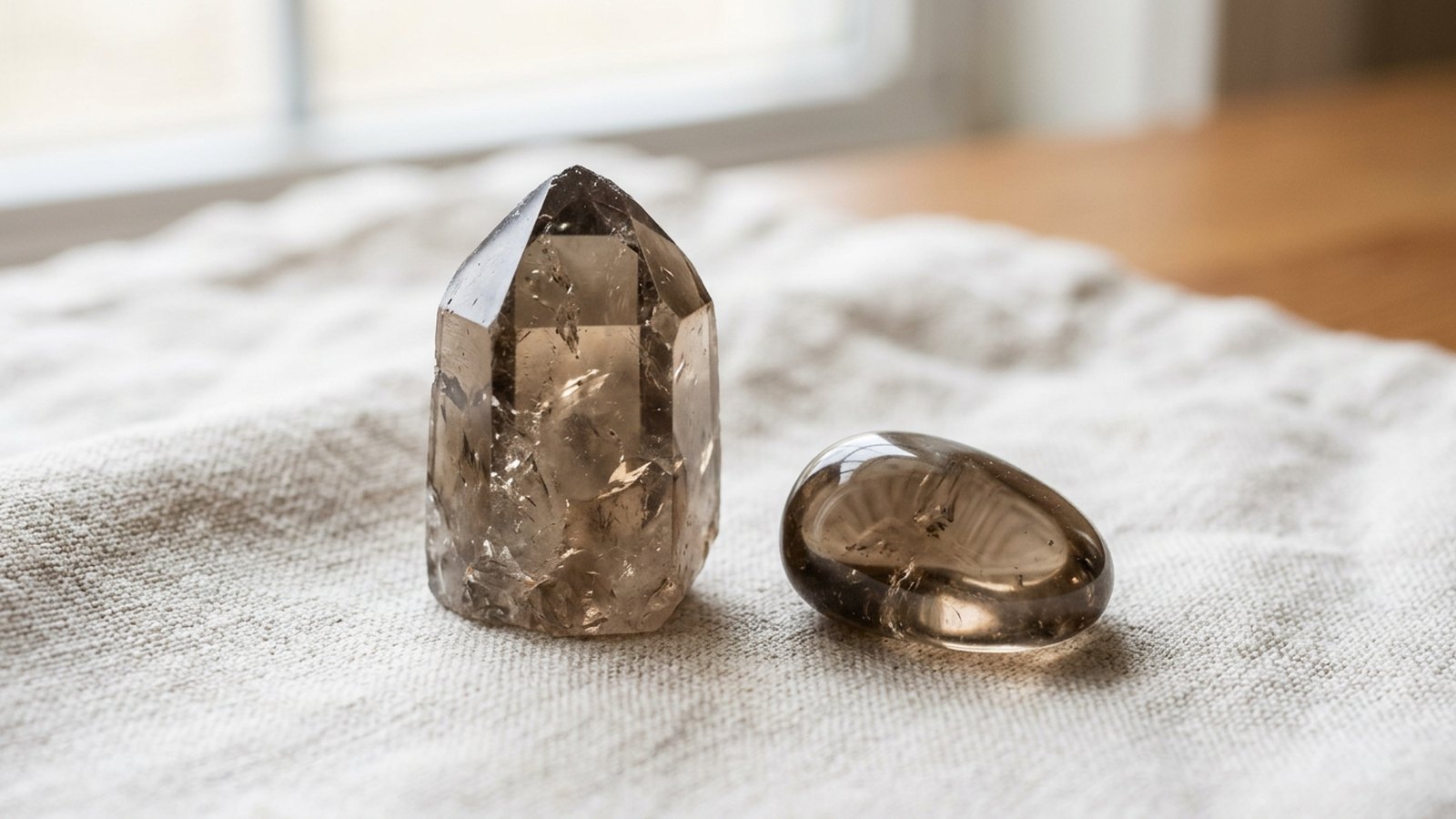
Smoky quartz is a translucent brown to smoky gray variety of quartz, and its meaning centers on grounding, protection, and gently clearing away what weighs you down. It has long been worked with as a steadying, earthy stone, the kind you reach for when life feels scattered and you want to feel rooted again. Its shadowy color ties it to the root chakra and the pull of the earth, which is why many people treat smoky quartz as an anchor stone: something to hold when stress, worry, or heavy moods need somewhere to go. If its soft, smoky glow draws you in, you are following a very old instinct.
This guide covers what smoky quartz is, what it symbolizes, its link to the root chakra, and simple, practical ways to use, cleanse, and charge it.
What Is Smoky Quartz?
Smoky quartz is a brown variety of quartz, made of silicon dioxide (SiO2). Its color ranges from a pale, tea-tinted gray through warm cocoa brown to a deep, almost opaque black. The very darkest form has its own name, morion. Like all quartz, smoky quartz sits at 7 on the Mohs hardness scale, which makes it durable enough for rings, pendants, beads, and everyday carrying.
What sets smoky quartz apart is how it earns its color. The smoky tone is not a surface stain or a trace metal in the usual sense. It forms when natural radiation from the surrounding granite acts, over millions of years, on tiny traces of aluminum tucked inside the crystal. That slow, natural process creates what mineralogists call a color center, which absorbs light and gives the stone its smoky depth. The more radiation, and the more time, the darker the crystal grows. It is worth knowing that a large share of the smoky quartz sold today is clear quartz that has been artificially irradiated to darken it quickly, so naturally colored specimens are quietly special.
Because it is a form of quartz, smoky quartz is stable and water-safe for brief contact, so a quick rinse is fine. It will, however, fade with long hours in strong sunlight or high heat, since the same energy that formed its color can undo it. Our guide on which crystals can go in water explains exactly where smoky quartz fits.
Smoky Quartz Meaning and Symbolism
The meaning of smoky quartz is built around grounding and release. Where clear quartz is prized as an amplifier that brightens and magnifies, smoky quartz is its earthbound cousin: it settles, steadies, and draws energy downward instead of up. The two are the same mineral doing very different jobs.
Traditionally, smoky quartz is seen as a stone of protection and transmutation. Rather than blocking heavy or unwanted feelings, it is thought to take them in and let them drain away into the ground, the way rain sinks into soil. That makes it a natural companion to other grounding and protective stones such as black tourmaline and obsidian. People often turn to smoky quartz when they want to let go of stress, worry, or a mood that has overstayed its welcome, and simply feel a little more solid in their own body.
It also carries a quiet symbolism of endurance. Its colors are the colors of the earth itself: peat, bark, river stone, and smoke. To hold one is to be reminded that heavy things pass and that steadiness is its own kind of strength.
Cairngorm: Scotland's Smoky Quartz
Smoky quartz has a proud place in Scottish tradition, where it is known as cairngorm, after the Cairngorm Mountains in the Highlands. It is recognized as Scotland's national gem, and its warm, tea-brown crystals have adorned traditional Highland dress for centuries. You will find cairngorm set into brooches and plaid pins, and crowning the handles of the dirk and the sgian-dubh. The stone became especially fashionable in the Victorian era, when Queen Victoria's love of Scotland helped turn it into a symbol of Highland heritage. Knowing this history gives an ordinary tumbled smoky quartz a little more weight in the hand.
Smoky Quartz and the Root Chakra
Smoky quartz is most closely tied to the root chakra, or Muladhara, which sits at the base of the spine and governs your sense of safety, stability, and belonging. When the root feels shaky, it can show up as restlessness, anxiety, or the feeling of being ungrounded and far from yourself. Smoky quartz is worked with to bring attention back down to the body and the present moment, like putting weight back into your feet. If you want to understand how it sits alongside the other stones of the body's energy centers, our guide to the seven chakras and their crystals maps the full picture.
How to Use Smoky Quartz
Smoky quartz is an easy, forgiving stone to live with. Here are a few simple ways to bring it into your day.
- Carry it. Slip a tumbled stone into a pocket or bag and hold it when a moment feels overwhelming. Its weight and cool surface give restless hands something to settle on.
- Place it at home. A cluster or point near the entrance, or on a desk where stress collects, works as a quiet anchor for a room. Our guide on where to place crystals in your home has more ideas.
- Meditate with it. Rest a stone in your palm or against the base of your spine and let your breath slow. Many people pair it with grounding practice from our notes on meditating with crystals.
- Keep one by the bed. Its calming reputation makes it a common choice for a bedside table when the mind will not switch off, alongside the ideas in our crystals for sleep guide.
In practice, the stone that has traveled with me longest is a small, smoke-gray point that lives on the corner of my writing desk. On the days when the inbox feels loud, I have gotten into the habit of picking it up and simply turning it over a few times before starting. Nothing dramatic happens, but the small ritual gives the anxious energy a place to land, which is exactly what smoky quartz is traditionally meant to do. If that appeals to you, our roundup of crystals for anxiety covers a wider set of calming stones.
How to Cleanse and Charge Smoky Quartz
Because it is quartz, smoky quartz is simple to care for. A brief rinse under cool running water is enough to refresh it, and the smoke of incense or a quick pass through sound both work well for those who prefer not to use water. The one thing to avoid is charging it in strong, direct sunlight for long stretches, as too much sun and heat can fade its smoky color over time. Gentle moonlight, a bed of dry salt beside it, or an overnight rest on a cluster are kinder choices. Our full guides on cleansing your crystals and how to charge them walk through each method.
Smoky quartz is also one of the stones I reach for at an ending rather than a start, which is why it sits at the centre of our guide to crystals for new beginnings.