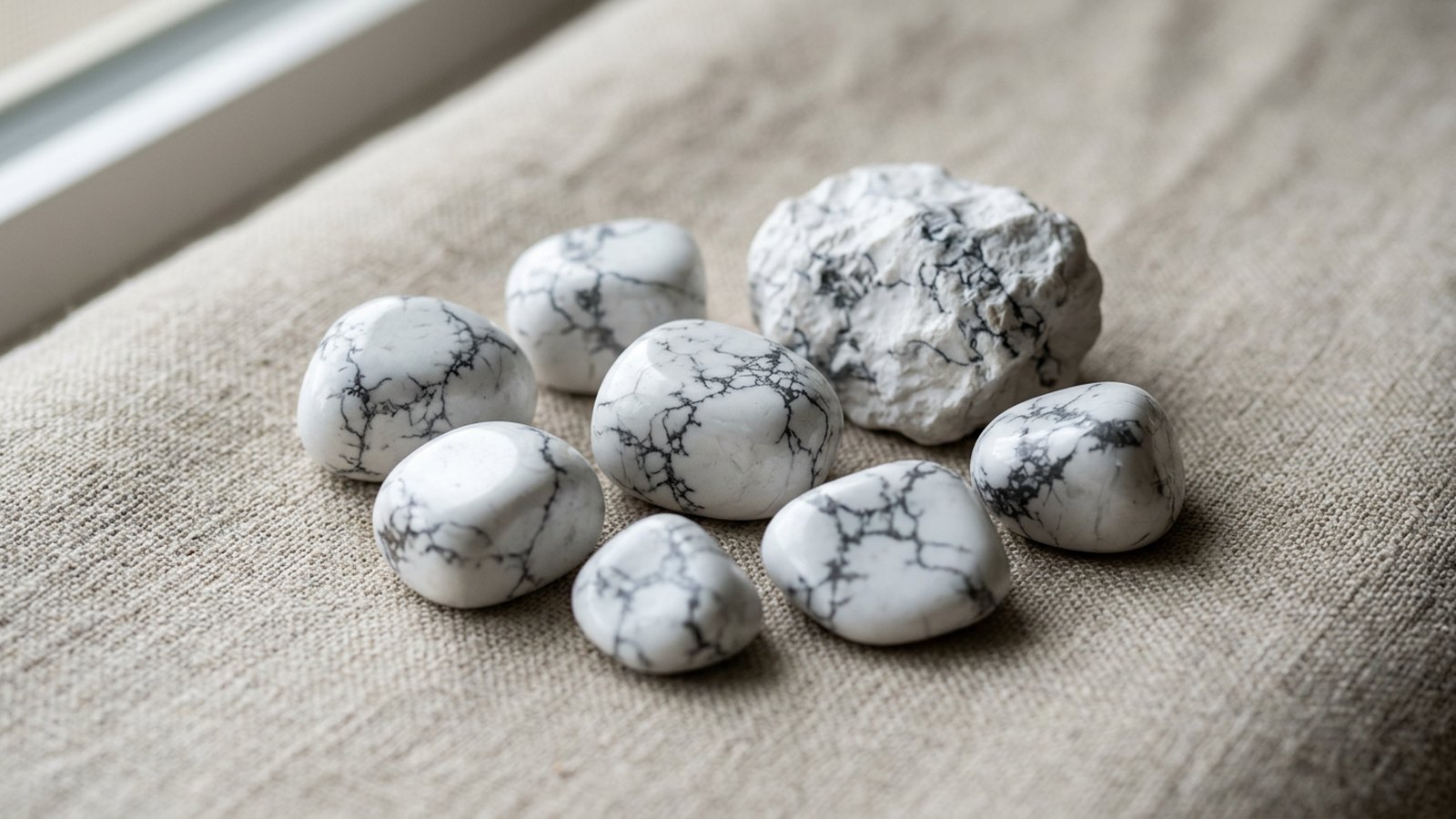
There is a bowl on my desk with two chalky white tumbled stones in it, and for about three years I told people one of them was howlite. It was magnesite. I had bought it from a shop I trusted, in a tray labelled howlite, and I repeated the label to everyone who picked it up. What finally gave it away was weight. Side by side, in the same hand, one of them simply sat heavier.
If you are here, you are probably holding something white with dark squiggles through it, or something blue that you are starting to suspect is not turquoise. Both suspicions are reasonable. These two minerals are confused more often than almost any other pair in the crystal trade, and the confusion is not always innocent.
Howlite vs magnesite: the short answer
Howlite is a calcium borosilicate and magnesite is a magnesium carbonate. They are unrelated minerals that happen to look alike: both chalky, white and porous. The quickest tells are the veining, which is fine grey to black webbing in howlite and broader brown crackling in magnesite, and the weight, since magnesite is noticeably denser.
| Howlite | Magnesite | |
|---|---|---|
| Mineral class | Borosilicate | Carbonate |
| Formula | Ca2B5SiO9(OH)5 | MgCO3 |
| Mohs hardness | 3.5 | 3.5 to 4.5 |
| Specific gravity | 2.53 to 2.59 | 3.0 to 3.2 |
| Typical veining | Fine grey or black web | Wider tan or brown crackle |
| Crystal system | Monoclinic | Trigonal |
| Reacts with acid | No fizzing | Fizzes, but only in warm acid |
| Usual shop price | Low | Low |
| Traditionally used for | Stillness, sleep, patience | Relaxation, visualisation, the heart |
Read that table as a set of clues rather than a single test. No one line of it settles the question on its own, and that is precisely why the two stones keep getting mixed up.
What howlite actually is
Howlite was described in 1868 near Windsor, Nova Scotia, by Henry How, a chemist who first called it silicoborocalcite. James Dwight Dana later renamed it for him. It is a borate mineral, chemically closer to borax than to anything else on a crystal shelf, and almost all of the howlite that reaches the market came out of borax workings in southern California rather than from Canada.
It grows as nodules, lumpy and irregular, sometimes described as cauliflower shaped. The dark webbing that makes it recognisable is not really inside the stone at all. It is the host clay pressed into the surface of the nodule as it formed, which is why the lines sit flush and fine, like ink drawn on porcelain rather than cracks filled in afterwards. Our howlite guide goes further into the stone on its own terms.
At 3.5 on the Mohs scale it is soft. A steel knife marks it, a house key marks it, and so does a zip in the same pocket.
What magnesite actually is
Magnesite is magnesium carbonate, a member of the calcite group, and it is one of the most heavily mined industrial minerals on earth. Tens of millions of tonnes come out of the ground every year, roasted into magnesia and pressed into refractory brick for steel furnaces. The tumbled nodule in a crystal shop is a rounding error against that tonnage, which is worth remembering the next time someone tells you magnesite is rare. It is not rare. It is ordinary in the most literal, industrial sense.
The material sold for jewellery and energy work forms mostly where magnesium rich rocks like serpentinite and peridotite are altered by fluids carrying carbon dioxide, and also as a sediment in old lake beds. Austria, China, Brazil, Turkey and Slovakia all produce it in quantity. There is more on the stone itself on our magnesite page.
The name is simply the mineral's chemistry and its best known source, the Magnesia region of Thessaly in Greece, which also gave us magnesium and, by a longer route, the magnet. If you see it called magnesium carbonate, magnesia alba or, less honestly, white turquoise, those all point back to the same mineral. Dealers sometimes describe the raw nodules as bone or tooth magnesite, which is a fair description of how they look before polishing.
Visually it is chalkier and more opaque than howlite, and its matrix runs tan, ochre or grey brown in wider, more irregular channels. The overall impression is crazed porcelain rather than spider silk.
Five ways to tell them apart at home
1. Read the veining first. This is the test that costs nothing and works most of the time. Howlite draws fine dark lines that branch and taper, often almost black, and they tend to sit level with the polished surface. Magnesite's matrix is wider, warmer in colour, and breaks the stone into irregular plates. If you are looking at brown rather than grey, you are probably looking at magnesite.
2. Weigh them against each other. Magnesite's specific gravity of around 3.0 against howlite's 2.58 means a magnesite piece is roughly a sixth heavier than a howlite piece of the same size. In isolation you will not feel that. With one in each hand, most people feel it immediately. This is what finally corrected me.
3. Try the hardness, carefully. Howlite sits at 3.5 and magnesite reaches 4.5 at its hardest, so a copper coin will sometimes scratch howlite and fail on magnesite. Do this on the base of the stone where the mark will not show, or do not do it at all. The range overlaps, so a negative result proves nothing.
4. The acid test, with a correction. Magnesite is a carbonate, so it releases carbon dioxide in acid, and howlite does not bubble at all. What most guides leave out is that magnesite is stubborn about it. Unlike calcite, it barely reacts to cold dilute acid. You need warm acid or powdered material to see a convincing fizz, which means a quick dab of vinegar on a bead usually tells you nothing. This test also permanently etches the stone, so keep it for a scrap chip, never a finished piece.
5. Distrust the tests you will be told about. The tongue test, where a stone is said to stick to damp skin, only shows that a stone is porous, and both of these are porous. Ultraviolet fluorescence is offered everywhere as a tell, but both minerals can fluoresce, both can stay dark, and the response depends on trace impurities rather than species. I have stopped using either one, and I would rather say so than hand you a test that will give you a confident wrong answer.
The blue problem: both of these are sold as turquoise
Here is the real reason this comparison matters. Both minerals are white and porous, which means both drink dye, and both have been dyed blue and sold as turquoise for the better part of a century. Howlite was the classic impostor. Magnesite has quietly become the more common one, because it takes colour beautifully and comes in endless supply.
Watch the vocabulary. "White turquoise" is usually magnesite or howlite. "White buffalo" is a genuine stone from Nevada but the name gets borrowed freely. So does "turquenite", which is a trade name for dyed howlite and nothing else. If a blue bead costs a few pounds and has a perfectly even colour with dark lines that look drawn rather than grown, assume dye until told otherwise. A cotton bud with a little acetone will often lift colour from a dyed piece, and real turquoise will not surrender any. Our guide on how to tell if a crystal is real covers the wider family of these tricks.
Price is a clue in itself, and a blunt one. Undyed howlite and undyed magnesite are both cheap, because both are abundant and neither is difficult to cut. A tumbled piece costs pocket change, a strand of beads costs a few pounds, and anything sold as turquoise at that price is not turquoise. Genuine stabilised turquoise from a named mine starts an order of magnitude higher and climbs from there.
None of this makes dyed stone worthless. I have a dyed howlite bracelet I am fond of. It makes it dyed stone, which should be priced and described as dyed stone, and the moment a seller is straight with you about that, the object stops being a small lie and becomes a nice blue bracelet.
Do they feel different?
I want to be careful here, because this is the part where honesty costs something.
In the traditions I work within, howlite is the quieter of the two. It is the stone I reach for when my mind will not stop narrating at eleven at night, and it turns up constantly in the lore around patience, insomnia and swallowed anger. It is usually placed at the crown, associated with Gemini and Virgo, and it pairs naturally with the approach in crystals for sleep.
Magnesite is traditionally described as the more physical relaxation, the one associated with releasing held tension in the body, and with vivid imagery during meditation. Because magnesium is bound up with the heart in so much folk thinking, it is often placed at the heart rather than the crown, and sometimes at the third eye for visualisation work.
In practice I use them differently because of how they behave rather than how they feel. Howlite goes under the pillow or in a pocket, where its softness does not matter and the point is proximity through a long stretch of time. Magnesite I hold, because it is the heavier of the two and there is something in that weight that settles a body faster than an idea does. Neither asks for a ritual. Both do better with a habit.
And here is the caveat almost nobody offers: these two traditions have contaminated each other. Decades of magnesite beads were sold as howlite and written about as howlite. A good deal of published howlite lore was very likely observed on magnesite. I hold my own sense of the difference lightly for exactly that reason, and I would encourage you to trust what a stone does in your own hands over what any of us, myself included, have written down. None of this is medical advice, and neither stone is a substitute for real treatment or real rest.
Which one should you choose?
If you want the stone for sleep, mental quiet or anxiety, take howlite. The tradition behind it is deeper and better documented for that use, and the fine grey webbing is genuinely lovely undyed.
If you want it for bodily relaxation, or for meditation where you are building images, take magnesite, and buy it undyed so you can actually see what you have.
If you want a blue stone for the throat, buy neither. Buy blue lace agate or amazonite, which are harder, more durable, and blue because they are blue.
And if you want turquoise, spend the money on turquoise from a seller who will name the mine.
Caring for two soft, porous stones
Both are too soft and too absorbent for water. Magnesite is a carbonate and will slowly dissolve in anything acidic, including citrus, sweat and many cleaning sprays. Howlite soaks and can craze. Salt is worse than water for both, and dyed pieces of either will bleed colour into a bowl of water and onto light clothing. Wipe them dry instead, and see crystals and water safety for the rest of the family, or how to cleanse your crystals for methods that involve no liquid at all.
Neither belongs in a ring you wear daily. At 3.5 they will go cloudy within a year against nothing more aggressive than dust. Beads, pendants and pocket stones are fine, kept apart from harder stones in storage so they do not get scratched, which is covered in how to store crystals and carrying and wearing stones.
Who should skip howlite, then? Anyone who wants an everyday ring stone, anyone who cleanses by soaking, and anyone buying it blue and expecting turquoise. The same applies to magnesite, with a slightly shorter fuse on acid.
A last thought
I kept my mislabelled magnesite. It sits next to the howlite now, and having the two together taught me more than either would have alone. That is usually how it goes: you learn a stone properly on the day you find out it was something else.