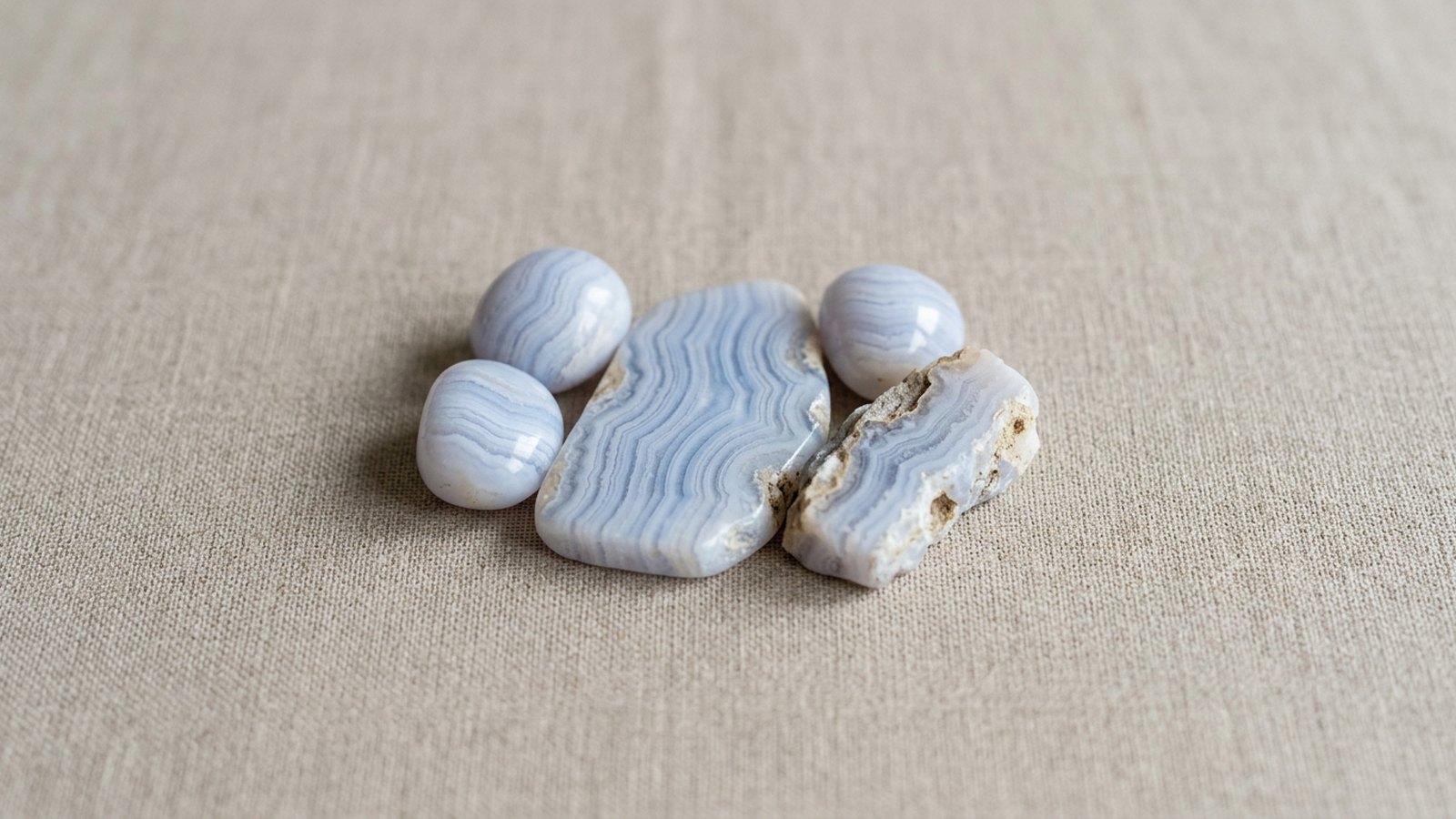
Blue lace agate is a pale blue banded variety of chalcedony, a microcrystalline form of quartz, known in crystal tradition as a stone of gentle communication and calm. It sits at 6.5 to 7 on the Mohs scale, carries soft sky-blue and white bands that curve like ribbon, and is associated with the throat chakra. Almost all of it on the market came from a single farm in southern Namibia, where the mine closed in January 2017.
I want to start with that last sentence, because it is the part nobody tells you, and it changes how you look at the stone in your hand.
Blue lace agate is quiet in a way that very few blue stones are. Lapis is regal, aquamarine is oceanic, sodalite is dense and thoughtful. This one is pale, almost hesitant, with white bands drifting through the blue like weather. If you have ever needed to say something difficult and found your voice going thin, this is the stone tradition hands you.
What blue lace agate actually is
It is an agate, which means it is a banded form of chalcedony, and chalcedony is quartz grown so finely that the individual crystals are microscopic. The chemistry is plain silicon dioxide, SiO2, the same as clear quartz and amethyst and every other quartz on your shelf. What differs is the size and arrangement of the crystals.
Under a lens, the structure is more interesting than "blue and white stripes" suggests. The blue layers are spherulitic chalcedony, fibres radiating outward in tiny sheaves, while the white layers are micro-granular quartz. So the lace pattern is not one material shading lighter and darker. It is two different textures of the same mineral, alternating.
Practical numbers for blue lace agate: Mohs 6.5 to 7, specific gravity around 2.6, conchoidal fracture, a waxy to pearly lustre rather than a glassy one. That hardness matters more than it sounds, and I will come back to it when we talk about care. It is in the same family as moss agate, though the two form in very different ways.
Why blue lace agate is genuinely rare
This is the question the search results are full of and the one almost no page answers with a fact, so here is the fact.
For most of its commercial life, essentially all good blue lace agate came from one place: Ysterputs Farm 254, in Karasburg West in the ǁKaras Region of southern Namibia, roughly 80 km north of Noordoewer near the South African border. Not a district. Not a region. One farm. It was privately held and worked by the late George Swanson from about 1962 (accounts differ on who first spotted the material) until January 2017, when the mine went quiet.
Nothing has been excavated from that deposit since. Access is closed and the future of the workings is uncertain.
So when you buy blue lace agate today, you are almost certainly buying stock mined before 2017, moving slowly through the trade. That is a real supply constraint with a date on it, and it is why prices have crept up and why quality has become uneven.
Other sources exist and some are legitimate: comparable banded blue chalcedony is reported from elsewhere in Namibia, and from Kenya, Malawi, Zambia, Turkey and Georgia, with paler material from Brazil, Madagascar and the western United States. But treat crystal-site source lists carefully. Several of the pages ranking for this search name South Africa, or "throughout Africa and Eastern Europe", as the origin. Neither tells you where the stone in your hand came from.
Why the bands look like lace
Nearly every article you will read explains agate formation the same way: lava cools, gas bubbles are trapped, silica-rich water seeps in over millions of years and fills the cavity in concentric layers. That is a fine description of most agate. It is not what happened here, and the difference is visible in the stone.
At Ysterputs, the host is the Tandjiesberg sill, a sheet of dolerite that intruded during the Jurassic, roughly 183 million years ago, pushing into much older Permian shale. That intrusion drove hydrothermal circulation, and the hot silica-bearing fluids moved into fractures and a shear zone rather than into bubbles. Silica precipitated on both walls of each fissure and grew inward, band by band, as conditions shifted.
That single detail explains the look. A bubble fill gives you concentric rings, an eye. A fracture fill gives you bands that run parallel to the crack and ripple with its shape, which is exactly the drifting, wavy, sheet-like lace the stone is named for. The veins were typically 20 to 30 mm thick, occasionally reaching about 60 mm where silica spanned the whole opening, which is also why blue lace agate is usually sold as slabs, cabochons and tumbles rather than as large carved pieces.
A collector's footnote: small cubic crystals up to about 9 mm turn up in cavities here. They were long assumed to be pseudomorphs after fluorite, but recent work suggests melanophlogite, a rare silica mineral. Some specimens also fluoresce green under ultraviolet light, from trace uranyl ions.
Why it is blue, and why it cannot fade
Here is my favourite thing about this stone. The blue is not a pigment.
There is no chromophore in blue lace agate, no copper or manganese or iron doing the colouring, whatever some sites tell you. The blue comes from Rayleigh scattering: light bouncing off sub-microscopic voids and particles inside the silica, structures far smaller than the wavelength of visible light, which scatter short blue wavelengths more strongly than long red ones. It is the same physics that makes the sky blue and the sunset red.
Two consequences follow, and I have not seen a single competing article draw both.
First, the colour cannot fade. Fading happens when light breaks down a colourant, which is why amethyst pales on a sunny windowsill and why so much crystal care advice warns about sunlight. There is no colourant here to break down. The blue is structural. One popular guide tells readers to keep blue lace agate out of prolonged sunlight to stop it fading, and that particular worry is simply unnecessary.
Second, and more usefully, the colour behaves differently depending on where the light is. Hold a thin piece up to a window with the light coming through it rather than bouncing off it, and the blue softens and warms, often toward a pinkish or milky tone. That is scattering doing what scattering does. It is also, as we will see, a free authenticity test.
Blue lace agate meaning and healing energy
Everything from here is tradition and intuition rather than measurable fact, and I would rather say that plainly than dress it up.
Blue lace agate is called the stone of communication, and in my experience the emphasis belongs on the gentleness, not the speaking. Plenty of stones are associated with speaking up. This one is associated with speaking softly and still being heard. It is for the conversation you have been rehearsing for a week, the boundary you need to set without a fight, the apology that is genuinely owed.
Emotional healing. It is traditionally used to take the heat out of feelings without suppressing them. Not silencing anger, but slowing it enough that what comes out is the actual grievance rather than the nearest cruel thing. It is a common companion stone for anxiety, particularly the social kind.
Spiritual healing. As a throat stone it is associated with truthfulness as a practice: aligning what you say with what you actually think. Many people keep it for meditation where the intention is listening rather than asking.
Mental healing. Traditionally used to quiet a looping mind, especially the loop that rehearses conversations at two in the morning. It is often suggested alongside stones for sleep for that reason.
Physical healing. Crystal lore associates it with the throat, the voice and nervous tension. This is folk tradition, not medicine, and it is no substitute for a doctor. If something in your body worries you, please see one.
- Chakra: Throat (Vishuddha), with a secondary link to the third eye. See the chakra crystals guide.
- Zodiac: Gemini and Pisces most often, with some traditions adding Libra.
- Element: Water, though a few sources assign it Air, which suits a throat stone just as well.
- Numerical vibration: 5.
- Affirmation: I say what is true, and I say it gently.
Who should wear blue lace agate
The honest answer is that it suits people who go quiet under pressure rather than loud. If your difficulty is that you say too much too fast, a grounding stone will serve you better. If your difficulty is that the sentence dies in your throat, this is your stone.
I would reach for it before a difficult meeting, a presentation, a medical appointment where you need to advocate for yourself, or a conversation postponed for years. Teachers, singers and anyone whose work is their voice tend to keep a piece nearby. It also suits people carrying grief they have not been able to talk about, which is a quieter use and, I think, its best one.
It is not a confidence stone in the bold sense. For that, look at carnelian or citrine. Blue lace agate does not make you louder. It makes you steadier.
How to use it
Keep it simple. A tumbled stone in a pocket, held in your hand before you speak, is the whole practice for most people. If you want more structure:
- Wear it. A bracelet or pendant sits it near the throat and the pulse. On which hand: the common convention is to wear a receiving stone on the left and a projecting one on the right, so for calming yourself, left. More on this in carrying and wearing stones.
- Hold it while you rehearse. Say the difficult sentence out loud to the stone first. This sounds silly and works surprisingly well.
- Meditate with it at the hollow of the throat, lying down, breathing slowly. See meditating with crystals.
- Place it by a desk phone or a workspace where hard conversations happen. Guidance on this in where to place crystals in your home.
If you set an explicit intention, the method in programming an intention suits this stone; keep it about honesty rather than outcome.
How to spot a dyed blue agate
Dyed banded agate is everywhere, and now that real material is finite you should expect to meet it. Plain grey agate is porous and takes dye readily, which is why marketplaces are full of bright red, purple and green "lace agate". Those are dyed. Here is how to tell.
- Backlight it. Real blue lace agate warms toward pink or milky white when light passes through it, because the colour is scattering rather than pigment. Dye looks the same blue whichever direction the light comes from. This is the best test and it costs nothing.
- Look at the saturation. Natural material is pale, uneven, and often a bit grey or lavender in places. Dyed stone tends to be uniformly, confidently blue.
- Follow the colour against the bands. Dye soaks into the porous layers and pools there, so the colour tracks porosity rather than the lace structure. Natural blue sits in the spherulitic bands themselves.
- Check the edges and drill holes. On beads, dye often concentrates around a drilled hole.
This is the same problem as dyed howlite sold as turquoise, and the general approach in how to tell if a crystal is real applies here too. A dyed stone is not worthless, and there is nothing shameful about owning one. It is just not what the label says, and you should not pay Namibian prices for it.
Caring for blue lace agate
This is one of the genuinely easy ones. At 6.5 to 7 it is harder than household dust, unlike softer stones that dull just sitting out, and it is chemically stable, so it is safe in water. Rinse it, cleanse it under the tap, leave it out in the rain if you like. The full picture is in crystals and water safety.
The real risks are mechanical. Chalcedony has conchoidal fracture, so a drop onto tile can take a curved chip out of it, and a sudden temperature change can crack it, which means no boiling water and no hot car dashboards. Store it away from harder stones so nothing scratches the polish.
For cleansing and recharging, anything gentle suits it: running water, moonlight, smoke. Sunlight will not hurt the colour. See cleansing crystals and how to charge crystals.
What pairs well with blue lace agate
It sits naturally with the rest of the throat-chakra family, and the pairings that work best are the ones that add something it lacks rather than repeating it.
- With sodalite for saying something true that also needs to be logical. Sodalite brings the structure, blue lace agate keeps the tone kind. If you are unsure which blue stone you own, sodalite vs lapis lazuli is worth a read.
- With amazonite, which spans throat and heart, for a conversation that is emotional rather than factual.
- With aquamarine for courage in the speaking itself, where blue lace agate alone can feel too soft.
- With lapis lazuli when you need authority rather than gentleness, though I find lapis tends to lead.
- With a grounding stone such as hematite or smoky quartz, because the throat cluster is top-heavy on its own and can leave you articulate but unsteady.
At 6.5 to 7 it is safe against most of these, though it will scratch softer carbonates stored in the same pouch. What crystals should not be together goes into where those rules come from, and where they fall apart.
A stone with no ancient past
You will read that ancient Egyptians used blue lace agate for eye ailments. They did not, and they could not have. The material was not identified or traded until the 1960s. Agate as a family is genuinely ancient, and the name goes back to the Achates river in Sicily, recorded by Theophrastus and repeated by Pliny. But blue lace agate specifically is younger than the electric guitar.
I find that clarifying rather than disappointing. Every meaning attached to this stone was written within living memory, by people who picked it up, felt something, and said so. That is not a lesser kind of meaning. It is just an honest one, and it is the same thing you are doing when you hold a piece before a hard conversation.
The mine is closed and the lace is finite. Handle yours accordingly, and say the thing you have been meaning to say.
If you are ever unsure whether a agate piece in your collection is really an agate or a jasper, our guide to jasper vs agate gives the one test that settles it.