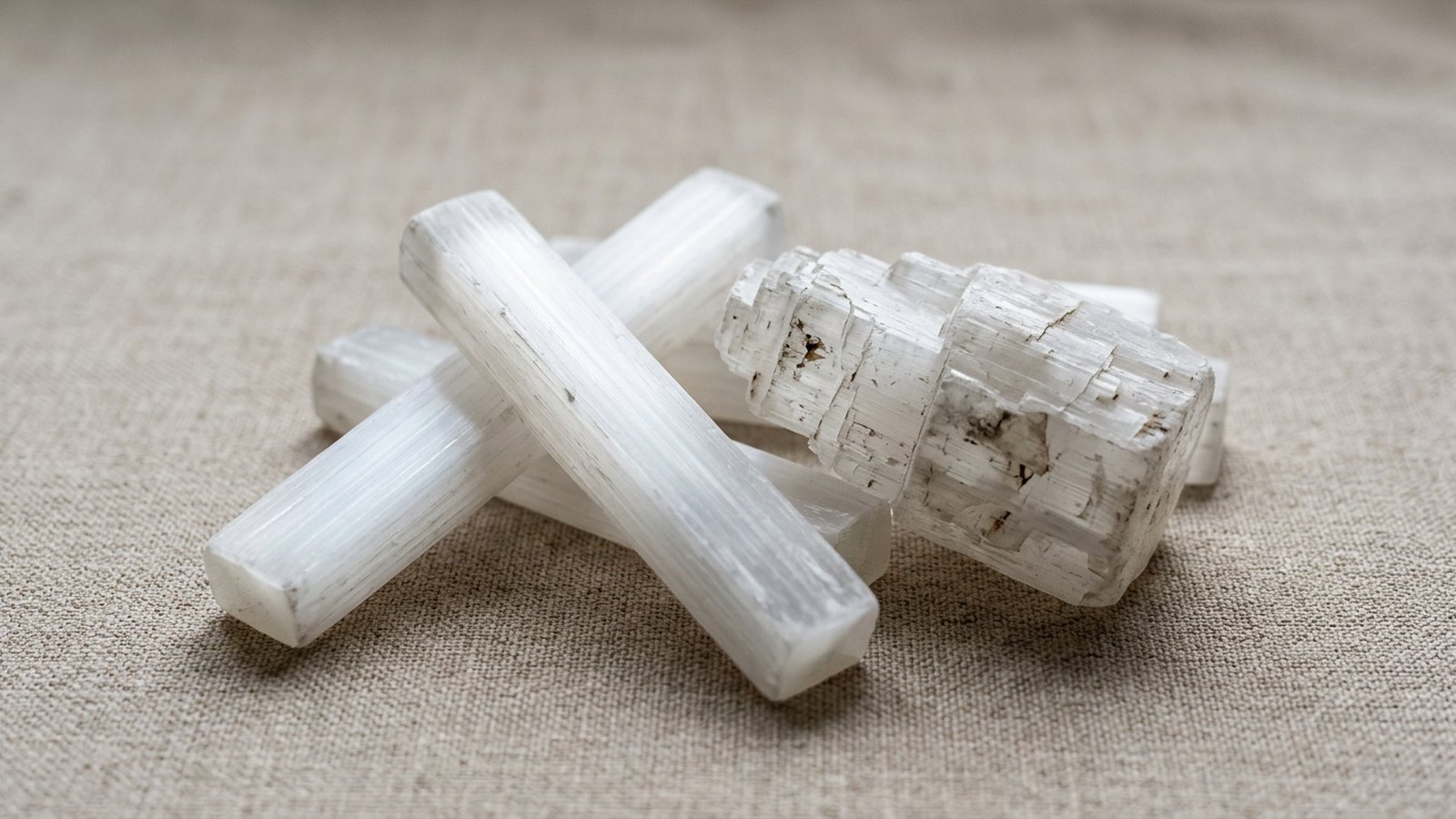
There is a drawer in my studio that I am not proud of. For about two years it was where stones went when I had finished with them: tumbled quartz, a fluorite octahedron, three pieces of selenite, a lump of pyrite I had been given, all of it loose and sliding over itself every time the drawer opened. When I finally emptied it out, the fluorite had lost a corner, one selenite bar had a grey scuff down its length that no cloth would lift, and the pyrite had gone dull and slightly powdery, leaving a rusty smear on the wood underneath.
None of that was bad luck. Each of those three things is a different, entirely predictable kind of damage with a different cause, and that is the part almost no storage guide says out loud.
Most advice on this subject is really decorating advice: use a wooden box, keep them out of the sun, wrap them in silk. Some of it is sound and some is repeated because everyone else repeats it. What follows is the version I wish I had read before I filled that drawer.
How to store crystals: the short version
Store crystals somewhere cool, dark and dry, with each stone separated from its neighbours by fabric or by a compartment so that nothing harder can rub against anything softer. Fabric pouches, a lined box with dividers, or a shallow drawer all work. Keep them out of direct sunlight, away from bathrooms and radiators, and give sulphide stones like pyrite a dry container of their own.
That is the whole method in five lines. The rest of this guide is why each clause is there, because once you understand the three failure modes you can work out the right storage for any stone you own, including ones I have not mentioned.
The three ways a stored crystal gets damaged
Everything that happens to a stone sitting in a box is one of three things: something rubs it, light reaches it, or the air around it reacts with it. Sort your collection by which of the three it is vulnerable to and the storage problem mostly solves itself.
1. Abrasion, and why the harder stone always wins
The rule is simpler than most guides make it sound. A mineral can only be scratched by something harder than itself. Not heavier, not bigger, harder, in the specific sense the Mohs scale measures.
This matters because of what a typical collection is made of. The quartz family sits at 7, and quartz is most of what any of us own: clear quartz, amethyst, citrine, rose quartz, agate, jasper, smoky quartz, tiger's eye. All of them will scratch anything below 7 and none will scratch each other. Selenite is 2, softer than your own fingernail. Calcite is 3. Fluorite is 4 and has perfect cleavage in four directions, so it does not merely scuff, it loses a clean corner, which is exactly what mine did.
So the working rule is not "protect the delicate ones". It is: keep the quartz away from everything with a lower number, which means one pouch per soft stone, or a compartment box where the 7s live on one side. Kyanite breaks the rule interestingly: it is 4.5 along one axis and 6.5 across the other, so the same blade scratches or does not depending on which way you drag it.
2. Light, and colour that does not come back
The second failure mode is the one people underestimate, because it happens slowly enough that you never catch it happening. Amethyst, citrine, rose quartz, kunzite and fluorite all fade in sustained direct light, and the fading is permanent.
The reason is worth knowing. The purple in amethyst is not a pigment sitting in the stone, it is a colour centre: iron impurities altered by natural irradiation over geological time, held in a state that ultraviolet light gradually undoes. Nothing leaves the crystal. The structure simply relaxes back to where it started, and no amount of moonlight returns it. I go into this properly in the fluorite guide, fluorite being the stone most often ruined by advice to charge it on a sunny windowsill.
Dark storage is therefore not fussiness, and it is the easiest of the three to get right. A closed drawer solves it completely.
3. Atmosphere, which is the one nobody mentions
The third is chemistry with the air itself, and this is where storage advice goes quiet.
Pyrite is the clearest case. Iron sulphide reacts with oxygen and water vapour to produce iron sulphates and sulphuric acid, and it does not need to be dunked in anything: humid air is enough. Conservation literature puts the threshold near 60% relative humidity, above which decay can begin within days, and museums hold mineral collections at roughly 45 to 50% for exactly this reason. The unpleasant part is that it does not stay put. The acid and the flaking sulphates spread, damaging neighbouring specimens, corroding the container and eating paper labels. Collections managers call it pyrite disease, and the rusty smear in my drawer was the mild beginning of it.
Selenite belongs here too, gently: it is gypsum, a hydrated calcium sulphate, and it prefers dry air. Halite is worse, pulling moisture straight out of humid air until it slumps. One stone wants the opposite, though. Opal holds several percent water inside its structure, and somewhere very dry or very warm can craze it with fine cracks, so opal is the piece I would not put in a desiccated box.
Which stones cannot tolerate water directly is a separate question, and it has its own guide: which crystals can and cannot go in water.
Why "use natural materials" is only half right
Every guide on this subject, and Google's own summary of them, says to use natural materials: wood, glass, cotton, silk, linen. Wood in particular gets called grounding and safe. Half of that is good advice and half is the opposite of what conservators actually do.
Unsealed wood is not chemically inert. It slowly gives off acetic and formic acid vapour, oak worst of all, acidic enough to corrode steel screws inside a cabinet, and in a closed box that vapour has nowhere to go. On calcareous material, meaning anything built from calcium carbonate, it reacts with the surface and leaves a powdery white bloom that destroys the polish underneath. Museums call it Bynesian decay and design storage specifically to avoid it, which is why serious collections live in coated metal cabinets with archival paper rather than in beautiful raw wooden chests.
Which of your stones care? The carbonates: calcite, aragonite, malachite and azurite. Quartz does not care at all, and neither does most of a beginner's collection, which is why the wooden box advice survives unchallenged.
So rather than banning wooden boxes: a sealed or varnished one is fine, and a lined one is fine because the lining is the barrier. An unfinished raw oak chest with a tight lid, holding your malachite for a decade, is the combination to avoid. Glass and metal have no such problem, and cotton or linen next to the stone is as good as everybody says.
Five ways to store crystals, and what each one actually solves
There is no single best container, only containers that solve one failure mode and ignore another. Here is how the common options really behave.
Fabric pouches, one stone each. Velvet, cotton, silk or organza. This is the most complete answer for a small collection because it defeats abrasion perfectly and blocks light entirely. It does nothing about humidity. Best for soft stones, and the honest reason to use one pouch per stone rather than five stones per pouch is that the pouch does not separate what is inside it.
A compartment box with a soft lining. My own preference once a collection passes twenty pieces. It solves abrasion and light, keeps everything visible and findable, and the lining doubles as the barrier against the wood. Look for real dividers rather than a single padded tray.
A drawer. Excellent for light, useless for abrasion unless you add pouches or dividers, which is precisely the mistake I made. A drawer is a dark room, not a storage system.
A glass jar. People ask about this constantly and the answer is yes, with one condition. Glass is chemically inert and looks lovely, but it is transparent, so a jar on a shelf gives your amethyst months of the light that fades it, and loose tumbled stones in a jar grind against each other every time you move it. Use jars for quartz-family tumbles, in a spot that never gets direct sun.
Open display. The honest one. Displaying stones is a real pleasure and I do it, but it is storage at maximum exposure to all three failure modes plus dust. Put the durable and the unfading ones on the shelf, and keep the fluorite, the kunzite and the selenite in the box. Larger shapes and towers tend to be display pieces anyway.
Which crystals should not be stored together
This is the question people ask most often about storage, and it usually gets answered energetically: this stone overwhelms that one, these two clash, keep the high vibration ones apart from the grounding ones. I have looked at that question closely elsewhere, and the short version is that no two lists agree with each other, which tells you something. If you want the long version, it is here: what crystals should not be together.
For storage specifically, there are only two pairings that matter physically, and both are boringly concrete.
Anything hard with anything soft. A quartz tumble and a selenite bar in the same pouch will produce a scratched selenite bar, every time, and the mark is permanent. This is the rule that actually earns the phrase "should not be stored together".
Pyrite with everything else. Because of the acid and the spreading sulphates, a pyrite specimen showing any dull film, rusty powder or sulphurous smell should be isolated in its own dry container, not tucked into the family box. If you want to know what a healthy piece looks like by comparison, the pyrite guide covers it.
Is it all right to keep the rest of your crystals together? Yes, genuinely, as long as they are separated by fabric or dividers and nothing in the box is oxidising. Mixed storage is not a spiritual problem.
Where to keep them in your home
Cool, dark, dry and stable, which in most homes means a bedroom drawer, a cupboard, a shelf away from the window, or a chest in a hallway. What you are avoiding is easy to list: sunny windowsills, the top of a radiator, a car in summer, the windowsill above a kitchen sink, and bathrooms, which fail on humidity every single day regardless of how good the shelf looks.
The bedroom question comes up a lot, and I think it deserves a straight answer. There is no mineralogical reason to keep any stone out of a bedroom. The traditional cautions are about sleep rather than safety: stones people find stimulating or mentally busy, often clear quartz or citrine, are sometimes said to make rest harder, while others are considered settling. That is tradition and personal experience talking, not chemistry, and the only real test is whether you sleep well with them there. If you want the traditional view set out properly, see crystals for sleep and where to place crystals in your home.
What to do with crystals when they first come home
Unwrap everything the day it arrives rather than leaving stones in shop tissue for a month, because paper holds damp against a stone and hides the thing you would otherwise notice.
Then look at each piece properly in daylight: chips, dyed patches, a suspiciously even colour, a repair. This is the moment to catch it, and the real or fake guide is the checklist I use. Cleanse it if that is part of your practice, using a method the stone tolerates, which for anything soft means not water and not salt. Then give it its home in the box before it becomes the loose stone on the shelf that gets knocked around for a year.
Keeping them cleansed while they are put away
Stones in storage do not need constant attention. If cleansing matters to you, a seasonal pass over the whole box is plenty, and the full-moon habit exists partly because it gives you a natural interval to work to. How to cleanse and charge your crystals and how to activate crystals both cover the methods.
One honest note about selenite plates, since every storage article recommends keeping one in the box, and since the most popular pairing in the hobby, black tourmaline and selenite, is built on one. As tradition, it is a lovely practice and I keep one. As physics, remember what selenite is: the softest thing in the container at Mohs 2. Resting a quartz cluster on a selenite plate scratches the plate, not the cluster. Lay stones on it gently, or lay them alongside it.
Travel, and crystal jewellery
For travelling, one stone per small pouch inside a hard case, and leave the fragile pieces at home. Fluorite and selenite do not enjoy suitcases. The same hardness logic decides where a bracelet lives while you are wearing it, since your dominant wrist meets far more edges than the other one: which hand to wear a crystal bracelet on works through that choice.
Crystal bracelets are worth a word because they store badly. Hang them or lay them flat rather than coiling them tight, keep the strung ones out of damp so the cord does not rot, and store bracelets of different stones separately for the same hardness reason as everything else. A quartz bracelet and a selenite bracelet in one pot will sand each other down.
In closing
I have become slightly evangelical about this, mostly because the damage in that drawer was entirely mine and entirely avoidable. None of it required expensive equipment. It required knowing that a scratch, a faded colour and a rusty bloom are three different problems, and that the box you choose is answering one of them at a time.
Buy the dividers, keep the drawer shut, give the pyrite its own tin. Your stones will outlast you by a comfortable margin if you let them.