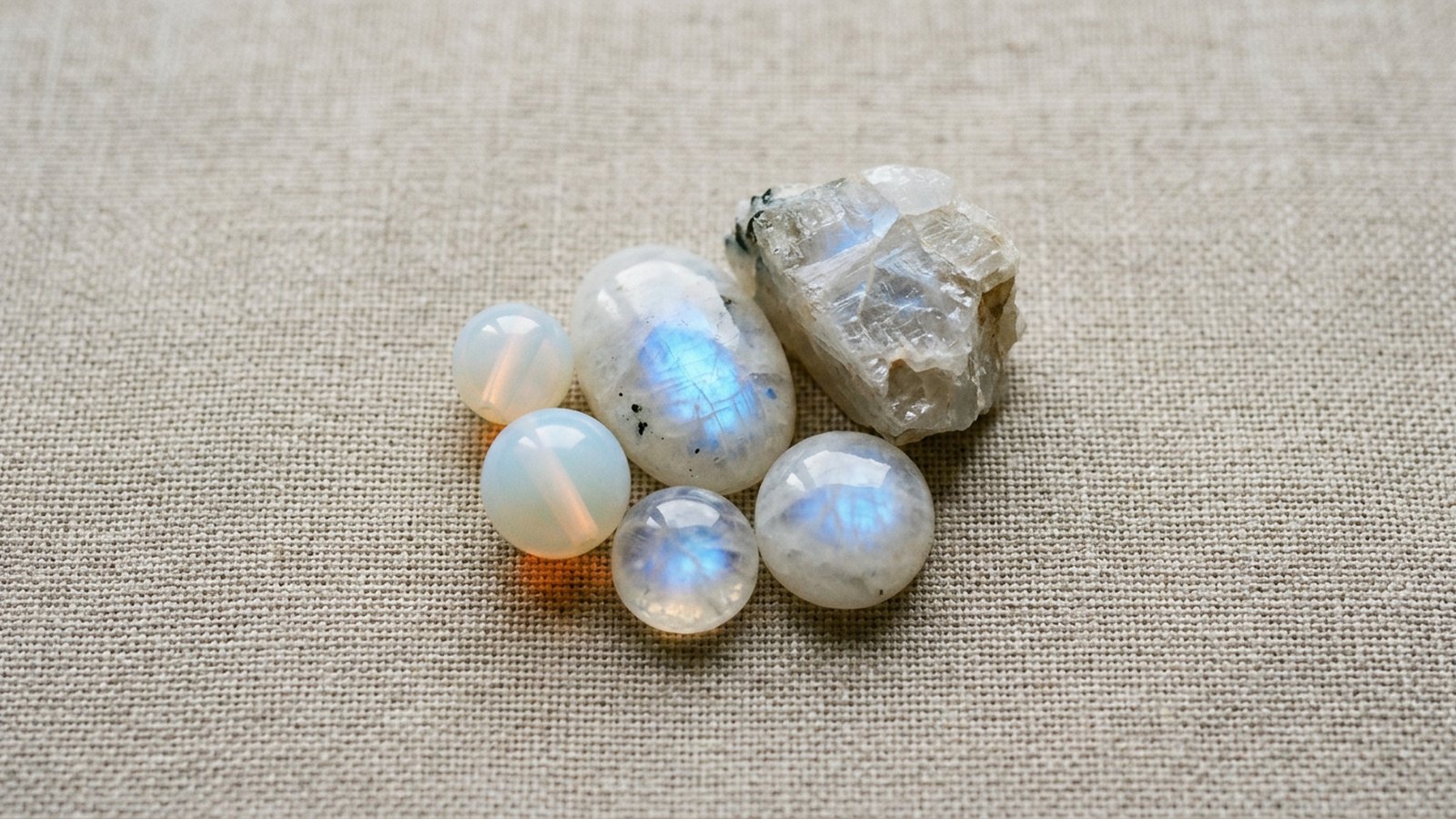
If you are holding a milky white stone with a blue shimmer in it and you are no longer sure what you bought, here is the short answer. Moonstone is a natural feldspar, mined from the ground, and its blue sheen comes from microscopic layers grown inside the crystal. Opalite is manufactured glass, made in a furnace, and its blue comes from tiny particles stirred into the melt. The quickest way to separate them costs nothing: tilt the piece slowly under a lamp. Moonstone's glow travels across the stone as you move. Opalite's glow stays put, but it changes colour depending on whether the light is behind the piece or in front of it.
That is the verdict. What I want to give you beyond it is the reason, because almost every guide online hands you these tests without explaining them, and a test you do not understand is one you cannot trust the moment it gives you an odd answer.
Why they look so much alike
This is not a coincidence, and it is not laziness on the part of whoever sold you the piece. Moonstone and opalite are doing the same thing to light.
Both glow blue because of scattering. When light meets structures inside a material that are around the same size as its own wavelength, short blue wavelengths get bounced sideways far more strongly than long red ones, by a factor tied to the fourth power of the wavelength. That single rule is why the daytime sky is blue and why a sunset seen through the same air is amber. Moonstone and opalite are both, in effect, small pieces of sky.
The difference is what is doing the scattering, and how it got there.
In moonstone, the material separated itself. Feldspar that cooled slowly deep in the earth split into alternating microscopic sheets, one richer in potassium (orthoclase), the next richer in sodium (albite), in a process called exsolution. Gemmologists call the resulting sandwich a microperthite. When those sheets land at roughly 60 to 150 nanometres thick, close to the wavelength of visible light, you get the coveted blue. Thicker layers scatter more broadly and give the softer silvery-white sheen. Thicker still and you see nothing at all, which is why most feldspar in the world is just grey rock. The effect is called adularescence, after adularia, a variety of orthoclase named for Mount Adular in the Swiss Alps.
In opalite, someone added the scattering particles on purpose. Opal glass is an ordinary industrial product: opacifiers such as tin oxide or calcium phosphate go into the batch at a few percent by weight, and as the melt cools they separate out as a fine cloud of droplets suspended in the glass. Milk-white lampshades and old apothecary bottles work the same way. Opalite is that glass, tumbled and drilled and given a gemstone name.
Same optics. One grew over geological time, the other was poured in an afternoon.
The difference that everything else comes from
Moonstone has a crystal lattice and opalite has none. Every practical difference below is downstream of that one fact: how each breaks, how each wears, what each costs, and what you can honestly say about it.
| Moonstone | Opalite | |
|---|---|---|
| Origin | Mined | Manufactured |
| Material class | Mineral (feldspar) | Glass |
| Composition | KAlSi₃O₈ with albite lamellae | Silica glass plus opacifiers |
| Internal structure | Crystalline, ordered | Amorphous, no lattice |
| Mohs hardness | 6 to 6.5 | About 5 to 5.5 |
| How it breaks | Flat steps on two cleavage planes near 90 degrees | Curved, shell-like scoops |
| Optical effect | Adularescence | Opalescence |
| Cause of the glow | Exsolution lamellae, 60 to 150 nm | Colloidal opacifier droplets |
| Typical inclusions | Fine cracks, feathery "centipedes" | None, or round bubbles |
| Held up to a light | Sheen stays blue or white | Turns warm amber or peach |
| Sources | Sri Lanka, India, Madagascar, Myanmar, Tanzania | A furnace, most often in Asia |
| Typical price | A few pounds a carat commercial, hundreds for fine blue | Around the price of a coffee for a whole bead strand |
How to tell which one you are holding
These are ordered by how little they risk. Do not skip to the last one.
1. Move the stone, not the light
Hold the piece under a single lamp and tilt it slowly. Moonstone's sheen is directional, because the lamellae producing it lie in flat parallel planes: the glow swims across the surface, brightens at one angle, and vanishes at another. Opalite's droplets are scattered randomly in three dimensions, so there is no favoured angle. Its glow simply sits there, evenly, however you turn it. This is the single most reliable free test, and it works on cabochons, beads and tumbles alike.
2. Move the light, not the stone
Now put the piece against a dark background, then hold it up with the light behind it. Opalite goes distinctly warm, amber to peach, when you look through it, and blue when you look at it against dark. That flip is the classic behaviour of opal glass, and it is dramatic. Moonstone shifts far less: light passing through it stays whitish, and the sheen does not turn orange. If your stone does the amber trick strongly, you have glass.
3. Read the chip it already has
Most second-hand or well-worn pieces carry a nick somewhere. Look at it under a loupe or a phone camera at maximum zoom. Feldspar has two cleavage directions meeting at close to 90 degrees, so moonstone damage looks like a flat step or a little cliff. Glass has conchoidal fracture, so opalite damage looks like a shallow curved scoop with faint ripples running through it, the same shape you see on a broken bottle. This test costs nothing and uses damage the piece already has, which is why I prefer it to anything involving a steel point.
4. Look for bubbles, and for the opposite of bubbles
Under magnification, opalite is often suspiciously perfect, and where it is not, the flaw is a round bubble, because bubbles trapped in a melt are spherical. Moonstone is rarely perfect: it usually shows fine internal cracks along the cleavage, and often the thin dark feathery inclusions dealers call centipedes. Flawless plus round bubbles means glass. Cracked and feathery means feldspar.
5. What is not worth doing
Skip the scratch test. The two sit close on the Mohs scale, moonstone is brittle along its cleavage, and you will damage a genuine stone learning nothing. Skip the temperature test as well: both feel cool to the touch and glass holds cold convincingly. And do not judge by price alone. Cheap moonstone exists, and opalite is sometimes set in real silver and priced as though it were not glass. If you want a broader version of this reasoning, our guide to telling a real crystal from a fake covers the same logic across other materials.
Opalite means at least three different things
Here is the part almost nobody tells you, and it explains a good deal of the confusion online.
"Opalite" is not a mineral name. It is a trade word, and the trade uses it for at least three unrelated materials. The first is the manufactured glass described above, usually sold as beads, tumbles, spheres and pendants, and often also labelled sea opal, opal moonstone or argenon. The second is Tiffany Stone, a genuine natural rock from Utah, a purple and cream mixture of opalized fluorite and bertrandite, which is sometimes marketed as opalite or purple opal. The third is natural opalized volcanic ash, a common opal with no play of colour, which some sellers also call opalite because the real name sounds less exciting.
That third case is worth pausing on, because "opalite vs opal" is one of the questions people ask straight after this one. Real opal is a hydrated silica mineraloid, and the precious kind flashes distinct spectral colours that shift as you move, an effect called play of colour that comes from ordered stacks of silica spheres. Opalite does not do that and cannot. It only glows. If you are seeing separate flecks of red, green and blue rather than one soft wash of light, you are not looking at opalite at all.
So when someone says opalite is natural, they are not always lying. They may be talking about a different substance from the one in your hand. It also means a listing that says "opalite" tells you almost nothing, which is exactly why the US Federal Trade Commission's jewellery guides treat a name that implies a product is something it is not as deceptive. If you care what you are buying, buy the description, not the word.
And rainbow moonstone is a fourth thing
One related question deserves an answer here, because it trips people constantly. Rainbow moonstone is not classic moonstone. It is white labradorite, a plagioclase feldspar, and its peacock flashes are labradorescence rather than the soft floating sheen of true adularescent moonstone. Both are feldspars, both are natural, and neither is glass, so it is a far gentler mislabelling than opalite, and our labradorite guide explains that flash in full. Still, if you wanted the quiet blue drift described in our moonstone guide and received something that flashes green and violet, that is why.
What each one is said to do
Moonstone carries a long tradition. It is the June birthstone, it was quarried at Meetiyagoda in Sri Lanka for generations, and it became an emblem of the Art Nouveau workshops around 1900. Roman writers described a moon-linked stone that waxed and waned with the lunar phases, though matching ancient gem names to modern species is genuinely contested and I would not build a claim on it. In modern crystal practice it is associated with intuition, cycles, and beginnings that have not fully taken shape yet, and with the third eye and crown chakras. People reach for it in transitions, which is also why it turns up in guidance on sleep and dreaming.
Opalite has no tradition, and I would rather say that plainly than pretend otherwise. The material is a twentieth-century product, so every meaning attached to it, usually joy, lightness, transition and easy communication, was written by sellers within living memory. That is not automatically worthless. Meaning made recently is still meaning, and a stone you chose because its glow makes you feel lighter is doing what most people actually want from a crystal. But an ancient lineage is not on offer, and anyone who sells you one is inventing it.
I will add the practical difference nobody mentions: a piece of glass will never surprise you. Two moonstones from the same tray behave differently in the hand, which is a large part of why people who work with stones prefer them.
How to look after each
Opalite is chemically inert, waterproof and untroubled by sunlight. Its only real enemy is impact, since at Mohs 5 it scratches easily in a jewellery box and chips like the glass it is. Store it separately and it will outlive you.
Moonstone needs more thought, and for a reason nobody explains when they warn you about water. It does not dissolve. Feldspar is not soluble in the way selenite is, so a brief rinse and a soft cloth are fine. The real risk is mechanical: those two cleavage planes near 90 degrees mean a knock or a sudden temperature change can split a stone cleanly along a plane you cannot see. That is why ultrasonic and steam cleaners are a genuinely bad idea for moonstone, why hot water straight after cold is worth avoiding, and why soap film collecting under a bezel setting is a nuisance rather than a disaster. Dry cleansing suits it well, as does the full moon ritual many people already associate with it, and it does not need charging in strong sun. If you plan to wear a piece every day, the advice on carrying and wearing stones applies here more than usual: a ring takes knocks that a pendant never will, and moonstone is the wrong stone for a knuckle.
Which one should you have
If you want the phenomenon itself, the drifting light that seems to come from inside the stone, buy moonstone and buy the best you can afford, because with adularescence quality is visible from across a room. If you want a soft glowing bead for a bracelet you will wear daily and knock about, opalite is honest value at a few pounds and it will not chip your budget when it eventually chips itself. If you are building a first collection, our guide to building your first set argues for fewer, better pieces, and I would apply that here.
The one situation where the choice really matters is when you intend to work with the stone rather than wear it. In meditation, a natural stone gives you something to look into that changes as you hold it, and glass does not. That is a practical difference, not a mystical one.
As for wearing them together, which is a question people ask often: there is no conflict. Stones do not cancel each other out, as I argued at length in what crystals should not be together. The only real caution is physical. Moonstone is harder than opalite, so on the same strand it will slowly scratch the glass, exactly the storage logic set out in rhodonite vs rhodochrosite.
What I will not tell you
I will not tell you that moonstone balances your hormones, eases a pregnancy or regulates anything in your body, and you will find pages ranking above this one that do. There is no evidence for any of it, and a stone is not a substitute for care from someone qualified to give it.
What I will say is that knowing what you own changes how you feel about it. If your piece turns amber in the light and shows a round bubble, you have a nicely made piece of glass, and you are allowed to like it. If it swims blue as you tilt it and shows a hairline crack, you are holding something that took a very long time to cool. Both are worth having. Only one is worth paying moonstone prices for. For the same kind of side-by-side reasoning on darker stones, see onyx vs obsidian and sodalite vs lapis lazuli, and for the strangest glass in the whole trade, one that nature made by accident, moldavite.
One last thing, offered in the spirit of the whole article. The official state gem of Florida is moonstone, adopted in 1970 to honour the Apollo launches from Cape Canaveral. No moonstone has ever been found in Florida, and none was found on the moon. Names in this trade point at what we wish were true remarkably often, which is precisely why it is worth learning to read the stone instead.