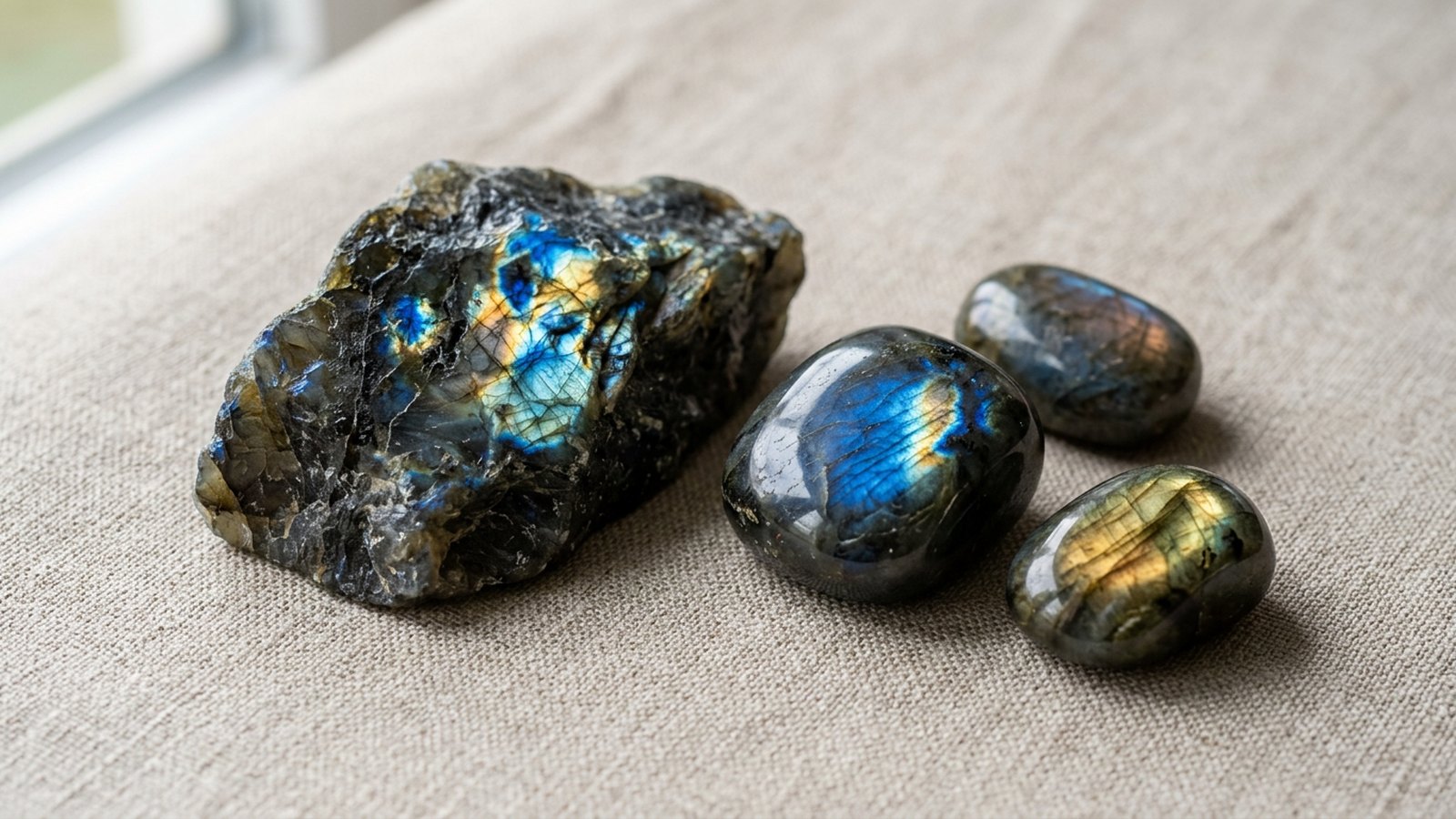
Yes, you can wear labradorite and moonstone together, and they pair unusually well: they are close cousins in the feldspar family, they share the third eye, and they ask for the same gentle handling. The twist is that a good share of the jewellery sold as "labradorite and moonstone" is really labradorite and labradorite, because the stone the trade calls rainbow moonstone is not moonstone at all.
I have handled a lot of both, and I want to give you the thing every comparison article I read while researching this one skipped. They all stop at telling the two stones apart. Almost nobody answers the question people actually type next, which is whether to put them together and what changes when you do.
The short answer, and what the pair is for
Labradorite and moonstone work together because they do different jobs in the same register. Both are stones of inner sight rather than outward push, so they do not argue the way a grounding stone and a high-energy stone can.
In the tradition I have learned from, labradorite is the boundary stone. It is the one you reach for when you are moving through a transition and want to stay yourself while it happens. Moonstone is softer and more receptive, associated with emotional weather, cycles, and beginnings you have not named yet.
Put plainly: labradorite holds the edge, moonstone holds the opening. That is the pairing. If you want one sentence for why people wear them on the same wrist, it is that combination of protection and permeability. As always, I offer this as tradition and personal intuition, not as fact, and not as a substitute for real support when you need it.
The naming trick: your moonstone may be labradorite
Here is the fact that reframes this whole pairing, and I found it on none of the top-ranking pages for this pair.
Rainbow moonstone, the milky white stone with the blue and multicoloured flash that fills bracelets and rings, is not a true moonstone. According to the Gemological Institute of America, material from Madagascar and India with a multicoloured sheen on a light body is plagioclase feldspar, which is labradorite. Its optical properties and refractive index settle it. True moonstone is an alkali feldspar, a different branch of the family.
So if you bought a "labradorite and moonstone" set and the moonstone half is white with rainbow flashes, you are most likely wearing two labradorites in two different body colours. That is not a scam and the stone is not fake. It is a trade name that stuck, the same way many stone names did.
It does change three practical things. Your pair is more optically uniform than you thought, which is why it looks so coherent. Its energy, read traditionally, leans further toward labradorite's protective register than the moonstone softness you were reaching for. And if you specifically want moonstone's association with cycles and new beginnings, you need to ask for true moonstone, sometimes sold as white, grey, or peach moonstone, with a soft floating glow rather than a rainbow flash.
Two feldspars, two different flashes
Both stones are feldspars and both sit at 6 to 6.5 on the Mohs scale, which is why so much of the practical advice is identical. But the light effect that makes each one beautiful comes from a different structure.
Labradorite shows labradorescence: a sheet of colour, often blue or gold, sometimes the full spectrum, that flares at particular angles and vanishes at others. It comes from light interfering with microscopically thin layers inside the stone that separated as the crystal cooled. The layers act on light the way a soap film does, which is why the colour shifts as you tilt it. The name comes from Labrador, Canada, where Moravian missionaries brought it to European attention in the 1770s. Finnish labradorite showing the full colour range is sold as spectrolite.
Moonstone shows adularescence: not a flash but a glow, a soft billow of light that seems to travel just under the surface as you move it. It comes from light scattering off alternating microscopic layers of orthoclase and albite. That is the real difference. One effect is interference producing colour, the other is scattering producing a floating sheen.
I find that distinction useful beyond geology. It is a fair description of how the two feel to work with. Labradorite catches you at an angle and surprises you. Moonstone glows steadily and does not.
| Labradorite | True moonstone | |
|---|---|---|
| Feldspar branch | Plagioclase | Alkali |
| Optical effect | Labradorescence (colour flash) | Adularescence (floating glow) |
| Cause | Interference in exsolution layers | Scattering off orthoclase and albite layers |
| Usual body colour | Grey to near black | Milky white to translucent |
| Mohs hardness | 6 to 6.5 | 6 to 6.5 |
| Traditional register | Transformation, protection | Cycles, emotional balance |
Where they come from, and what people believed
Labradorite was described from Paul's Island off the coast of Labrador, in Canada, in the 1770s, and the place gave the mineral its name. Today most of what you will handle comes from Madagascar, with Finland producing the dark, full spectrum material sold as spectrolite. The Inuit of Labrador have a tradition that the northern lights were once trapped in the rocks along the coast until a man struck them with his spear and freed most of them, leaving the colour that stayed behind in the stone. I have no way to verify how old that telling is, but it is the most exact description of labradorescence anyone has given me.
True moonstone comes mainly from Sri Lanka, India and Myanmar, and the finest blue sheen material has long been associated with Sri Lanka. Its lore is better documented. Roman writers held that it was solidified moonlight, and Pliny the Elder recorded the belief that the stone changed with the phases of the moon. In Hindu tradition it is a moonlight stone as well, worn for calm. Moonstone had a genuine second life around 1900, when Art Nouveau jewellers, René Lalique among them, used it heavily, which is why so much antique moonstone jewellery dates from that window.
I mention the provenance for a practical reason as well as a romantic one. The Madagascar material is exactly the source that produces rainbow moonstone, and knowing that a white flashing stone described as Madagascan is almost certainly labradorite saves you a question at the counter.
How to tell which one you are holding
You do not need a lab. You need light and patience.
- Tilt it slowly under a single light source. A flash that appears and disappears at a narrow angle is labradorescence. A glow that drifts across the stone as you turn it is adularescence.
- Look at the body colour behind the effect. A dark grey or black base is labradorite almost every time. A milky translucent base could be either, which is where rainbow moonstone confuses people.
- Ask what colour the flash is. Multicoloured rainbow flashes on a white body point to labradorite sold as rainbow moonstone. A single soft blue or white sheen on a translucent body points to true moonstone.
- Ask the seller for the mineral, not the trade name. "Is this plagioclase or alkali feldspar?" is a fair question. A good seller will know or will say they do not.
If you want a broader version of this habit, I wrote about it in how to tell if a crystal is real. The principle is the same: judge the material, not the label.
What the pair does together, by situation
I do not think a pairing means much in the abstract. Here is where I have found this one genuinely useful.
Moving through a change you did not choose. A house move, a job ending, a relationship shifting. Labradorite for holding your own outline while things rearrange, moonstone for staying soft enough to feel what is actually happening rather than bracing against all of it. I carry both loose in a pocket rather than wearing them, so I notice them.
Sleep and dreams. Both are traditionally third eye stones, and moonstone reaches the crown as well. Keeping the pair near the bed is one of the oldest uses for either. I would gently say that if sleep is genuinely broken, this is a companion to real help, not a replacement for it.
Creative work that has gone rigid. Labradorite is linked with creativity and moonstone with receptivity. The combination suits the stage where you have technique but nothing is arriving.
They also overlap where it matters structurally: both are associated with the third eye, and both are traditionally offered to Scorpio, with labradorite also given to Leo and moonstone to Cancer. Moonstone is a June birthstone. That shared third eye is the honest reason the pair coheres, rather than any claim that one amplifies the other.
If you want a softer version of the same idea, rose quartz and moonstone covers the emotional end more directly.
Wearing them: the problem that breaks this pair
This is the part the jewellery articles skip, and it is the reason I see so many broken labradorite and moonstone bracelets.
Both stones have good cleavage, meaning they split cleanly along internal planes. Hardness 6 to 6.5 sounds durable, and against scratching it is acceptable. Against a knock it is not. Cleavage is what decides whether a stone chips, and both of these will chip on a doorframe or a car door in a way that quartz simply would not.
So: no ultrasonic cleaners, no steam, no hot water. Warm water, mild soap, a soft cloth, and dry them properly. Take a bracelet off before the gym, the washing up and gardening. If you want the pair as a ring, choose a bezel setting over prongs, because a bezel protects the girdle where chips start.
Which form to buy follows from that. A necklace or a pair of earrings is the safest way to wear these two, because neither takes the daily knocks a wrist does. A ring in labradorite or moonstone is the most beautiful and the most exposed, and if you wear rings hard I would keep this pair off your dominant hand. The bracelet, which is how the pair is most often sold, is the format that fails soonest: it swings against desks and doorframes all day. If you want the bracelet anyway, and I understand why you would, look for one strung with spacer beads of a softer material rather than tight against quartz or hematite, and re-string it before the cord frets rather than after.
For cleansing, I would keep both out of salt and out of long water soaks. Moonstone in particular does not enjoy prolonged wetting. Moonlight, sound, or a few hours on a dry surface is plenty, and I have written the fuller method in how to cleanse and charge your crystals. When you store them, keep them apart from harder stones so they do not scratch each other, which how to store crystals goes into properly.
What not to pair them with
I would rather say something useful here than list ten stones.
The pair works because it stays in one register: quiet, inward, receptive. What dilutes it is stacking a loud stone on top. Carnelian or pyrite next to moonstone tends to pull the attention outward, and you lose the reason you chose moonstone in the first place. That is a matter of intention, not danger. Nothing bad happens.
The real caution is physical. Do not string either one next to a much harder bead. Quartz at 7, garnet at 7.5, and anything above will abrade them over time in a bracelet that moves all day.
And I do not hold with the idea that some crystals are forbidden together. I looked at that claim closely in what crystals should not be together, and the short version is that no two lists agree, because the rule was never based on anything shared. Choose by intention and by hardness. That is the whole of it.
Where I would start
If you are buying one thing, buy true moonstone and let labradorite come second, because true moonstone is the half you are more likely to be sold something else as. If you already own a white stone with rainbow flashes, you probably own labradorite, and it is still a good stone. It just changes what you are holding, and I would rather you knew.