The short answer
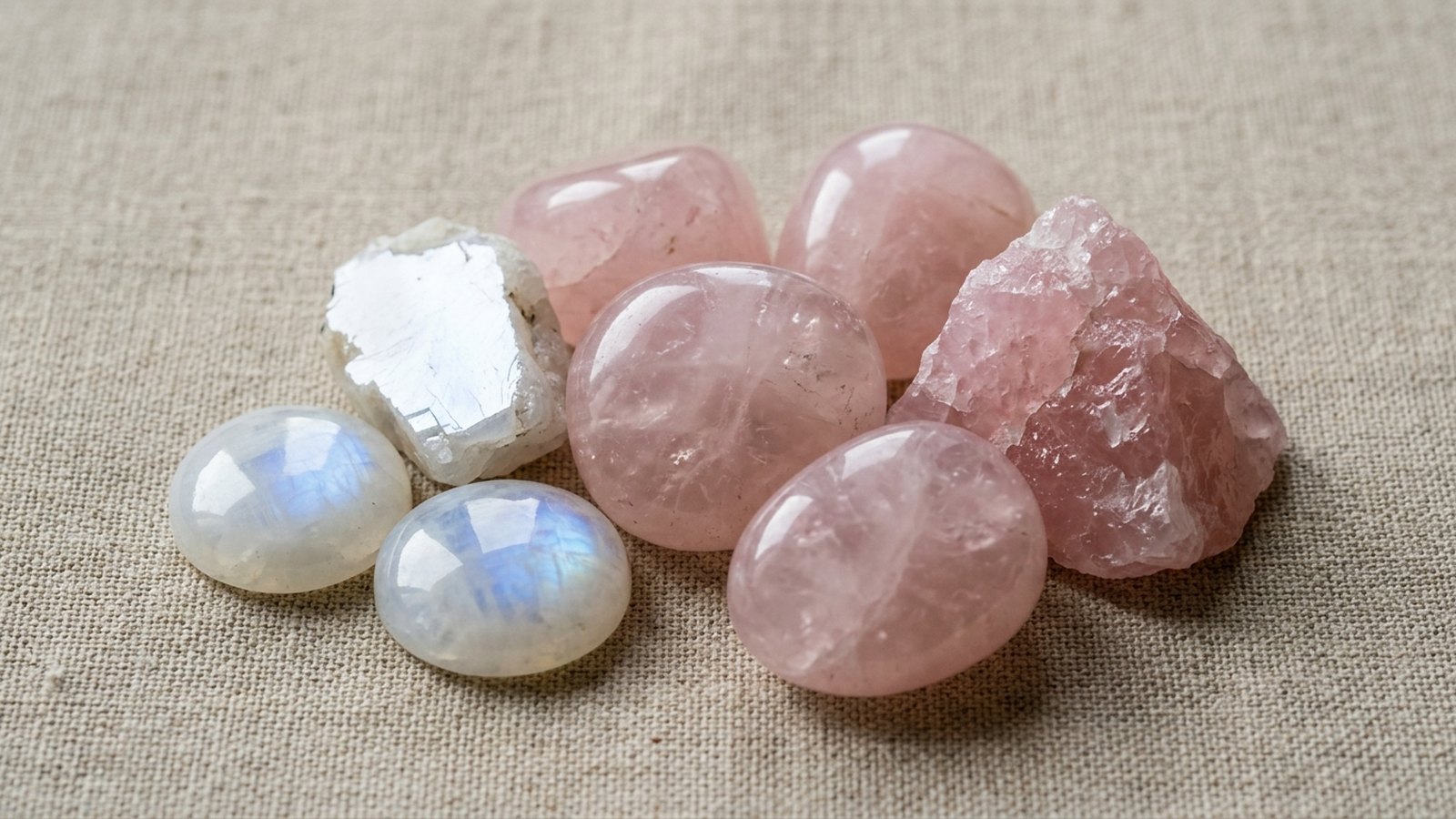
Rose quartz and moonstone are a good pair, and they are safe to wear together. At 7 and 6 to 6.5 on the Mohs scale they are close enough in hardness that neither will chew up the other in a bracelet. What the combination is traditionally for, though, is narrower than most pages suggest. Rose quartz is the stone of staying open. Moonstone is the stone of letting a phase end. Put together they are not love plus more love, they are love plus permission to let it change, which makes this a transition pair rather than an attraction pair.
And if you take one practical thing from this guide, take this: the moonstone is the half that breaks first, and not because it is softer.
What each stone actually brings
Rose quartz, the open heart
Rose quartz is the pink variety of quartz, and its colour does not come from the quartz at all. It comes from microscopic pink fibres threaded through the stone, a dumortierite-like phase rather than the titanium so often quoted. Those same fibres are why rose quartz is almost never clear. It is cloudy, milky, a little sleepy-looking, and in the rare pieces where the fibres happen to line up, they throw a six-rayed star when you hold the stone against a single light. Star rose quartz is uncommon, and worth stopping for if you ever meet one.
Traditionally it is the heart stone. I would put it more precisely: it is the stone of not closing. Not of attracting anyone, but of staying soft when the sensible move would be to armour up. It sits with the heart chakra and with Taurus and Libra, and the full picture is in the rose quartz guide.
Moonstone, the turning phase
Moonstone is a feldspar, and its sheen is not colour either. Light scatters off microscopic layers of two feldspars that separated from each other as the crystal cooled, and the blue-white glow that drifts across the surface as you tilt it is called adularescence. It moves. That is the whole point, and it becomes a test further down this page.
Its tradition is cycles: the moon, intuition, endings that turn into beginnings. It is the June birthstone. It sits with the third eye and crown chakras and with Cancer, Libra and Scorpio, and there is more in the moonstone guide.
One correction while I am here, because it is currently sitting at the very top of the results for this exact search. The AI summary Google shows says moonstone supplies logic. It does not, in any tradition I know of. Moonstone's entire reputation rests on the other faculty, the one that knows something before you can argue for it. Watching a real tradition get quietly replaced by an averaged-out one is worth objecting to, even in passing.
Why the pair works, and the tension nobody names
Every page ranking for this pair says roughly the same thing: rose quartz brings love, moonstone brings intuition, together they bring balance. It is true, and it is not useful, because it never tells you when to reach for them.
Here is what I think is actually going on. These two stones want slightly different things from you.
Rose quartz asks you to stay. It is a holding stone, a keep-your-heart-where-it-is stone. On its own, it is what I offer someone who is turning hard, or who is being hard on themselves.
Moonstone asks you to release the shape a thing is currently in. It is a cycle stone, and cycles only work if something is allowed to finish.
Those are not opposites, but they are in tension, and the tension is exactly why the pairing is good. Alone, rose quartz can tip into holding on to something that has already ended. Alone, moonstone can tip into reading every difficulty as a sign to move on. Each one is a check on the other's failure mode. That, rather than love plus intuition, is what I think this combination genuinely does.
It also gives the pair a natural home: change that involves people. A relationship ending or beginning, a move, a new baby, an old friendship shifting shape, grief that has started to soften. Anywhere you need to keep your heart open while the ground moves. If that is your situation, this is a well-matched pair and I would not swap either half of it.
When this pair fits, and when it is the wrong one
| Your situation | Is this the right pair? |
|---|---|
| A relationship or a chapter changing shape | Yes. This is what the pair is for. |
| Grief that has begun to move | Yes, gently. |
| You want to attract a new partner | Rose quartz alone. Moonstone adds little here, and crystals for love covers the better companions. |
| You are trying to hold a relationship in place | No. A cycle stone is the wrong companion for that intention. |
| An anxious, racing mind | Reach for amethyst and rose quartz together instead. |
| Sleep and vivid dreams | Moonstone is the stronger half on its own, and crystals for sleep has the rest. |
I want to be plain about the fourth row, because it is the one nobody wants to hear. If what you want is for something to stop changing, then adding a cycle stone to your heart stone is working against you. Use rose quartz on its own, and be honest with yourself about which of the two you are really asking for.
The half that breaks first
Not one of the eight ranking pages I read while preparing this guide mentions hardness, cleavage or care, and every one of them is happy to point you at a bracelet carrying both stones. So here is the part they leave out.
The good news first. When I wrote about black tourmaline and selenite, the problem was a five-point hardness gap grinding itself down inside a bracelet. Rose quartz and moonstone are separated by half a point to one point. Over years, quartz will slowly dull a feldspar bead it rubs against, but this is not a pair that destroys itself. Mechanically, they are compatible.
The bad news is that hardness is the wrong property to be watching here. Hardness tells you about scratching. Cleavage tells you about breaking, and the two are unrelated.
| Rose quartz | Moonstone | |
|---|---|---|
| Mohs hardness | 7 | 6 to 6.5 |
| Cleavage | None | Two perfect planes, meeting near 90 degrees |
| How it fails | Chips at an edge | Splits along a plane you cannot see |
| Long sun exposure | Pink pales | Unaffected |
| Sudden temperature change | Tolerant | Can part along a cleavage plane |
Quartz has no cleavage whatsoever. Drop a rose quartz bead on a tiled floor and the likely outcome is nothing, or a small chip at the drill hole. Drop a moonstone bead from the same height and it can come apart into two flat pieces, and the break will look almost polished, because the stone did not shatter. It separated along a plane that was there all along. This is the same reason you keep moonstone away from ultrasonic cleaners, from steam, and from the jump between hot washing-up water and a cold rinse.
So the care instructions differ by half, which is the thing worth carrying away. Rose quartz's vulnerability is light: it pales with long sun exposure, which I went into properly in the amethyst and rose quartz guide. Moonstone's vulnerability is mechanical shock. The common advice to leave a combination bracelet on a sunny windowsill to charge harms exactly one of the two stones, and the common advice to give it a brisk scrub under the tap harms the other. Moonlight, or a shaded shelf overnight, suits both, and how to charge crystals covers the gentler methods. For keeping them, how to store crystals has the full approach; the short version is a soft pouch each rather than one shared bowl.
Is the moonstone in your bracelet actually moonstone?
Worth checking, because moonstone is one of the loosest words in the crystal trade.
True moonstone is orthoclase feldspar, usually the variety adularia, and its sheen floats and shifts as you tilt the bead. Three other things are regularly sold under the name.
Rainbow moonstone is white labradorite, a different feldspar species. It is a lovely stone and the name is only half a fib, but it is not adularia, and opalite vs moonstone works through the distinctions properly.
Belomorite, also called peristerite, is a fine intergrowth of albite and oligoclase from the granitic pegmatites of northern Karelia, near Russia's White Sea. Academician Alexander Fersman named it after that sea in 1925. It is Mohs 6 to 6.5 like moonstone and it does shimmer, and at least one of the bracelets ranking for this very search names belomorite in its own product copy. That is a real stone, honestly labelled, and I have no complaint about it. But if you were expecting adularia, it is not what is on your wrist.
Opalite is glass, and it has no business being sold as moonstone at all.
The test costs nothing. Tilt the bead slowly under a single light source. Real adularescence swims across the surface and changes where it sits. A glass imitation glows identically from every angle, because the glow is in the material rather than in a structure that has a direction. How to tell if a crystal is real sets out the wider set of checks.
Rose quartz is easier. It should look cloudy and slightly uneven. A flawlessly clear, evenly pink bead, especially one with a round bubble in it, is glass.
How I actually use them
- On the wrist, together. The simplest version, and the one most people arrive with. Two stones, one intention, worn on whichever wrist you prefer. Take it off before the shower and before the gym, which handles both stones' weaknesses at once.
- One in each hand, sitting still. Rose quartz in the left, moonstone in the right, ten minutes, no agenda. I find the pair works better this way than any grid I have tried with it.
- Beside the bed, not under the pillow. Moonstone earns its place here more than rose quartz does. A bedside dish also keeps a cleavable stone out of the way of a knee at three in the morning.
- In a pocket on the actual day. The move, the conversation, the appointment. This is the pairing's real use, and carrying it on the day itself does more than a month of it sitting decoratively on a shelf.
Cleansing follows the same halves. A brief rinse under cool running water and a soft cloth is fine for both, no salt, no soaking, no temperature shocks. Cleansing crystals has the alternatives if you would rather not use water at all, and what crystals should not be together covers the wider question of storing a mixed collection.
What I will not claim for this pair
I will not tell you that rose quartz and moonstone will bring you a partner, mend a relationship, regulate a cycle or treat anxiety. There is no evidence for any of it, and the one genuinely careful study on the SERP for this pair found that people holding fake plastic crystals reported the same sensations as people holding real ones. I think that finding deserves respect rather than a sneer.
What I do believe, having worked with stones for a long time, is that choosing an object, naming what you want from it and carrying it where you can feel it is a real act of attention, and attention changes how you move through a difficult week. That is worth something. It is not medicine, and nothing here replaces a doctor, a therapist or an honest conversation with the person concerned.
A last thought
Most pairings I get asked about are two stones that do the same job twice. This one is not. It asks you to hold on and to let go at the same time, which is uncomfortable and is also, usually, exactly what a transition requires. If that describes where you are, put them both on.