Every time someone asks me for crystals for new beginnings, they are holding something that has just ended. A job that finished on a Friday. A flat with the keys already handed back. A relationship that stopped being survivable. The word "beginning" is the one they say out loud, but it is almost never the part that needs the help.
That is the thing the lists get wrong. Search this phrase and you will get ten stones ranked by how much they smell of spring: moonstone, clear quartz, green aventurine, and a photograph of someone's palm in good light. It is not bad advice. It is just advice for the second half of the story, handed to people who are still standing in the first half.
So I want to do this differently. I want to start where you actually are, which is at an ending, and work forward from there. The stone that helps you close a chapter is usually not the stone that helps you open one, and knowing which of those two you need is worth more than memorising a top ten.
The short answer, and why it is only half an answer
If you want the one-line version: moonstone is the traditional stone for new beginnings, and it has been for a long time. Its association with cycles, with the moon's reliable return, with the idea that a dark phase is a phase and not a permanent condition, makes it the stone almost every tradition reaches for at a threshold. If you buy one stone today, buy that one. I would not argue with you.
But watch what happens when you press on it. Google's own summary of this question names moonstone, then ends by asking what kind of new beginning you are facing: a new job, a move, personal healing. Even the machine can tell the answer depends on the situation. The most upvoted threads on this topic are people asking about "letting go and new beginnings" in the same breath, because that is how it arrives in real life, joined together.
A stone is not a switch. What it is, honestly, is a small physical object that carries an intention you have decided on, and keeps reminding you of it while your attention wanders. That is a real mechanism and it is worth respecting. It is also why the choice matters: the reminder has to be aimed at the right thing.
Every new beginning has two halves
Sit with any fresh start for a moment and it splits cleanly in two.
There is the release half. Something is over and part of you has not accepted it yet. You are rehearsing arguments in the shower. You are still checking a calendar that no longer concerns you. Nothing new can occupy the space because the space is not empty. Traditionally this is the work of the dark, grounding, absorbing stones: smoky quartz for setting down what you have been carrying, black obsidian for looking at the ending honestly rather than around it, lepidolite for the nights when the ending keeps you awake.
Then there is the arrival half. The space is genuinely clear, and now the problem is nerve. You have the thing you wanted and you are quietly terrified of it. This is where the famous stones belong: moonstone for trusting the new cycle, carnelian for actually moving, green aventurine for the optimism to try.
Most people buy for the arrival half while living in the release half, and then wonder why the stone on their desk feels inert. It is not inert. It is answering a question you have not reached yet.
Start from your situation
Here is the same question sorted by the life you are actually in. Find yours, and notice whether you are releasing or arriving.
A new job or a career change
The fear here is specific: being found out. Most people starting a role are not short of ambition, they are short of the nerve to speak in the first meeting. So I would not reach for an abundance stone, which is aimed at getting the job you already have. Tiger's eye is the traditional pick for steady courage under observation, and carnelian for the push to volunteer for the thing rather than wait to be asked. If the last job ended badly, or ended for you rather than by you, do the release half first: you cannot walk in clean while still defending yourself against the old place. Amazonite sits nicely between the two, being associated with saying the true thing calmly, which is most of what a new job asks.
Moving house or a new home
Moving is an ending disguised as an errand. You are busy for six weeks, and the grief arrives later, usually in the first quiet evening in a room that does not sound right yet. Howlite is the one I suggest most often here, for the settling of an overstimulated mind, and it is cheap enough to put one in every room. Moss agate is the traditional stone of the new ground itself, of putting roots into soil you did not grow in. If you keep a stone by the door, make it black tourmaline: the threshold of a new home is exactly where that tradition lives.
The end of a relationship
This is the most release-heavy situation on the list, and the one where the standard advice is least useful. Rose quartz gets recommended constantly, and it is the wrong timing: an open-hearted stone handed to someone whose heart is currently an open wound. Start lower and heavier. Smoky quartz and black obsidian for the months of putting it down. Peridot, traditionally, for the specific work of releasing resentment, which is the part that outlasts the sadness. Move to moonstone when you notice you have stopped narrating it. If the ending was a death rather than a parting, that is different ground and I have written about it in crystals for grief. Please also lean on people, not only stones.
Recovery, sobriety, or coming out of a hard year
The distinctive thing about this beginning is that it repeats. It is not one threshold, it is the same threshold every morning, and what you need is not inspiration but ballast. Grounding stones earn their reputation here: black tourmaline and smoky quartz, carried rather than displayed, because the point is the hand in the pocket at the difficult hour. Lepidolite genuinely contains lithium, which is a nice piece of poetry and nothing more, so please read it as poetry. Traditional support only. If you are in recovery, your clinician and your people are the intervention. A stone is a reminder of a decision you already made, and that is not nothing, but it is not treatment.
A deliberate reset
New year, birthday, the Monday you decided would be different. There is no ending to grieve here, which makes this the one situation where the standard list is exactly right. Clear quartz to hold the intention you are setting, citrine for momentum, green aventurine for the willingness to try something that might not work. The risk is the reset that stays decorative, so pair the stone with one concrete change and let the stone mark it. If you want the mechanics of that, how to activate crystals covers it properly.
The seven the lists agree on
Across the guides ranking for this phrase, seven stones come up again and again. Here is what each is actually for, so you can place it in the right half.
| Stone | Half | What it is traditionally for |
|---|---|---|
| Moonstone | Arrival | Trusting a new cycle; the threshold stone |
| Labradorite | Both | Transformation while it is still uncomfortable |
| Clear quartz | Arrival | Holding and clarifying an intention |
| Green aventurine | Arrival | Optimism, opportunity, willingness to try |
| Carnelian | Arrival | Motivation, doing the thing today |
| Citrine | Arrival | Confidence and momentum |
| Amazonite | Both | Speaking clearly about the change |
Notice the imbalance. Six of the seven belong to the arrival half, and only labradorite and amazonite do much for release. That is the gap in the standard advice in one table, and it is why I keep sending people to smoky quartz, obsidian, peridot and lepidolite, which almost never appear on these lists at all.
What these stones actually are
The lore is more interesting when the mineralogy is real, and here it genuinely is.
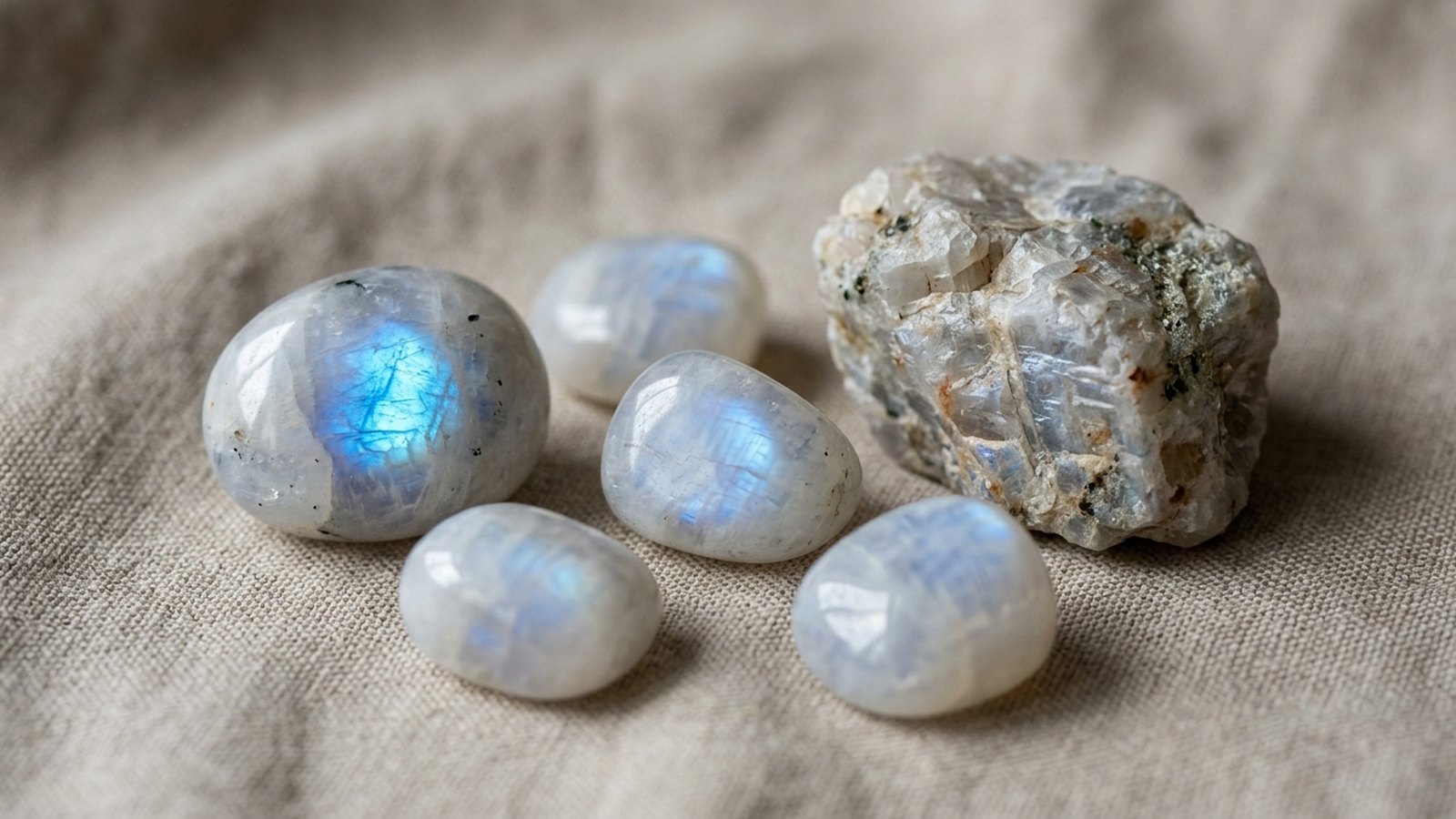
Moonstone is a feldspar, and its glow has a mechanism. As the crystal cooled, it separated into alternating microscopic layers of two feldspars, and light bouncing between those layers scatters into that soft blue-white sheen that seems to float below the surface rather than sit on it. The effect is called adularescence, after Mount Adular in Switzerland. It moves as you tilt the stone, which is a fair description of what it is meant to help with.
Worth knowing before you buy: most "rainbow moonstone" sold today is not the same mineral. It is white labradorite, a different feldspar, and its flash comes from labradorescence, a related but distinct interference effect that throws blue, green and gold rather than a single drifting sheen. Neither is fake. They are simply not the same stone, and the label rarely tells you. I go through the confusion properly in opalite vs moonstone.
Green aventurine is not one mineral either. It is quartzite shot through with tiny flakes of fuchsite, a chromium-bearing mica, which supplies both the green and the faint glitter. Citrine deserves one caution: natural citrine is uncommon, and most on the market is amethyst that has been heated until it turns golden. It is still quartz and still lovely. It is just made, not found.
How to actually use them
Nothing here is complicated, and complication is usually a sign someone is selling you something.
- Pick one stone, from the half you are actually in. One reminder works. Five compete.
- Say the thing once, holding it, in ordinary words. Not "I attract abundance" but "I am going to speak up in Thursday's meeting." Vague intentions produce vague reminders.
- Put it where the difficulty is. The desk, the coat pocket, the bedside table. A stone in a drawer is a stone you have stopped consulting.
- Give it a fixed job for a fixed time. Two weeks, then look again. Thresholds move, and the stone should be allowed to change with you.
One practical warning the listicles skip. Moonstone is around 6 to 6.5 on the Mohs scale and has perfect cleavage in two directions, which means it does not merely scratch, it splits along a plane if you knock it hard. Carrying a tumbled moonstone loose in a pocket with your keys is how people chip the stone they bought for a fresh start, in week two, which is a rotten little omen to hand yourself. Keep it in a soft pouch, or wear it somewhere protected. Amazonite has the same weakness. Lepidolite is softer still, closer to 3, and will flake if you treat it like quartz. If you want a stone that survives a pocket and a set of keys, use quartz or carnelian at 7.
None of this is medical, and none of it is a substitute for help. Where a beginning is genuinely hard, the stone is a companion to the work, not the work.
Questions people ask
What is the best crystal for new beginnings? Moonstone, if you want one answer. It is the traditional threshold stone and the most widely agreed choice. But if you are still letting go of what ended, smoky quartz will serve you better first.
What crystal is best for starting a new job? Tiger's eye for steady nerve in a room of strangers, carnelian for the push to speak first, amazonite for saying it clearly. If the last job ended badly, deal with that before you carry anything hopeful.
What crystals are good for release and letting go? Smoky quartz, black obsidian, peridot and lepidolite. These are the release-half stones, and they are exactly the ones missing from most new beginnings lists.
Can I use more than one at a time? You can, but I would not, not at first. Two stones with two intentions tend to become no intention. Once one is doing its job and you have stopped thinking about it, add the second.
Which stone should I start with if I am not sure which half I am in? Labradorite. It is the one on the list that genuinely covers both, being traditionally the stone of transformation while it is still in progress rather than once it has resolved.
Before you choose
Ask yourself one question, and be honest about the answer: is the space actually clear? If you are still arguing with someone who is not in the room, you are in the release half, whatever the calendar says, and moonstone will sit on your desk being beautiful and slightly beside the point.
There is no rush. Endings take the time they take, and a beginning that arrives on its own schedule tends to hold. Start with the stone for where you are standing, not the one for where you would like to be, and let it move when you do.