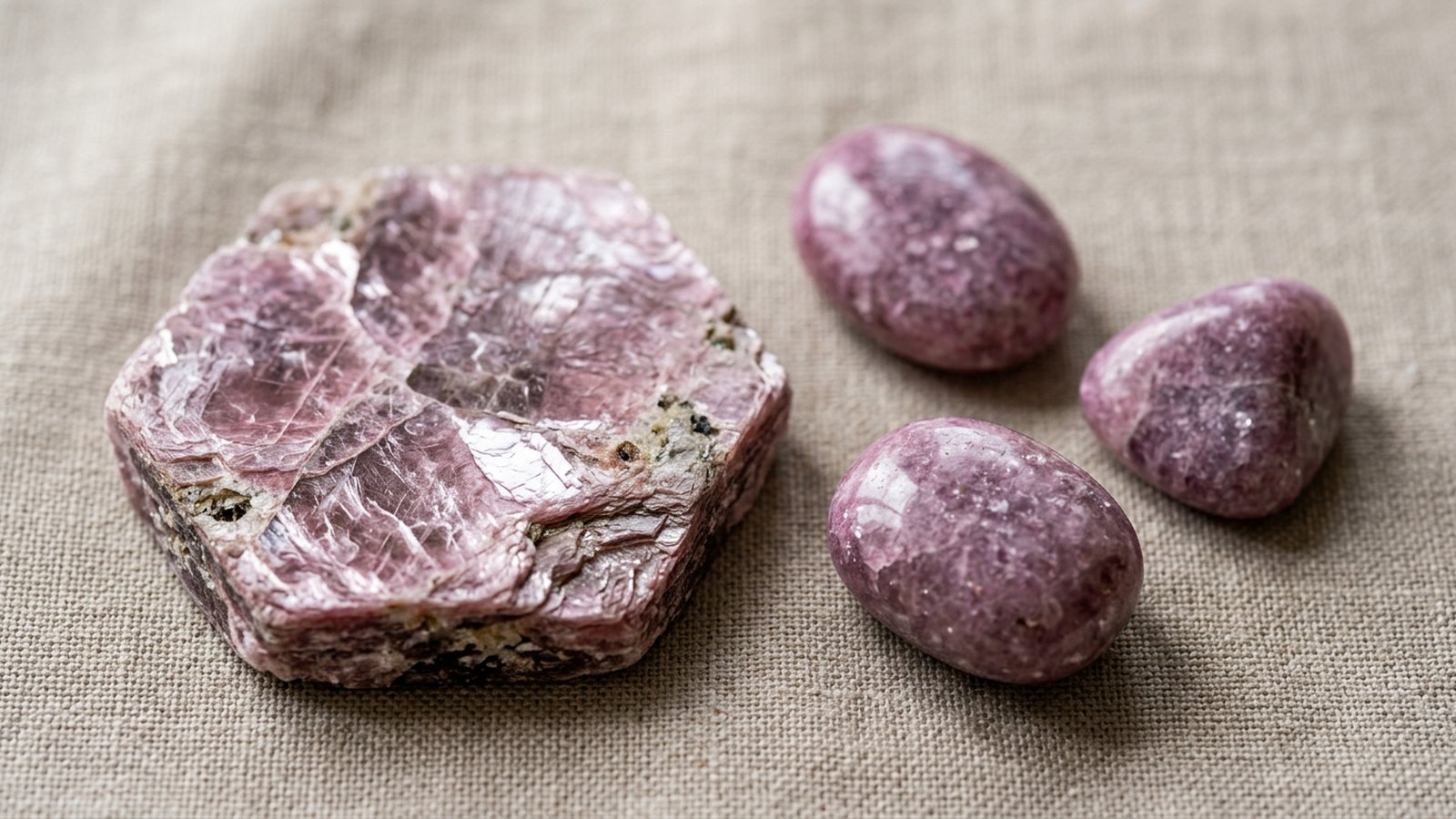
Lepidolite is a lilac to pink mica, a soft, flaky mineral that is genuinely rich in lithium, and in crystal tradition it is the stone people reach for when the mind will not stop running. Its meaning is calm: emotional steadiness through a period of change, quieter nights, a gentler relationship with your own worry.
I keep a small plate of it on my desk, and the thing I notice most is that it sheds. Tilt it and the surface breaks into hundreds of tiny mirrors, and if you rub a thumb along the edge you will lift a flake so thin it is translucent. This is not a stone that pretends to be indestructible. That softness is part of why I like it.
It is also the stone that the internet gets most confidently wrong. There are two things worth knowing before you buy one, and neither appears on the first page of Google: what the lithium in it actually does for you, and the fact that lepidolite is barely a mineral in the first place.
What You Are Actually Holding
Lepidolite belongs to the mica group, which means it is a sheet silicate. Its atoms are arranged in layers held together weakly, so it has what mineralogists call perfect basal cleavage: it splits into sheets, cleanly, in one direction, more or less forever. A single crystal is called a book, and the pages are real.
Here is the part nobody mentions. Modern mineral nomenclature does not treat lepidolite as a species at all. It is a series name, covering the range between two approved end members, polylithionite and trilithionite, with the lithium and aluminium swapping places in varying proportions. In practice "lepidolite" means lithium-rich mica of the lilac sort, and that is a field and trade term rather than a strict identity. The stone on your shelf is, technically speaking, a range.
What you buy is rarely a clean mica book either. Most retail lepidolite is a massive, granular aggregate: mica plates grown through quartz and feldspar, sometimes with black tourmaline needles running across a face. That is why one piece glitters like crushed glass and the next looks like dull grey putty. Both are lepidolite. They just contain different amounts of everything else.
The Lithium Question
Yes, the lithium is real. Good lepidolite ore runs to roughly three or four percent lithium oxide by weight, and for a long stretch of the twentieth century it was the main commercial source of the element, before spodumene and brine deposits took over. Lepidolite is not a stone that is said to contain lithium. It has been mined for it.
The leap the crystal internet makes from there is understandable and wrong. Because lithium carbonate is a genuine psychiatric medicine, page after page concludes that holding a lithium-bearing rock must calm you by the same mechanism. I read one site that stated flatly that lepidolite yields a natural antidepressant. I would like to be careful here, because this is the single most repeated claim about the stone.
The lithium in lepidolite is a structural cation, locked into an aluminosilicate framework. It is not loose, not soluble in water, and not soluble in sweat. It does not cross skin. Getting it out is an industrial process: the ore is roasted at close to a thousand degrees Celsius, usually with sulphate salts or limestone, and only then leached out with acid or water. That is what it takes to separate that lithium from that rock. A warm palm does not qualify.
Which also means no lepidolite elixir, and I would not want one even if the chemistry cooperated. Prescribed lithium is dosed by blood test precisely because the gap between a useful amount and a harmful one is narrow. A rock that dosed you unpredictably would be the opposite of care.
So what is happening when people say it settles them? Something I think is real, just not pharmacological. You are holding a cool, weighted, softly coloured object that you have deliberately associated with slowing down, and you reach for it at the moments you have decided to slow down. That is a cue, and cues work. Our guide to crystals for anxiety treats lepidolite exactly that way. If you take lithium on prescription, nothing here is a substitute for it, or an addition to it.
Reasons to Work With Lepidolite
Lepidolite is a transition stone, and that is the reputation I find most earned. Not crisis, not celebration, but the awkward middle: the fortnight after you hand in your notice, the month a relationship is ending but neither of you has said so, the first weeks in a flat that does not feel like yours. It is traditionally carried for the stretch where nothing is decided and everything is unsettled.
Lepidolite is a night stone. The nightstand is where most pieces end up, and the association with easier sleep is one of the oldest attached to it. I would frame it honestly: a stone on the bedside table is a small, deliberate marker at the end of the day. If you want the practical version of that, the crystals for sleep guide has it.
Lepidolite is a stone for the self-surveilling mind. There is a particular kind of stuck that is not emptiness but a loop, the part of you that watches and grades everything you do. That is the register lepidolite is reached for in, and why it turns up in our crystals for creativity guide rather than the more obvious warm, energising stones.
Lepidolite is a quiet companion for grief. It asks nothing. In the tradition it belongs to, it is kept nearby rather than worked with, and the crystals for grief guide takes the same view: company, not a task. All of these are traditional associations and personal experience rather than proven effects, and none of them replace real support when you need it.
Lepidolite Properties
- Chakras: heart, third eye and crown, with most sources leading on the third eye and crown.
- Zodiac signs: Libra by broad consensus, with Pisces often added.
- Element: Water.
- Numerical vibration: 8.
- Affirmation: I can be steady without being certain.
Lepidolite Geology
Lepidolite forms in granite pegmatites, and that origin explains almost everything about it. A pegmatite is the last part of a granite body to crystallise, the leftover melt that stayed liquid longest because it was rich in water and in elements that do not fit neatly into ordinary rock-forming minerals. Lithium is one of those elements. So are caesium, rubidium, beryllium and boron, which is why a lepidolite pocket so often holds tourmaline, spodumene, beryl, topaz or amblygonite alongside it.
The colour is manganese. Traces of it, sitting in the crystal structure, produce everything from pale silvery lilac to a strong rose pink. You will read very often that the lithium makes it purple. It does not. Lithium micas can be perfectly colourless, and the difference between a pink piece and a lavender one is how much manganese it happened to take up.
Hardness is where the sources fall apart, and it is worth understanding why rather than picking a number. On the first page of results I found lepidolite given as 2.5 to 3, as 2.5 to 3.5, as 2.5 to 4, and as 3 to 4. All of those are defensible. Mica scratches far more easily along its cleavage than across the edge of a sheet, so the answer depends on where you put the point. And most retail material is an aggregate stiffened by quartz, which is Mohs 7, so a tumbled piece behaves harder than the mica in it.
The useful version is a test you can run. Your fingernail is about 2.5 and a copper coin about 3.5. On clean lepidolite, a fingernail will mark the mica. Try it on the back, once.
For the record: formula K(Li,Al)3(Si,Al)4O10(F,OH)2, monoclinic, specific gravity around 2.8 to 2.9, vitreous to pearly, and the name comes from the Greek lepis, scale, and lithos, stone.
History and Lore
Lepidolite has less ancient lore than almost any stone in a crystal shop, and I would rather say that plainly than invent some. It has no classical name, no biblical entry, no medieval reputation.
What it has is a good documented history. Before it was lepidolite it was lilalite, named around 1790 by Nicolaus Poda von Neuhaus for its lilac colour. In 1792 Martin Heinrich Klaproth, working on material from a quarry at Rožná in Moravia, renamed it for its scales rather than its colour and published the analysis a few years later. He had no idea it contained lithium, because lithium had not been discovered yet. That came in 1817, and lepidolite was quickly recognised as one of its richest sources.
Its real moment came in 1861, when Robert Bunsen and Gustav Kirchhoff worked through about 150 kilograms of lepidolite to isolate a few grams of salts of a new element, rubidium, which they had spotted as unfamiliar red lines in a spectroscope. Caesium is often credited to lepidolite in the same breath. It should not be: they had found caesium the year before, in mineral water. Rubidium is lepidolite's own.
One more correction, since it circulates widely: the story about large mica sheets being split and used as window panes belongs to muscovite, lepidolite's common cousin, which is why old sheet mica was called Muscovy glass.
Choosing, Cleansing and Caring for Lepidolite
Choose by what you want it to do. Raw plates and books show the shimmer that makes the stone worth looking at, and they are also the ones that will flake on you. Tumbled aggregate pieces are duller and much tougher, and if the stone is going in a pocket, that is the one to buy. If a piece is being sold as amethyst-adjacent or you are unsure which you have, look for the mica glitter and try the fingernail test: amethyst is quartz and will not mark.
Water is the question everyone asks, and the honest answer has a mechanism behind it. Lepidolite does not dissolve. What happens is mechanical: water wicks between the cleavage sheets, the edges lift, the surface goes cloudy and the piece begins to shed. Salt is worse, being abrasive as well as drying. Keep it dry, and see crystals and water safety for the wider list. Long hours in direct sun will also pale that manganese colour over time, the same slow fading that affects fluorite, so the windowsill is the wrong shelf.
That leaves the dry methods, which suit it perfectly well: smoke, sound, a night out under the moon, or simply setting it down somewhere quiet. Our cleansing crystals guide covers each. For storage, give it its own soft pouch, because at Mohs 3 almost everything else you own is harder than it is, including your keys and the rest of your collection. The how to store crystals guide goes further on that.
For wearing: pendants and earrings are realistic, rings are not. Most lepidolite reaching the market now comes from Brazil, chiefly Minas Gerais, along with Madagascar, Afghanistan, Zimbabwe, the Urals, and classic North American pegmatites in California, Maine, the Black Hills and Manitoba. A fair amount of it is a by-product of lithium mining, which is worth asking your seller about if provenance matters to you. And if you are deciding where it lives, where to place crystals in your home has the room-by-room version.
Mine stays on the desk, shedding gently, which feels about right for a stone whose whole message is that coming apart a little is survivable.