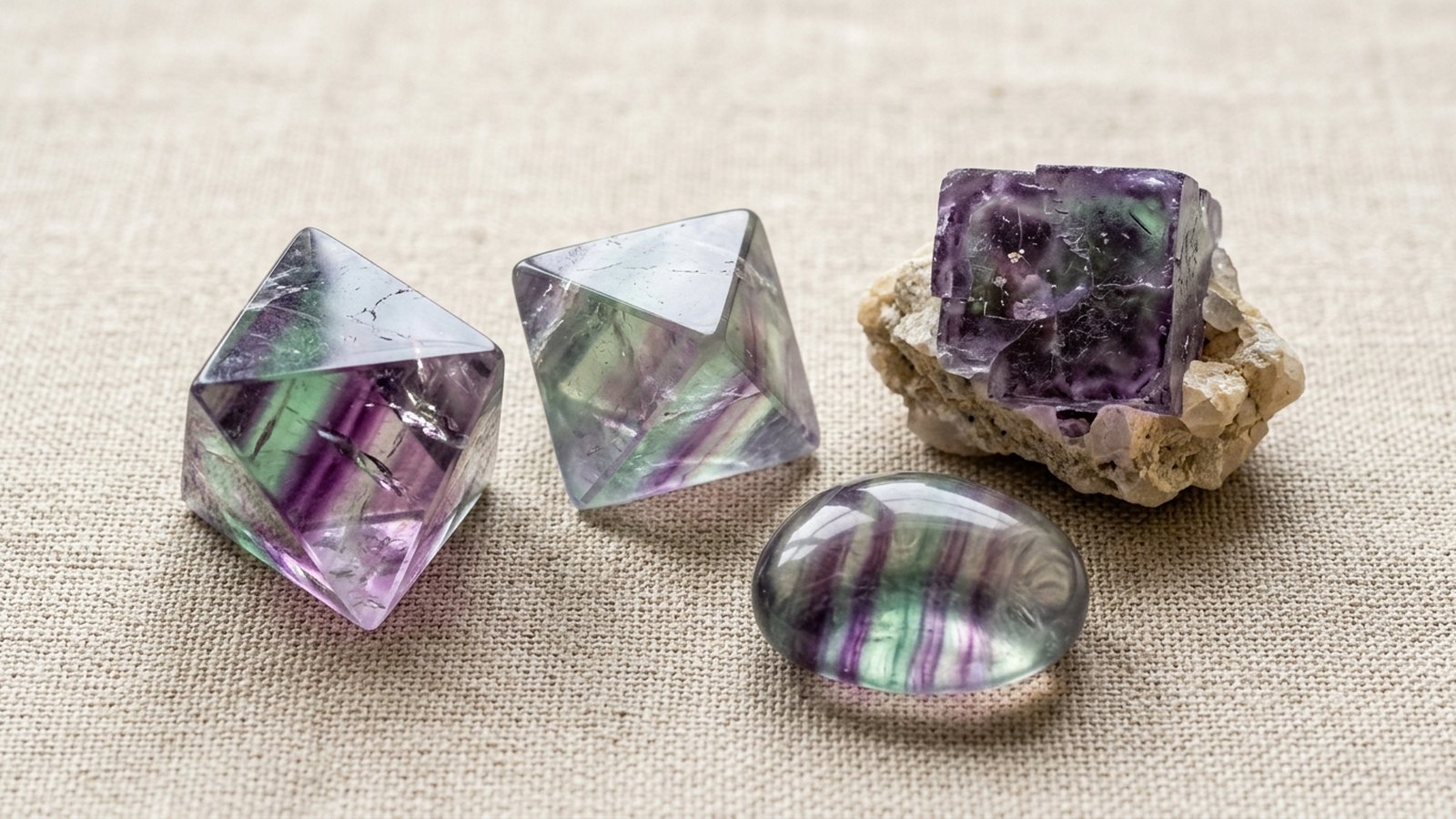
The first piece of fluorite I owned was a small green octahedron that a friend pressed into my hand during a week when I could not finish a single thought. Fluorite is calcium fluoride, a soft, glassy mineral that grows in cubes and comes in more colours than almost any other stone, and in crystal tradition it is the stone of mental clarity, focus and order. Most people know it as the "genius stone". After years of keeping one on my desk, I would call it the stone of putting things back in sequence.
It is also one of the most misunderstood stones on the shelf. Nearly every guide I read while writing this one recommends charging fluorite in sunlight. That advice will fade your fluorite, sometimes within weeks, sometimes permanently, and the reason why turns out to be the most interesting thing about the mineral. I will come back to it.
Here is what fluorite is traditionally used for, what each colour is associated with, the real geology sitting under those colours, where the stone comes from, and how to keep the piece you own looking like the piece you bought.
Reasons to work with fluorite
Fluorite is for the week when your mind has too many tabs open. Not the anxious kind of overload, which is a different problem and asks for a different stone, but the scattered kind: five half-finished tasks, none of them hard, all of them somehow undone. This is the situation fluorite has always been given to. I keep a piece beside my keyboard and treat it as a marker for one job at a time. If your overwhelm is closer to a racing heart than a cluttered desk, start with the stones in my guide to crystals for anxiety instead.
Fluorite is for decisions you keep deferring. There is a particular kind of stuck where you already know the answer and are waiting to feel certain about it. Tradition frames fluorite as the stone that separates what you actually think from the noise around it. In practice it works as a small ritual of attention: hold it, name the decision out loud, notice what you were avoiding.
Fluorite is for chaotic rooms and other people's moods. Open-plan offices, family houses over the holidays, shared studios. Fluorite has a long reputation as a stone that absorbs mental static, which is why it turns up so often on desks and in study spaces. I am careful with how far I take that claim, and I will explain why further down.
Fluorite is for learning something you are not good at yet. Language apps, a new instrument, a certification you resent. Its association with the mind is not about being clever, it is about staying patient with the part where you are bad at it. Pair it with citrine if the thing you are learning also asks you to be seen doing it, or read crystals for confidence for the whole set.
Fluorite meaning and healing energy
Emotional healing
Fluorite is traditionally used to steady an emotional state that has become tangled with a mental one, the mood that is really just exhaustion from thinking about the same thing for six days. The old idea is that it sorts, rather than soothes. In my own experience it makes it easier to say what is actually bothering me, which is usually smaller and more specific than the fog suggested.
Spiritual healing
Purple fluorite in particular is linked to the third eye and to what tradition calls discernment: telling a real intuition from wishful thinking or fear wearing an intuition's clothes. It is a good meditation stone precisely because it does not flood you with anything. If you sit with crystals, my guide to meditating with crystals has a short practice that suits it.
Mental healing
This is fluorite's home ground. Study, memory, structure, revision, the ability to hold a complicated thing in your head long enough to write it down. If you want a companion for it, clear quartz is the amplifier and sodalite is the one for thinking out loud.
Physical wellbeing
You will find pages claiming fluorite supports the immune system, detoxifies the body, or strengthens bones and teeth. I am not going to repeat any of that. Those are traditional and modern folk claims, not findings, and no stone treats anything. If something in your body is worrying you, please see a doctor. What a stone can honestly offer is a small, calming ritual, and rituals are worth having.
Chakras: third eye and crown for purple, heart for green, throat for blue, solar plexus for yellow. See the chakra crystals guide for placement. Zodiac signs: Pisces and Capricorn. Element: Air. Numerical vibration: 7. Affirmation: I think clearly, and I finish what I start.
What each colour of fluorite is for
Fluorite comes in more colours than almost any other mineral, and a single crystal often holds several of them in bands. The colour associations below are a modern convention rather than an ancient one, built mostly on colour and chakra correspondence, which is also how my guide to crystal colours reads them.
| Colour | Chakra | Traditionally worked with for |
|---|---|---|
| Purple | Third eye, crown | Discernment, intuition, meditation, sleep and dream work |
| Green | Heart | Balancing head and heart, emotional reset, growth |
| Blue | Throat | Clear speech, difficult conversations, calm |
| Yellow | Solar plexus | Confidence in your own judgement, creative follow-through |
| Clear or colourless | Crown | Simplicity, clearing, a blank slate to programme |
| Rainbow (banded) | All of the above | General order, study and desk work |
Rainbow fluorite is the one most people meet first, and its bands are not decoration: they are a record of the fluid that built the crystal changing chemistry between growth stages, layer by layer. If you like the idea of a stone that shows its own history in stripes, labradorite and malachite do the same thing in their own ways.
What fluorite actually is
Fluorite is calcium fluoride, CaF2, a halide mineral that crystallises in the cubic system. Left alone it grows as cubes, sometimes with the corners cut into octahedrons, and it is often perfectly transparent. Pure fluorite is colourless. Everything else is added.
Its hardness is 4 on the Mohs scale, and that is not an approximation: fluorite is the mineral that defines 4. Friedrich Mohs picked it as the reference in 1812, so when you read that a stone is "harder than fluorite", fluorite is the ruler being used. That number matters more than it sounds. Ordinary household dust contains quartz at Mohs 7, which means the dust on your shelf is harder than your fluorite and will dull a polished surface over time.
Fluorite also has perfect cleavage on four planes, meaning it splits cleanly in four directions rather than chipping randomly. Here is a thing almost nobody tells you: those flawless little octahedra sold in every crystal shop are usually not grown that way. They are cleaved, split out of larger masses of fluorite along those four planes by someone with a blade and a good eye. It is honest work and the shapes are real, but they are cut, not found, and it is worth knowing what you own. My guide on telling a real crystal from a fake covers the difference between shaped, treated and outright fake.
Where the colour comes from
Most coloured stones get their colour from an element sitting in the crystal structure. Fluorite is stranger. Its purples and blues come largely from colour centres: places where natural radiation from uranium in the surrounding rock has knocked fluoride ions out of position, leaving trapped electrons and tiny colloids of calcium metal that absorb light. The colour, in other words, is a record of damage. The clarity stone is coloured by its own disorder, which I find quietly appropriate.
It also explains the care rules further down, because a colour built from displaced electrons is not permanent. Light can put those electrons back. Heat can too.
The most extreme version of this is a variety called antozonite, the "stinking fluorspar" of Wolsendorf in Bavaria, which reeks when you break it. Chemists argued about why for roughly two hundred years. In 2012 a team led by Florian Kraus at TU Munich and Jorn Schmedt auf der Gunne at LMU settled it with fluorine NMR: the stone contains actual elemental fluorine, sealed in microscopic pockets, the only place it has ever been found free in nature. Radiation from uranium had split the calcium fluoride apart from the inside.
The stone that named a phenomenon
Fluorite glows under ultraviolet light, usually blue or violet, sometimes green or cream. In 1852 the physicist George Gabriel Stokes named that whole class of behaviour fluorescence, after fluorspar, the old miner's word for this mineral. Every fluorescent lamp and highlighter pen carries the name of this stone.
Two honest footnotes. Not all fluorite fluoresces, since it depends on which rare earth elements happen to be present. And a rare few pieces, most famously the deep green cubes from the Rogerley Mine in Weardale, County Durham, fluoresce so strongly that the blue shows in ordinary daylight. There is also a variety called chlorophane that glows green from the warmth of your hand alone. It is very uncommon, so if a shop offers you one at a normal price, be sceptical.
The history hidden in the name
The name comes from the Latin fluere, to flow. Smelters had been throwing fluorite into furnaces for centuries because it lowers the melting point of ore, and Georgius Agricola wrote the German Flussspat down in 1530. That is still the mineral's main job. Most fluorite mined today never reaches a crystal shop: it goes to steelmaking as flux, and to the chemical industry, where reacting it with sulfuric acid produces hydrogen fluoride and, from there, refrigerants, non-stick coatings, medicines and the fluoride in your toothpaste. The stone of mental clarity is the world's source of fluorine.
Its most beautiful chapter is English. Blue John is a banded purple, blue and yellow fluorite found in only two caverns in the hills above Castleton in Derbyshire, which makes it about the most geographically restricted gemstone on earth. The first record of it being carved dates to 1743, when a local craftsman was commissioned to turn a block into a vase. By the late eighteenth century Georgian taste had made Blue John vases and columns fashionable in the grandest houses in Britain, Chatsworth among them. Miners named fourteen distinct veins over the centuries, and in 2015 a fifteenth, the Ridley Vein, was found, the first in more than 150 years.
On the other side of the Atlantic, Illinois named fluorite its state mineral in 1965, when the Illinois and Kentucky district was the largest producer in the United States. Those mines are closed now, and old Illinois specimens have become collectors' pieces.
One last honest note: the nickname "genius stone" is modern crystal-book vocabulary, not old lore. Fluorite's documented history is industrial and ornamental. Its reputation as a mind stone is roughly a century old at most, and it is fair to enjoy it as tradition rather than as heritage.
Where fluorite comes from, and how to care for it
China is by far the largest producer today, followed by Mexico, with fine specimen material also coming from Spain, Russia, Namibia and the historic English mines of Weardale. Prices are gentle, which is one of the reasons fluorite is such a common first stone, and my guide to building your first set explains where it fits.
Now the part I promised. Do not charge fluorite in sunlight. Because its colour lives in those fragile colour centres, ultraviolet light undoes them. Green fluorite from Weardale pales in the sun, and some blue material from the Haute-Loire in France has been reported to lose its colour after half an hour of direct exposure. Weeks on a bright windowsill will visibly wash out a good piece, and it does not come back. Heat does the same thing. This is the single most common piece of advice given about fluorite online and it is backwards. Use moonlight, a night in the dark, smoke, sound, or simply intention instead. My guide to charging crystals lists the gentle methods.
The rest is simpler:
- Water: a quick rinse in cool water is fine, but do not soak it. Calcium fluoride is close to insoluble, so the water itself is not the enemy, but it works into cleavage cracks and many pieces are lightly oiled or waxed to improve their polish. Never use salt water. See crystals and water safety for the whole rule.
- Knocks: at Mohs 4 with four cleavage planes, fluorite chips flat. A dropped point loses a corner rather than scuffing. It makes a poor ring stone and a fine pendant.
- Storage: wrap it separately, away from quartz, and dust it with a soft cloth rather than a bristle brush.
- Cleansing: dry methods suit it best. My guide to cleansing crystals covers smoke, sound and breath, all safe here.
If you want it working rather than sitting, the traditional placements are a desk, a study, or a bag pocket. Where to place crystals in your home and carrying and wearing stones both cover the practical side, and if you like giving a stone a specific job, try programming an intention.
A last thought
I still have the green octahedron. It has a small flat scar on one corner where I knocked it off a shelf, exactly along a cleavage plane, exactly as the mineralogy predicts. I like it more for that. Fluorite is a stone that is honest about being fragile: it fades if you leave it in the light, it splits along the lines it was always going to split along, and it still manages to be one of the most beautiful things you can put on a desk.
If you are choosing your first piece, take rainbow or green for everyday work, purple if what you want is quiet rather than order. Keep it out of the sun. And if you want a companion for it, amethyst for rest, clear quartz for amplification, or smoky quartz when the thinking needs grounding as much as sorting. You can find the full record for this stone on its fluorite page.
If you came here because your attention keeps slipping, it is worth knowing that fluorite is only the right answer to one of the several ways focus actually breaks. I have sorted them out in crystals for focus, which routes each failure mode to the stone that suits it.