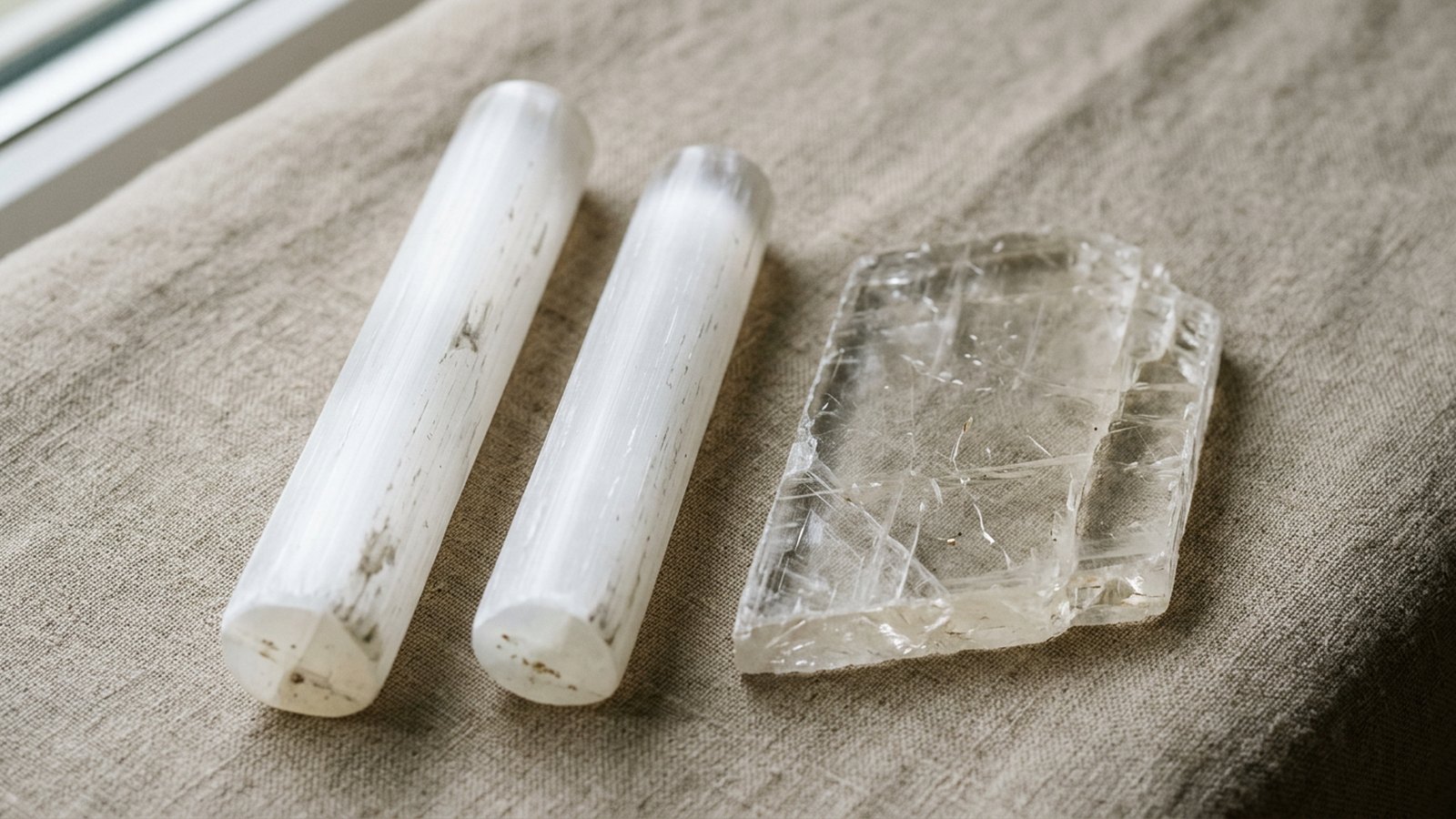
Selenite means moon stone. The name comes from the Greek selenites lithos, and it was given because people once believed the mineral swelled and thinned with the phases of the moon. It does not, but you can see why they thought so. Hold a good piece up to a lamp and the light does not bounce off it, it travels through it, arriving on the far side softened and a little milky, the way moonlight arrives through cloud.
In the crystal tradition, selenite's meaning is clearing. Not protection, not attraction, not manifestation. Clearing: the sense of a room that has just been aired, a desk that has just been emptied, a conversation that has finally been had. It is the stone people reach for when nothing is exactly wrong but nothing feels particularly clean either.
It is also, and I want to say this early because almost nobody does, probably not the mineral you think you bought. The white silky sticks and towers and charging plates that fill every crystal shop are gypsum, yes, but they are a different variety of it. I will come back to that, because once you know the difference you cannot unsee it.
Reasons to work with selenite
Selenite is for a space that has been holding something. After an argument in the kitchen, after weeks of working from the same corner of the same room, after guests, after illness, a room can feel used up in a way that airing it does not quite fix. Selenite's traditional job is exactly this, and it is the reason so many people keep a stick by the door rather than in a drawer. Whether the stone does anything or the walking around the room does it, I genuinely cannot tell you. I only know the room feels different afterwards, and that this is one of the few crystal practices that asks you to move through your own home with attention.
Selenite is for the person who cannot put the day down. There is a specific end-of-day tiredness where the body is finished but the head is still filing things, and selenite belongs to it more than any other white stone I know. It sits well on a bedside table, it asks nothing, and it pairs sensibly with the rest of the stones in our guide to crystals for sleep. If sleep is genuinely broken rather than just late, please treat that as something worth real help, not a stone.
Selenite is for honesty with yourself. This is the quality the old sources keep circling, and it is subtler than it sounds. The tradition does not claim selenite makes you truthful with other people. It claims it makes it harder to keep telling yourself the comfortable version. That is a fair description of what a still, quiet, uncluttered few minutes does to anyone, which may be the whole mechanism.
Selenite is for the beginning of a practice. It is soft, it is inexpensive, it needs no charging under any moon, and it does not carry a heavy reputation that beginners feel they have to live up to. If you are assembling a first small set of stones, selenite alongside clear quartz and black tourmaline covers most of what people actually want from crystals in their first year.
Selenite meaning: healing energy
Emotional healing
Selenite is traditionally used for emotional overload rather than emotional pain. It is the stone for the week where too much has happened to feel any of it properly, when what you need is not comfort but space. Working with it tends to look like sitting still with the stone in your lap for five minutes and letting the backlog settle into an order. It does not do grief, and it does not do heartbreak. For those, rose quartz and the stones in our grief guide are the better company.
Spiritual healing
This is where selenite has the strongest reputation. It is associated with the crown chakra, the point where personal effort is meant to give way to something wider, and it is used in meditation to quiet the running commentary rather than to induce visions. Many practitioners also place it as the still centre of a crystal grid, on the logic that a clearing stone belongs at the point everything else refers back to.
Mental healing
The traditional reading here is discernment: separating what is yours from what you have absorbed from other people. If you work in a role where you carry other people's moods home, this is the claim worth testing. Practically, it means a few unhurried minutes with the stone at the end of a shift, sorting through the day and deliberately leaving most of it behind.
Physical healing
Older texts link gypsum stones to the skeleton and to skin, largely by association with their pale, bone-like appearance, and modern crystal writing tends to repeat it. Take that as tradition and folklore, not medicine. Selenite treats nothing, and no stone is a substitute for a doctor, a therapist or a pharmacist. What it can honestly offer is a reason to stop for five minutes, which is not nothing.
Chakra: Crown, with a secondary link to the third eye. Zodiac: Taurus and Cancer. Element: Air, and the moon among the planets. Numerical vibration: usually given as 8. Affirmation: I am clear, and what is not mine can leave.
Selenite is not a traditional or modern birthstone for any month. If a listing tells you otherwise, it is selling, not citing.
Is your selenite actually selenite?
Here is the thing the shops rarely mention. Selenite is one of four named varieties of the same mineral, gypsum, and the trade uses the prettiest name for all of them.
True selenite is the transparent, glassy variety. It looks like a thick pane of slightly cloudy ice and it splits into flat sheets you can peel apart with a fingernail. Satin spar is the fibrous variety: white to cream, opaque or barely translucent, with a silky sheen and a band of light that slides along the surface as you tilt it, the same cat's-eye effect you see in tiger's eye. Desert rose is gypsum grown in sand into overlapping petals. Gypsum flower is the curved, fibrous rosette found in caves.
Almost every selenite wand, tower, lamp, sphere and charging plate on the market is satin spar. The test takes two seconds: look for the moving line of light. If the stone glows along one axis like brushed silk, it is satin spar. If it is genuinely see-through and layered like mica, it is selenite in the strict sense.
Does it matter? Mineralogically, not much. Same formula, same softness, same family, and the crystal tradition has treated them as one stone for so long that the practices are identical. It matters for two reasons only. You should know what you own, and you should not pay a premium for a rebranded common variety. Our guide to black tourmaline and selenite goes further into which form to buy and which one to leave on the shelf.
Selenite geology
Selenite is gypsum, hydrated calcium sulfate, formula CaSO₄·2H₂O. It crystallises in the monoclinic system, typically as tabular or blade-like crystals with one perfect cleavage direction, which is why it peels so readily into sheets. It sits at 2 on the Mohs scale, the reference point for that number: gypsum is the mineral hardness 2 is defined by. Your fingernail is about 2.5, so you can scratch it yourself, and you will, by accident, if you keep it loose in a pocket.
It forms by evaporation. When a shallow sea or salt lake dries down, calcium sulfate is one of the first things to come out of solution, so gypsum beds are the fossil signature of ancient water leaving. That is also why the crystals can grow enormous when conditions stay stable for long enough. The Cave of the Crystals at Naica, in Chihuahua, Mexico, holds selenite beams over 11 metres long weighing tens of tonnes, grown in mineral-saturated water held near 58°C for hundreds of thousands of years. The cave is still that hot and close to fully humid, which is why visits are measured in minutes.
Pure gypsum is colourless. The white you usually see is fibres and inclusions scattering the light, and the honey, peach and grey tints come from iron oxides or clay picked up as the crystal grew.
There is a footnote to all this that I find hard to get over. In 2011 NASA's Opportunity rover photographed a narrow pale vein at the rim of Endeavour Crater on Mars, nicknamed Homestake, and the instruments identified it as gypsum. Water once ran through a crack in that rock and left the same mineral sitting on your windowsill.
Selenite history and lore
The name was formalised in 1747 by the Swedish chemist Johan Gottschalk Wallerius, but the Greek root is far older, and so is the moon association it preserves.
The most concrete piece of selenite history is Roman. The Romans quarried transparent gypsum sheets, which they called lapis specularis, and glazed windows with them long before clear glass was affordable. Pliny the Elder describes the trade, and the mines at Segóbriga in central Spain supplied it across the empire. For a couple of centuries, a significant share of the light getting into Roman rooms had passed through this mineral. When people say selenite is a stone of clarity, that is not only metaphor.
Satin spar has a quieter history of its own. In Derbyshire and Nottinghamshire it was carved into small ornaments and sold to Victorian visitors, and fine-grained gypsum, alabaster, has been carved into lamps and figures since Mesopotamia and Egypt. Gypsum is also the plaster on old walls and the core of modern plasterboard. Few stones move so easily between the sacred and the utterly ordinary.
Where selenite comes from, and how to care for it
Most of the material sold today comes from Morocco, with important sources in Mexico (Naica and Chihuahua more broadly), Madagascar, Brazil, Australia and the United States. The Great Salt Plains of Oklahoma produce hourglass selenite, with a shadow of trapped sand inside, and White Sands in New Mexico is a whole desert of gypsum grains. Gypsum is abundant and cheap to quarry, which is genuinely good news: there is little economic pressure behind selenite mining and no reason to accept a vague answer about origin from a seller.
Care is where selenite is unforgiving, and it comes down to one number. Gypsum dissolves in water at roughly two grams per litre. That is slight, not dramatic, so a stick will not vanish in a rinse, but the polish will go cloudy, the fibres will lift, and a satin spar wand left on a damp bathroom shelf will fray at the ends within months. Never put selenite in water, salt water, or a humid room. Our guide to which crystals can and cannot go in water has the full list, and how to store crystals covers the padding a Mohs 2 stone needs.
To cleanse it, use sound, incense, breath, or a few minutes of indirect moonlight. Direct summer sun will not dissolve it but will dull the surface over time. Handle it with dry hands: skin oils and moisture together are what turn a bright wand chalky.
Which brings me to the claim you will meet everywhere, that selenite cleanses and charges your other crystals and never needs cleansing itself. I want to be straight about this. There is no measurable mechanism, and the idea is modern rather than ancient. What a flat selenite plate genuinely gives you is a designated place and a repeatable habit, and in practice that is most of what any cleansing routine is doing. There is also a real risk hidden in the ritual: pieces that are still wet from a rinse should never be set down on gypsum. If you like the plate, keep it, and keep it dry. Our guide to charging crystals offers alternatives that ask less of a soft stone.
A last word
Selenite is the least demanding stone I own and the one I would replace first. It does not ask to be worn, programmed, or watched over. It sits on the shelf, catches whatever light there is, and gives it back a little softer. If you want a companion for it, moonstone shares the lunar association and the inward turn, and a full moon ritual is the natural evening to bring both out.
Buy the cheap piece first. Learn the difference between the silky one and the glassy one. Keep it away from the bathroom. That is nearly everything.