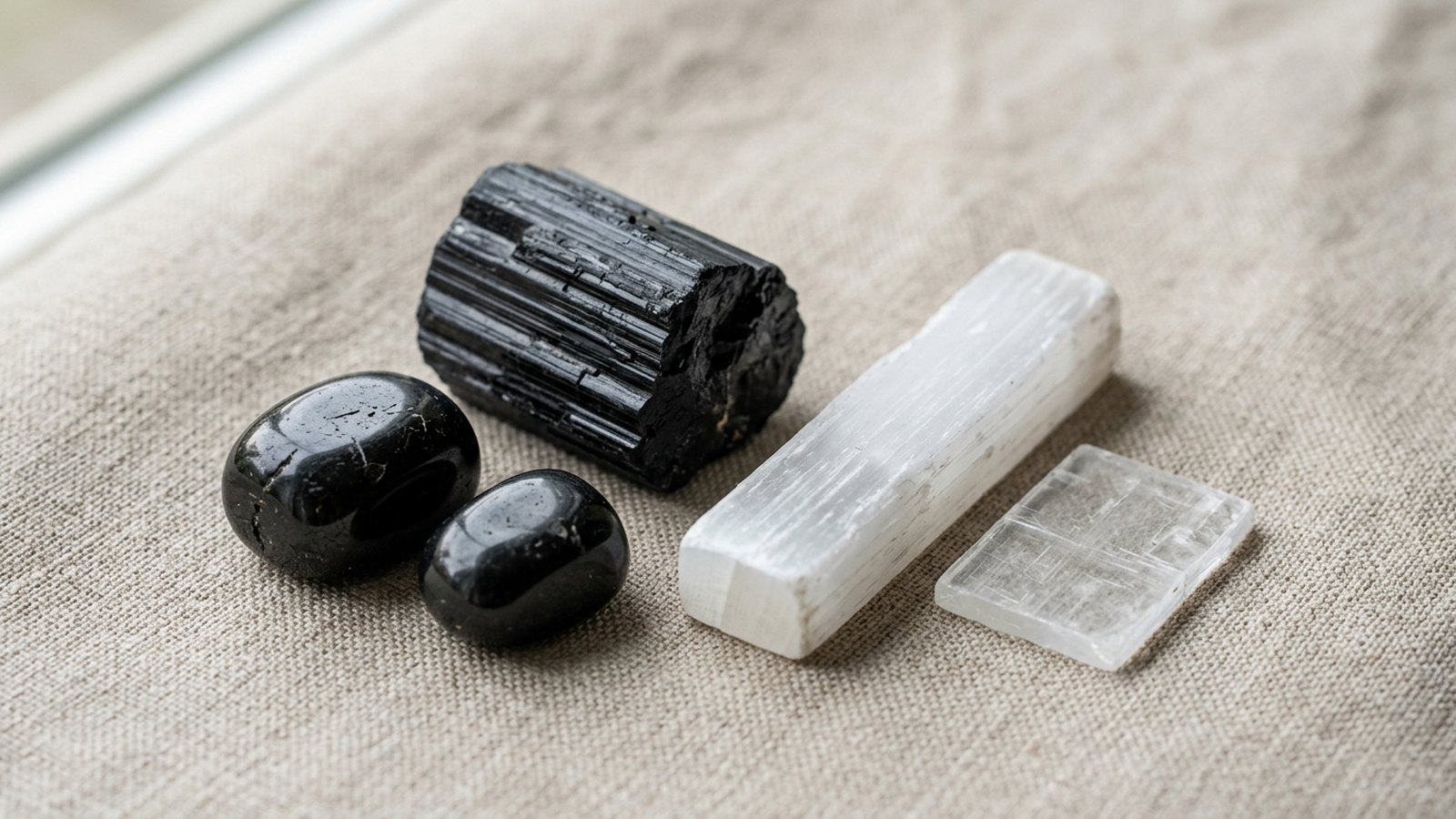
The first time someone showed me the setup, it was a saucer by a front door: three black tumbled stones resting on a milky white bar, arranged the way you would lay cutlery on a tray. Tourmaline on selenite. Absorb and clear. I have seen some version of it in a hundred homes since, and I have kept one of my own for years.
It is a good pairing, and the reasoning behind it is sounder than most crystal advice. It is also the pairing I get the most worried emails about, because these two stones sit further apart physically than any other popular duo, and almost nobody selling them mentions it. So here is what the pair is traditionally for, how I place mine, and the one shape of it I would not spend money on.
The short answer
Yes, you can keep black tourmaline and selenite together, and the tradition pairs them for a reason: tourmaline is the boundary stone, selenite is the clearing one. Same bowl, same shelf, same doorway is all fine. What I would not do is let them rub against each other. Black tourmaline sits at 7 to 7.5 on the Mohs scale and selenite sits at 2, the widest hardness gap in any common crystal pairing, so the harder stone quietly sands the softer one down. Place them side by side, not stacked, and the pairing costs you nothing.
Two stones that could not have formed further apart
Black tourmaline's mineral name is schorl, a sodium iron aluminium borosilicate that crystallises out of hot, boron-rich fluids late in the life of a cooling granite. It grows in pegmatites and hydrothermal veins, deep underground, under pressure, in the last hot water a magma body has left to give. It comes out as stubby striated prisms, glassy black, with no cleavage plane anywhere in it. It is a stone built by heat and time.
Selenite is gypsum, calcium sulphate with two water molecules locked into the structure, and it forms at the opposite end of the world. Seawater or a salt lake evaporates in the sun, the dissolved calcium and sulphate run out of room, and gypsum precipitates at ordinary surface temperature. No heat, no pressure, no depth. Just water leaving.
The famous exception proves the point beautifully. In the Naica mine in Chihuahua, Mexico, miners broke into a chamber holding gypsum crystals up to twelve metres long, one of them weighing around fifty-five tonnes and roughly half a million years old. They grew in water held at a steady 58 degrees Celsius for that entire stretch. The softest common stone in your house makes the largest crystals ever found on Earth, simply by never being disturbed.
Selenite takes its name from Selene, the Greek goddess of the moon, for its pale sheen. Gypsum takes its from the Greek word for plaster. One stone is fire and pressure, the other is patience and evaporation. You do not need any metaphysics to see why a tradition would read them as a pair of opposites. They genuinely are.
What each stone is asked to do
Black tourmaline, the boundary
Black tourmaline is the stone people reach for when something needs keeping out. In tradition it works as a shield and an anchor: heavy, opaque, unbothered, associated with the root chakra and with grounding and protection, and with Scorpio and Capricorn. It is the one you put where the disturbance comes from, which is usually a threshold or a desk. If you want the full picture of the stone on its own, I have written it up in the black tourmaline guide, including the electrical curiosity that gave it its reputation in the first place. It is also one of the few popular stones that asks almost nothing of you in return, which matters more in this pairing than in any other.
Selenite, the clearing
Selenite is asked to do the opposite job. It is not a shield. It is a stone of clearing and quiet, linked to the crown chakra and to Cancer, and it is the stone most often used to freshen other stones. Its whole reputation is about lightness, and the material itself is light: translucent, soft, almost weightless in the hand next to a lump of tourmaline. Whatever you make of the energy, the physical contrast is real, and I suspect that is where the pairing came from. It turns up in the same role in most cleansing routines, including the ones I set out in how to activate crystals, and it is a common bedside stone for sleep.
Why the pairing holds together
The logic runs like this. Black tourmaline is said to take on the heaviness in a room, and a stone that takes something on eventually needs emptying. Selenite is said to clear without needing clearing itself. Put the two together and you have a self-maintaining set, which is why almost every shop sells them as a kit and why the AI answer at the top of Google leads with it.
I like the pairing. I use it. I also want to be straight with you: none of that is testable. Nobody has measured a stone absorbing anything, and "selenite never needs cleansing" is a claim you cannot check either way. What I can tell you is that the pair makes sense as a practice. One stone marks the boundary, one marks the reset, and having two objects with two different jobs makes the habit easier to keep than a single stone asked to do everything. That is worth something on its own, and it does not require the energy claim to be literally true.
Crystals sit alongside real support, never in place of it. If a room feels unbearable, a stone by the door is not the intervention that will fix it.
The hardness gap, and what it costs you
Here is where the pair needs care rather than enthusiasm.
| Black tourmaline | Selenite (gypsum) | |
|---|---|---|
| Mineral | Schorl, a borosilicate | Calcium sulphate dihydrate |
| Mohs hardness | 7 to 7.5 | 2, softer than a fingernail |
| Cleavage | None, uneven fracture | Perfect, splits into sheets |
| Water | Fine for a brief rinse | Never |
| Formed by | Hot fluids, deep, under pressure | Water evaporating at the surface |
| Traditional job | Boundary, grounding | Clearing, clarity |
| Chakra | Root | Crown |
Mohs is a scratch scale, not a strength scale, and the gap between 2 and 7 is not a small step. Anything harder marks anything softer, permanently, and gypsum is the mineral that defines 2. This is why the classic charging plate arrangement has a cost nobody mentions: resting tourmaline on a selenite slab abrades the slab, not the tourmaline. I go into that failure mode properly in the guide to storing crystals, and the wider question of which stones damage each other is covered in what crystals should not be together.
There is a second, quieter consequence. Because the damage runs one way, the pair leaves a record: after a year, your selenite will be scuffed and your tourmaline will look exactly as it did the day you bought it. If your white piece is still flawless and your black one has picked up marks, something else is going on, and the usual answer is that the black stone is not tourmaline. The same asymmetry shows up in any pairing with a wide hardness gap, which is the thread running through what crystals should not be together.
The plate is a fair trade if you know you are making it. A slab that goes cloudy over two years has done its job. The problem is the trade nobody tells you about, which is the next section.
The one form of this pair I would not buy
Look at what is actually for sale when you search this pairing: combo bracelets, double pendants, hanging strings with tourmaline and selenite beads knocking together. That is the most-sold form of the most-recommended duo in the whole hobby, and it is the one arrangement the mineralogy cannot survive.
A bracelet is not storage. It is two hours of gentle grinding every time you type, thousands of small contacts a day, beads at Mohs 7 rolling against beads at Mohs 2. The selenite loses its polish first, then its edges, then its shape. Skin oil and sweat do the rest, because gypsum does not like moisture in any form. I read the longest, most careful product page on this search, a bracelet listing with its own care section and FAQ, and its only warning was to take the bracelet off before bathing so the water would not weaken the elastic. Not one word about the selenite.
If you want to wear this pair, wear black tourmaline and keep the selenite at home. A tourmaline bead bracelet or pendant is genuinely hard-wearing, and if you want a companion stone on the wrist that can take the same treatment, obsidian or clear quartz will survive where selenite will not. I compared the two dark stones directly in black tourmaline vs obsidian.
What you own is probably satin spar
One more thing worth knowing before you care for yours. Almost every white "selenite" tower, plate, bowl and lamp on the market is not selenite in the strict sense. It is satin spar, the fibrous, silky, milky-white variety of gypsum. True selenite is the transparent, glassy kind that splits into clear sheets, and most of it is either small or stays in the rough.
Both are gypsum, so nothing about the meaning or the care changes. I am not telling you that you were cheated, and I would not correct anyone in a shop about it. But it explains something practical: satin spar is fibrous, so it does not dissolve into nothing so much as fray. Its silk is an optical effect produced by parallel fibres, and once water gets between them, the shine goes and does not come back. A true selenite sheet, by contrast, tends to cloud and flake along its cleavage rather than dull, so the two varieties fail in visibly different ways.
Where I actually put mine
Black tourmaline goes at the source. For me that is the inside of the front door and beside the desk where the screens are, which is the traditional placement and the one every guide agrees on. I do not make the EMF claim some shops make, and I explain why in the protection guide.
Selenite goes where the air is, not where the traffic is. High on a shelf, on a mantelpiece, on the bedside table, well back from anything that gets knocked. It is not doing boundary work, so it does not need the doorway, and the doorway is where things get bumped.
If you keep the two together in one dish, and I do, put a piece of cloth or felt between them. That is the entire fix. Otherwise place them apart and let the tradition do its work at a distance, which is how I use them most of the time now. If you like the idea of a pair with jobs that complement each other, amethyst and rose quartz work the same way without the durability problem.
Caring for the pair
Black tourmaline is easy. It is hard, it has no cleavage, it is chemically stable, and it will not fade in sunlight. A brief rinse under running water is fine.
Selenite is the demanding one, which is the small irony of a stone whose reputation is that it never needs anything. Keep it dry. Gypsum dissolves slowly in water, about two grams per litre, and it has the unusual habit of getting less soluble as the water warms, so "use warm water, it is gentler" is wrong twice over. Keep it out of steam and away from radiators too, because heating gypsum drives the water out of its structure and turns it chalky. For both stones, smoke, sound and moonlight are the safe routes, and I have set them out in the guides to cleansing crystals and crystals and water safety.
Which leaves one nice absurdity to finish on. The stone people use to cleanse everything else is named after the moon, and moonlight is the one cleansing method that suits it perfectly, so long as you do not leave it out in the dew.
A last thought
I would keep this pair. Not because I can prove that one stone empties the other, but because two objects with two clear jobs make a habit stick, and the habit is the part that changes a room. Just buy them as two separate things rather than as one bracelet, keep a scrap of cloth between them, and let the soft one sit somewhere quiet. The tradition asks selenite to look after everything else. It seems only fair to look after the selenite.