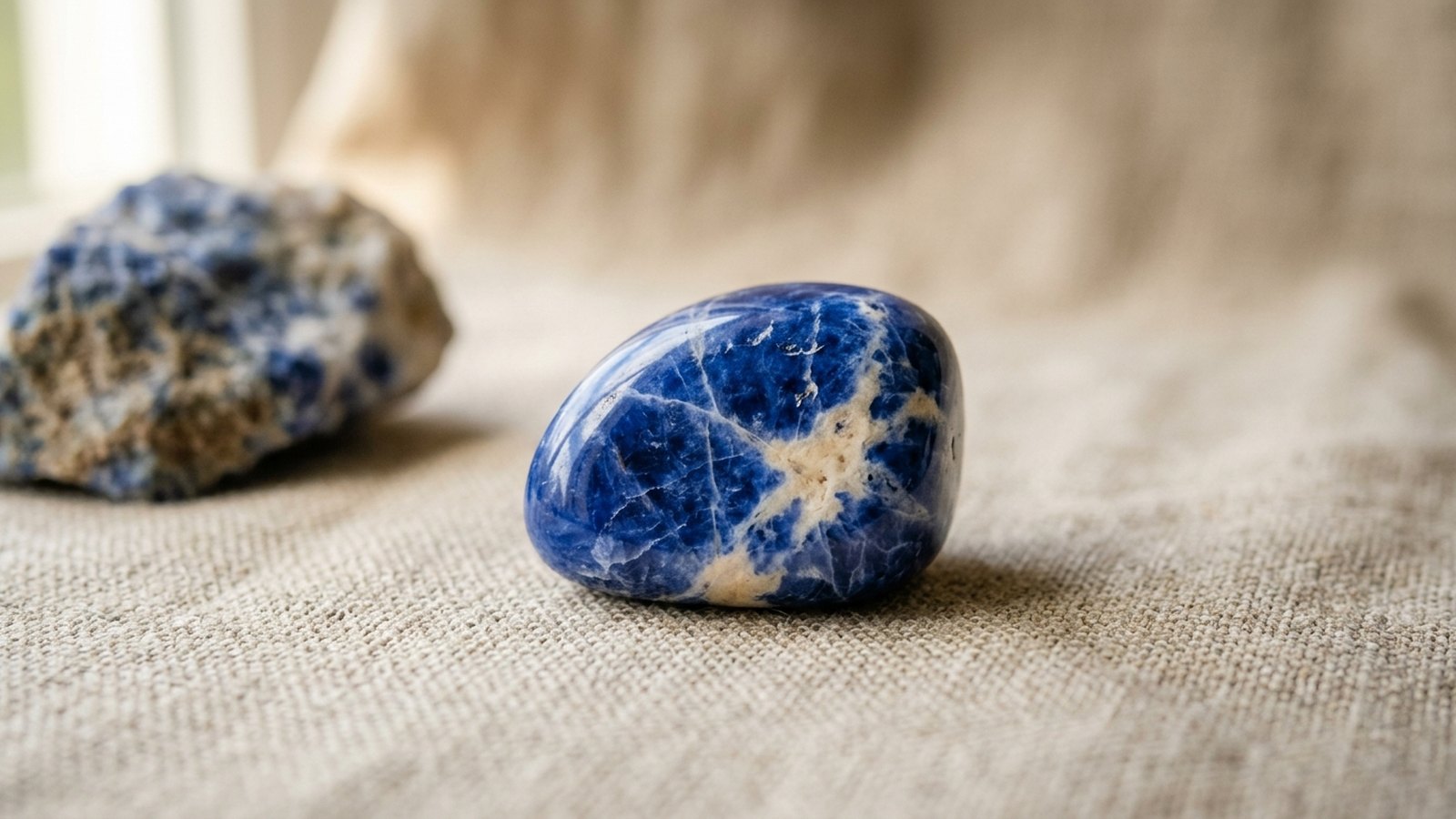
Sodalite is a deep royal blue stone streaked with white, long treasured as a symbol of logic, truth and clear communication. Its meaning centres on the thinking mind: sodalite is the classic "stone of the intellect," associated with rational thought, honest speech and calm inner focus. Traditionally linked to the throat and third eye chakras, it is the stone people reach for when they want to speak their truth without heat, organise scattered thoughts, or bring feeling and reason into the same room. Below is what sodalite means, where the symbolism comes from, and how to work with it.
The meaning of sodalite
The heart of sodalite's meaning is the union of head and heart. Where many blue stones lean purely spiritual, sodalite has always carried a more grounded, mental character. Folk tradition calls it the "poet's stone" and the "stone of logic," a companion for writers, students, thinkers and anyone whose work lives in words and ideas.
Symbolically, sodalite stands for:
- Clear thinking and mental organisation, cutting through mental fog
- Truthful communication, speaking honestly and being heard
- Emotional balance, especially calming an overactive or anxious mind
- Intuition guided by reason, so insight and logic support each other
That last point is what sets sodalite apart. It is not asking you to abandon logic for feeling, or feeling for logic. Its symbolism is the quiet negotiation between the two.
Sodalite and the throat chakra
Sodalite is one of the traditional throat chakra stones, alongside blue lace agate, which works the same centre far more gently. In the chakra system, the throat centre (Vishuddha) governs expression: the ability to say what is true for you, to listen, and to communicate without fear. Its deep blue also touches the third eye, the centre of insight and perception. You can read more in our full guide to the seven chakras and their crystals.
This pairing is why sodalite is so often chosen for honest conversations. People keep a piece nearby before a difficult talk, an interview or a piece of writing, using it as a symbolic anchor for speaking calmly and clearly. If you are drawn to blue stones for expression and insight, sodalite sits naturally alongside lapis lazuli and the more spiritual amethyst.
What sodalite looks like (and why it is not lapis lazuli)
Sodalite and lapis lazuli are constantly confused, and it is easy to see why: both are royal blue, and sodalite is actually one of the minerals that helps form lapis. But there is a simple way to tell them apart.
Lapis lazuli usually carries flecks of golden pyrite that sparkle like stars. Sodalite does not. Instead, sodalite shows soft white veining of calcite running through a more uniform, sometimes slightly violet, blue. If your "lapis" has no gold and plenty of milky white marbling, it is very likely sodalite.
Mineralogically, sodalite is a tectosilicate of the feldspathoid group, with the formula Na₈(Al₆Si₆O₂₄)Cl₂. It was first described in 1811 by the Scottish chemist Thomas Thomson, working from samples brought back from Greenland, and named for its sodium content. It is softer than quartz, at 5.5 to 6 on the Mohs scale, which matters for care (more on that below). If you are ever unsure whether a stone is genuine or dyed, our guide on how to tell if a crystal is real or fake walks through the tests.
The stone that glows: hackmanite and tenebrescence
Sodalite hides one of the most remarkable tricks in the mineral world. A sulfur-bearing variety called hackmanite is tenebrescent: freshly exposed or kept in the dark, it shows a vivid pink to violet colour that fades to pale grey in daylight, then slowly returns in darkness. Many sodalites also fluoresce a fiery orange under ultraviolet light.
This reversible colour change comes from what mineralogists call colour centres, tiny shifts of electrons within the crystal. For a stone whose symbolism is all about seeing clearly and shifting perspective, a mineral that literally changes its colour in the light is a fitting emblem. It is also a lovely reminder that a stone's beauty is written into its physics, not only its folklore.
Sodalite's royal story
Sodalite's most famous chapter belongs to Canada. In 1901, a specimen of deep blue sodalite from near Bancroft, Ontario was presented to the Duke and Duchess of Cornwall (later King George V and Queen Mary) at the Pan-American Exposition in Buffalo. The Duchess admired it so much that around 130 tons were later shipped to England, about 1906, to decorate her London home, Marlborough House. The quarry has been known as the Princess Sodalite Mine ever since.
I keep a single tumbled "Princess Blue" piece on my writing desk, and the thing I notice is not drama but steadiness. It is a quiet, unshowy stone. Its blue does not flash like labradorite; it simply sits there, cool and even, which is exactly the mood people describe when they use sodalite to settle a busy mind before they write or speak.
How to use sodalite
Sodalite is a gentle, everyday stone that suits practical use:
- On your desk or workspace, as a focus point for study, writing or clear decisions. See our notes on where to place crystals in your home.
- In the hand or pocket before a conversation, presentation or interview, to steady your words.
- In meditation, resting on the throat or held while you breathe, to quieten mental chatter. Our guide to meditating with crystals covers simple ways to begin.
- For calm, alongside other soothing stones. If an anxious mind is your reason for reaching for it, browse our wider list of crystals for anxiety.
There are no medical claims here. Sodalite is a symbolic and contemplative tool, a way of setting an intention and giving it a physical anchor, not a treatment.
How to cleanse and care for sodalite
Because sodalite is relatively soft and contains chlorine within its structure, it is not a stone for long water baths or salt soaks. Wipe it with a soft dry cloth, and avoid prolonged soaking or leaving it in strong sunlight, which can dull its colour over time. Our guide on which crystals can and cannot go in water explains why.
To reset it energetically, favour dry methods: moonlight, sound, smoke, or a bed of dry cleansing stones. For more options, see how to charge your crystals. Sodalite pairs beautifully in the blue family with other stones covered in our overview of crystal colours and their meanings.
Frequently asked questions
What is sodalite good for? Traditionally, sodalite is used as a symbol of clear thinking, honest communication and a calm, focused mind. Many people keep it on a desk or carry it before conversations where they want to speak truthfully and stay composed.
Is sodalite the same as lapis lazuli? No. They are closely related and often confused, but lapis lazuli usually shows golden pyrite flecks, while sodalite has white calcite veining and no gold. Sodalite is one of the minerals that helps make up lapis.
Which chakra is sodalite for? Sodalite is mainly associated with the throat chakra (Vishuddha), the centre of expression and truth, and it also connects with the third eye chakra of insight and intuition.
Can sodalite go in water? It is best to keep sodalite out of water. It is relatively soft and contains chlorine in its structure, so prolonged soaking and salt water can damage it. Wipe it with a dry cloth and cleanse it using dry methods instead.
A final word on sodalite
Sodalite's meaning is refreshingly down to earth for such a beautiful blue: a stone of logic, truth and steady expression, uniting the thinking mind with honest feeling. Whether you value it for its royal Canadian history, its glowing hackmanite chemistry, or simply as a calm blue companion for your desk, it rewards quiet, consistent use. Choose a piece that feels right in the hand, give it a clear intention, and let it become a small anchor for speaking and thinking with clarity.