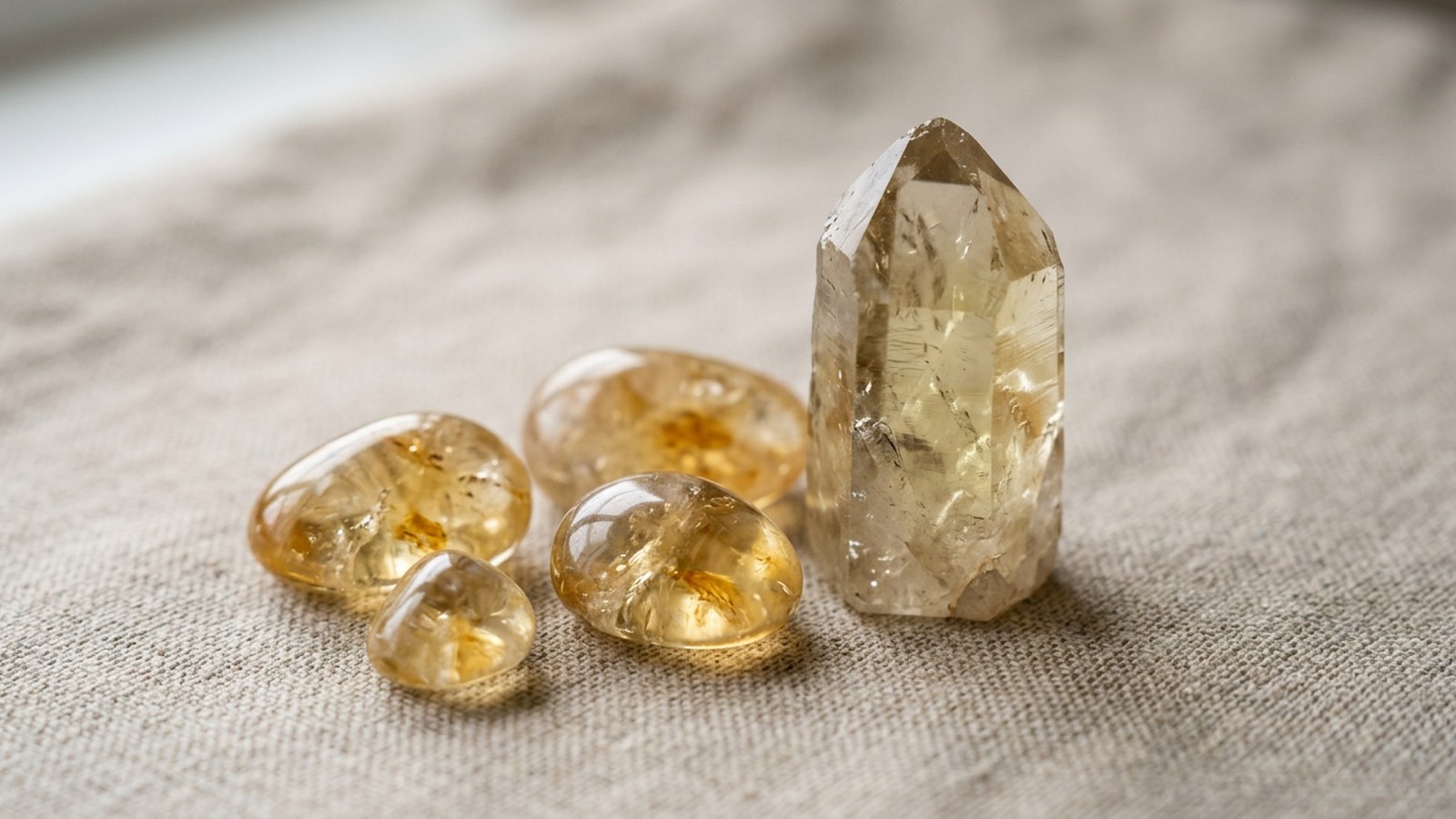
My grandmother had a brooch she always called her topaz. It was a large, honey coloured oval in a gold claw setting, and she wore it every November because that was her birth month. Years later I put it on a scale at a gem fair, out of curiosity more than suspicion, and the numbers said quartz. Her topaz was a citrine, and a lovely one, sold to her grandmother under a name that jewellers used for both stones for more than a century.
That story is the heart of the citrine vs topaz question. The two stones can look almost identical once they are cut, they share November as a birth month, and the word topaz itself has been stretched to cover yellow quartz for a long time. This guide covers what each stone actually is, the tests that separate them at home and at a jeweller's bench, the treatments behind most of what you will see for sale, prices, care, what crystal tradition says about each, and which one I would choose for different people.
Citrine vs topaz: the short answer
Citrine is a yellow to orange variety of quartz, silicon dioxide, coloured by traces of iron. Topaz is a separate mineral, an aluminium silicate containing fluorine, that comes in yellow, golden, orange, pink, brown, blue and colourless forms. Topaz is harder at 8 on the Mohs scale against 7 for citrine, noticeably heavier for its size, and splits along one perfect cleavage plane. Citrine has no cleavage, costs less, and is the more forgiving stone for daily knocks.
| Citrine | Topaz | |
|---|---|---|
| Mineral | Quartz, SiO2 | Topaz, Al2SiO4(F,OH)2 |
| Crystal system | Trigonal | Orthorhombic |
| Hardness (Mohs) | 7 | 8 |
| Cleavage | None, breaks with a shell-like fracture | Perfect, in one direction |
| Specific gravity | About 2.65 | About 3.5 to 3.6 |
| Refractive index | 1.544 to 1.553 | About 1.61 to 1.64 |
| Usual treatment | Heated amethyst or smoky quartz | Blue is irradiated, pink often heated |
| Price range | Low to moderate | Moderate, very high for imperial |
| Tradition | Optimism, abundance, warmth | Clarity, intention, steady confidence |
If you only remember one thing, remember the weight. Two stones of the same size and cut will feel different in the palm, and topaz is the heavy one.
What each stone actually is
Citrine belongs to the quartz family, the same mineral as amethyst, smoky quartz and rock crystal. Its colour comes from iron held in the crystal lattice, and it ranges from pale lemon through golden honey to a deep, reddish orange that the trade sometimes calls Madeira. Natural citrine forms in the same kind of pegmatite and vein settings as other quartz, and the largest sources of material today are Brazil, Bolivia, Madagascar and parts of Africa. Its name comes from the French citron, for lemon. You can read more about the stone itself in my citrine meaning guide.
Topaz grows mostly in granite pegmatites and in cavities in rhyolite, where fluorine rich fluids were present as the rock cooled. Its colour has several causes: chromium gives the pinks and the warm orange of imperial topaz, while yellows, browns and blues come from small defects in the crystal called colour centres. Brazil is the best known source, with the Ouro Preto district of Minas Gerais producing the sherry and imperial golden orange material that collectors value most. Pakistan, Russia, Sri Lanka, Nigeria and the United States also produce topaz.
So the two stones are unrelated minerals that happen to overlap in one part of the colour range. Everything else in this guide follows from that.
How topaz became a name for yellow quartz
The word topaz has wandered a long way. Pliny the Elder described topazos as a green stone from an island in the Red Sea of the same name, usually identified today with Zabargad, which is famous for peridot. For much of the medieval period, topaz was used loosely for almost any yellow gem.
When large amounts of yellow quartz began reaching European markets, sellers borrowed the more prestigious name. Citrine was sold as Madeira topaz, Spanish topaz, gold topaz, Bahia topaz and simply quartz topaz, and smoky quartz became smoky topaz. Gemmological bodies now treat these names as misleading, because they suggest a mineral the buyer is not getting, but they still turn up in antique shops, inherited jewellery and some online listings.
This is also why the November birthstone list holds two stones. Topaz has been on the American list since 1912, and citrine was added later as an accessible alternative. If you were given a November topaz before the middle of the twentieth century, there is a fair chance it was citrine, and that is worth knowing before you insure it or sell it.
How to tell citrine from topaz
Once a stone is faceted, colour alone will not separate these two. The checks below run from the gentlest home test to the ones a jeweller does in a few minutes.
1. Feel the heft
Topaz has a specific gravity of about 3.5, and citrine sits close to 2.65. That means a topaz is roughly a third heavier than a citrine of the same size. Hold two similar stones, one in each palm, and the topaz usually feels dense in a way you notice without trying. It is a rough guide, since cut and depth change the weight, but it is the test that first made me doubt my grandmother's brooch.
2. Measure the density properly
For a loose stone you can confirm the heft with a kitchen scale that reads to 0.01 g. Weigh the stone in air. Then suspend it on a fine thread in a small cup of water placed on the scale, without letting it touch the sides or bottom, and note how much the reading rises. Divide the weight in air by that rise. A result near 2.65 points to citrine, and a result near 3.5 points to topaz. Very small stones push the error up, so treat anything under two carats with caution. This does not work for set stones.
3. Look for flat internal breaks
Topaz has perfect cleavage in one direction, so cracks inside it tend to run as flat, shiny planes parallel to the base of the crystal. Citrine has no cleavage and breaks with a curved, shell-like fracture. With a 10x loupe, flat mirror-like internal feathers favour topaz, and curved chips on a girdle edge favour citrine. Many clean stones show neither, so this test only helps when it shows something.
4. Ask for a refractometer reading
A jeweller with a refractometer can settle the question in a minute. Citrine reads about 1.544 to 1.553, topaz about 1.61 to 1.64, and the ranges do not overlap. A dichroscope can add a second clue, because many imperial and pink topaz stones show two distinctly different colours from different angles, while citrine shows very little of this. For anything valuable or inherited, this is the step I recommend over all the others.
5. Skip the scratch test
Topaz is harder, so it is tempting to scratch one stone with the other. Please do not. You learn very little, you can chip a facet edge, and on topaz you risk starting a cleavage crack that runs through the stone. My general guide to telling whether a crystal is real explains why I avoid destructive tests on anything I care about.
Treatments behind most of what you buy
Most citrine on the market began as amethyst or smoky quartz. Heating amethyst to several hundred degrees turns it yellow to orange, and the result is stable and sold openly in good shops. The tell is often a reddish orange tone, and in the clusters and geode pieces with white bases, colour that is strongest at the crystal tips, because the amethyst was most saturated there. Natural, unheated citrine tends to be paler and slightly smoky, and it costs more. I wrote more about this family link in my guide to amethyst and citrine together.
Topaz is treated too. Nearly all blue topaz, including the shades sold as sky, Swiss and London blue, starts as colourless topaz that is irradiated and then heated. Pink topaz is often heated imperial material, and some topaz carries a thin surface coating to create rainbow effects, which wears off with use. Both minerals are also grown in laboratories. These treatments are accepted in the trade as long as the seller discloses them, so ask about treatment whenever you buy.
Which costs more, and how rare is golden topaz?
Citrine is one of the most affordable transparent gems in this colour, and fine heated material in good sizes is still reasonably priced. Natural, unheated citrine with good colour costs more but remains accessible.
Topaz pricing depends heavily on colour. Treated blue topaz is inexpensive because colourless rough is plentiful. Golden and sherry topaz is less common, and fine imperial topaz, with its warm orange touched by pink, is genuinely rare and can cost many times more per carat than citrine, especially above a few carats. So when someone asks how rare golden topaz is, the honest answer is that ordinary yellow topaz is available but uncommon, and the top imperial colours from Ouro Preto are a collector's stone.
Energy and tradition
In crystal tradition both stones are tied to the solar plexus chakra, the centre linked with will, confidence and personal warmth, and both are associated with the signs of November, Scorpio and Sagittarius. What follows is traditional and intuitive association, and it is no substitute for medical, psychological or financial advice.
Citrine is the cheerful one. Practitioners call it a merchant's stone and reach for it for optimism, motivation and abundance. I keep a piece on my desk on weeks when I need to start things, and it pairs well with pyrite, as I describe in citrine and pyrite. You may read that citrine never needs cleansing. I cleanse mine anyway, because the habit is good for me.
Golden topaz carries an older and more sober reputation. Medieval lapidaries said it cooled anger and steadied the mind, and Hildegard of Bingen recommended it for dim eyesight. Modern practitioners link it to clear intention and calm self-assurance, a confidence that stays level, and they often suggest it for goal setting and for keeping promises to yourself.
One of the most common questions is who should not wear citrine. The question comes from Vedic astrology, where citrine and yellow topaz are both sold as substitutes for yellow sapphire, the stone of Jupiter. Some Jyotish practitioners advise against them for certain ascendants. I am not trained in that system, so if it matters to you, ask a qualified astrologer. Outside that tradition there is no rule against anyone wearing either stone.
Caring for each stone
Citrine is easy to live with. Warm water, a drop of mild soap and a soft brush are all it needs, and it handles everyday knocks well because it has no cleavage. Long hours in strong direct sun can slowly pale some natural citrine, so I avoid sunny windowsills and use the gentler methods in my guide to charging crystals.
Topaz is harder and resists scratching better, but a sharp knock on the cleavage plane can split it. Hardness measures resistance to scratching, and resistance to knocks depends on other properties such as cleavage, which I also explain in moonstone vs opal. Clean topaz with warm soapy water, keep it away from ultrasonic cleaners, steam and sudden temperature changes, and choose protective settings for rings. Some brown and sherry topaz fades in sunlight, so store it in the dark. Both stones are fine with the water based methods in my cleansing guide.
Which one should you choose?
Choose citrine if you want a warm yellow or orange stone for daily wear, a larger stone on a modest budget, or a crystal for desk work and new projects. It is also the gentler choice for a first November birthstone gift, since it forgives the knocks that rings and bracelets take. My crystals for money and abundance guide shows where it fits among other stones.
Choose topaz if you want maximum sparkle and scratch resistance in earrings or a pendant, if you love colours citrine cannot offer such as imperial orange, pink or blue, or if you are buying an heirloom piece to keep. Pay for a lab report on anything sold as imperial.
And if you have a family stone labelled topaz, weigh it or take it to a jeweller before you assume either answer. Mine turned out to be citrine, and I love it no less. You can see both stones together on the November birthstone page.