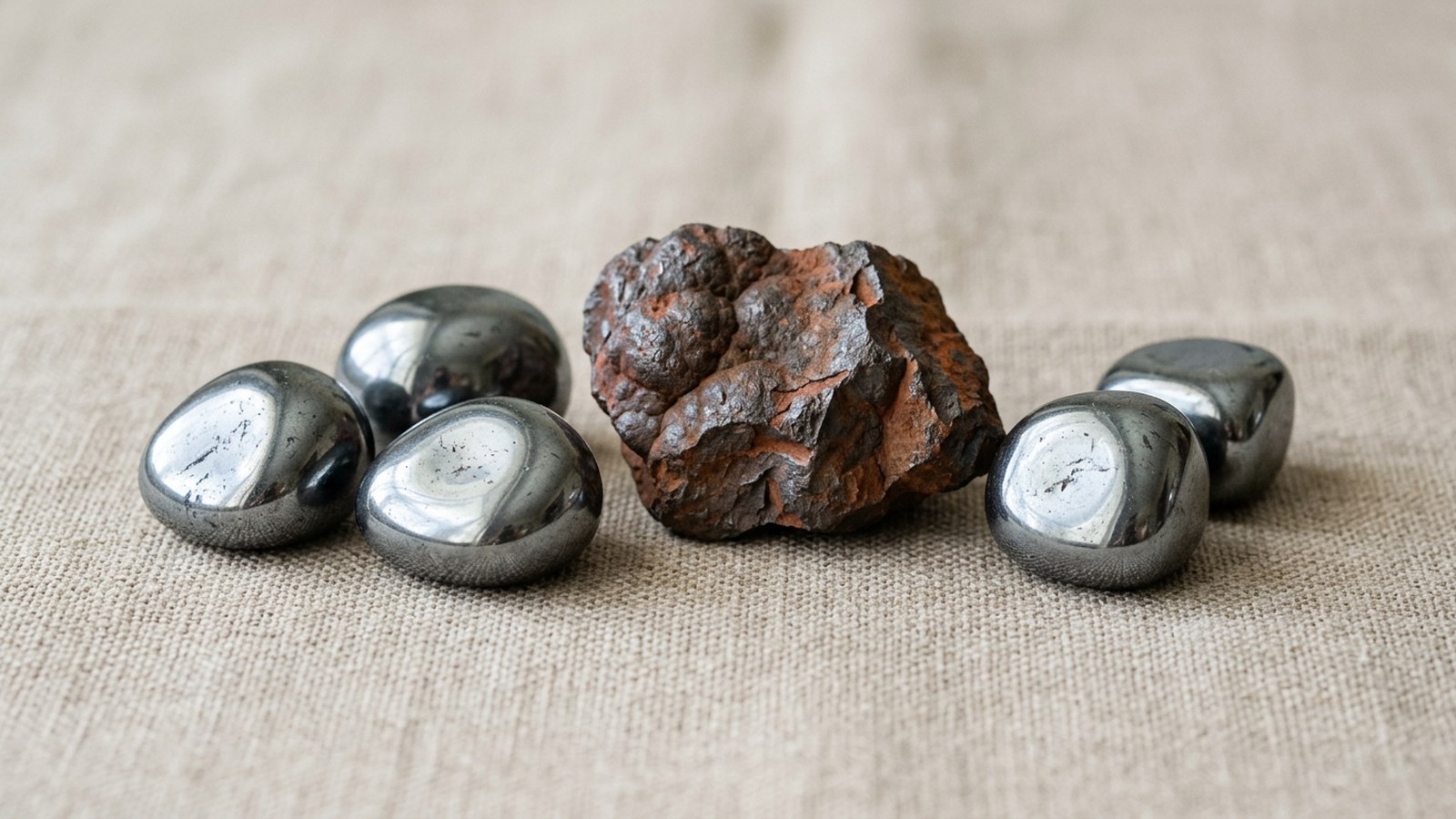
There is a particular feeling I have learned to recognise in myself. My thoughts run a few seconds ahead of my body, I forget why I walked into a room, and my feet seem to belong to somebody else. It usually arrives after a long day of screens, a crowded event, a hard conversation or a deep meditation. The first thing I reach for in those moments is a heavy, dark stone, and over the years I have learned that the right one depends on what kind of scattered I am.
This guide covers what grounding means in crystal practice, why the stones people choose for it tend to be dark and dense, which stone I use for which situation, a simple practice you can do in three minutes, and the care details that most lists leave out.
What are grounding crystals? The short answer
Grounding crystals are stones used to bring your attention back into your body and the present moment when you feel spacey, overwhelmed or disconnected. In crystal tradition they are linked to the root chakra and the earth element. The stones most often used are hematite, black tourmaline, smoky quartz, red jasper, obsidian, garnet and bloodstone. Most are dark, earthy in colour and noticeably heavy in the hand, and that weight is a large part of how they work.
You can see every stone on the site connected to this intention on the grounding page.
What grounding means here, and how it differs from earthing
The word grounding gets used for two different practices, and several popular guides mix them together, so it is worth separating them before choosing a stone.
Earthing is the practice of putting bare skin in contact with the ground, or using conductive mats and sheets wired to an electrical ground. Its supporters say that electrons from the earth reduce inflammation and improve sleep. The research behind those claims is small and early, mostly short pilot studies, and it concerns electrical contact with the soil. A crystal sitting in your palm does not conduct anything to the earth, so the earthing studies say nothing about stones either way.
Grounding in crystal practice, and in the wider wellbeing world, means something closer to what therapists mean by the word: returning your attention to your body, your senses and the place you are standing in. Therapists teach grounding techniques for panic and dissociation, and many of them use simple physical anchors, such as naming five things you can see, pressing your feet into the floor or holding something cool and solid. A grounding stone fits naturally into that family of techniques. It gives your hand a weight, a temperature and a texture to attend to, and the tradition around it gives you a small ritual to follow. I find that combination genuinely useful, and I present the energetic meanings below as what they are, a long tradition and my own experience, with no claim that the stone changes anything in your nervous system on its own.
Why grounding stones are dark and heavy
When I lay the classic grounding stones out on a table, two things stand out. They are dark or earth coloured, which matches the root chakra and earth element symbolism, and many of them are dense. Specific gravity measures how heavy a mineral is compared with the same volume of water, and it is the reason a tumbled hematite feels almost twice as heavy as a quartz stone of the same size.
| Stone | Mohs hardness | Specific gravity | Water | Best situation |
|---|---|---|---|---|
| Hematite | 5.5 to 6.5 | about 5.3 | Brief rinse only | Spacey, floaty |
| Pyrite | 6 to 6.5 | about 5.0 | Keep dry | Drained, low drive |
| Garnet (almandine) | 6.5 to 7.5 | 3.9 to 4.3 | Fine | Running on empty |
| Black tourmaline | 7 to 7.5 | about 3.1 | Fine | Overstimulated |
| Smoky quartz | 7 | 2.65 | Fine | Overthinking |
| Red jasper | 6.5 to 7 | about 2.6 | Fine | Tired body |
| Bloodstone | 6.5 to 7 | about 2.6 | Fine | Upheaval |
| Obsidian | 5 to 5.5 | about 2.4 | Fine | Facing something |
If you want the strongest physical sense of weight, hematite, pyrite and garnet lead the table. If you want something you can carry every day without worrying about chips, the quartz family stones at hardness 7 are the easiest to live with. Water notes follow the guidance in my crystals and water safety guide.
Grounding crystals by the kind of scattered you feel
Being ungrounded shows up differently from one day to the next, so I sort my grounding stones by situation. Choose the description that sounds most like you right now, and start with one stone.
When you feel spacey after meditation or breathwork: hematite
Long meditation, breathwork and energy work can leave me light headed and vague, as if I have not fully come back into the room. Hematite is the stone I hand to anyone in that state. It is iron oxide, the same mineral that gives red soil and red jasper their colour, and polished it has a cool, silvery metallic surface and a weight that surprises people the first time they pick it up. In crystal tradition it is the anchor stone of the root chakra. I hold one in each palm for a minute after a session and press my thumbs into it.
One honest note: the shiny strongly magnetic beads sold as "magnetic hematite" or "hematine" are usually manufactured ferrite, a synthetic material. Natural hematite is only very weakly magnetic, so if your bracelet clings to the fridge, it is the synthetic version. My guide on how to tell if a crystal is real covers the streak test that settles it, since real hematite leaves a reddish brown streak on unglazed porcelain.
Hematite suits people who like a strong, immediate sensation. If you find it too heavy or cold, smoky quartz is the gentler choice.
When you feel overstimulated by crowds, noise or screens: black tourmaline
After a busy market, an open plan office or a long stretch of video calls, I feel full of other people's energy and noise. Black tourmaline is the stone tradition gives for this, because it combines grounding with protection, and it is a favourite on both the protection and grounding lists. Mineralogically it is schorl, a hard and fairly tough striated crystal, which makes it practical in a pocket or at the base of a computer screen. I keep a raw piece by my front door and touch it when I come home, as a small signal that the outside part of the day is over.
It suits sensitive people and anyone who works with the public. It feels a little austere to some, and they often prefer red jasper.
When your mind keeps racing ahead: smoky quartz
Some days the problem is my thinking: rehearsing tomorrow, replaying yesterday, planning a conversation that may never happen. Smoky quartz is my stone for that. Its brown to grey colour comes from natural radiation acting on traces of aluminium in quartz over long periods, and in crystal tradition it is said to soften heavy thoughts and bring you back to what is in front of you. It is the gentlest stone on this list, which is why I recommend it to beginners and to anyone with anxiety who finds hematite too intense.
Be aware that a lot of very dark, almost black smoky quartz on the market is clear quartz that has been artificially irradiated. It is safe, and I simply prefer to know what I am buying. Smoky quartz also pairs beautifully with black tourmaline, as I explain in my guide to black tourmaline and smoky quartz together.
When your body feels drained and far away: red jasper and garnet
Tiredness can be its own kind of ungrounded, where you feel dim and slightly detached from your own limbs. For this I use warmer stones. Red jasper is microcrystalline quartz coloured by iron oxide, opaque, smooth and steady, and tradition links it to stamina and a slow, patient kind of strength. Garnet, usually the deep red almandine variety in tumbled form, is dense and warm in colour and is associated with vitality and the body. Pyrite belongs in this family too, for days when you need a little more drive, though it needs to stay dry.
These stones suit people who feel flat more than anxious. If you are already wired and restless, they can feel like too much, and smoky quartz is the better fit.
When life is moving under your feet: bloodstone and moss agate
A house move, a new job, a separation, a bereavement: during big changes I feel ungrounded for weeks, in a quieter and more persistent way. Bloodstone is green chalcedony with red spots of jasper or iron oxide, and it carries a long tradition as a stone of courage and steadiness through difficult times. Moss agate, with its green dendritic inclusions that look like plants growing through clear stone, is linked to nature, patience and new roots. I keep one of them in a coat pocket for the whole length of the transition.
When you need to face something you have been avoiding: obsidian, with care
Obsidian is volcanic glass, and in crystal tradition it is a grounding stone with a strong reputation for honesty and shadow work. I use it for the specific kind of ungrounded that comes from avoiding something, when the floatiness is partly a way of not looking at a problem. I treat it as a stone for short, intentional sessions, followed by a walk or a cup of tea, and I suggest beginners start elsewhere. Obsidian breaks with sharp, curved fractures, so a chipped piece can cut, and it is softer than quartz.
Onyx and tiger's eye also appear on many grounding lists. I use onyx for steadiness under pressure and tiger's eye when grounding needs to come with focus, though for me they sit closer to balance than to grounding, which I cover in crystals for balance.
A three minute grounding practice with a stone
This is the practice I use most, and the one I teach to friends.
- Choose one stone from the situations above. Hold it in your non dominant hand, or one in each hand if you have two.
- Sit or stand with both feet flat on the floor. Notice the floor under your heels.
- Feel the stone's weight and temperature. Note silently how heavy it is, whether it is cool or warm, and where it is smooth or rough.
- Breathe out slowly, a little longer than you breathe in, for six to eight breaths.
- Look around and name five things you can see, then three things you can hear.
- Set an intention in one plain sentence, for example "I am here, in this room, and I can take the next step."
- Put the stone somewhere you will see it, or in your pocket, and carry on with your day.
If you meditate regularly, you can place a grounding stone at your feet or at the base of your spine during the session, as I describe in my guide to meditating with crystals. Coming back from a deep session, I always end with steps 2 and 3.
Where to place grounding crystals
For daily wear, a hematite or smoky quartz bracelet, or a tumbled stone in a trouser pocket near the hip, keeps the stone close to the root chakra area that tradition associates with grounding. At home I keep black tourmaline by the entrance, a smoky quartz point on my desk, and a piece of hematite or red jasper under the bed or on the bedside table for evenings when I cannot settle. My guide to where to place crystals in your home goes into room by room detail, and the chakra crystals guide shows how root stones fit with the rest of the body.
Care details most lists leave out
Grounding stones are mostly tough, but a few need specific care. Pyrite slowly oxidises in damp air and can develop a white or yellow powder over time, so keep it dry and away from bathrooms. Hematite tolerates a quick rinse, but left soaking it can leave rust coloured stains, so dry it straight away. Obsidian and hematite are both softer than quartz, so keep them apart from quartz beads and points in a bag. For energetic cleansing, sound, smoke and moonlight suit every stone on this list, and my cleansing guide explains the options.
When a stone is not enough
A grounding stone is a gentle support for ordinary scattered days. If you feel detached from your body or surroundings often, for long periods, or after a frightening experience, please speak to a doctor or a mental health professional, because persistent dissociation deserves proper care. In the United States you can call or text 988 at any time if you are in crisis. Stones can sit alongside that help as a small comfort, and that is the place I give them in my own life.
For most of us, most of the time, a heavy stone in the hand, a few slow breaths and the floor under our feet are enough to come back into the day.