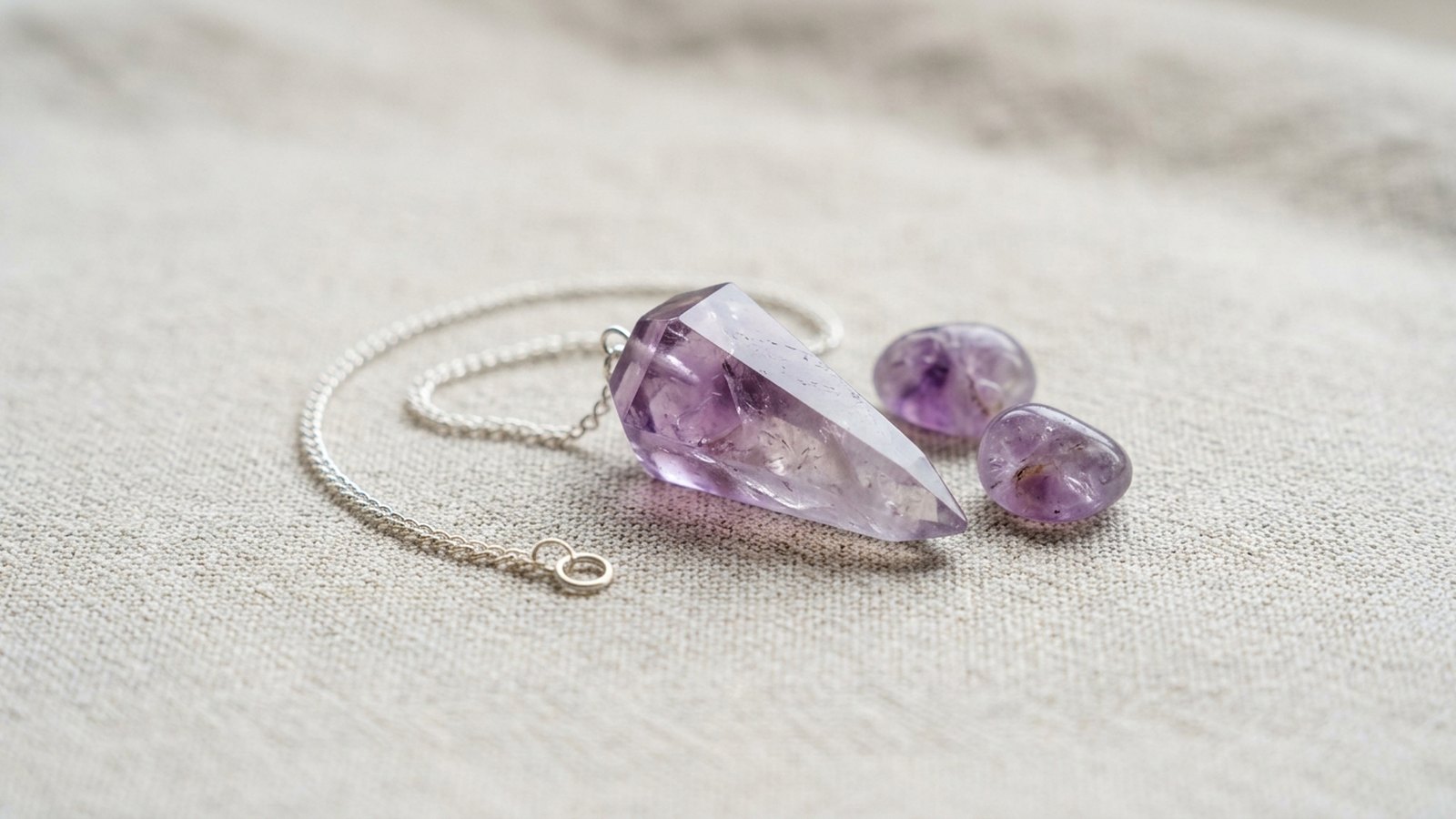
The pendulum is usually the first tool people own that they feel silly holding. A stone on a chain arrives as a gift, or comes home from a shop because it caught the light, and then it sits on the table for a week while you wonder whether you are supposed to believe something in particular before you pick it up.
You are not. Here is the short version, and then the long one.
A pendulum is a small weight, most often a pointed crystal, hanging from a short chain, which you hold still and let swing in answer to a yes or no question. To use one: cleanse it, agree with it on which movement means yes and which means no, test it on a few questions you already know the answers to, then ask one clear question at a time, stopping the swing between each.
That is the method, and most guides stop there. This one also tells you why the pendulum moves, because the honest answer turns out to be the instruction manual. Once you understand what is actually driving the swing, every rule below stops being superstition and becomes technique.
What a pendulum actually is
Physically, it is nothing much: a weight, a chain of six to nine inches, and a bead or ring at the top to hold. The weight can be wood, brass, glass or stone. Crystal pendulums are the most common in this corner of practice, usually a faceted point drilled at the blunt end and hung from an eye pin.
The shape is not decorative. A point gives the eye something unambiguous to track, which matters more than it sounds. If you have read our guide to crystal shapes and their meanings, the pendulum point is the same logic as a wand: the stone is given a direction.
Why it moves, and why that is good news
In 1833 the French chemist Michel Eugène Chevreul published an open letter to the physicist André-Marie Ampère about exactly this object. Chevreul was a serious scientist, the man who worked out the chemistry of fats and later ran the dye works at the Gobelins, and he had noticed that a hand-held pendulum swung over certain materials and not others. Rather than accept the popular explanation, he ran the experiment on himself.
He found two things. When his arm was supported externally instead of held up by his own muscles, the swing shrank. And when he could not see the pendulum, it died away. The oscillation depended on his sight and on his own muscular support, which meant the source of the movement was not the table, the water or the metal underneath. It was him.
Roughly twenty years later the physiologist William Benjamin Carpenter gave the phenomenon a name that is still used: the ideomotor response, the way an idea held in the mind produces real muscular movement without any sense of having chosen it. Modern work on what researchers still call the Chevreul pendulum has filled in the mechanism. A pendulum has a natural swing rate, and the tiny involuntary tremor in your fingers, far too small to feel, only has to match that rate to build a large, smooth, apparently self-driven swing. This is resonance, the same reason a child on a swing goes higher from small pushes given at the right moment.
I want to be careful about what this does and does not mean. It does not mean you are faking. You genuinely cannot feel the movement you are making, and telling yourself to stop will not stop it. What it means is that a pendulum is an amplifier for something already happening in you: a hesitation, a preference, a piece of knowledge your body has and your talking mind has not admitted yet. Some traditions read that source as spirit, or as a higher self, and I am not going to rule on it. My own honest reading, after years of using one, is more modest and more useful. The pendulum is a mirror with a magnifying glass in front of it.
Keep that in mind, because everything below follows from it.
Choosing a pendulum
Chain length matters more than the stone
The People Also Ask box for this topic asks about the four laws of the pendulum, which is a physics question that has drifted into a divination search. It is worth answering, because two of the four are practical.
The laws describe a simple pendulum. The law of isochronism, which Galileo is traditionally said to have noticed watching a swinging lamp, says that for small swings the time of a swing does not depend on how wide it is. The law of length says the swing time depends on the square root of the length. The law of mass says it does not depend on the weight of the bob at all. The law of gravity says it changes with local gravity, which for our purposes never changes.
The useful consequences: a chain of six to nine inches gives a full swing of roughly eight tenths of a second to a second, which happens to sit comfortably within the range your hand tremor can drive. Much longer and it becomes slow and vague, much shorter and it goes jittery. And because of the law of mass, a heavy stone does not swing differently from a light one. So the choice of crystal is not a mechanical decision. It is about meaning, and about what feels good between your fingers.
| Stone | Traditionally reached for | Practical note |
|---|---|---|
| Clear quartz | A neutral, all-purpose first pendulum | Mohs 7, hard-wearing, the one I recommend to beginners |
| Amethyst | Calm, intuition, quieting the noise | Mohs 7, but the colour fades in strong sun |
| Rose quartz | Questions about relationships and self-worth | Mohs 7, often slightly heavier and slower |
| Sodalite | Clear thinking, honesty with yourself | Mohs 5.5 to 6, softer, keep it off hard tables |
| Smoky quartz | Grounding, steadying an anxious hand | Mohs 7, also fades in prolonged sunlight |
| Labradorite | Intuitive work, seeing what is hidden | Mohs 6 to 6.5, cleaves, chips more easily than quartz |
| Black tourmaline | Boundaries, working when you feel scattered | Mohs 7 to 7.5, but naturally striated and prone to snapping along those lines |
The stone pages for clear quartz, amethyst and smoky quartz carry their full profiles if you want them. And if you own none of these, a brass or wooden pendulum works exactly as well. The physics is indifferent. Our building your first set guide covers the wider question of what is actually worth buying first.
Cleanse it, then settle yourself
A new pendulum has been handled, boxed and shipped, and cleansing it is less about removing anything sinister than about marking a beginning. Use a dry method: smoke, sound, a night in moonlight, or a few hours resting on a quartz cluster. Our guide to cleansing crystals covers each one properly, and how to charge your crystals covers what comes after.
Do not use salt or a long soak. I will come back to why in the care section, but one of the guides currently ranking for this search recommends sea salt and cold water without naming a single stone it would damage.
People often ask what you are supposed to say before you use a pendulum. There is no required formula, and anyone who tells you there is a wrong one is adding a rule that does not exist. What helps is a plain statement of what you are here for, said out loud or silently: something like "I am asking about my own decision, and I want a clear answer." If you like a more formal approach, programming an intention walks through it. A minute of slow breathing does more for accuracy than any words, because a tense arm gives a poor swing.
How to use a pendulum, step by step
- Sit at a table. Both feet on the floor, back supported. This is not ceremony. A steady body gives a steady reading.
- Rest your elbow on the table. Chevreul's own finding was that an unsupported arm makes a bigger, wilder swing. Supporting your elbow is how you keep it honest.
- Hold the chain between your thumb and index finger of whichever hand feels natural, most people use the dominant one, with the stone hanging six to nine inches below and clear of the table.
- Steady the stone with your other hand, then let go and wait until it hangs still.
- Ask for your yes. Say "show me yes" and wait. Do not help it. Somewhere between ten seconds and a minute a movement will build: often a straight line away from and towards you, or a clockwise circle. Note it.
- Ask for your no, then for "I don't know" or "I won't answer that". You want three distinct signals, and the third one matters most. A pendulum with no way of declining a question will answer everything, including the questions it should not.
- Reset between questions by touching the stone to your other palm or the table to stop it. Momentum from the last answer is the single most common way people fool themselves.
Your signals are yours. Mine are not the same as my mother's. If yours change over months, recalibrate rather than forcing the old pattern.
The test almost no guide will offer you
Here is something the pendulum pages I read while researching this guide do not do, and I think it is the most respectful thing you can do with a new tool: test it on questions where you cannot cheat.
Ask a friend to hide a coin under one of two identical cups while you are out of the room. Come back, hold the pendulum over each cup, and ask "is the coin under this one?" Record your answer, then look. Do this twenty times.
Now the honest part. Most people, most of the time, land near chance. That is the expected result, and it is not a failure of your practice or of the stone. It tells you what kind of instrument you are holding. A pendulum is very good at surfacing what some part of you already knows, and poor at retrieving information you have no access to at all. Which is precisely why the questions in the next section are the ones worth asking, and why the coin under the cup is not.
If your results are startlingly good, keep the record. Genuinely. But run it again with someone else placing the coin.
How to ask a question worth asking
- One thing at a time. "Should I take the job and move city" is two questions wearing one coat.
- Ask about you. Your feelings, your readiness, your reluctance. A pendulum held over another person's private life is guessing, and you already know that.
- Prefer "am I" and "do I" to "should I". "Should I leave" asks for a verdict. "Am I already sure I want to leave" asks for the thing you are avoiding, and that is where this tool is strongest.
- Write the question down first. Reading it aloud from paper keeps you from quietly rewording it after an answer you did not like.
- Notice your reaction, not just the swing. The flinch when it answers is data. Often it is the real answer.
- Never ask it anything medical. Not a diagnosis, not whether to take a medication, not about someone else's health. I mean this plainly. That is a doctor's question, and a pendulum is a mirror, and mirrors are not qualified.
If a question keeps returning muddled answers, the question is usually the problem. Sitting with it in meditation tends to be more productive than asking a fourth time.
When it will not move, or spins wildly
Nothing is wrong with you or the stone. In my experience, a dead pendulum usually means cold hands, a tense arm, or a question you do not actually want answered yet. Warm your hands, drop your shoulders, support your elbow properly and try a question you know the answer to in order to get the movement going again.
A wild, wobbling swing is often the opposite, an arm held up in mid-air with nothing to steady it, or a question loaded with so much hope that your hand is arguing with itself. Put the pendulum down and come back tomorrow. That is a legitimate answer too.
What not to do to a drilled stone on a chain
This is the part that goes missing from almost every pendulum guide I have read, and it matters, because a pendulum is a crystal with a hole in it swinging over a hard surface.
The drilled seat, the eye pin and the glue holding them together are the weak point, not the stone. Catch your pendulum in your palm rather than letting it clatter onto a table, and store it hanging or in a soft pouch rather than loose in a bag where the chain can wrap and torque the pin.
On cleansing, be specific about the material. Selenite is gypsum at Mohs 2, soft enough to mark with a fingernail, and it will dissolve in water, so a selenite pendulum should never be rinsed. Hematite is iron oxide and rusts. Malachite is soft and copper-bearing. Sodalite and labradorite are softer than quartz and chip on impact. Salt water is bad for nearly all of them, and it also creeps into the drill hole and dries there. Our guide to which crystals can and cannot go in water has the full list.
And leave sunlight out of it. A sunny windowsill is the most repeated charging advice on the internet, and it will slowly bleach the colour out of an amethyst or smoky quartz pendulum, permanently. Moonlight is a safer habit, and the full moon ritual guide gives it a shape if you want one.
Boards, chakras and spirits
Three questions come up often enough to answer briefly. A pendulum board is a printed dial of options, letters or numbers, and it does not change the method: it changes the resolution, letting the same ideomotor swing pick from many answers rather than two. It also, in my view, makes the mirror effect stronger, not weaker.
Holding a pendulum over the body to read the chakras is a long-standing practice. Treat what it shows you as a prompt to pay attention to a part of yourself, in the same spirit as the rest of crystal healing, never as an examination.
As for contacting spirits, that is a matter of belief and I hold mine loosely. What I will say is that if a session starts to frighten you, stop, put the pendulum away and do something ordinary. Nothing here obliges you to keep going.
What I will not promise you
I will not tell you a pendulum predicts the future, finds the truth about other people, or knows anything your own nervous system does not. I will not tell you the stone matters more than the question. And I will not tell you a pendulum can help with a diagnosis, a legal decision or a crisis. Those need people, not stones.
What I will tell you is that a well-used pendulum is a remarkably good way of catching yourself in the act of already knowing. Use it a few minutes at a time, a few times a week, with better questions than you think you need. Keep it clean, keep it dry, and if you want to go further into everyday practice, how to use crystals and carrying and wearing stones are the natural next steps.