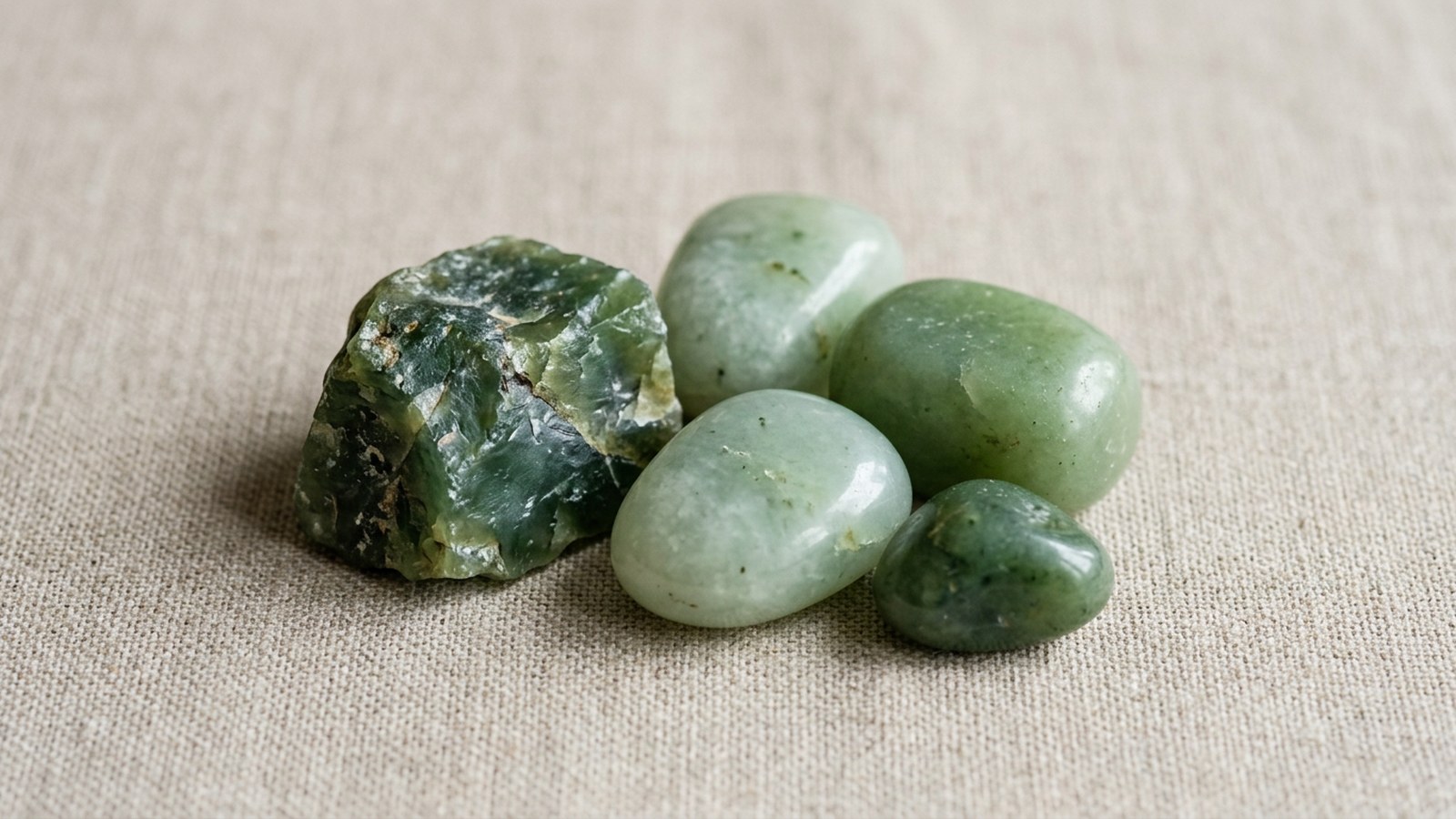
Last spring a reader sent me a photograph of a bracelet she had worn almost every day for three years. It alternated pale green jade beads with sky blue turquoise ones, and she had chosen it because the two colours together reminded her of a lake under a clear sky. Her question was simple: why did the jade still look new while the turquoise beads had gone dull, slightly greener and faintly scuffed where they touched their neighbours? The answer says a lot about this pair. Jade and turquoise have been set side by side for thousands of years, on two continents, and they suit each other in colour and in tradition. They are also very different materials, and one of them quietly wears down the other if you string them carelessly.
This guide explains what each stone really is, why cultures as far apart as the Aztecs and the early Chinese courts treasured both, what the pairing is traditionally said to bring, how to wear and place the two together, the one care routine that protects the softer stone, and the imitations you meet on both sides.
Jade and turquoise: the short answer
Jade and turquoise are two unrelated stones. Jade is the name for two silicate rocks, nephrite and jadeite, prized for their toughness and waxy glow. Turquoise is a soft, porous copper and aluminium phosphate in sky blue to green. They pair well because their colours sit next to each other on the blue-green scale and because jade is linked with harmony, the heart and slow prosperity in crystal tradition, while turquoise is linked with protection, luck and clear speech. They can be worn together safely as long as the harder jade does not rub against the turquoise and the turquoise is kept away from oils, perfume and chemicals.
Two stones, side by side
Before talking about meaning, it helps to know what you are holding. The jade on your bracelet is one of two minerals that shared a name until 1863, when the French chemist Alexis Damour showed that the jade carved in China for millennia (nephrite, an amphibole) and the bright green stone arriving from Burma (jadeite, a pyroxene) were different rocks. Both are made of tightly interlocked crystals, which makes them extraordinarily tough. Turquoise forms near the surface, where water seeping through copper-bearing rock deposits fine grains of a hydrated phosphate in veins and nodules. That shallow, damp origin is why it is porous and comparatively soft.
| Jade | Turquoise | |
|---|---|---|
| What it is | Nephrite (amphibole) or jadeite (pyroxene) | Hydrated copper aluminium phosphate |
| Hardness (Mohs) | 6 to 6.5 nephrite, 6.5 to 7 jadeite | 5 to 6 |
| Toughness | Exceptional | Modest, can chip |
| Specific gravity | About 2.95 nephrite, 3.33 jadeite | About 2.6 to 2.9 |
| Porosity | Very low | High, absorbs oils and dyes |
| Colour | Green, white, lavender, black, yellow | Sky blue to green, often with dark matrix |
| Traditional chakra | Heart | Throat |
| Common treatment | Bleaching, resin, dye (lower grades) | Stabilising with resin, dye |
If you want to go deeper on either stone's look-alikes, I have separate guides on aventurine vs jade, jade vs serpentine and chrysocolla vs turquoise.
Why cultures have paired them for thousands of years
The pairing is very old and predates modern crystal practice by thousands of years. In the Valley of Mexico, the Aztecs prized green stones above almost everything. A 1929 article from the Penn Museum on turquoise mosaics notes that jade was valued even above gold, and that turquoise came second. The Nahuatl word chalchihuitl covered precious green stones, jade first among them, and xihuitl meant turquoise, a word also tied to the year and to fire: the old fire god was Xiuhtecuhtli, the Turquoise Lord. The two stones appear together in masks, mosaics and ornaments because they belonged to one idea, the colours of water, young maize and the sky, which for that culture meant life and preciousness.
On the other side of the world, the story runs in parallel. The Chinese character yu, usually translated as jade, has long meant fine stone in a broad sense, and the classic Confucian line from the Book of Rites says that a gentleman compares his virtue to jade. Turquoise arrived in Chinese craft early as well: one of the most famous objects from the Erlitou site, dated to around 1700 BCE, is a dragon about seventy centimetres long built from some two thousand small turquoise pieces. Later, jade carvings set or inlaid with turquoise became a recurring decorative choice, and Hubei turquoise is still sometimes discussed by Chinese collectors among the country's fine stones.
Two traditions that never met reached the same pairing. I find that a good reason to take it seriously. Green and blue-green together read as something living and calm, and people kept putting these two stones side by side because the combination looks like water and growth.
What the pair is said to bring
Everything in this section belongs to crystal tradition and personal practice. It is how people have used these stones, and it is no substitute for medical, psychological or financial help.
Heart and throat. Jade is traditionally placed at the heart, turquoise at the throat. Worn together, the pair is said to support speaking from a settled place: saying what you need without sharpness, and listening without bracing. People who work in caring or teaching roles often tell me this is the reason they wear it.
Steady prosperity, protected. Jade has a long reputation as a stone of slow, cumulative good fortune, the kind that builds over years. Turquoise is an old travellers' and riders' talisman, carried for protection and luck on the road. Modern crystal writers combine the two into a pairing for abundance that is guarded rather than chased, and you will find both stones in my guides to stones for protection and calm.
Grounding with a lift. Both stones are associated with the earth element in many lists, which is why some readers find the pair quietly grounding. Turquoise adds the sky to it, and that is the balance most people describe when they say the bracelet simply feels right.
What it is not for. The pair is gentle. If you are looking for a sharp, energising combination for a deadline or a fresh start, other stones are a better fit. You will also read online that jade should never be combined with turquoise because each is too strong on its own. I have found no tradition behind that claim, in Chinese, Mesoamerican or modern Western practice, and the long history above points the other way.
How to wear and place jade and turquoise together
Jewellery. A single strand of alternating beads is the arrangement I would avoid, for the reason my reader discovered. Jade is harder than turquoise and very tough, so every movement grinds the turquoise slightly. Knot the beads individually, use small metal spacers between the two stones, or wear them in separate pieces: a jade bangle on one wrist and turquoise studs or a pendant on the throat, which also matches the chakra placement.
At home or at work. A jade palm stone and a turquoise tumble in a small dish near the door, or on the desk where you make calls, is a simple way to keep the pair in view. I like turquoise in the communication spot (by the phone, the laptop) and jade where money and plans live.
In meditation. Rest the jade on your chest and hold the turquoise loosely in one hand, or place it at the base of the throat if you are lying down. Five slow minutes, breathing towards the heart and letting the out-breath soften the throat, is enough.
Birthdays. Turquoise is one of the traditional December birthstones, which makes the pair a thoughtful gift for a December birthday when the person loves green.
One care routine, set by the turquoise
Look after the pair as if both stones were turquoise, and the jade will be fine.
- Put it on last, take it off first. Perfume, hand cream, sunscreen and hair spray soak into turquoise and slowly shift its colour towards green. This is my practical answer to the question of who should not wear turquoise: anyone who will not take it off for the pool, the gym or the dishes.
- No soaking. Wipe both stones with a soft, slightly damp cloth and dry them. Jade tolerates a quick rinse, turquoise prefers to stay dry.
- No ultrasonic, steam or heat. Stabilised turquoise and resin-filled jadeite (sold as type B) can both cloud, crack or yellow.
- No salt and no sun bath for cleansing. Use smoke, sound or a night under moonlight instead.
- Store them apart. A soft pouch for each, so the jade does not scratch the turquoise in a drawer.
Fakes on both sides, and how to check at home
Both stones are heavily imitated, so a mixed bracelet can hide two different problems.
Turquoise. Dyed howlite and magnesite are the classic stand-ins. Dyed stones often show colour pooled in cracks, and a cotton bud with a little acetone on a hidden spot may pick up dye. Many genuine turquoises are stabilised, which is normal and should be disclosed. "African turquoise" is a green-blue jasper, attractive in its own right and best bought under its real name.
Jade. "Malaysia jade" is dyed quartzite, "Mexican jade" is usually dyed calcite or marble, and "new jade" is serpentine. Lower-grade jadeite may be bleached and filled with resin (type B) or dyed (type C). For an expensive piece, ask in writing for untreated type A, as the old gemmologists' advice goes.
The weight check. Jadeite is heavy for its size, around 3.3, while turquoise, howlite and quartzite all sit near 2.6 to 2.7. Two beads of the same size, one in each palm, will often tell you which one is the jade before anything else does.
When in doubt about a valuable piece, a gem lab report costs less than a mistake. For more on turquoise's other classic partners, see my guides to lapis lazuli and turquoise, turquoise and coral and the larimar vs turquoise comparison.
My reader restrung her bracelet with tiny silver spacers, and she now takes it off before her evening hand cream. The turquoise will not return to its first blue, but it has stopped changing, and the pair looks the way she remembered it: a green lake under a blue sky, two stones that have kept each other company for a very long time.