A reader once sent me two photos of the same ring, taken in different light, and asked whether the stone was larimar or turquoise. The seller had called it "Caribbean turquoise", which is not a real stone name, and the photos could have supported either answer. When the ring arrived at my table, the question took about ten seconds: the white lines ran in soft, branching waves through a pale sea blue, and the edge glowed slightly when I put a torch behind it. It was larimar, and a good one.
Larimar and turquoise are both soft, opaque-looking blue stones, both popular in silver jewellery, and both linked to the throat in crystal tradition, so the confusion is understandable. This guide covers how to tell larimar from turquoise in your hand, which tests actually help and which ones only seem to, the imitations both stones share, what each one costs and why, how their care differs, and which one I would choose for different people and situations.
Larimar vs turquoise: the short answer
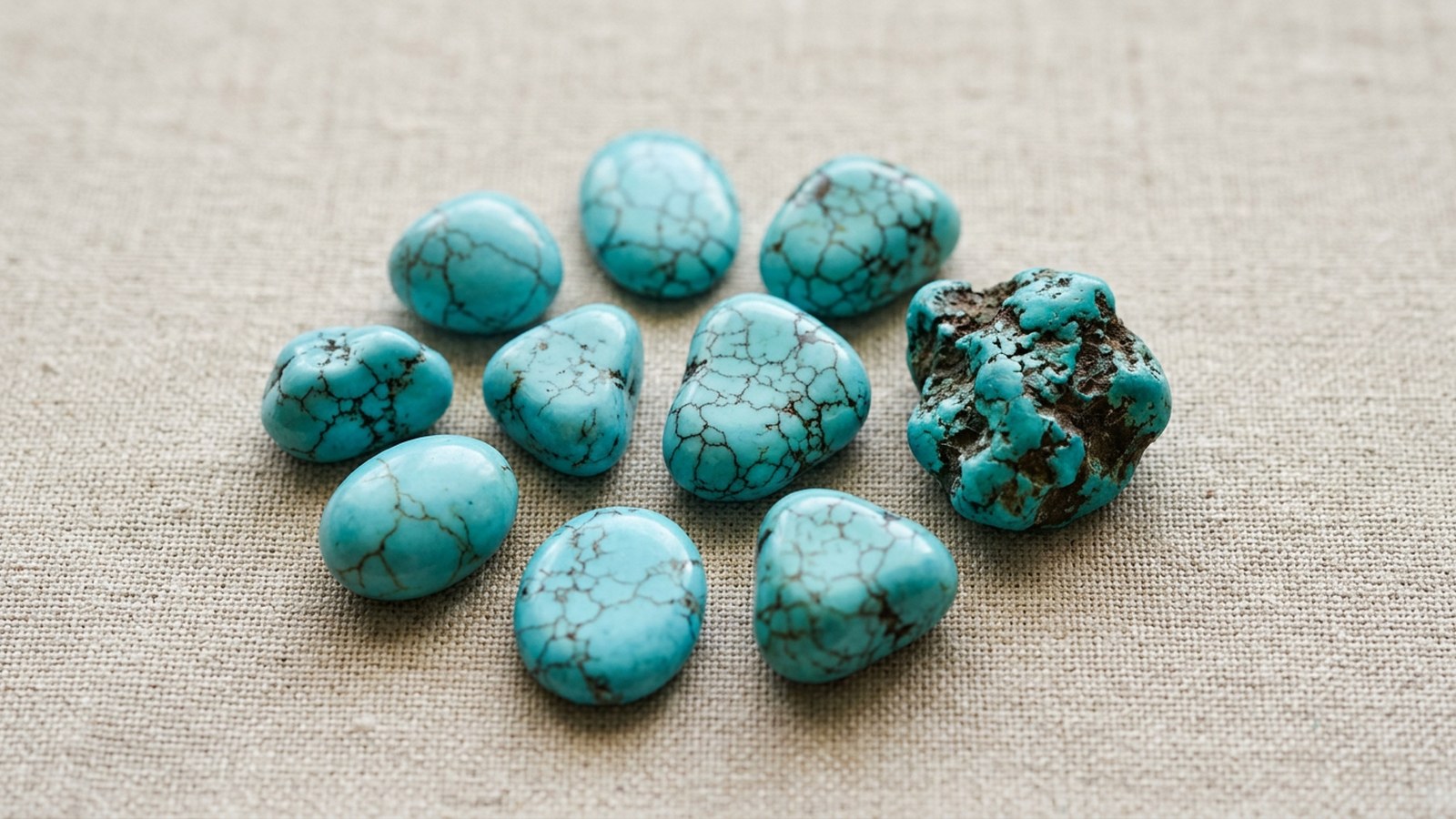
Larimar is a blue variety of pectolite, a sodium calcium silicate found in commercial quantity only in the Dominican Republic. Turquoise is a hydrated copper aluminium phosphate mined in Iran, the American Southwest, China, Egypt, Mexico and elsewhere. Larimar shows white, wavy, fibrous patterns in sky to sea blue. Turquoise is more evenly coloured, ranges from robin's egg blue to green, and is often crossed by brown or black veins of host rock called matrix.
| Larimar | Turquoise | |
|---|---|---|
| Mineral | Pectolite, NaCa2Si3O8(OH) | Turquoise, CuAl6(PO4)4(OH)8·4H2O |
| Source | Barahona province, Dominican Republic | Iran, USA, China, Egypt, Mexico and more |
| Colour | Pale to deep sea blue, white waves | Sky blue to green, even colour |
| Pattern | Radiating fibres, "turtleback" cells | Matrix veins, spiderweb |
| Hardness (Mohs) | 4.5 to 5 | 5 to 6 |
| Main weakness | Light and heat | Oils, chemicals, drying out |
| Usual treatment | Rarely treated | Very often stabilised |
| Tradition | Calm, gentle speech, water | Protection, travel, sky and earth |
If you only want a quick check, look at the white. White in larimar forms flowing, feathery lines. Turquoise has very little white unless it is pale chalky material, and its lines are darker than the stone.
What each stone actually is
The two stones come from very different geology, and that difference explains almost everything else in this guide.
Larimar grew in cavities inside volcanic basalt in the Bahoruco mountains, around the mining area of Los Chupaderos. Hot fluids crystallised pectolite as bundles of needle-like fibres radiating from a point, and those fibres are what give larimar its white feathering and its slight silky sheen. Pectolite exists all over the world in white and grey; the blue is found almost nowhere else. The colour comes from a trace element in small amounts, usually said to be copper, although gemmological work has also pointed to vanadium, and I treat the question as open. I go further into its story, from the 1916 request to mine it to the 1974 rediscovery by Miguel Méndez and Norman Rilling, in my full guide to larimar meaning.
Turquoise forms near the surface, in dry regions, where rainwater seeps through copper-bearing rock and deposits a fine-grained phosphate in cracks and nodules. Copper is part of its formula, so the blue belongs to the mineral itself, and iron replacing some of the aluminium pushes it toward green. Because it is made of tiny crystals packed together with pores between them, turquoise behaves a little like a hard sponge. You can read more about the stone itself on the turquoise stone page.
That gives two stones with two different vulnerabilities. Larimar's trace colour can weaken with long exposure to strong light and heat. Turquoise's porous body absorbs skin oils, lotion and perfume, and can shift toward green over years of wear.
How to tell larimar from turquoise in your hand
These are the checks I use, in the order I use them, and none of them harms the stone.
1. Read the pattern
Hold the stone in daylight and follow the pale lines. In larimar they branch and flow like light on the floor of a shallow pool, and in the best pieces they form rounded cells called turtleback. Larimar can carry reddish brown spots of iron oxide, which people sometimes mistake for turquoise matrix, but those spots sit inside a blue and white field. Turquoise matrix runs as dark veins, sometimes as a fine web, and the blue between them is fairly uniform.
2. Shine a light through the edge
Put a small torch behind a thin edge. Larimar is slightly translucent and often glows a little at the rim, sometimes with a silky shimmer along the fibres when you tilt it. Turquoise stays dark: light does not pass through it.
3. Look at the colour range
A clear green tint points to turquoise. Larimar can lean toward green blue in paler grades, but it rarely reaches the apple green of iron-rich turquoise, and it never shows the deep, flat robin's egg blue of Persian material.
4. Know which tests will not decide it
Several tests you will read about elsewhere cannot separate these two. Their densities overlap (around 2.6 to 2.9 for turquoise, 2.74 to 2.88 for larimar), so weighing the stone in your hand will not settle it. Both stones react only weakly under ultraviolet light. Their hardness is too close to judge with a scratch, and scratching a cabochon damages it anyway. These checks are useful for spotting plastic or glass, which is a different question, covered in my guide on how to tell if a crystal is real.
Fakes and treatments you will meet
The most common imitation of both stones is the same material: dyed howlite or dyed magnesite, chalky white stones that absorb dye easily. Dyed howlite sold as turquoise usually keeps its grey veins, and the dye collects in cracks as darker lines. Sold as larimar, the same stone shows blotchy colour instead of fibrous white waves. A cotton bud moistened with acetone, rubbed on a hidden spot, often lifts some blue from dyed pieces. I explain how to separate the two white base stones in howlite vs magnesite.
Most turquoise on the market has been treated, and that is normal. Stabilised turquoise is soft, chalky material impregnated with resin so it can be cut and worn. Reconstituted turquoise is powder bound with resin into blocks. Some material receives the proprietary Zachery treatment, which reduces porosity and deepens colour. Stabilised and Zachery-treated pieces are real turquoise, reconstituted blocks sit far lower in value, and a good seller tells you which one you are buying. Larimar is rarely treated, so the issue there is outright imitation in glass, resin or dyed stone.
The hot needle test, recommended on many pages for spotting plastic, needs a warning. A red hot needle can mark the resin in stabilised turquoise, so a scorch does not prove the stone is fake. I would only use it on a rough piece you are willing to damage. The same caution applies to chrysocolla and other copper blues; I go through that family in chrysocolla vs turquoise.
Which costs more?
Most price comparisons say larimar is the more expensive stone, and for everyday jewellery that is usually true. Larimar comes from small, hand-dug shafts on one mountainside, the deposit is not growing, and deep blue pieces with clear turtleback patterns are scarce. A good larimar pendant often costs more than a similar piece in commercial stabilised turquoise.
The answer reverses at the top of the turquoise market. Natural, untreated turquoise from named American mines such as Lander Blue, Bisbee or Number 8 can sell for much more per carat than any larimar, because those mines are exhausted or closed. Even Sleeping Beauty, the Arizona mine that supplied much of the even blue turquoise in modern jewellery, stopped producing turquoise in 2012. For turquoise, the name of the mine and the treatment history set most of the price. For larimar, the depth of the blue and the clarity of the pattern matter most.
Energy and tradition
The meanings below come from crystal tradition and personal practice. They are not proven effects, and neither stone replaces medical or psychological care.
Both stones are associated with the throat chakra, but in my experience they are used for different moods. Larimar is the water stone: people reach for it for calm, for softening a conversation that keeps getting heated, and for emotional cooling, and it is often linked to the heart chakra as well. It sits comfortably in my selection of crystals for communication for anyone who needs to speak more gently.
Turquoise carries a much older and more outward-facing tradition. Persian, Turkish and Native American cultures used it as a protective stone for riders, warriors and travellers, which is why I list it among crystals for travel and why it appears in many collections of stones for protection. It is also the traditional December birthstone. In practice I give larimar to people who want to settle and soften, and turquoise to people who want to feel steadier and better guarded when they are out in the world.
Caring for each stone
Their care differs in exactly the way their geology predicts.
- Larimar: keep it out of strong sun and away from heat, so no windowsills, car dashboards or sunlight charging. Wipe it with a damp cloth rather than soaking it, and use moonlight or simple intention to recharge it.
- Turquoise: put it on after lotion, perfume and hairspray, and wipe it after wearing to remove skin oils. Avoid long soaks, salt water and harsh cleaners, and keep it away from heat, which can dry and crack natural material.
- Both: store them apart from quartz and other harder stones, and avoid ultrasonic or steam cleaners.
My guides on crystals and water safety, cleansing crystals and how to store crystals cover the gentle methods that suit both.
Wearing them together, and other blue look-alikes
Larimar and turquoise sit well together in a necklace or on a desk. Their hardness is close enough that neither will badly scratch the other, and in tradition their pairing combines larimar's calm with turquoise's protection. Store them separately all the same. If you like turquoise in pairs, I wrote about its most classic partner in lapis lazuli and turquoise.
People often ask how turquoise differs from lapis lazuli. Lapis lazuli is a deep royal blue rock made mostly of lazurite, often flecked with gold-coloured pyrite, while turquoise is lighter, greener and never sparkles. Stones that look like turquoise include larimar, amazonite, chrysocolla and dyed howlite or magnesite. Aquamarine is sometimes mentioned in the same breath, but it is a transparent crystal of pale blue to blue-green beryl, while turquoise is opaque and more saturated in colour.
Which one should you choose?
- For a ring or bracelet worn every day: turquoise, ideally good stabilised or natural material in a protective setting. It handles knocks a little better and does not fear daylight.
- For calm, gentler speech and emotional cooling: larimar, worn as a pendant near the throat or kept by the bed.
- For protection and travel: turquoise, which has the longer tradition there.
- For a sunny climate, beach wear or someone who forgets jewellery on the windowsill: turquoise, because larimar can fade with long light exposure.
- For a collector: larimar if you love one-source rarity and patterns that are never repeated; natural mine-named turquoise if you want a piece with documented history.
- For a December birthday gift: turquoise, the traditional birthstone.
If you are still unsure after reading the pattern and shining a light through the edge, take the stone to a gemmologist or a reputable dealer. Both stones are lovely, and the right choice depends on how you plan to wear it and what you want it to remind you of.