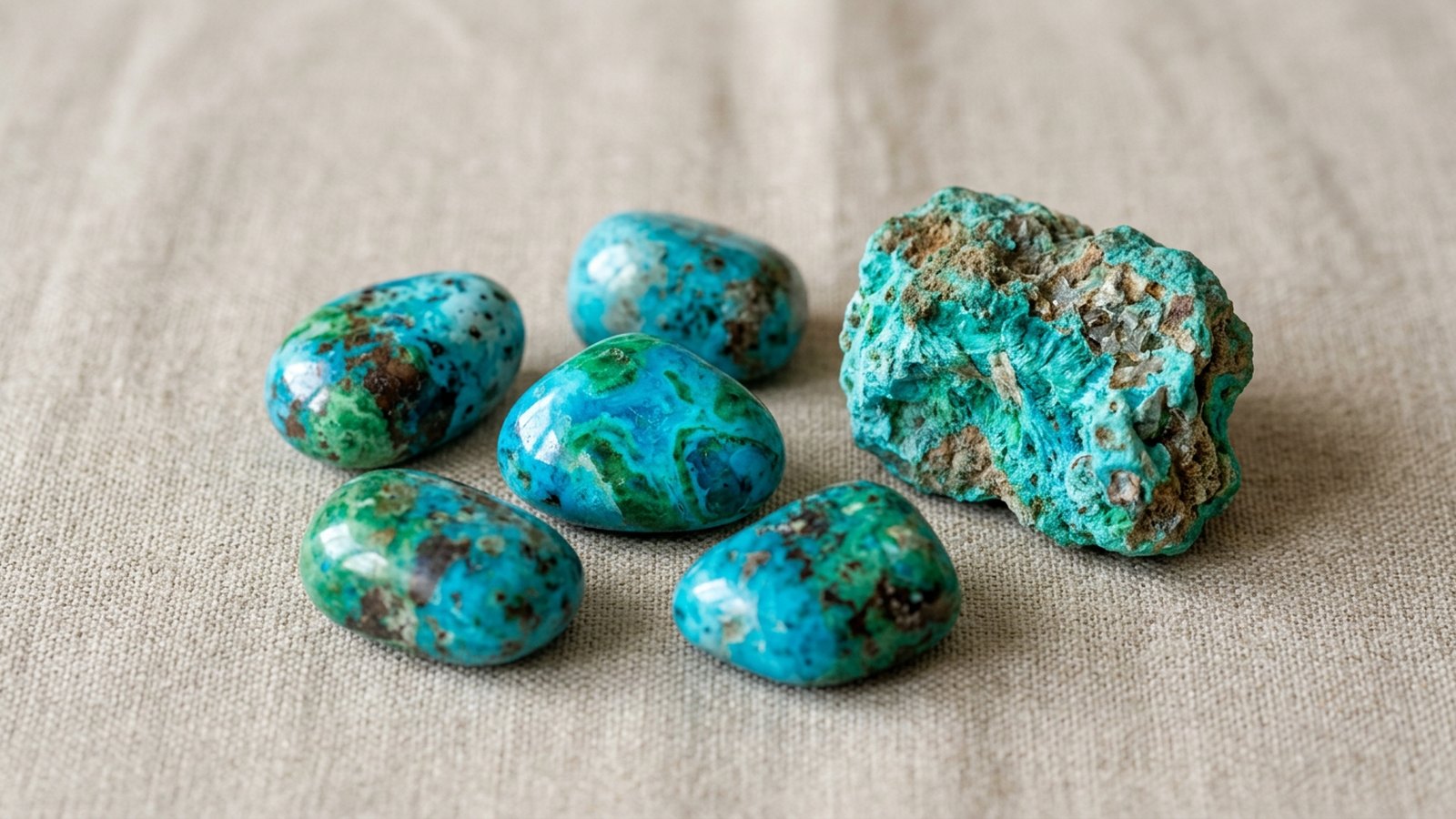
The first piece of "turquoise" I ever bought was a small blue cabochon from a market table in the Southwest, and it was chrysocolla. I only found out years later, when a friend who cuts stones picked it up, turned it under the lamp and said it felt too light and looked too bright. She was right on both counts. I still wear it, and I have grown fond of it on its own terms, but I would have liked to know what I was paying for at the time.
If you are holding a blue-green stone and wondering which of the two it is, this guide walks through the checks I now use, in the order that keeps your piece intact, then covers price, fakes, care, and the traditions attached to each stone so you can decide which one belongs with you.
Chrysocolla vs turquoise: the short answer
Chrysocolla and turquoise are both copper minerals, which is why they share that sky blue to green colour. Turquoise is a copper aluminium phosphate that is harder (Mohs 5 to 6), denser and waxy when polished. Chrysocolla is a hydrated copper silicate that is much softer (Mohs 2 to 4), lighter in the hand, and usually a brighter, more electric blue that often shades into green or brown within one piece.
| Chrysocolla | Turquoise | |
|---|---|---|
| Mineral family | Hydrated copper silicate | Copper aluminium phosphate |
| Formula | (Cu,Al)2H2Si2O5(OH)4·nH2O | CuAl6(PO4)4(OH)8·4H2O |
| Mohs hardness | 2 to 4 (7 in gem silica) | 5 to 6 |
| Specific gravity | about 1.9 to 2.4 | about 2.6 to 2.9 |
| Lustre when polished | Glassy to dull, sometimes chalky | Waxy, soft sheen |
| Typical colour | Vivid cyan blue, often mottled with green, brown or black | Robin's egg blue to green, often with a matrix web |
| Crystal habit | Amorphous, no visible crystals | Microcrystalline, crystals almost never visible |
| Usual price | Low, except gem silica | Moderate to very high |
| Traditional chakras | Throat and heart | Throat |
| Birthstone | None official (some modern lists give May) | December |
Why they get confused, and who each stone is for
Both minerals form in the oxidised upper zone of copper deposits, where rainwater slowly alters copper ore near the surface. The same Arizona and Nevada mines have produced both, sometimes in the same rock, and miners sold the blue from these deposits by the bucket for generations without always sorting it. So the confusion begins at the source and continues all the way to the jewellery counter.
In practice, turquoise suits someone who wants a stone to wear daily, in a ring or bracelet that will knock against things, and who cares about a long cultural history. Chrysocolla suits someone drawn to colour and softness, who is happy to keep it on a desk, in a pendant or in a meditation bowl, and who does not want to spend much. If you want to know more about each one on its own, I have written a full chrysocolla guide, and our turquoise stone page covers its properties.
How to tell them apart without damaging the stone
I always work from the gentlest test to the harshest, and I stop as soon as I have an answer. Most pieces give themselves away in the first three checks.
1. Look at the colour and the pattern
Turquoise tends toward a softer, slightly milky blue, or a green where iron replaces some of the copper. Its pattern, when there is one, is usually matrix: thin brown, black or golden veins of the host rock running through it, sometimes in the fine "spiderweb" pattern collectors prize. The colour between those veins is fairly even.
Chrysocolla is usually more saturated, a cyan that can look almost too bright, and it rarely stays one colour. You will see patches of green, streaks of deep blue, and brown or black areas where other copper and iron minerals sit alongside it. When a stone shows clear green bands of malachite or dark blue specks of azurite, that points strongly to chrysocolla, since these minerals grow together (the azurite malachite guide shows that family well).
2. Look at the surface and the shine
Polished turquoise has a waxy glow, a little like a candle or a smooth bar of soap. Chrysocolla polishes to a glassier shine when it is hard enough to take one, and in softer pieces the surface stays dull or slightly chalky. On a rough specimen, chrysocolla often looks crusty and powdery, with small cracks where it has dried out.
There is an old rockhound trick that belongs here, and I mention it with a caveat. Touch the tip of your tongue to an unpolished spot, and very porous chrysocolla will cling to it for a moment. It is unhygienic, it proves nothing on a sealed or polished piece, and natural turquoise can do it a little too, so treat it as a hint.
3. Weigh it in your hand
This is the check that caught my market cabochon. Turquoise has a specific gravity of about 2.6 to 2.9 and chrysocolla sits around 1.9 to 2.4, so two stones of the same size feel clearly different when you hold them together. If you have a kitchen scale that reads to 0.01 g and a glass of water, you can measure specific gravity at home (weight in air divided by the weight lost in water), though I would only dip a stone briefly and dry it at once, for the reasons in the care section below.
4. Hardness, only on rough or hidden spots
Turquoise at 5 to 6 resists a copper coin and often a steel pin. Soft chrysocolla scratches with a copper coin and sometimes with a fingernail. I never do this on finished jewellery, and I would urge you not to either: a scratch on turquoise lowers its value, and on chrysocolla it can take the polish off. If you want certainty on a valuable piece, a gemmologist can test it without marking it. Our guide on how to tell if a crystal is real covers the wider set of home checks.
5. The streak, for rough specimens
Drag a raw corner across the back of an unglazed tile. Turquoise leaves a white to pale greenish streak. Chrysocolla leaves a pale blue-green to white streak, so this test helps less than people expect and I keep it for when I already have a rough piece I do not mind marking.
When chrysocolla is worth more than turquoise
The question "is chrysocolla more valuable than turquoise?" usually gets a quick "no", and for the everyday stones you will see, that is true. Common chrysocolla is inexpensive, and good natural turquoise, especially from closed American mines like Sleeping Beauty (which stopped mining turquoise in 2012) or from the old Nishapur deposits in Iran, can cost a great deal.
There is one important exception, and it also breaks the hardness test. Gem silica is chalcedony, a form of quartz, coloured by chrysocolla from the inside. It is translucent, intensely blue, and has quartz hardness of about 7. The finest material came from the Inspiration and Ray mines in Arizona, and top gem silica can sell for more per carat than most turquoise. So a very hard, glowing, translucent blue stone sold as "chrysocolla" may be exactly that, in its rarest form. Chrysocolla bonded into ordinary quartz sits in between: harder and more durable than pure chrysocolla, cheaper than gem silica.
Stones that are both
Some pieces contain both minerals. Mines around Morenci and Globe in Arizona produce rock where turquoise and chrysocolla sit side by side, often sold as "chrysocolla turquoise". Eilat stone, from the ancient copper district near the Gulf of Aqaba, mixes chrysocolla, turquoise and malachite in one green and blue swirl. If your stone seems to pass the turquoise tests in one area and the chrysocolla tests in another, it may well be one of these.
Fakes and treatments you will run into
Most of the turquoise sold today is stabilised, meaning soaked in resin to harden it and deepen its colour, because natural turquoise is porous and often too chalky to cut. Stabilisation is an accepted practice as long as it is disclosed. Reconstituted turquoise is made from powder and chips pressed together with resin and dye, and it should sell at a fraction of the price.
The most common imitation of all is dyed howlite or magnesite, white stones soaked in blue dye (see howlite vs magnesite for how to tell those two apart). A cotton bud with a little acetone rubbed on a hidden spot will often pick up the blue from a dyed piece. And the swap between our two stones runs both ways: chrysocolla sold as turquoise at a turquoise price, and dyed turquoise or howlite sold as rare chrysocolla. A seller who can name the mine, and who states treatments plainly, is worth coming back to.
Energy and tradition
In crystal tradition the two stones share the throat chakra, which fits their shared blue, but they are read quite differently.
Turquoise carries one of the longest human histories of any stone. It was mined in the Sinai by the ancient Egyptians, where a temple at Serabit el-Khadim honoured Hathor as "Lady of Turquoise", set into Aztec mosaic masks, carried through Persia as a stone of protection, and remains central to Navajo, Zuni and Pueblo jewellery and ceremony. In modern crystal practice it is used for protection, steadiness and travel, and it is the birthstone for December.
Chrysocolla's name comes from the Greek for "gold glue", because a similar green copper material was used to solder gold in antiquity. Crystal workers today treat it as a gentle stone for communication, especially for speaking calmly about feelings, which is why it is linked to both the throat and the heart chakra. You will read that Cleopatra carried it; I have found no ancient source for that, so I would take it as modern lore.
These readings are tradition and personal intuition. Neither stone treats illness or replaces care from a doctor or therapist.
As for the common question "who should not wear turquoise?", that advice comes mainly from Vedic astrology, where some practitioners recommend turquoise only for certain birth charts. If that system matters to you, ask an astrologer you trust. Outside it, I know of no reason for anyone to avoid turquoise, other than being careful with very cheap pieces whose dyes can rub off onto skin.
Care and durability
Both stones are porous, and both dislike the same things. Keep them out of long water soaks, salt and ultrasonic cleaners. Chrysocolla can dry out and crack under strong sun or heat, and unstabilised turquoise slowly absorbs skin oils, perfume and lotion, which can shift its blue toward green. Put your jewellery on after perfume and lotion, wipe it with a soft dry cloth, and choose gentle methods from our cleansing guide, such as smoke or sound. Our water safety guide covers the reasons in more detail.
Store them apart from harder stones like quartz, which will scratch both, especially chrysocolla. A soft pouch per piece is enough, and how to store crystals has more ideas.
Which one should you choose?
- For a ring or bracelet you will wear every day: turquoise, preferably natural or openly stabilised, or chrysocolla in quartz. Pure chrysocolla will scratch and dull on a hand.
- For a pendant, a meditation stone or a desk piece: chrysocolla gives you more colour for less money, and a soft stone is fine where nothing rubs against it.
- For speaking up, or for difficult conversations: tradition leans to chrysocolla, with its throat and heart link. Amazonite and lapis lazuli are good company for it.
- For travel, protection or a December birthday: turquoise is the traditional choice.
- For a special piece to keep for life: fine natural turquoise with a named mine, or top gem silica, both bought from a seller who discloses treatments.
If you are still unsure after all this, there is no harm in keeping both, since they come from the same kind of deposit. In my own bowl the chrysocolla cabochon from that market table sits next to a small piece of Kingman turquoise. Our chakra crystals guide has other throat and heart stones if you want to build around them.