The first time I saw lapis lazuli and turquoise side by side, they were in a museum case, set into a small gold pectoral made for an Egyptian princess almost four thousand years ago. The deep night blue of the lapis and the soft sky blue of the turquoise sat next to a few chips of red carnelian, and the colours still looked fresh. Years later I strung my first necklace from the same two stones, and I understood why people keep returning to this pair: it is one of the oldest stone combinations in human hands, and it still makes sense today.
This guide covers what the pairing means in crystal tradition, where it comes from, how to tell the two stones apart, how I actually wear and place them, and the one care routine that keeps both of them blue.
Lapis lazuli and turquoise together: the short answer
Lapis lazuli and turquoise are a classic pairing for communication and truth. In crystal tradition, lapis lazuli works with the third eye and the throat chakra and is associated with wisdom, inner truth and insight, while turquoise works with the throat and is associated with calm, honest expression, protection and travel. Worn together, they are said to help you know what you mean and then say it clearly and kindly.
Physically they also suit each other. Both are opaque, both sit around 5 to 6 on the Mohs scale, and both are sensitive to water, acids and oils, so they share the same care routine and will not damage each other on a single strand.
Why these two have travelled together for millennia
The pairing is older than any modern crystal book. Lapis lazuli comes mostly from the mines of Sar-e-Sang in Badakhshan, in the mountains of northeastern Afghanistan, which have been worked for more than six thousand years. Turquoise came to the ancient world from the Sinai, where Egyptian expeditions mined it from around 3000 BCE and honoured the goddess Hathor as the "Lady of Turquoise", and from Nishapur in northeastern Iran.
In Egypt, the two blues joined red carnelian as the standard palette of royal jewellery. Lapis outlines the eyes and brows on Tutankhamun's gold mask, and pectorals from the Middle Kingdom set lapis, turquoise and carnelian into gold cells as a deliberate colour scheme. Lapis stood for the night sky, turquoise for the life of the Nile and for joy.
In Persia, the two stones moved along the same caravan routes. The historian Arash Khazeni notes that the Safavid empire treasured lapis from Badakhshan and turquoise from Nishapur together, and that the old Persian books of stones grouped them as opaque stones thought to hold more earth than water. Both stones even left their mark on European languages. Our word "azure" comes, through Arabic, from the Persian name for lapis, lajvard, and "turquoise" means "Turkish stone" in French, because it reached Europe through Turkish traders.
In the American Southwest, turquoise has been central to Diné (Navajo), Zuni and Pueblo jewellery for centuries, and lapis joined it later. From the late 1960s, jewellers trained in fine lapidary work began setting imported lapis into inlay and channel work beside turquoise and coral, and that is where many of today's lapis and turquoise bracelets and pendants take their look.
What each stone brings to the pair
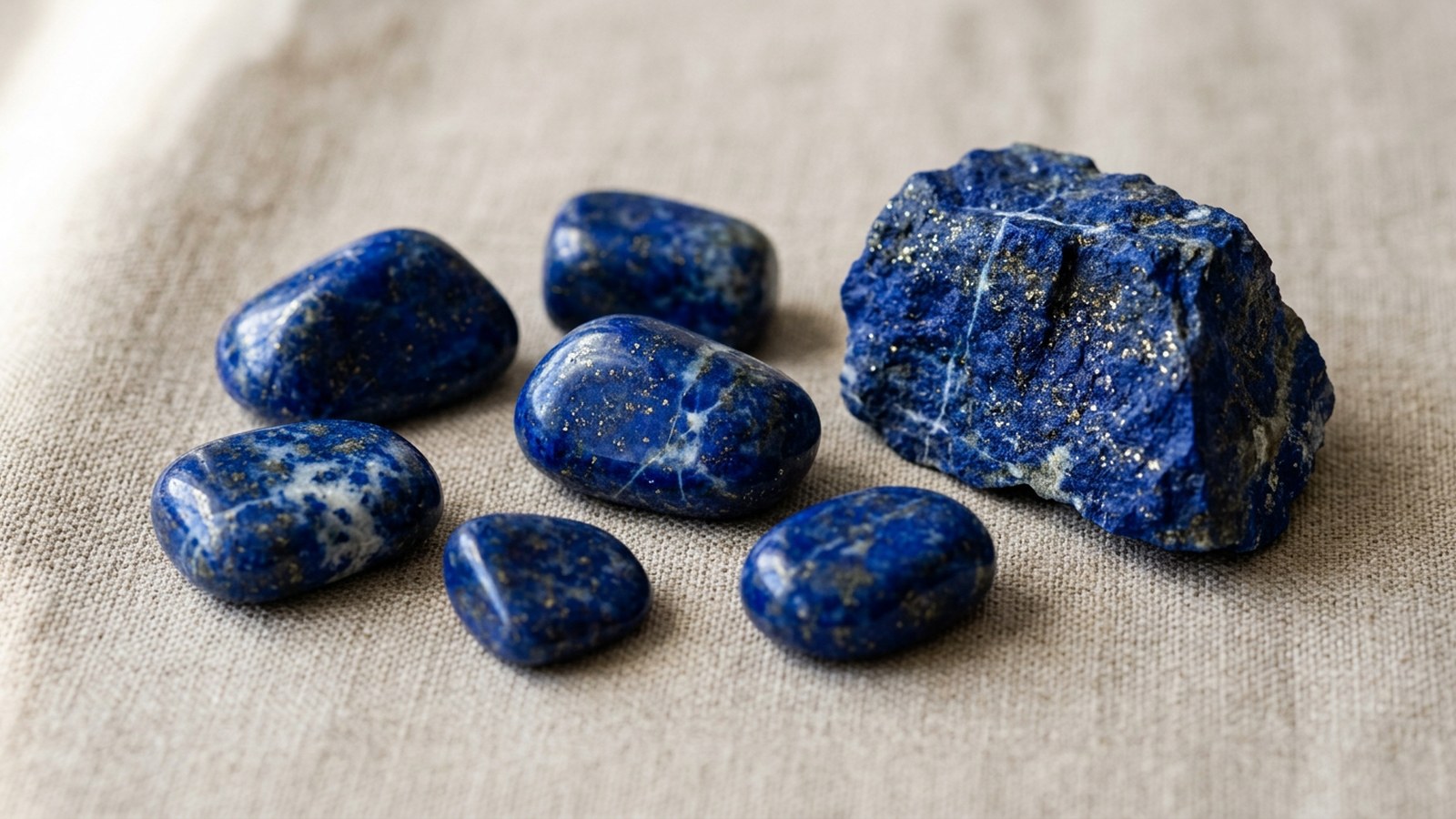
In my own practice, lapis lazuli is the stone I hold when I am working out what I think. It is a rock made mostly of blue lazurite, with white streaks of calcite and the little gold flecks of pyrite that look like stars. In tradition it belongs to scholars, priests and kings, and people reach for it when they want clarity, honest self-reflection and a sharper mind. Its energy is often described as cool and focused. It is listed among the stones for intuition, and it can feel a little intense on its own.
Turquoise is the one I hold when I need to say it to someone. It is a hydrated phosphate of copper and aluminium, formed where copper-rich water seeps through dry rock, and its colour runs from robin's egg blue to green depending on how much copper and iron it holds. In tradition it is a stone of protection, friendship and safe journeys, and its energy is described as warm, steady and forgiving.
Together, the reading goes like this: lapis helps you find what is true for you, and turquoise softens the way you say it. That is why the pair is so often recommended to teachers, writers, people who speak in public, and anyone facing a conversation they have put off. It also fits the long tradition of turquoise as a traveller's stone, and I often pack the two when I am heading somewhere I will need to explain myself in a new place (see my notes on crystals for travel).
These are traditions and personal impressions. Neither stone treats any condition of the throat or anything else, and they are no substitute for medical or psychological care.
How to tell lapis lazuli from turquoise
People do ask, especially when looking at greenish lapis or a blue, dyed piece. Weight will not help much here, because both stones have a similar density. Colour, inclusions and the matrix tell them apart quickly.
| Lapis lazuli | Turquoise | |
|---|---|---|
| What it is | A rock: lazurite with calcite, pyrite, diopside | A mineral: CuAl6(PO4)4(OH)8·4H2O |
| Usual colour | Deep royal to night blue | Sky blue to blue-green |
| Inclusions | Gold pyrite flecks, white calcite | Brown, black or golden matrix veins |
| Hardness (Mohs) | About 5 to 5.5 | About 5 to 6 |
| Lustre when polished | Glassy to dull | Waxy |
| Colour change over time | Very stable in light | Can drift green with oils and age |
| Main sources | Afghanistan, Chile, Russia, Pakistan | Iran, USA, China, Egypt, Mexico |
| Traditional chakras | Third eye and throat | Throat |
If your blue stone is nearly navy and carries tiny gold sparkles, it is almost certainly lapis. If it is a lighter, waxy blue with a spiderweb of darker veins, it is turquoise. If it is a vivid, even blue with grey veins and no sparkle at all, you may be holding something else, and I cover that below. For a closer neighbour of lapis, see my guide to sodalite vs lapis lazuli, and for turquoise's own look-alike, chrysocolla vs turquoise.
How I wear and place them
As a necklace. This is the classic form and the one I use most. A strand of alternating beads, or a turquoise pendant on a lapis chain, sits right at the throat. I wear it on days with a difficult call, a talk, or a meeting where I know I tend to swallow what I mean.
On the desk while writing. I keep a small lapis tumble and a turquoise nugget beside the keyboard when I write anything that needs to be honest and careful at once, like a hard email or a letter I keep rewriting. The ritual is simple: hold the lapis while you decide what you actually want to say, then set it down and hold the turquoise while you write it.
In meditation. Lying down, place the lapis on the brow and the turquoise at the base of the throat, and breathe slowly for ten minutes. I like to finish with a plain affirmation such as "I know what is true for me, and I can say it with care."
As a trio. If you want to repeat the Egyptian palette, add carnelian for courage. I reach for this trio when I already know the words and need the nerve to say them.
What the pair is not for, in my experience: it does little for sleep, and lapis can feel too mentally active at night, so I keep it out of the bedroom (I use the stones in crystals for sleep instead). If you want grounding, you will find more in darker, heavier stones. For more communication stones, see crystals for communication.
One care routine for both stones
This is where the pairing is easiest to live with, because both stones are soft, slightly porous and chemically sensitive, and they want the same treatment.
- No soaking and no salt. Turquoise is porous and lapis contains calcite and pyrite. Long soaks can dull turquoise, and damp storage can make the pyrite in lapis tarnish. My guide to crystals and water safety lists both among the stones to keep dry.
- No acids. The calcite in lapis reacts with acids, including vinegar and lemon juice, so keep those well away.
- Keep oils and perfume off turquoise. Skin oils, sweat, lotions, perfume and hairspray are slowly absorbed by turquoise and can turn it greener over the years. Put your jewellery on last, after creams and scent.
- Clean gently. Wipe both with a soft cloth barely damp with plain water, then dry at once. Never use an ultrasonic or steam cleaner.
- Cleanse with smoke, sound or moonlight. These methods suit both stones and need no water. See cleansing crystals for the details.
- Store them away from harder stones. At 5 to 6, the two will only rub each other lightly, but quartz beads or points at hardness 7 will scratch them. On a mixed bracelet, avoid quartz spacers between them.
As for energy, I know of no tradition that sets these two against each other. The care points above are the only cautions I keep with this pair, and I go through the wider question of stones that damage each other in what crystals should not be together.
Fakes and treatments to watch for
Both stones are heavily imitated, so a cheap lapis and turquoise bracelet deserves a careful look.
On the turquoise side, most stones sold today are stabilised, meaning they have been impregnated with clear resin to harden them and fix the colour. This is a normal, accepted treatment as long as it is disclosed. Reconstituted turquoise is powder bound with resin, and the most common imitation of all is dyed howlite or magnesite, white stones dyed blue whose grey veins give them away (see howlite vs magnesite).
On the lapis side, low-grade material is often dyed to a deeper blue, and some "lapis" is actually dyed jasper sold as "Swiss lapis" or sodalite with no pyrite in it. A cotton swab dipped in acetone and rubbed on a hidden spot will often lift colour from a dyed stone. For a full set of checks, see how to tell if a crystal is real.
Is turquoise a real gem, and what does the Bible say?
Turquoise is a real mineral and one of the oldest gem materials in use. The problem is that much of what carries the name is stabilised, reconstituted or simply dyed howlite, so it pays to ask the seller what you are buying.
As for the Bible, the stones of the high priest's breastpiece in Exodus 28 are translated differently from one version to another. In some modern translations, such as the NIV, turquoise and lapis lazuli sit side by side in the second row. Many scholars also believe that the Hebrew word usually rendered "sapphire" referred to lapis lazuli, since true blue sapphire was barely known in the region at the time.
Who should not wear lapis lazuli?
There is no physical reason for anyone, female or male, to avoid lapis lazuli. The question comes from Vedic astrology, where lapis is sometimes used as a substitute for blue sapphire and linked to Saturn, and some astrologers advise checking a birth chart before wearing Saturn stones. That rule belongs to one tradition, it has nothing to do with gender, and you are free to follow it or not. If you are allergic to certain metals, the setting matters more than the stone.
Closing thoughts
For me, the appeal of this pair is how long it has held together. People in Egypt, Persia and the American Southwest arrived at the same two blues without consulting one another, and the reasons still hold: the colours sit beautifully side by side, the stones share the same gentle hardness and the same needs, and their traditional meanings fit together comfortably. If there is something you have been meaning to say, a strand of lapis and turquoise at your throat is a lovely way to remind yourself of it.