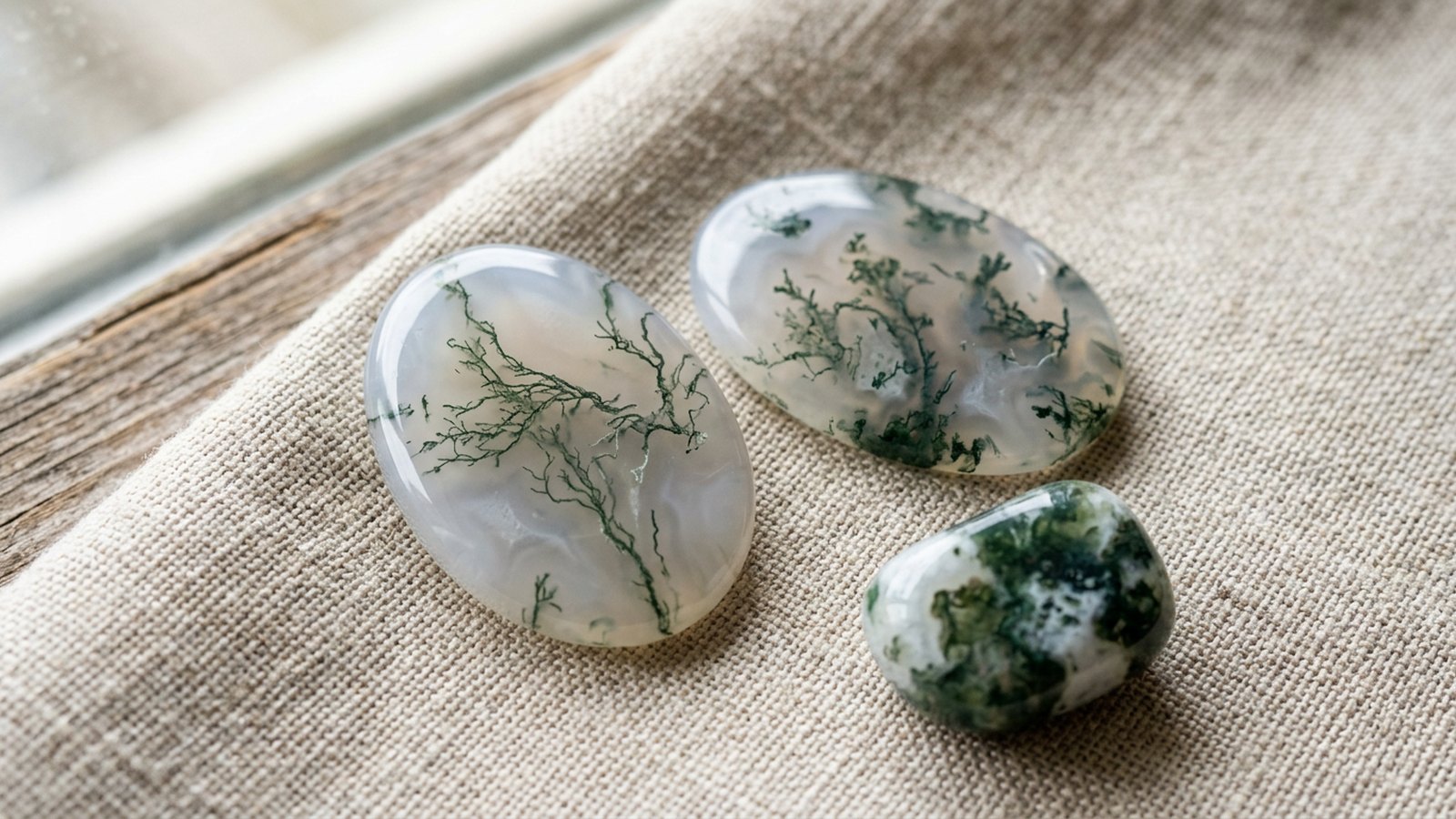
Moss agate is a translucent green-and-white chalcedony known as the stone of new beginnings, growth and quiet patience. Its meaning comes straight from what it looks like: soft green filaments spreading through pale stone like moss across a window in winter. Traditionally it is the gardener's stone, carried for slow steady progress, grounded abundance and a calmer relationship with time. Here is what moss agate actually is, where its symbolism comes from, and how people work with it day to day.
What moss agate is, mineralogically
Moss agate is a variety of chalcedony, a microcrystalline form of quartz with the formula SiO2. It sits at roughly 6.5 to 7 on the Mohs scale, which makes it durable enough for everyday rings, worry stones and pocket pieces.
Two things about it surprise almost everyone.
There is no moss in moss agate. The green tendrils are entirely mineral. They are dendrites, branching crystal growths that formed as mineral-rich fluid crept through cracks in the silica while it set. The green usually comes from iron-rich silicates such as chlorite or hornblende, while the black and rust-brown patterns come from oxides of manganese and iron. Nothing organic was ever involved, and no plant was ever fossilised inside.
It is not technically an agate either. A true agate is defined by concentric banding, and moss agate has none. Mineralogists more often call it dendritic chalcedony. The full rule, and the one test that separates the two families, is in our guide to jasper vs agate. The name stuck for the same reason most stone names stick: it describes what the eye sees rather than what the lab finds.
It also carries an older name, mocha stone, after the port of Mocha in Yemen, once a trading source for the material reaching Europe. Today the best-known deposits are in India, Brazil, Uruguay and the United States, where Montana moss agate is collected from the gravels of the Yellowstone River.
Moss agate meaning and symbolism
Because it looks like a garden held still inside stone, moss agate has been read for centuries as the stone of growth. Not sudden growth. The slow, root-first, unglamorous kind.
Its traditional associations cluster around a few themes:
- New beginnings. Starting again after an ending, when the outcome is not yet visible.
- Patience and persistence. Progress measured in seasons rather than days.
- Grounded abundance. Prosperity that comes from tending something, close to the meaning carried by green aventurine and other green stones.
- Connection to nature. A reminder of the outdoors for people who spend their days indoors.
- Emotional steadiness. Loosening the grip of urgency without dulling motivation.
Its folk name, the gardener's stone, comes from an old European belief that it helped crops and gardens flourish. Whatever you make of the horticulture, the symbolic logic is clear enough: a stone that looks like living growth became a talisman for anything you are trying to grow.
Moss agate is associated with the heart chakra, Anahata, alongside the other green stones in our chakra crystal guide. Its green also links it to Taurus and Virgo in most modern zodiac correspondences, both earth signs, both patient by temperament.
What moss agate looks like in the hand
Working with tumbled and slabbed moss agate over time, a few practical things stand out.
The stone is far more interesting backlit than face-on. Held up to a window, a piece that looked murky on a shelf suddenly reads as depth, with the dendrites hanging at different levels inside the silica rather than sitting flat on a surface. If you are choosing between pieces, lift them to the light before you decide. The same backlight test is the quickest way to separate moss agate from its opaque white cousin, which I cover in tree agate vs moss agate.
No two are alike, and the variation is genuine rather than marketing language. One slice from the same batch may be mostly clear with a single sprig of green in the corner, the next densely packed and nearly opaque. Because of that, moss agate is one of the few stones where people commonly bond with a specific piece rather than the type.
Cut also changes the reading. Thin slices show the dendrites best; thick tumbles hide them. See crystal shapes and their meanings for how form affects the way a stone is used.
How to use moss agate
Carry it during a slow project. The most natural fit is any effort with a long horizon: a new job, a degree, a recovery, a business in its first unprofitable year. Keep a tumbled piece in a pocket or bag and let it stand in for the reminder that roots come before leaves. Pairing it with an intention you have set deliberately makes the habit stick.
Keep it where you work or grow things. A piece on a desk, a windowsill or a shelf near your plants suits the stone's character better than tucking it away in a drawer. Our guide to where to place crystals in your home covers placement in more detail.
Hold it when you feel rushed. Moss agate is a common choice for people who want something steadying rather than sedating, and it sits comfortably alongside the stones in our guide to crystals for anxiety. In practice this means five slow breaths with the stone in your palm before a difficult call or an overloaded afternoon.
Use it in meditation on cycles. Its patterning gives the eye something to rest on, which suits a gentle open-eyed practice. See meditating with crystals if you are new to this.
Wear it. Moss agate has become popular in rings and pendants, helped by its hardness and by the fact that every stone is visually unique. At 6.5 to 7 it handles daily wear well, though it can still chip on a hard knock.
Caring for moss agate
Moss agate is one of the easier stones to look after.
- Water: safe for brief rinsing under cool running water. Avoid long soaks and skip salt water, which can work into any surface fractures. Our crystals and water safety guide lists which stones tolerate this and which do not.
- Sunlight: short exposure is fine; prolonged direct sun can fade some dyed or heat-treated material.
- Cleansing: rinsing, moonlight, sound or a smoke cleanse all work. See how to cleanse and charge your crystals and how to charge your crystals.
- Dyed pieces: vivid, uniform, unnaturally saturated green often signals dyed chalcedony rather than natural dendrites. Natural moss agate is irregular and uneven. Our guide on how to tell if a crystal is real covers the usual tells.
A stone for the long middle
Most stones that speak to ambition speak to the beginning of it, the spark or the goal. Moss agate speaks to the long middle, the part where nothing visible is happening and the work is mostly waiting well. That is a narrower meaning than "good luck", and a more useful one.
If green stones appeal to you, read our guide to crystal colours and their meanings next, or start with how to use crystals if this is your first stone.