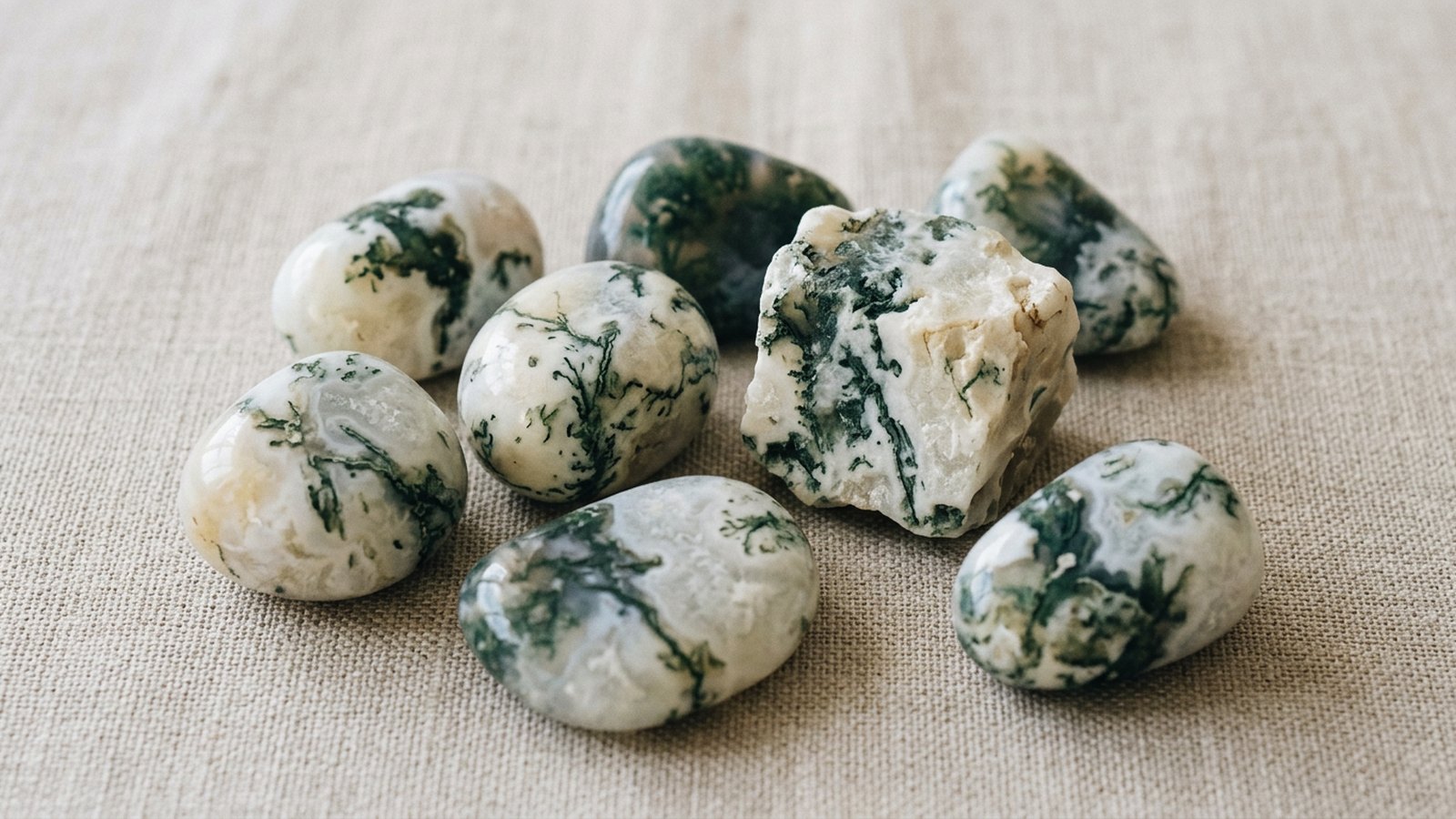
I keep two green and white stones on the windowsill above my desk, and for a long time I called both of them moss agate. One is a small palm stone I bought at a mineral fair, the other a tumbled piece from a bead shop that came in a bag labelled "tree agate". It was only when the afternoon sun hit them side by side that I understood why they carried different names. The light went straight into the first one and lit up a little underwater garden inside it. The second stayed milky and solid, with dark green branches sitting on it like ink on paper.
That difference in the way each stone takes the light is the heart of this comparison. Below I go through what the two stones are, the checks I use to tell them apart (and where those checks can mislead you), the dyed pieces worth avoiding, what each stone is traditionally used for, and which one I would choose for a given situation.
Tree agate vs moss agate: the short answer
Moss agate and tree agate are both chalcedony, a microcrystalline quartz (SiO2), with a hardness of about 6.5 to 7 on the Mohs scale. Moss agate has a translucent, clear to milky base with green, brown or black mineral growths suspended inside it, so it has visible depth. Tree agate has an opaque white or cream base with green branching patterns that seem to sit on or just under the surface. Held up to a light, moss agate glows from within and tree agate stays solid.
| Moss agate | Tree agate | |
|---|---|---|
| Material | Chalcedony (SiO2) with mineral inclusions | Chalcedony (SiO2) with mineral inclusions |
| Base | Clear, grey or milky, translucent | White to cream, opaque |
| Pattern | Clouds and filaments suspended in depth | Branches and ferns across a pale face |
| Usual colours | Green, also brown, black, red, yellow | White and green |
| Hardness | 6.5 to 7 | 6.5 to 7 |
| Common forms | Cabochons, rings, slices, palm stones | Beads, tumbles, towers, spheres |
| Traditional chakra | Heart | Root and heart |
| Traditional theme | Growth, new beginnings, patience | Stability, rootedness, belonging |
| Price | Low; clear gem pieces cost more | Low |
What the two stones really are
Neither stone is a true agate in the strict mineralogical sense. Geologists reserve the word agate for chalcedony with concentric banding, the rings you see in a sliced geode or in blue lace agate. Moss agate and tree agate have no banding at all. Their patterns come from other minerals that grew through the silica while it was still a gel or was slowly filling a cavity, which is why a mineralogist would more often call them dendritic or included chalcedony. The trade has used the agate name for centuries, and I use it too, but it helps to know that the name describes a look rather than a structure. I cover the wider family in my guide to jasper vs agate.
In moss agate the green comes from iron-bearing silicates such as chlorite or hornblende. They grew as threads and clouds in three dimensions, so when you tilt a polished piece you see some growths near the surface and others further in. That layered depth is what earned it the name, and it is the quality people fall for. I wrote about the stone on its own in my moss agate meaning guide.
Tree agate is also chalcedony, but the silica is dense, fine and white, packed so tightly that light scatters before it can travel through. The green branching minerals formed in that opaque body, and because you can only see the ones close to the surface, the pattern reads as flat, like branches drawn on snow.
There is a third stone that muddies every conversation about these two, and none of the pages I read before writing this separated it clearly: dendritic agate. Its branches are black or dark brown manganese oxides that crept along hairline cracks in clear or milky chalcedony. Because they grew inside a thin crack, they are almost perfectly flat and look like fern prints or tiny trees in Indian ink. Some sellers sell dendritic agate as tree agate, and some older books use "tree agate" and "dendritic agate" as the same thing. On today's market the name tree agate almost always means the opaque white stone with green branches, and dendritic agate means black fern prints in a clear or pale stone.
How to tell them apart in your hand
These are the four checks I use, in order. None of them damages the stone.
1. The light test, done on the edge
Shine a phone torch through the stone in a dim room. Moss agate lets the light in, and the base glows grey, white or honey coloured around the dark growths. Tree agate blocks it, and the light stays a bright spot on the surface.
Two things can fool you here. Thickness matters more than material: a thick moss agate sphere can look opaque, and a thin tree agate slice can let a little light through. So I always shine the torch through the thinnest edge I can find. The second trap is polish. A glassy polish on tree agate can look translucent in daylight, because a bright shine is easy to mistake for depth. The torch shows the difference.
2. Where the pattern sits
Tilt the stone slowly under a lamp. In moss agate the growths shift against one another at different depths, like looking into a pond. In tree agate, and in dendritic agate, the pattern stays on one plane and moves with the surface.
3. The shape of the growth
Moss agate tends to form soft clouds, tufts and filaments that spread in every direction. Tree agate tends to form lines that branch and fork, with thicker trunks and finer twigs. This is a tendency, since the two overlap, so I only use shape to confirm what the first two checks suggest.
4. Colour, used last
Most guides open with colour, and it is the least reliable of the four. Green is common in both stones. Montana moss agate, one of the classic American moss agates found in the gravels of the Yellowstone River, is usually clear with black, brown or reddish growths and hardly any green at all. Indian moss agate can be mostly green with very little clear base. If you judged by colour alone you would get both of those wrong.
Dyed and mislabelled pieces
Both stones are inexpensive and naturally coloured, so dyeing them is uncommon. What you do meet is plain chalcedony or low-grade agate dyed green and sold under either name, often as beads. The warning signs are an even, bright green with no pale areas, colour that collects in cracks and around drill holes, and a whole strand where every bead looks the same shade. A cotton bud with a little acetone, rubbed inside a drill hole, will sometimes pick up the dye.
Glass imitations exist too, mostly as moulded pendants. They tend to feel warm quickly in the hand and can show round bubbles under a loupe. My general checks are in how to tell if a crystal is real. The same care about dye applies to green look-alikes such as aventurine and jade.
Energy and traditional use
Everything in this section is tradition and personal experience, and none of it is medical. What strikes me is how closely the two traditions follow the look of each stone, which suggests that people read their meanings in the pattern long before anyone wrote them down.
Moss agate is the gardener's stone. Its tradition is about growth that happens where you cannot see it: new projects, a slow recovery of confidence, the patience needed for something that will take seasons. It belongs to the heart chakra and to the intentions of new beginnings and abundance. Old agate lore, going back to classical writers, has farmers tying the stone to their oxen or their plough in the hope of a good harvest. When I am at the start of something with an uncertain outcome, it is the one I carry, and it appears in my list of crystals for new beginnings.
Tree agate carries the image of the tree itself: roots in the ground, a trunk that does not move much, branches that bend in wind. Its tradition is about stability, feeling at home, family and belonging, and staying calm while life around you changes. It is linked to both the root and heart chakras, and to grounding. I reach for it when I feel scattered, which is why it would sit comfortably next to the stones in my guide to crystals for balance.
As to the question of why people feel so drawn to moss agate, I think the honest answer is the depth. It is one of the few inexpensive stones that looks like a whole landscape when you hold it to the light, and many people feel calm looking into it. That response is real, and I would trust it when choosing a stone.
Rarity, origin and price
Neither stone is rare. Most of the moss agate on the market comes from the volcanic Deccan Traps of western India, with other sources in the United States, Brazil and Uruguay. Tree agate comes almost entirely from India. For centuries, Indian moss and dendritic agates were shipped to Europe through the Yemeni port of Mocha, and they were known in English as mocha stones, a name you still see in older books.
Tree agate is one of the cheapest stones in any bead shop, sold as tumbles, beads and towers for a few dollars. Moss agate covers a wider range. Most tumbles and slices are just as cheap, while clear, well-patterned material cut for rings, especially with a clean landscape inside, costs more, though far less than most gemstones.
Caring for both stones
Care is identical. At 6.5 to 7 on the Mohs scale with no cleavage, both are tough enough for daily wear and scratch only against quartz, sapphire or diamond. A quick rinse under lukewarm water with mild soap is fine, as explained in my guide to crystals and water safety. Chalcedony is slightly porous, so I keep lotions and perfume away from it and avoid long soaks. Sunlight will not fade natural colour, while a dyed piece may lose some of its green in a sunny window. For energetic cleansing, smoke, sound and moonlight all suit both stones, and I describe the methods in cleansing crystals.
Which one should you choose?
Choose moss agate if you want a stone you look into, for a ring or a pendant that catches the light. It also suits a new project, a new job, a garden or any situation where growth has to happen slowly. It is also my pick if you already love translucent stones such as clear quartz.
Choose tree agate if you want something to hold rather than look at: a palm stone, a sphere or a bracelet you wear daily. It suits times of change when you need to feel rooted, a home you are settling into, or family matters. The bold white and green also reads well from across a room, so it works on a shelf or desk.
If you are torn, I would start with the stone your eye went to first. They are inexpensive enough to own both, and they sit well together, the tree agate for footing and the moss agate for growth. If you want a third green stone for the heart, green aventurine is a gentle companion to either.
These days the two stones on my windowsill have swapped roles. The moss agate is the one I pick up on mornings when I start something new, and the tree agate stays where it is, a steady green and white shape at the edge of my view while I work.